- Biblical fundraising focuses on the donor’s wealth plans.
- Ordinary fundraising focuses only on the charity’s plans.
1 Timothy 6:17-19, “Instruct those who are rich in this present world not to be conceited or to set their hope on the uncertainty of riches, but on God, who richly supplies us with all things to enjoy [. Instruct them] to do good, to be rich in good works, to be generous and ready to share, storing up for themselves the treasure of a good foundation for the future, so that they may take hold of that which is truly life.”343
Part I
Wealth: The Time To Decide Is Now!
In the now time
Now is the time! This passage immediately emphasizes time. This may not be as obvious in English translations. These often begin with “instruct” or “command.” The Greek does not. Instead, it begins with “To the rich in the now time.” The phrase rendered “in this present world” is “en to nyn aiōni.” Literally, this is “in the now time.” It is in [en] the [to] now [nyn] time [aiōni].
Emphasizing “in the now time” is natural for a practicing fundraiser. The goal is to get the donor to act. There’s no more universal fundraising message than
“Now is the time!”
Paul was a practicing fundraiser. Biblical scholars almost never are.344 When they read “in the now time,” they don’t think of a fundraising appeal. They think of eschatology.
In eschatology, “in the now time” would reference “in this present world.” The “now” age contrasts with the age to come.
This is a valid translation. But it’s not the only one. Interesting evidence supports another. This is the fundraiser’s usage. It implies, “Right now is the opportune time to act.”
In the now time: aiōn
The simple meaning is “time.” For example, the Common English Bible begins the sentence with
“Tell people who are rich at this time” (1 Timothy 6:17a).
So, how do we get to a translation of “world”? The Greek word is aiōn. It means a space of time or an age. For a Christian, the current age contrasts with the age to come. In this way, the “now time” can also reference “this present world.”
Aiōn stands somewhere between two other Greek words: kosmos and kairōs. Kosmos is a physical reference to “the world.” It’s a place. Aiōn is different. Professor Ronald Ward explains,
“When we speak of the world (aiōn) our emphasis is on time;”345
Aiōn is different than kosmos. Aiōn is a space of time, not a place. But how long is this space of time? When fundraising references time, it’s usually short. The idea is often
- Now is the time!
- Now is the time to act!
- Now is the opportune moment!
In Greek, this “fundraising” meaning is kairōs. It means the “opportune time.” It means “the suitable time.” It means “the right moment.” The word’s origin references things “coming to a head.” (Kara means “head.”)
Tell a fundraiser to use the phrase “in the now time,” and he’ll use it more in the sense of kairōs. Tell a theologian to use it, and he’ll use it more in the sense of kosmos. So, who’s right?
In this epistle, Paul gives practical instructions for how to manage the church. This passage gives practical instructions for fundraising. It describes the ministry of major gift fundraising. Using the phrase “in the now time” the way a fundraiser would use it fits the context. Using aiōn more as kairōs than kosmos fits.
But there’s another reason. And it’s much more important. The word in scripture may actually be kairōs and not aiōn.
In the now time: It’s kairōs not aiōn
The oldest New Testament manuscripts are called the papyri. Many date from as early as the 200’s A.D. These come from scrolls. They contain segments from the New Testament.
However, these papyri do not include the entire New Testament. For example, only one fragment survives from 1 Timothy. It contains only 1 Timothy 3:13-4:8. Thus, the earliest evidence of our passage is not in the papyri. Instead, it’s found in the oldest complete copy of the New Testament. This is the Codex Sinaiticus. It dates to the A.D. 300’s.
In the Codex Sinaiticus, there’s a surprise. 1 Timothy 6:17 doesn’t read “en to nyn aiōni.” It reads “en to nyn kairō.” The word is not aiōni – a space of time. The word is kairō – the opportune moment.
So, how did our modern version come to read aiōni instead of kairō? We can track this change. The Codex Sinaiticus Project labels kairō as the original text.346 Aiōni comes from a revision by “Ca.” This was reviser “a” in the “C” group. The “C” group references,
“correctors who revised the manuscript rather extensively between the fifth and seventh centuries.”347
More to the point, scholars,
“give a more specific judgement concerning the Ca corrector in particular, dating him to the sixth century.”348
Thus, this aiōni substitution was made about two centuries after the original text.
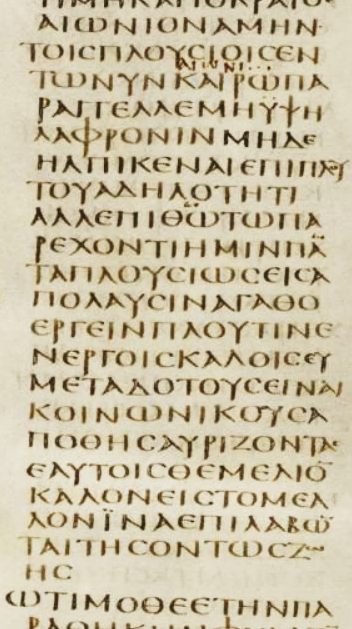
Below is an image of our passage in the Codex Sinaiticus. 1 Timothy 6:17-19 is the indented section beginning with “TOI”. (The text is all capital letters with no spaces between words.)
Notice the insertion of “aiωni” above the original “KAIPω.”
Describing someone as “rich at this opportune moment [kairō]” is a great fundraising phrase. It’s practical. It’s positive. It’s motivational. It spurs action.
However, most theologians don’t know fundraising. They know eschatology. Using aiōni, “rich in this present world,” matches that background. It makes the passage more about two-world theology. It makes it less about practical fundraising.
This orientation also matches another change. In the original text, the donor gets to take hold of “ontōs zōēs.” This is
However, a few later texts also changed this phrase.353 The term “ontōs zōēs” became “aiōniou zōēs [eternal life].” Or, in some cases, it became “aiōniou ontōs zōēs [eternal life indeed].”354
That change reflects a similar bias. It, too, makes the passage more about two-age eschatology.355 And it makes it less about right now. These changes don’t make the passage wrong. (Other scriptures confirm these ideas about eschatology.) But it does make the passage different. And it might miss the original point.
In the now time: It’s kairōs and aiōn
So, is kairōs the original word from scripture? It certainly might be.356 But don’t worry. You don’t have to decide.
Like most textual variants in scripture, it doesn’t really matter which option you choose. It doesn’t matter because other scriptures independently support both ideas. A word variation doesn’t make scripture unreliable. It just creates alternate paths to get to the same place.
That’s certainly true in this case. The earliest text reads “en to nyn kairō.” It was later replaced with “en to nyn aiōni.” I think “en to nyn kairō” is correct.
But suppose I’m wrong. Have I led you into rank heresy? No. In fact, we can still use “en to nyn kairō.” Why? Because Paul used it, and not just in our passage. He used it in his actual fundraising appeal letter. In 2 Corinthians 8:14, he writes,
“at this present time [en to nyn kairō] your abundance will serve as assistance for their need,”
Paul references the donors’ wealth – their “abundance” – using “en to nyn kairō.” He might also do this in 1 Timothy 6:17. I think he does. But he definitely does this in 2 Corinthians 8:14. Either way, referencing the donor’s wealth with “en to nyn kairō” is scriptural. It’s a scriptural approach to fundraising.
In each case, the person is rich (or has abundance) “at this opportune moment [kairō].” This is an opportune moment to put his wealth to work. He can use it,
- to do good [agatho-ergein]
- to be rich in good works [ergois kalois]
The wealthy person uses his wealth to do work: ergon. He does intrinsically-good [agathos] work: agatho-ergein. He does visibly-good [kalos] works: ergois kalois.
Paul repeats this idea in Galatians:
“Let’s not become discouraged in doing good [kalon], for in due time we will reap, if we do not become weary. So then, while we have opportunity [kairōn], let’s do good [ergazōmetha to agathon] to all people, and especially to those who are of the household of the faith.” (Galatians 6:9-10).
The ideas and the words match.357
- In Galatians 6:10, we have an opportunity [kairōn]. This matches 1 Timothy 6:17, where rich Christians are rich at this opportune moment [en to nyn kairō].
- In Galatians 6:10, we use it to “work good” [ergazōmetha to agathon]. This matches 1 Timothy 6:18, where we use it “to do good work” [agatho-ergein].
- In Galatians 6:9, we also use it in doing beautiful “good” [kalon]. This, too, matches 1 Timothy 6:18, where we use it to become rich in beautiful “good works” [ergois kalois].
We can look at 1 Timothy 6:17-18 [Codex Sinaiticus], 2 Corinthians 8:14, or Galatians 6:9-10. The message is the same. Each motivates good works by pointing to kairō. Each points to “this opportune moment.” This idea is scriptural. Now that we know it’s scriptural, let’s consider why it’s important.
Right now at this opportune time!
Using “en to nyn kairō” says something about the donor’s wealth. That wealth is temporary. Yes, the donors are rich. But they’re rich only “right now.”358
It also says something about the giving opportunity. The donors aren’t just wealthy “right now.” They’re wealthy right now “at this opportune moment.” This isn’t just routine giving. It’s a special opportunity to make an impact.359
This same notion arises in Paul’s fundraising appeal letter. Paul references the donor’s “opportune moment” of abundance in 2 Corinthians 8:14. Just before this, he writes,
“I give my opinion in this matter, for this is to your advantage [sympherei]” (2 Corinthians 8:10a).
This benefit or profit [sympherei] results from a bringing together of various circumstances. Professor Marvin Vincent describes this word as
“From syn together, and phērō to bear or bring. The underlying idea of the word is concurrence of circumstances.”360
One lexicon defines the word as
“properly, combine in a way that brings a profit (gain), especially by a ‘concurrence of circumstances’ that results in benefit or advancement.”361
Paul’s message is consistent. The donors have the chance to profit, right now, because of a “concurrence of circumstances.” (2 Corinthians 8:10). They are, at this instant, in an “opportune moment” of abundance. (2 Corinthians 8:14). This opportunity is urgent: the time is now! Our passage delivers this same message.
Those with wealth have been given a window to make a choice. That window can close soon. Their wealth is unreliable. It might disappear. Their life is unreliable. They might disappear.
They have an opportunity right now “to do good, to be rich in good works.” That chance is here today. But that chance may quickly pass. They’ve been placed in a special position at an opportune moment. As Mordecai explains to Esther,
“And who knows but that you have come to your royal position for such a time as this?” (Esther 4:14).
They’re not just wealthy. They’re wealthy right now, at this opportune moment! They’re wealthy “en to nyn kairō.”
That’s the good news. The bad news? This opportune moment can suddenly disappear.
Part II
Wealth Comes with a Timer
“No” is not the enemy
Large gifts are gifts of wealth, not disposable income. Generating these gifts starts with a question:
“What are you going to do with your wealth?”
Often, people think that the enemy in fundraising is a “no.” It’s not. A “no” can be a great starting point. It can lead to conversations about what’s missing. Was it the project? The organization? The amount? Is there a financial barrier? Is it just the wrong time?
These conversations start with a “no.” But they can lead to a gift. They can help identify – and perhaps overcome – the barrier to generosity.
The fundraiser’s first goal is not to get a yes. It’s to force a decision. Getting the donor to decide is powerful. It’s powerful, even if the answer is “no.”
A compelling challenge can make a lasting impact. A “no” today can become a “yes” tomorrow. The donor’s circumstances can change. He sells a business. He receives an inheritance. His children become financially independent. He is reminded of his own mortality. Then, the compelling challenge can come to mind again.
The biggest barrier to generosity is not “no.” It’s avoidance. Avoiding the giving decision can be attractive. It doesn’t have the negative feelings of saying “no.” And it’s free. It doesn’t cost anything. It’s easy. It’s just doing nothing. It’s not “yes” or “no.” It doesn’t require thought or judgment.
The fundraiser must intervene to force a choice. Otherwise, the donor decides poorly by not deciding at all.
Why now?
“What are you going to do with your wealth?” This is the key question of our passage. Often, wealthy people never decide. They accumulate wealth without an end point in mind. Accumulation is simply a habit. Being a frugal saver can be more of a personality than a plan. They just continue to accumulate. At some point, they accumulate more than they will likely consume during life. They become rich.
Paul’s message interrupts this habitual accumulation. It attacks this inertia. It forces an intentional decision. It asks,
“Now what? What are you going to do with your wealth?”
The easiest response is not to decide. It’s simply to avoid or postpone the decision. It’s the response of,
“Why now?”
“Why must I make wealth plans today?”
“Why must I decide what to do with my wealth right now?”
Now is the time because wealth holding is temporary
Why now? Why must the rich person decide what to do with his wealth? Paul gives three reasons. Each explains why the time to decide is now. Each says why a delay is risky. He argues,
- You can’t take it with you when you die.
- You’re rich, but only right now at this critical moment.
- Your wealth is uncertain (disappearing).
Paul’s message interrupts habitual wealth accumulation. It forces a decision. It asks,
“What are you going to do with your disappearing wealth?”
It begins this interruption with … estate planning. A few sentences before, Paul mentions,
“For we have brought nothing into the world [kosmon], so we cannot take anything out of it, either.”362 (1 Timothy 6:7).
The message is this:
You’re holding wealth right now. But just for the moment. You can’t keep holding it. That’s not an option. You can’t take it with you.
Facing this reality forces a decision. It forces a decision about wealth. It forces an answer to the question,
“So, now what? What are you going to do with your disappearing wealth?”
Wealth holding is temporary. (1 Timothy 6:7). Paul emphasizes this again in verse 17. The donor is rich. But they are rich only “in the now time.” (1 Timothy 6:17b). This status of being rich is temporary.
Wealth holding is temporary. Paul then emphasizes this a third time. The rich Christians have not set their hope on “the uncertainty of wealth.” (1 Timothy 6:17c).
In 387 A.D., John Chrysostom (archbishop of Constantinople) explained it this way,
“For this reason he calls them rich ‘in the present world,’ to teach you that along with the present life, worldly wealth is annihilated. It goes no further, neither does it change its place with its migrating possessors, but it often leaves them before their end; which he shows by saying, ‘Neither trust in uncertain riches;’”363
One commentator summarizes Paul’s argument,
“First, the duration of life itself, even for a day is uncertain, and wealth cannot be possessed after death. Second, the shifting circumstances of life, such as commercial depressions and war make wealth uncertain.”364
Wealth holding comes with a hidden timer. It’s like a kitchen timer. That timer will go off. We just don’t know when. The window of opportunity is right now. That chance may disappear at any moment. What are you going to do with your wealth? The time to decide is now!
God blesses with disappearing manna
2 Corinthians 8 & 9 is Paul’s fundraising appeal letter.365 In the middle of this letter, he talks about manna. He writes,
“as it is written, ‘The one who had gathered much did not have too much, and the one who had gathered little did not have too little.’” (2 Corinthians 8:15).
Paul is reminding his audience of manna. He’s quoting Exodus 16:18. They would have known the next words. Exodus continues,
“everyone gathered as much as he would eat. Moses said to them, ‘No one is to leave any of it until morning.’ But they did not listen to Moses, and some left part of it until morning, and it bred worms and stank; and Moses was angry with them. They gathered it morning by morning, everyone as much as he would eat; but when the sun became hot, it would melt.” (Exodus 16:18b-21).
God blessed them with food to enjoy. But He blessed them with disappearing food. It melted. Wealth holding behaves the same way. It disappears. It will disappear at the end of life and often before.
Hoarding manna was possible. But it violated God’s intentions. And it was a bad idea. Hoarded manna “bred worms and stank.”366 These Hebrew words also describe death.367 Going to sleep with hoarded manna turned out poorly. Dying with hoarded wealth often does, too. It can cause family division. It can fuel heirs’ self-destructive bingeing. It can be used to oppose the owner’s values.
God can bless with wealth. But it’s the same blessing as manna. It’s disappearing. And hoarding it does not end well.
A message for the fundraiser’s ministry
Wealth holding is temporary. This reminder is an important part of the fundraising message. It’s important for the donor. But it also has another implication. This second meaning is not for the donor. It’s for the fundraiser.
It’s natural to be hesitant about approaching the rich. We can have feelings of trepidation. The rich aren’t like me! They’re different!
These feelings of separation calm down when we realize how temporary these differences are. Yes, we’re talking to people who are rich. But we’re talking to those who are rich only “right now” (in the now time). They may not have been rich yesterday. They may not be rich tomorrow. These differences are only momentary.
This reminder helps the fundraiser to be comfortable approaching the rich. It opens the door for a “close-beside” ministry relationship. These people are like us. Any differences are transitory.
We don’t need to stand far off. We don’t need to look way up. We can come alongside. (This is the para part of the direction to para-angelle.) We can come alongside with an authorized message. (This is the angelle part of the direction to para-angelle.) That message begins with,
“Now is the time to decide what to do with your temporary wealth.”
Part III
Wealth Is Not for Hiding
Message overview
Paul gives Timothy a message. It’s a fundraising message for wealthy Christians. That message begins with these ideas:
- Now is the time to decide what to do with your wealth. Why? Because
- You can’t take it with you when you die.
- You’re rich, but only right now at this critical moment.
- Your wealth is uncertain (disappearing).
- When you decide, you have two options:
- Wrong choice: Bury your wealth to be lost by misfortune or death
- Right choice: Enjoy your wealth by putting it to work (doing good, being rich in good works, being a generous sharer with your fellowship community)
The message affirms that the donor is the kind of person who will make the right choice. They will be a generous sharer [koinōnikous] with the fellowship community [koinōnia]. Why? Because they’re not conceited or high-minded. They don’t separate themselves from the fellowship community.
Also, they have not set their hope on wealth. More specifically, they have not set their hope on “the uncertainty of wealth.” The word translated as “uncertainty” has a double meaning. Its two meanings make two arguments:
- Your wealth is unreliable. (You haven’t placed your hope in the uncertainty of wealth.)
- Your wealth is not for hiding. (You haven’t placed your hope in the hiddenness of wealth.)
Adēlotēs: Uncertain-disappearing-hidden
The rich Christian is the kind of person who shares generously. One reason is that they have not placed their hope in the “uncertainty” [adēlotēti] of wealth. This word has a specific set of meanings. These range from “uncertainty” to “disappearing” to “hiddenness.” Definitions include:
- “the quality of being unseen (of disappearing), indefiniteness, uncertainty”
- “uncertainty (indefinite, unperceived)”368
- “uncertainty, obscurity”369
These meanings are connected. If something is subject to disappearing, it’s not certain. Hiding something will also cause it to disappear. Hiding makes its existence become uncertain. As one commentator notes, adēlos
“is equivalent to ‘not manifest, hidden,’ is properly ‘hiddenness,’ then ‘uncertainty.’”370
Adēlotēs: New Testament examples
The meaning of adēlotēs ranges across uncertain, disappearing, and hidden. We can see these multiple meanings in the New Testament. The noun form of adēlotēs isn’t used elsewhere. However, both the adjective and adverb forms are.371
Strong’s dictionary defines the adjective form [adēlos] as hidden, indistinct, or uncertain.372 Luke uses this adjective form:
“Woe to you! For you are like unseen [adēla] tombs, and the people who walk over them are unaware of it.” (Luke 11:44). (The 1995 NASB renders this as “concealed [adēla] tombs”.)
1 Corinthians 14:8 uses the same word in a different sense:
“For if the trumpet produces an indistinct [adēlon] sound, who will prepare himself for battle?”
Thus, in the New Testament, we see the multiple senses of this word. It can mean concealed, unseen, indistinct, or uncertain.
So, which is it?
We have a word with more than one English translation. The immediate question becomes, “So which is it?” In other words, “Which one is the right one?” Is Paul referencing the uncertainty of wealth? Or is he referencing the hiddenness of wealth?
The answer is both. The word choice is intentional. Paul could have used a word that referenced “uncertainty” but not “hiddenness.” He didn’t. He could have used one that referenced “hiddenness” but not “uncertainty.” He didn’t. Instead, he used a word that can mean both things.
I think Paul intentionally references both notions. But I have good news. You don’t have to agree with me. Once again, the Bible gives multiple ways to get to the same place.
Suppose you feel this references only the hiddenness of wealth. That’s fine. I can still talk about not relying on the uncertainty of wealth. Paul makes this point immediately before the adēlotēs phrase. He reminds us that those who are rich are rich only “in the now time.” (1 Timothy 6:17). He reminds us that we cannot take it with us when we die. (1 Timothy 6:7). And of course, this notion of wealth being uncertain arises in many other Bible passages.373
Or suppose you feel this references only the uncertainty of wealth. That’s fine, too. I can still talk about not relying on the hiddenness of wealth. Jesus’s Parable of the Talents does this. It tells us what happens when we rely on hiding wealth. It shows the outcome when, out of fear, we bury wealth in the ground. His Parable of the Minas shows what happens when we hide it away in a napkin.
Why both?
Regardless of your preferred translation, both messages are true. Even without this passage, we get both ideas elsewhere. We shouldn’t put our hope in the uncertainty of wealth. Also, we shouldn’t put our hope in the hiddenness of wealth.
This passage says both things. I think it’s intentional. It intentionally references both meanings. The word itself has both meanings. But there’s another reason. This passage likely references a well-known stage scene by Menander.374 (Paul quotes Menander elsewhere, too.375) In this famous scene, a son convinces his rich father to act generously. His plea opens with
“You talk of wealth, a thing on which you can’t rely [avēvaiou - uncertain].”
And closes with
“Far better, father, is a friend you see
Than hidden [aphanēs - hidden] treasure [ploutos] buried underground.”376
Paul doesn’t use avēvaiou, as in the opening line. This would mean “uncertain” but not “hidden.” He doesn’t use aphanēs, as in the closing line. This would mean “hidden” but not “uncertain.” Instead, he uses a word that can mean both things. For Paul’s original readers, the allusion to this famous scene would likely have brought both ideas to mind.
The “hidden” meaning of wealth
Usually, the English word here is “uncertainty.” This is the typical approach in translations and commentaries. This is a safe and reasonable translation. The Bible is clear that wealth is indeed uncertain. As Bill Mounce explains,
“The futility of setting one’s hope on riches is a common theme throughout the Bible (Pss 52:7; 62:10; Prov 23:4-5, Eccl 5:8-20; Jer 9:23; Mark 10:17-27; Luke 12:13-21).”377
This meaning works. It creates a contrast. Wealth is uncertain, but God is not. Becoming “rich in good works” is permanent. Even a financial disaster won’t change it. The generous person stores up “the treasure of a good foundation for the future.” He trades an uncertain future for a certain one. Thus, translating adēlotēti as the “uncertainty” of wealth fits.
However, the additional meaning of the “hiddenness” of wealth is also useful. One translation renders the phrase as
“vest hope not in the hiddenness of riches”.378
Professor David Bentley Hart notes of this translation,
“(adēlotēti): the common translation of (adēlotēs) is ‘uncertainty,’ but principally in the sense of ‘obscurity,’ ‘unclarity’; literally, it means ‘what is not manifest’ or ‘not evident.’ Here I suspect it means simply the hiddenness of riches stored away in private possession.”379
Professor Richard Lenski explains,
“On etymological grounds it has been understood in the sense of … not to put their hope on the hiddenness of their riches, on having their riches well hidden;” 380
A commentary from 1874 argues for translating this exclusively as the “hiddenness” of wealth. It explains that using “uncertainty” doesn’t make sense. Why not? Because uncertainty cannot be a reason for placing one’s hope in something. Using “uncertainty” would mean that
“the insecurity of wealth would appear as a reason for which one would like to put his hope in it, rather than being a reason not to.”381
No one needs to be warned not to trust in insecurity. However, having secret reserves is naturally attractive. In other words,
“what a rich man should not trust in must be that he has his wealth well-hidden and that it remains unnoticed.”382
Thus, the instruction here is about looking on one’s wealth
“not in such a way that he thinks himself safe because he does not let it be noticed.”383
Everyone likes the idea of having secret reserves. Hidden wealth is attractive. The more “hidden” the better. Hidden wealth is protected wealth. It’s protected from thieves, lawsuits, divorce, and taxes. Such hidden wealth is attractive. It’s easy to place our hope in it. The generous Christian has rejected this lure.
Hidden wealth in scripture
Paul’s message is for rich Christians. It’s for those inside the church. For this audience, hidden wealth has a special meaning. They know Jesus’s parables. They know someone who put his hope in the hiddenness of wealth. They know the Parable of the Talents.
For the reader in Paul’s time, this allusion may have been even more blunt. As mentioned, our passage matches Menander’s well-known plea for generosity. That appeal ends with
“Far better, father, is a friend you see
Than hidden treasure buried underground.”
In the Parable of the Talents, a servant was entrusted with a huge sum of money. He was given 75 to 100 pounds (a talent) of gold, silver, or money. What did he do with it? Jesus says,
“But he who received the one talent went away and dug a hole in the ground, and hid his master’s money.” (Matthew 25:18).
Why did he do this? Because he was afraid. When the master returned, the servant said,
“And I was afraid, so I went away and hid your talent in the ground.” (Matthew 25:25).
What did the servant trust in? He trusted in the hiddenness of his wealth. He concealed it. He protected it. He didn’t spend it in wild living. He was sober. He was responsible. And he was afraid. He was afraid of losing the wealth.
But, as Paul’s audience would have known, burying wealth didn’t end well. The servant trusted in the hiddenness of his wealth. But he lost everything. His temporary wealth was taken from him. Worse, he was thrown
“into the outer darkness; in that place there will be weeping and gnashing of teeth.” (Matthew 25:30).
The servant had wealth. He had a lot of it. But it was wealth with a timer. It had a hidden expiration date.384 He was rich, but only for a time. His fear caused him to do exactly the wrong thing. He took his wealth, and he hid it.
It’s a very real scenario. It can be the exact position of rich Christians. They’re sober. They’re responsible. They accumulate wealth. But they don’t enjoy it. They don’t use it. They don’t use it to do good work. They don’t do this because they’re afraid.
The fear of the future causes them to bury their wealth. They bury it because “you never know.” They bury it “just in case.” They bury it because of fear about the future. This fear leads to a bad ending.385
Being wealthy the right way: Put your wealth to work!
In the parable, things went much better for the other servants. They, too, had wealth. They had even more riches. They were two times or five times as wealthy. And the wealthiest servants were the biggest winners!
What did the richest servant do with his wealth? He put it to work. Right away. He
“went at once and put his money to work [ergasato]” (Matthew 25:16 NIV).
How does this connect to our passage? First, the rich servant acted right away. He didn’t wait. He didn’t dither. He didn’t postpone. He acted right now, at this opportune moment.
And when he acted, what did he do? He “put his money to work [ergasato].” This word comes from ergon “work.” As a result, the master said,
“Well done, [Eu,] good [agathe] and faithful servant” (Matthew 25:21).
Instead of hiding the wealth, he put it to work, ergon. The result was the master’s approval. The master called him eu and agathe. One path was hiding wealth. The other was using it for ergon, eu, and agathe.
These same two paths appear in our passage. One relies on hidden [adēlotēti] wealth. The other results in
“to do good [agatho-ergein], to be rich in good works [ergois kalois], to be generous [eu-metadotous]”
This path uses wealth for ergon, eu, and agathe.
The rich Christian puts their wealth to work, ergon. They use wealth to do intrinsically good work, agatho-ergein. They use wealth to do good work that is inspiring and beautiful, ergois kalois. They use it to share, metadotous, in a way that is good, eu-metadotous.
The semantic parallels are clear. The text reminds listeners of Jesus’s parable. The rich have wealth. But the wealth is temporary. (They are rich only “in the now time.”) They have two options. They can rely on the hiddenness of their wealth. Or they can, right now, put it to work. They can use it to do good. They can become rich in good works. They share in a way that is good.
In the parable, Jesus tells a story. In our passage, that story becomes the rich person’s story. They get to pick which temporarily rich person they want to be. They get to pick which role they’ll play. They get to choose. They can hide their wealth or they can put it to work.
A big gift example: Putting your wealth to work!
In Jesus’s parable, each servant had temporary wealth. The wise servant immediately “put his money to work [ergasato].” This matches the instructions in our passage. It also matches another example of a big gift of wealth.
This identical word form, ergasato,386 appears in only two other scriptures. Both describe the same gift to Jesus. This gift wasn’t a share of regular income. It was a gift of an asset. It was a gift of a valuable asset. It was worth over a year’s wages!
Mark explains,
“a woman came with an alabaster vial of very expensive perfume of pure nard. She broke the vial and poured the perfume over His head. But there were some indignantly remarking to one another, ‘Why has this perfume been wasted? For this perfume could have been sold for over three hundred denarii, and the money given to the poor.’ And they were scolding her. But Jesus said, ‘Leave her alone! Why are you bothering her? She has done a good deed [kalon ergasato] for Me.’” (Mark 14:3b-6).
Matthew also writes,
“For she has done a good deed [kalon ergasato] for Me.” (Matthew 26:10).
She had an asset. It was worth more than a year’s wages. She had wealth. And what did she do with it? Jesus said she put it to work. She used it to do a good deed: kalon ergasato. Others saw her gift as a waste. Jesus disagreed. She used her wealth in the right way.
She was in an opportune moment. In that opportune moment, she used an asset from her wealth to accomplish a beautifully good work: kalon ergasato. (Mark 14:6; Matthew 26:10). The rich Christian does the same thing. He also has wealth right now, at an opportune moment. He, too, uses it to be rich in beautifully good works: ergois kalois. (1 Timothy 6:18).
Conclusion: The message of ministry
This passage has a message. It’s a message to the wealthy. It’s a message about their wealth. Wealth is temporary. It’s disappearing. It’s not for hiding. Don’t bury it. That just guarantees loss and a sad ending.
Now, right now, is your opportune moment. Now, right now, you can do wonderful, beautiful things. The time for decision is now. Now is the time to decide what to do with your temporary wealth!