Story elements: Characters, Setting, and Backstory (Identity)
- Biblical fundraising is a scriptural ministry to the wealth holders.
- Ordinary fundraising is just a way to get quick cash to a charity.
1 Timothy 6:17-19, “Instruct those who are rich in this present world not to be high-minded or to set their hope on the uncertainty of riches, but on God, who richly supplies us with all things for enjoyment: to do good, to be rich in good works, to be generous and ready to share, storing up for themselves the treasure of a good foundation for the future, so that they may take hold of that which is truly life”
Part I
The Missing Ministry
Something’s missing
As a matter of text analysis, the directive is clear. It’s not subtle. It requires no clever hermeneutics. It commands a ministry to the wealth holders. It commands a ministry to the rich.16 This ministry has specific messages. It has specific goals. It’s a ministry for one specific group. And, in the modern church, it’s a ministry that’s missing.
In fact, it seems to be the only ministry that’s missing. Except for this, the modern church loves ministries to specific groups. We’ll easily find ministries for young marrieds, singles, seniors, youth, children, women, or men. We’ll find ministries for those dealing with grief, addiction, or chronic pain. We’ll find special ministries for bikers, cowboys, prisoners, exconvicts, working professionals, college students, or even college professors.
The modern church embraces all of these and more. But one group seemingly cannot be added to that long list. And yet it is a group specifically mentioned in scripture. It is a ministry specifically commanded by scripture. It is the ministry to the rich.
Minister to the rich
This commanded ministry is foreign to our modern church sensibilities. We might easily imagine a conversation like the following:
“Hi I’m Bob. I’m the new youth minister.”
“You’re the what?”
“The youth minister. I’ll be working with the young people in our church. I’ll also be working on programs to reach out to other young believers in the community to minister to them as well.”
There’s nothing notable about that conversation. Now, let’s make it offensive. Let’s replace one group with another. Consider this conversation:
“Hi, I’m Bob. I’m the new minister to the rich.”
“You’re the what?”
“The minister to the rich. I’ll be working with the rich people in our church. I’ll also be working on programs to reach out to other rich believers in the community to minister to them as well.”
This feels strange. It feels vaguely wrong. Isn’t this somehow profaning the church? Isn’t this mixing with worldliness, capitalism, or “filthy lucre”?
No. It’s not. As we’ll see, this isn’t about giving a superior position to the rich. It’s about delivering a specific message. It’s about providing a specific ministry.
Ancient words are the latest thing
People love to hear what’s new. When I speak for fundraising groups, I’ll send a list of topics. Often, the organizers will ask, “Which one is your latest?” They want the new stuff.17
Of course, I’m happy to share the latest findings. In fact, I’ll be doing that a lot in this book. But here’s the truth. The most effective fundraising advice is not new.18 It was written down about two thousand years ago.19 This passage describes it.
Where does the money come from?
Consider some mathematical realities. Suppose you want your ministry or charity to have a big impact. What do you need? Many things! But money can help. And where do you get that? Probably from donations.
Statistically, the money won’t come just from any donations. It will come from a specific type of donation. It will come from major donations. It will come from major donors.
A 2022 study of over 8,000 charities found that three-fourths of fundraising dollars came from the top 2.6% of donors.20 A 2024 study looked at multi-year capital campaigns from over 500 nonprofits. On average, the 20 largest gifts met 70% of total campaign goals.21 Another study found,
“Currently, many of the large not-for-profit campaigns are experiencing closer to a 95/5 ratio.”22
This means the top 5% of donors provide 95% of the money. That’s extreme! This is not an 80/20 or “Pareto principle” world. This is more like an 80/2 world. The top 2% of donors will commonly give 80% of the dollars. But the full picture is even more extreme.
For example, these studies don’t include gifts to charitable trusts. They don’t include gifts to private family foundations. Wealthy donors often give using these structures. In these entities, the largest 1% receives about half of the money.23 In estate gifts, the results are yet more extreme. The wealthiest 0.1% of decedents give most of the charitable estate dollars.24
Depending on how we measure it, the real charitable dollars will come from the top 2%, 1%, or even 0.1% of donors.25 That’s reality.
None of these discounts the spiritual importance for all donors, even poor widows, to give. But it does reveal a statistical truth. Donations can provide the resources we need to fully fund our mission. But this won’t come from “normal” donors. It will come from a small handful of donors. It will come from those with the capacity to make a transformational impact. It will come from the rich.
This may be uncomfortable. It may be offensive. But it’s still true. This ministry to the rich is important. It was 2,000 years ago. It still is today.
The missing ministry in the data
Of course, you don’t have to minister to the wealthy. You don’t have to guide their use of wealth. Others are already doing that. But they won’t be encouraging generosity – at least not towards your ministry or nonprofit.
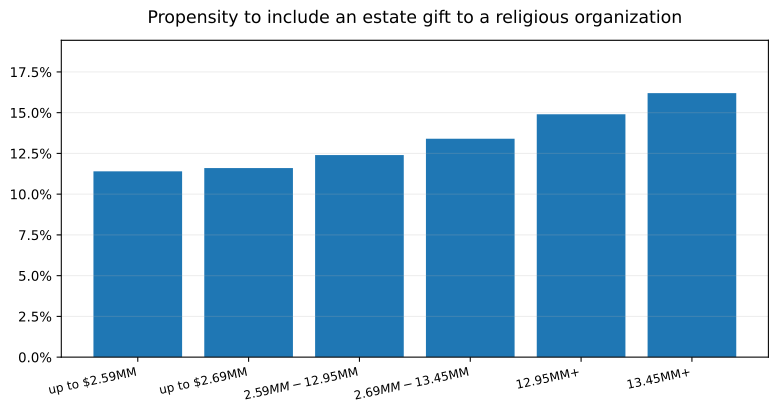
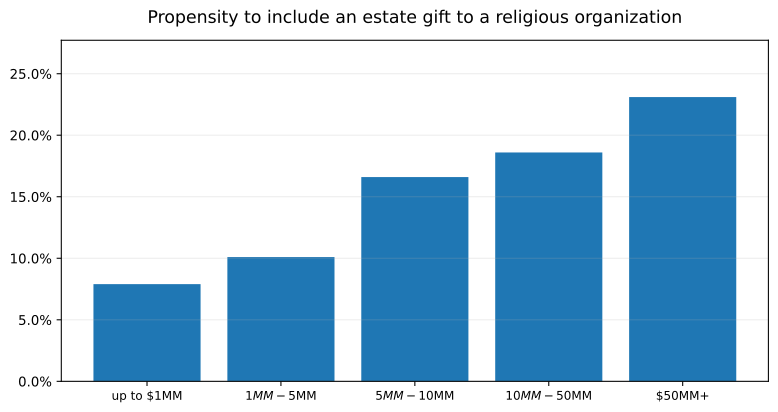
Despite Paul’s direction, the ministry to the wealthy is missing from the church. And the church is missing out on these gifts. Evidence of this missing ministry appears in the giving data. Consider national data from charitable estate gifts. First, the good news. As wealth increases, the likelihood of giving to religious organizations also increases. The below charts from different years of IRS data show this.
| Estate size | Percent |
|---|---|
| up to $2.59MM | 11.4% |
| up to $2.69MM | 11.6% |
| $2.59MM-$12.95MM | 12.4% |
| $2.69MM-$13.45MM | 13.4% |
| 12.95MM+ | 14.9% |
| 13.45MM+ | 16.2% |
| Estate size | Percent |
|---|---|
| up to $1MM | 7.9% |
| $1MM-$5MM | 10.1% |
| $5MM-$10MM | 16.6% |
| $10MM-$50MM | 18.6% |
| $50MM+ | 23.1% |
The likelihood of giving to religious organizations increases with wealth.26 But here’s the problem. These gifts never get big.
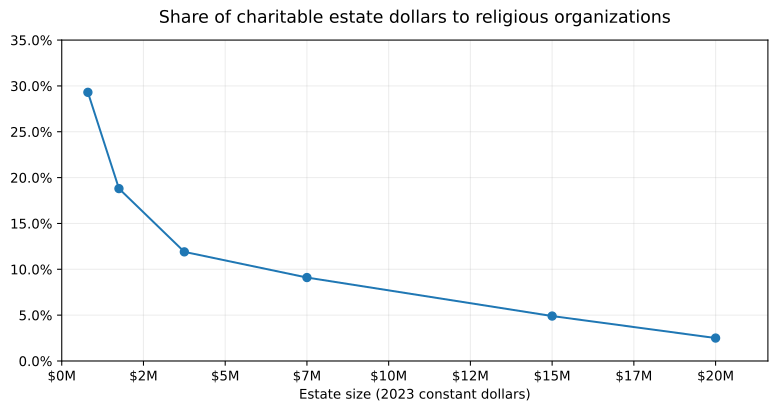
As wealth increases, the large gifts don’t go to religious organizations. They go to universities. They go to healthcare organizations.27 As wealth increases further, they go to private family foundations. Gifts to religion stay small. Again, national data from the IRS shows this:
| Estate size | Percent |
|---|---|
| $800,000 | 29.3% |
| $1,750,000 | 18.8% |
| $3,750,000 | 11.9% |
| $7,500,000 | 9.1% |
| $15,000,000 | 4.9% |
| $20,000,000 | 2.5% |
The share of people giving to religion increases with wealth. But the share of charitable dollars going to religion plummets. The number of charitable donors to religion goes up. The share of charitable dollars to religion goes down.
Religious organizations do receive estate gifts from the wealthy. They receive small, pat-on-the-head gifts. Yes, they are included. But the significant philanthropy goes elsewhere.
Religious organizations are good at getting small gifts. They are bad at getting large ones. The major gifts to religion are missing. These missing gifts match the missing ministry of major gift fundraising.
We see this same missing segment in current donations. A 2022 study looked at giving to all kinds of US charities. It included all gifts to 8,816 charities (from 7.4 million donors). About half of all charitable dollars came from the top 0.3% of donors.28 This is what charitable giving normally looks like. This is the typical charitable organization.
However, this typical funding from top donors is missing in the American church. Another 2022 study looked at giving to US churches. In the typical charity, the top 0.3% of donors provides half of the money. But in churches, that top 0.3% of donors provides only 14.4% of the money. Even the top 1% of church donors provides only 19.6% of gift income.29 Again, the story is the same. Churches were good at getting small gifts. They were bad at getting large ones. The major gifts to religion were missing.30
It’s not that wealthy people aren’t Christians. In fact, the majority of millionaires in the world are Christian.31 It’s not that they don’t attend church. More frequent church attendance actually predicts higher income.32 It’s not that wealthy Christians don’t make large gifts. They just don’t make them to the church. They don’t make them to religious organizations.
These large gifts are missing. Also missing: Paul’s ministry to the rich – the ministry of major gift fundraising.
Part II
Powerful Fundraising Practices
Focusing on the high-capacity donor
So, let’s get practical. Suppose we want to raise more money. What works? One approach usually wins. It always starts the same way. It starts by spending more time with high-capacity prospects. One study analyzed hundreds of fundraising campaigns. What worked? It found that
“In the vast majority of cases, portfolio optimization provides the biggest delta in rapid production increases … It is a simple question of, ‘Are we seeing the best prospects?’ So much energy goes into the ‘seeing,’ but the ‘best prospects’ portion of the question continues to be our main missed opportunity pain point.”33
Another author put it this way,
“Many would gladly trade cold million-dollar prospects for warm ten-thousand-dollar prospects. Unfortunately, many do make this swap – a recipe for failure.”34
The math is undeniable. Suppose you spend the next two years working with 100 donors. Each has the capacity to make a $10,000 gift. Each has a 75% chance of making that gift. This results in $750,000 of gifts.
Now suppose instead you work with 100 donors, each with the capacity to make a $1 million gift. But each has only a 3% chance of making that gift. This results in $3,000,000 of gifts. These donors were 25X less interested in giving. But the results are still 4X better.
That’s the math. But here’s the reality. No one wants to get turned down 97% of the time. That feels like failure. It’s disheartening. It’s emotionally unsustainable.
Unless. Unless we think differently. Things change if we’re in ministry, not sales. We’re delivering a scriptural message about generosity. We’re delivering it to a specific group. Doing this is important. It’s commanded.
No, the response won’t always be “Yes.” We can’t control that. But that doesn’t change our responsibility to deliver the message. We’re carrying out a ministry. It’s a scriptural ministry to this specific group.
Getting a big gift is great. And that should happen. But our job is not to “always be closing.” Our work is not just sales. Our work is to deliver this specific message. Our work is to minister to this specific group.
Donor capacity vs. donor commitment
In fundraising, donor capacity is important. It’s hard to argue against that. But capacity isn’t everything. We want donors with high capacity and high interest. But these factors are not equally important. That’s not how the math works. That’s also not how people work.
We can do a lot to increase a donor’s interest. Creating donor experiences helps. Building relationships with employees, beneficiaries, or other donors helps. Making connections with the donor’s values, people, and life story helps. Any of these can increase interest.
And what can we do to increase a donor’s capacity? Nothing. If we start with high-capacity, low-interest prospects, we can grow their interest. But if we start with low-capacity, high-interest prospects, we can’t grow their capacity.
Capacity + beliefs: It’s not for all rich people
This passage describes a ministry to the rich. But wealth isn’t the only factor. 1 Timothy is about managing the church household. It describes ministries to those within the church.
1 Timothy also describes a ministry to older widows. But this was not for every older widow in Ephesus. It was only for those in the church. The same was true for the ministries to younger widows, younger men, younger women, older men, or older women. Paul was not describing ministries to the entire pagan world. These were only for those within the church. These were ministries only to believers.
So, yes, this ministry is to the rich. But it is only to rich people who are part of the church. It is only for believers.
Again, the passage matches modern fundraising practice. Financial capacity is great. But spending time with wealthy people who will never care about your cause won’t work. Of course, they don’t have to start with a passion for your specific organization. That can develop over time. But if their underlying values and beliefs don’t align, it’s a dead end. Fundraising can’t fix that.
This passage matches that reality. The wealthy donor might not start with a passion for your cause. But their underlying values and beliefs must align.
Effective ministry practice: Seeking out your people group
Suppose we accept a call to minister to a specific people group. Great! Now what? Well, at some point, we’ll probably have to find them. Do we want to minister to prisoners? We’ll probably have to visit a prison. Do we want to minister to people overseas? We’ll probably need to go there.
Some groups aren’t as easy to find. Suppose we want to minister to ex-convicts. How might we find them? Public records could be a great starting place. Word-of-mouth referrals might help. Offering relevant classes or services could work.
Regardless of the group, the concept is the same. We must find our people group in order to minister to them. We have to seek them out.
This is also true when ministering to the rich. We have to seek them out, too. Having an authorized message for them is great. But we still have to find them first.
Effective fundraising practice: Capacity analytics
What the Bible says is true. It works. The largest, most effective, modern fundraising charities use the same approach. They dedicate extensive resources to identifying the wealthy among their friends and supporters. Many books and consultants focus on this single task.35 There’s even an industry association for it.36 Why? Because it works.
The latest trends all point to the same thing. Successful fundraising charities focus on identifying and connecting with their high-capacity donors. Yet, the latest thing isn’t new. It’s thousands of years old. Yes, this is a ministry to encourage generosity. But it’s a specialized ministry. It’s for “those who are rich in this present world.”
Doing this is hard work. For a fundraiser, it’s more fun to work with highly committed, lower-capacity donors. That’s more enjoyable. But that’s not this ministry. That’s not this people group.37
Now that we know the people group, what’s next? How should we approach them? The next word in the passage gives the answer.