Who is the hero?
Is the donor the hero of our fundraising story? If not, then we may not be
• Telling the donor’s story
• Talking about the donor’s impact, or
• Deeply connecting the donor to the cause.
Advancing the donor’s hero story is effective. It makes a compelling fundraising story. But wait. Isn’t the charity important? What about its expertise and infrastructure? What about its history and goals?
Role change
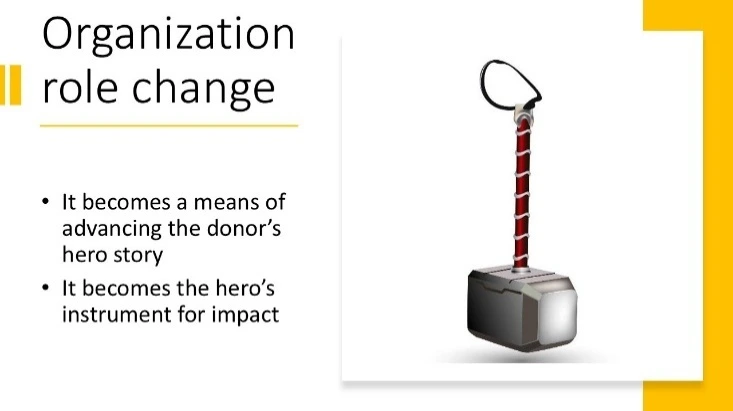
The charity and its administrators are still essential. Just because the charity isn’t the hero, doesn’t mean it isn’t part of the story.
But when we drop the administrator-hero story, there’s a difference. The organization story stops competing with the donor’s hero story. Instead, it starts supporting the donor’s hero story. The charity becomes important as a means of advancing the donor’s hero story. It becomes the hero’s magical instrument for impact. It becomes the hero’s weapon.
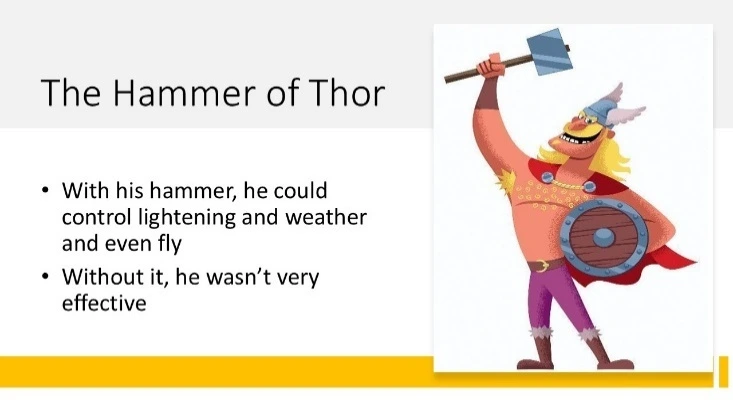
The hammer of Thor
When I was a kid, I loved comic books. My friends and I studied the latest issues. We traded tattered copies. What we loved most was arguing. Mostly, we argued about which superhero would win in fight.
One of my favorites was Thor. When Thor had his enchanted hammer, he was powerful. He could control lightening and weather. He could fly. He could really make an impact! Without his hammer, Thor wasn’t very effective as a hero.436 The hammer of Thor was a key part of the story.437
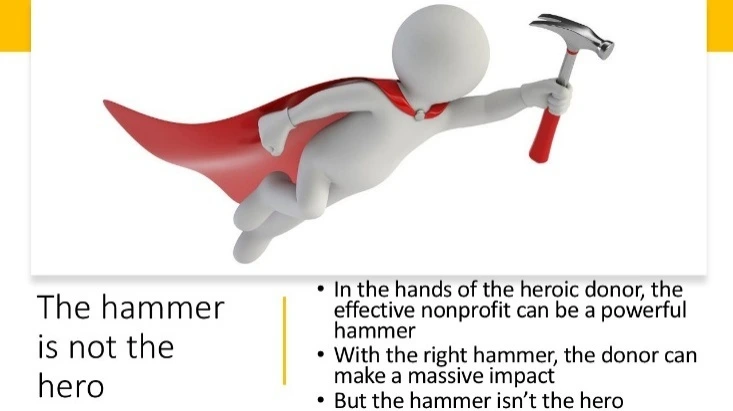
The hammer is not the hero
Thor’s hammer is powerful. But what does it do without Thor? Nothing. Thor’s hammer is cool. But nobody ever cheered for the hammer to win. The hammer isn’t the hero.
In the hands of the heroic donor, the effective nonprofit can be a powerful hammer. With the right hammer, the donor can make a massive impact. The hammer is important. But the hammer isn’t the hero.
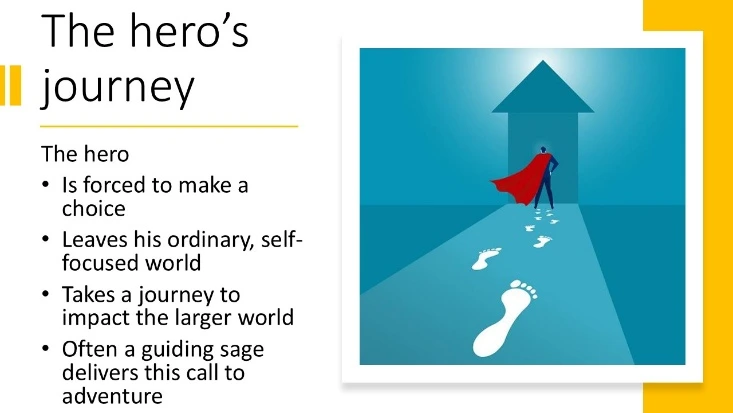
The hero’s journey
In Joseph Campbell’s monomyth, the hero takes a journey. The hero’s journey begins when the hero is forced to make a choice. The hero leaves his ordinary, self-focused world. He embarks on an adventure to impact the larger world. Often a guiding sage delivers this call to adventure.
But the guiding sage role continues after the call to adventure. The guiding sage provides help, advice, and direction along the journey. This ongoing role is also common in hero movies. Consider
- Obi-Wan Kenobi (original Star Wars)
- Morpheus (The Matrix), or
- Gandalf the Grey (The Hobbit).
These guiding sages forced a choice to start the adventure. But they also helped along the way.
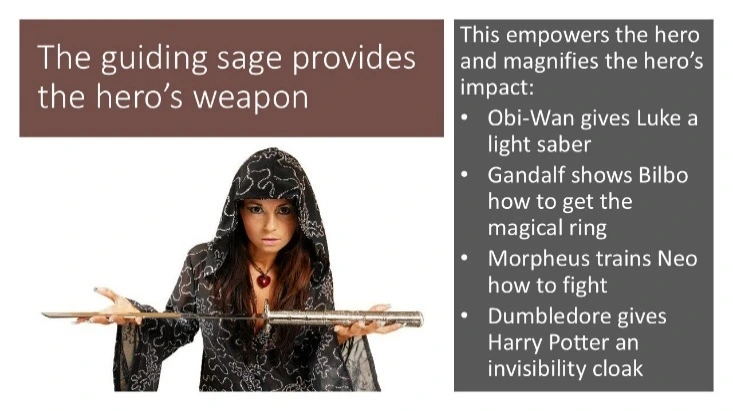
The guiding sage provides the hero’s weapon
The guiding sage can help in several ways. She may introduce the hero to friends and allies. Often, she gives a powerful instrument or weapon to the hero.438
Obi-Wan gives Luke a light saber. Gandalf shows Bilbo how to get the magical ring. Morpheus trains Neo to fight. Dumbledore gives Harry Potter an invisibility cloak. These tools aren’t just for fun. They help the hero complete the journey. They empower the hero. They magnify the hero’s impact.
The instrument encourages the hero to make the journey. It makes the adventure feasible. Could I be an epic hero? I don’t know. I’m a little unsure. But what if I had Luke Skywalker’s light saber? What if I had Harry Potter’s invisibility cloak? What if I had Thor’s hammer? That changes things! The powerful instrument makes epic heroism more achievable.
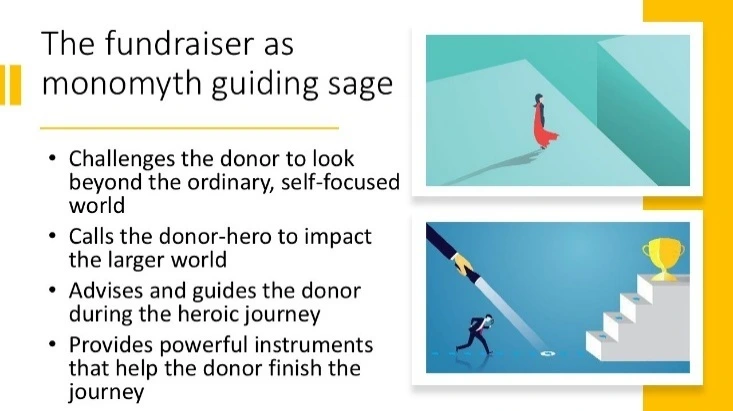
The fundraiser as monomyth guiding sage
The effective fundraiser plays an archetypal role in the donor’s hero story. This role is the guiding sage. It’s the sage who challenges with a choice. The fundraiser
- Challenges the donor to look beyond the ordinary, self-focused world
- Calls the donor-hero to impact the larger world
- Advises and guides the donor during the heroic journey, and
- Provides powerful instruments that help the donor complete the journey.
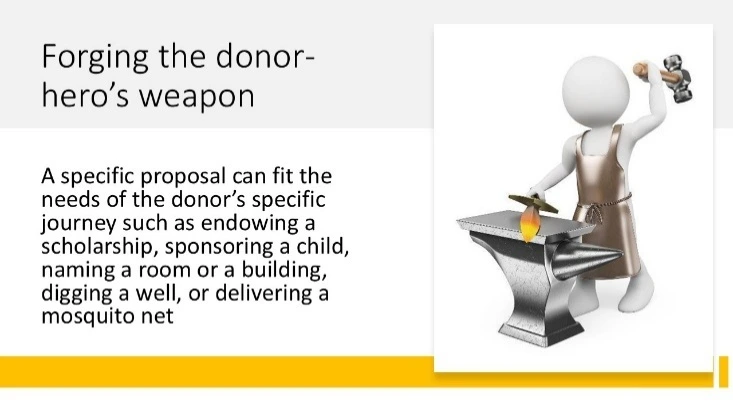
Forging the donor-hero’s weapon
What magical instruments can the fundraiser offer to the donor hero? Maybe it’s an endowed scholarship fund. Maybe it’s sponsorship of a child. Maybe it’s a named room or building. Maybe it’s digging a well. Maybe it’s delivering a mosquito net.
These are all things that would be difficult for the donor to do alone. But the guiding-sage fundraiser provides the magical weapon. A proposal can fit the instrument to the needs of the donor’s specific journey. The guiding sage selects the weapon to match the hero’s journey.
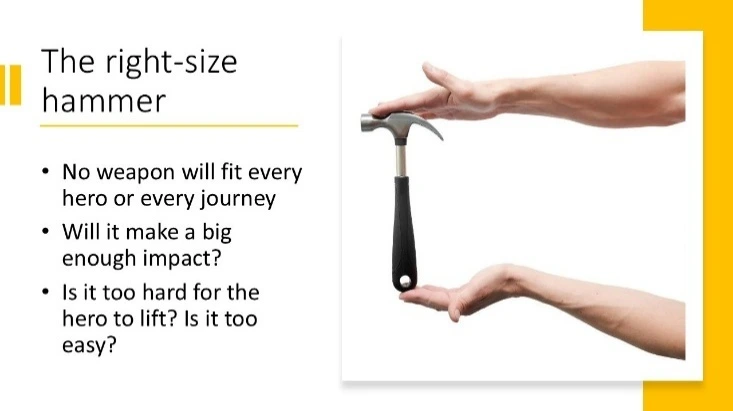
The right-sized hammer
No weapon can fit every hero or every journey. If the hero can’t lift the hammer, it can’t be part of his story. On the other hand, Thor shouldn’t be holding a tiny reflex hammer. That doesn’t fit a heroic story either.
In 2015, John Paulson gave $400 million to Harvard’s (renamed) John A. Paulson School of Engineering. If a donor wants to use $400 million to make an impact in engineering research and education, Harvard is the right-sized hammer. If he wants his story to live on with future generations of leading engineers, Harvard is the right-sized hammer. This weapon matches this hero and this hero’s journey.
On the other hand, it would do no good to convince me to give $400 million to make this impact. It’s a really nice hammer, but it’s the wrong size. I can’t lift that hammer. It can’t be part of my hero story.
Suppose $50 provides mosquito nets to people in need. I can lift that hammer. But it might be the wrong size, too.439 If I can lift it too easily, it’s not that heroic. It’s a cute hammer, but it’s too small to really advance my hero story.
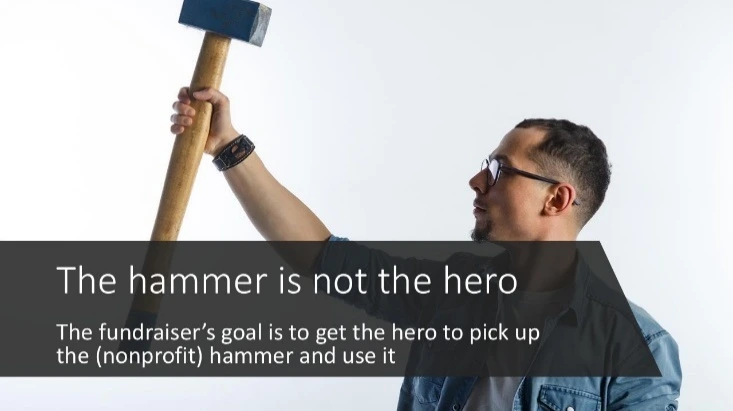
The hammer is not the hero
In comics, the hammer increases the hero’s impact. In fundraising, the nonprofit increases the donor’s impact. The nonprofit is the donor’s hammer. The fundraiser’s goal is to get the hero to pick up the hammer and use it.
To accomplish this goal, it’s fine to talk about how great the hammer is. But be careful. The goal is to sell the hammer to the hero. It’s not to sell the hammer as the hero.
Talking about the wonderful charity is fine. But don’t slide into telling the administrator-hero story. That’s not the goal. The goal is to show how great the nonprofit is as an instrument for the donor hero. The message is,
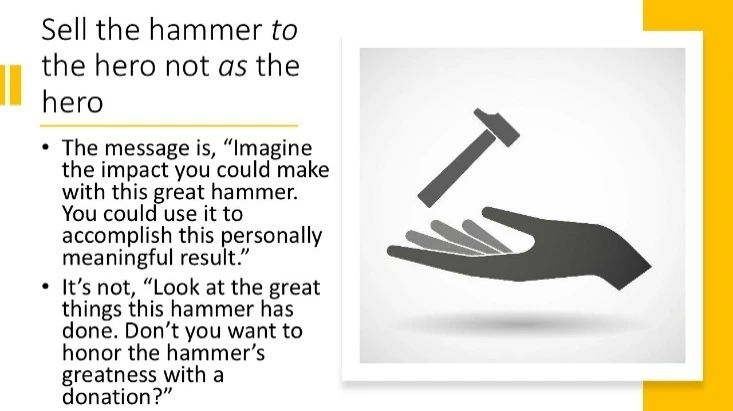
“Imagine the impact you could make with this great hammer. You could use it to accomplish a personally meaningful result.”
The message is not,
“Look at the great things this hammer has done. Don’t you want to honor the hammer’s greatness with a donation?”
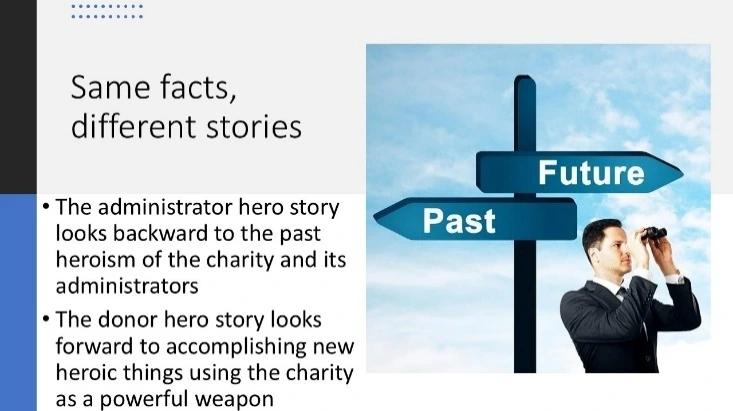
Same facts, different stories
The administrator-hero story looks backward. It honors the past heroism of the charity and its administrators. The donor-hero story looks forward. It shows how the donor can accomplish new heroic things. The charity can be a powerful weapon in the donor-hero’s hands.
The charity appears in both stories. The facts can be the same, but the story is different. Suppose a charity has an impressive history. That fact can be part of either story.
- Administrator-hero story
- Look at our grand history and all that we have done. You should give us money because we are so great.
- Donor-hero story
- Look at what we have helped these heroic donors to accomplish in the past. You’re just like them. We can help you make a lasting impact, too.
Both messages include details about the organization. Both share examples of past impact. But the stories are different. One tells an administrator-hero story. (“We are great. See all the great things we have done.”) The other tells a donor-hero story. (“We are a great instrument for you to use. Other donors like you have used this instrument to accomplish great things.”)
Same facts, different hero
The difference in these stories is not whether the charity is great. The difference is the hero. In the donor-hero story,
- The donor is the agent.
- The donor makes the impact.
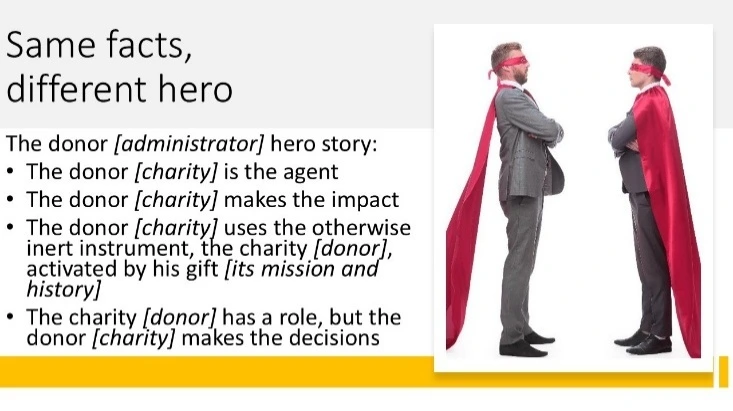
- The donor uses the otherwise inert instrument, the charity, activated by his gift.
- The charity has a role, but the donor makes the decisions.
In the administrator-hero story,
- The charity is the agent.
- The charity makes the impact.
- The charity uses the otherwise inert instrument, the donor, activated by its inspirational mission and accomplishments.
- The donor has a role, but the administrators make the decisions.
Mission drift problem?
Won’t advancing the donor’s hero story send the organization off course? Doesn’t helping donors prevent a narrow focus? No.
Let’s return to the story. The charity is the magical instrument or weapon in the hero’s journey. In popular movies, this might be Thor’s hammer, Luke’s light saber, or Harry Potter’s invisible cloak.
But Thor’s hammer is not a light saber. A light saber is not an invisible cloak. The instrument may be magical, but it does one thing, not everything. To be a powerful instrument for a donor hero, the charity must be excellent. This excellence means doing a few things well.
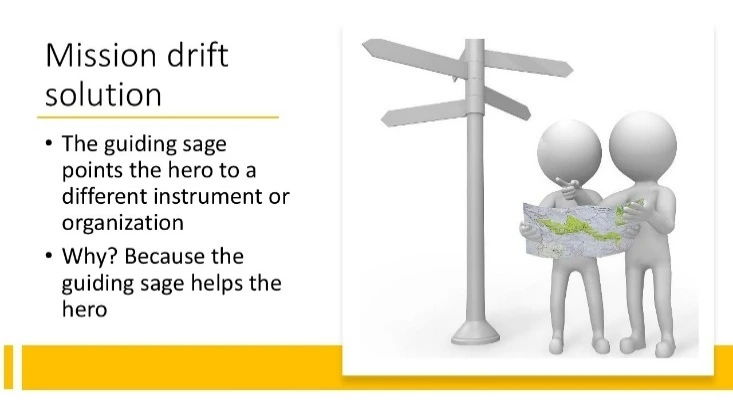
Mission drift solution
If the instrument doesn’t fit the hero’s task, what does the guiding sage do? Does she try to change the instrument into something it’s not? (“Yes, you need an invisibility cloak. But we can widen this hammer so you could hide behind it!”) No. She points the hero to a different instrument.
The fundraiser points the donor to a different charity. She introduces a new mentor who knows that instrument. Of course, that’s not what a “pushy salesperson” would do. And that’s the point. The guiding sage plays a different role. The guiding sage helps the hero.
Advising against interest
Helping a donor in this way shatters stereotypes. A “pushy-salesperson” type would never connect a donor with a “competitor.” Doing this might seem counterproductive. It’s not. It establishes the fundraiser in the role of trusted advisor. Such authentic behavior transforms the donor-fundraiser relationship.
Of course, in the administrator-hero story, this is an act of heresy. The fundraiser’s job isn’t to help the donor. The fundraiser’s job is to sell the administrator-hero story to the donor. The fundraiser is supposed to be the pushy salesperson.
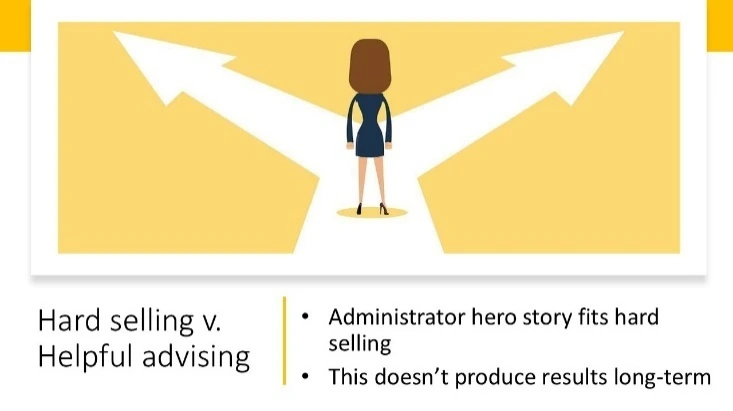
But even from a purely financial perspective, this aggressive approach isn’t the best. Establishing a guiding-sage relationship is like planting an almond. Over time, it can be nurtured into a tree that will produce a thousand-fold more. Forcibly selling the charity as the right tool even when it doesn’t fit? That’s like eating the almond instead of planting it.
The charity is still important
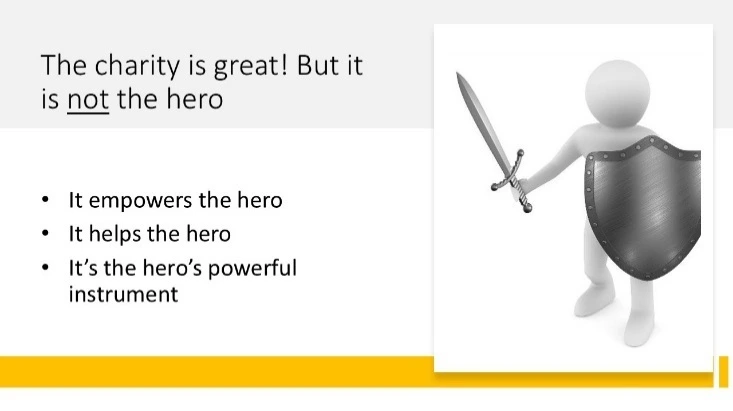
The charity plays an important role in the donor-hero story. It empowers the donor hero. It helps the donor hero accomplish his heroic goals. It serves as a powerful instrument for the hero.
Advancing the donor’s hero story doesn’t mean that the charity isn’t important. It doesn’t mean that the charity isn’t great. It only means that the charity isn’t the hero.
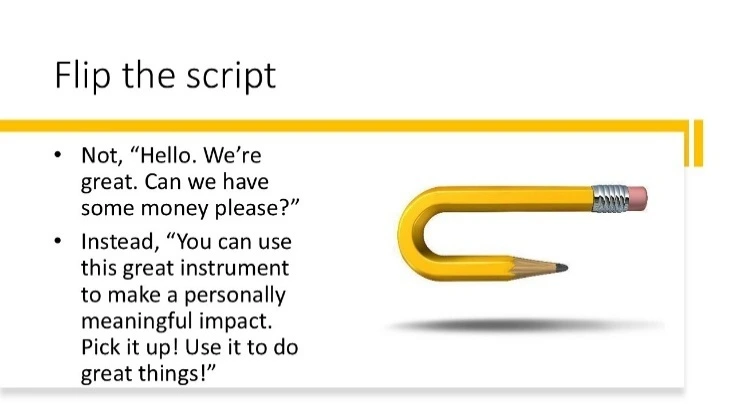
The facts about the organization are the same in both stories. But the story changes. The story is no longer,
“Hello. We’re great. Can we have some money please?”
Instead, the story becomes,
“You can use this great instrument to make a personally meaningful impact. Pick it up! Use it to do great things!”
In fundraising, the right story – with the right hero – leads to the right results. However, there can be another barrier to the donor-hero story. Sometimes the problem isn’t having the wrong hero. Sometimes the problem is having no hero at all.
Charity role: Strength or need?
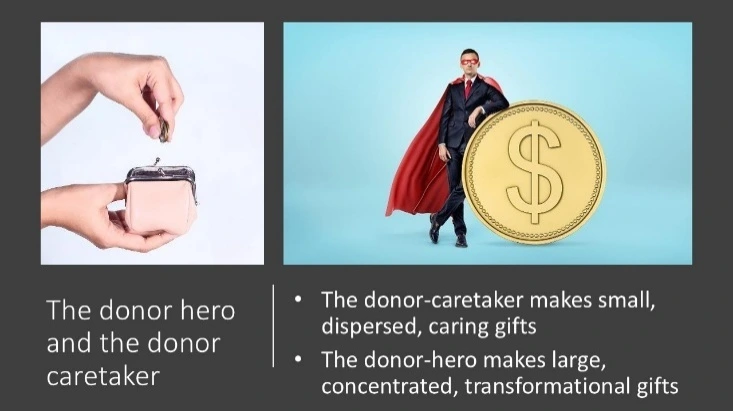
There are many archetypal characters besides the hero. However, only two are definitionally philanthropic: The hero and the caretaker. In fundraising, either story can work. But each works for different gift sizes. The donor caretaker makes small, dispersed, caring gifts. The donor hero makes large, concentrated, transformational gifts.
In each story, the charity plays a different role. In the donor-hero story, the charity’s role is one of strength. The charity is the donor-hero’s powerful instrument.
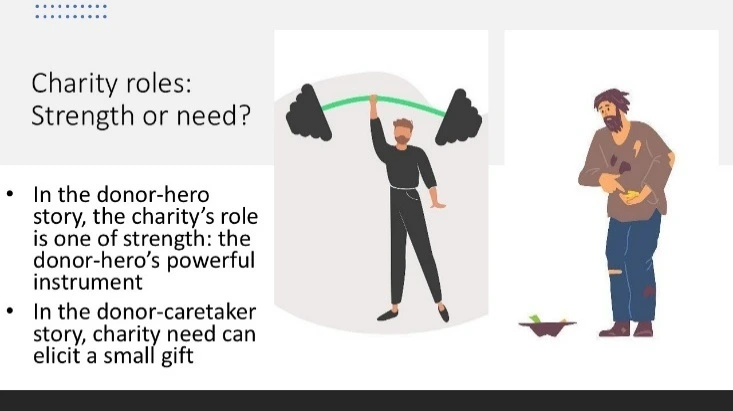
In the donor-caretaker story, the charity’s role is different:
- Charity strength can be a problem.
- Why would the charity hold wealth when there is immediate need? Why focus on the charity’s long-term stability when others want help now?
- Instead, charity need can fit this story.
- The charity has a financial crisis. What happens? The sympathetic caretaker responds with a little help.
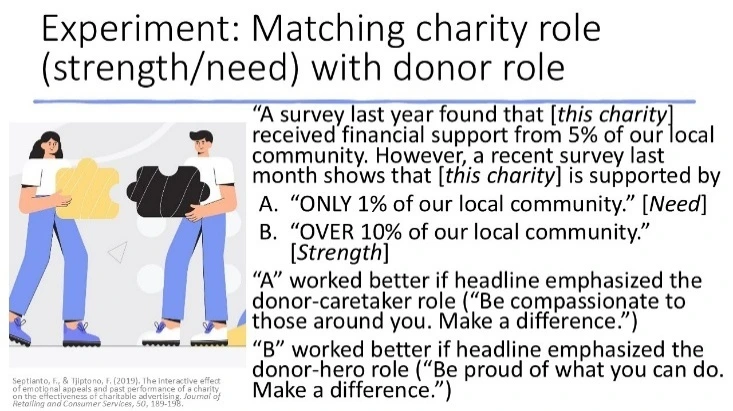
Experiment: Matching charity role (strength or need) with donor role (hero or caretaker)
The organization story can be one of need or strength. In either case, it should match the story archetype. One experiment tested this.440 The fundraising message included a reference either to the charity’s need or strength. The charity need message read,
“A survey last year found that [this charity] received financial support from 5% of our local community. However, a recent survey last month shows that [this charity] is supported by ONLY 1% of our local community.”441
The charity strength message replaced “ONLY 1%” with “OVER 10%.” Which version worked better? It depended. One headline emphasized the donor-caretaker role. It read,
“Be compassionate to those around you. Make a difference.”442
With this headline, the charity need message (“ONLY 1%”), worked twice as well. Another headline emphasized the donor-hero role. It read,
“Be proud of what you can do. Make a difference.”443
With this headline, the charity strength message (“OVER 10%”) worked twice as well. Matching the charity role (strength vs. need) with the donor role (proud hero vs. compassionate caretaker) worked.
Practice: Charity strength or charity need?
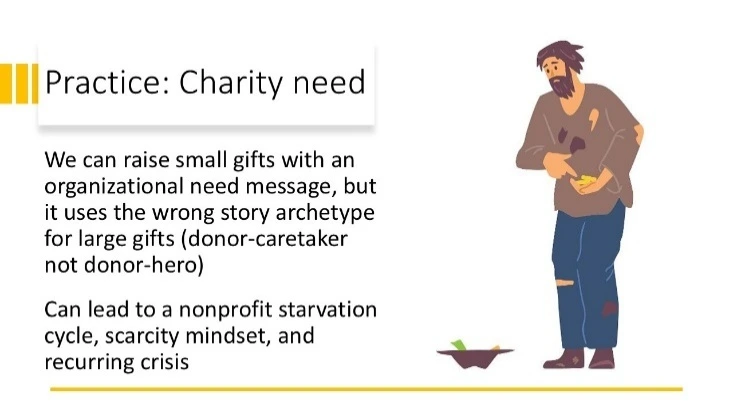
Yes, it’s true. We can raise funds with an organizational need message. But this won’t lead to large gifts. Why not? Because it uses the wrong archetype for large gifts. The donor caretaker makes small, dispersed, caring gifts. Only the donor hero makes large, concentrated, transformational gifts.
Charities can get stuck in the wrong story. This can create a nonprofit starvation cycle. Charities project organizational need because this matches the caretaker story. Charities then internalize this need-based “scarcity” mindset.444 They avoid building long-term capacity. They avoid projecting financial strength.
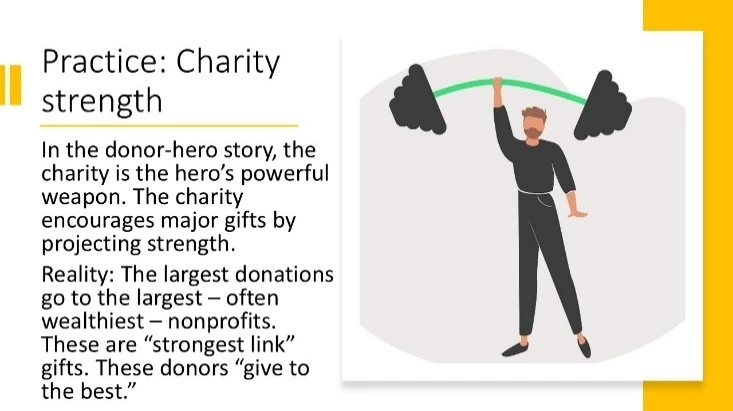
Their next financial crisis triggers a few quick gifts. It works! But it “works” at the cost of future major investment gifts. This need-based “scarcity” mindset can lead to recurring organizational crisis.
But there is another path. There is another story. The donor-hero story matches the strong, powerful nonprofit. The charity is the donor-hero’s powerful weapon. In this story, the charity projects strength and abundance. This message supports major investment gifts.
This is not just about story or experiments. It’s about real-world fundraising.445 The largest donations go to the largest – often wealthiest – nonprofits. These are “strongest link” gifts.446 These donors “give to the best.”
Conclusion
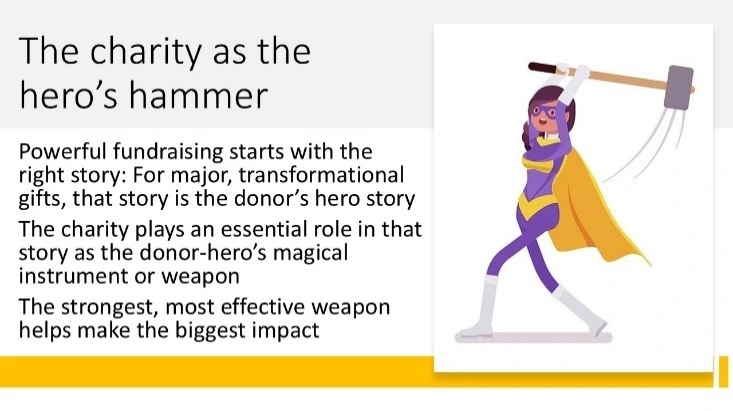
Powerful fundraising starts with the right story. For major, transformational gifts, that story is the donor’s hero story. The charity plays an essential role in that story. The charity is the donor’s magical instrument or weapon. A donor hero wants the strongest, most effective weapon. That weapon helps him make the biggest impact. The charity is an essential part of this story. It’s not the hero. It’s the hero’s hammer.
Notes and references
For this story line, see Branagh, K. (Director). (2011). Thor. [Film]. Marvel Studios.
↩Real fanboys or fangirls will know that Thor’s hammer actually had a name. From the original Norse myth, it was called Mjölnir.
↩“Unleashing the heroic imagination involves fostering the development of new mental scripts and enhancing people’s heroic self-efficacy.” Allison, S. T., Goethals, G. R, & Kramers, R. M. (2017). Setting the scene: The rise of heroism science. In S. Allison, G. Goethals, and R. Kramer (Eds.), Handbook of heroism and heroic leadership (pp. 1-16). Routledge. p. 4
As the “hammer of Thor,” the organization fulfills this role of “enhancing people’s heroic self-efficacy”.
↩The impact of this type of mismatch is shown in Lewis, J., & Small, D. (2018). Ineffective altruism: Giving less when donations do more. In A. Gershoff, R. Kozinets, and T. White (Eds.), NA - Advances in Consumer Research (Vol. 46). Association for Consumer Research. p. 194-198
https://www.acrwebsite.org/volumes/v46/acr_vol46_2412099.pdf
See also, Lewis, J., & Small, D. (2019, June 4). Ineffective altruism: Giving less when donations do more. [Working paper]. SSRN. p. II. (“In four studies (N = 2,725), when we inform participants of the cost of a unit of impact (e.g. the cost of a mosquito net), they perversely donate less when the cost is cheaper. This result arises because people want their donation to have a tangible impact, and when the cost of such an impact is lower, people can achieve it with a smaller donation.”)
↩Septianto, F., & Tjiptono, F. (2019). The interactive effect of emotional appeals and past performance of a charity on the effectiveness of charitable advertising. Journal of Retailing and Consumer Services, 50, 189-198.
↩Id. p. 192.
↩Id.
↩Id.
↩See Covey, S. R. (2004). The 7 habits of highly effective people: Powerful lessons in personal change. Simon and Schuster. (Discussing “scarcity mentality” and “abundance mentality.”)
↩For matching commentary from fundraisers on scarcity vs. abundance mindsets see, e.g., Edgington, N. (2018, March 20). Nonprofit scarcity thinking will get you nowhere. [Blog]. https://www.socialvelocity.net/nonprofit-scarcity-thinking-will-get-you-nowhere/ ; Tomchin, A. (2019, September 19). Scarcity versus abundance mindset: Which one will lead your fundraising? [LinkedIn Article]. https://www.linkedin.com/pulse/scarcity-versus-abundance-mindset-which-one-lead-your-amy-tomchin/ ; Wright, A. (2017, May 10). 3 tactics to shift your nonprofit from scarcity to abundance mindset. [Blog]. https://www.globalgiving.org/learn/listicle/nonprofit-abundance-mindset/
↩Birkholz, J. (2019, June). Principal gifts. [White paper]. BWF. https://www.bwf.com/wp-content/uploads/2019/06/Principal-Gifts-by-Birkholz.pdf
↩