Making the ask can be the scariest part of fundraising. Setting up social events is great fun. Being friendly with others is enjoyable. Talking about their interests is comfortable. But asking for money? That’s hard! Many fail simply by avoiding this critical step.
So how do we do this? What are the magic words? Let’s start at the beginning.
Theory
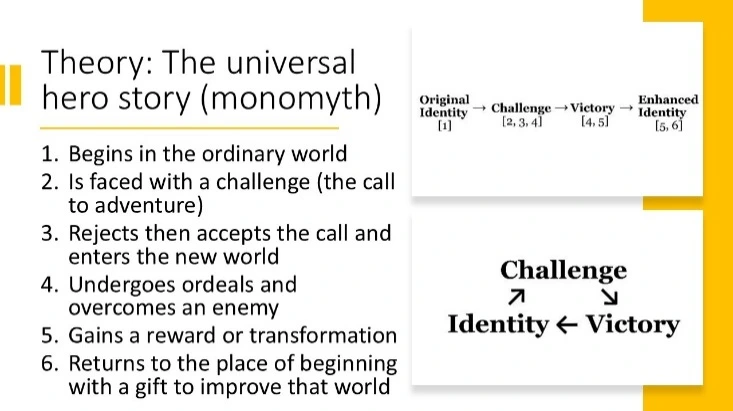
The “one big thing” in fundraising is always the same: Advance the donor’s hero story. The universal hero story, called the monomyth, includes specific steps. The hero,
- Begins in the ordinary world
- Is faced with a challenge (the call to adventure)
- Rejects then accepts the call and enters the new world
- Undergoes ordeals and overcomes an enemy
- Gains a reward or transformation
- Returns to the place of beginning with a gift to improve that world
This hero story progresses through

In three words, the monomyth cycle is1320

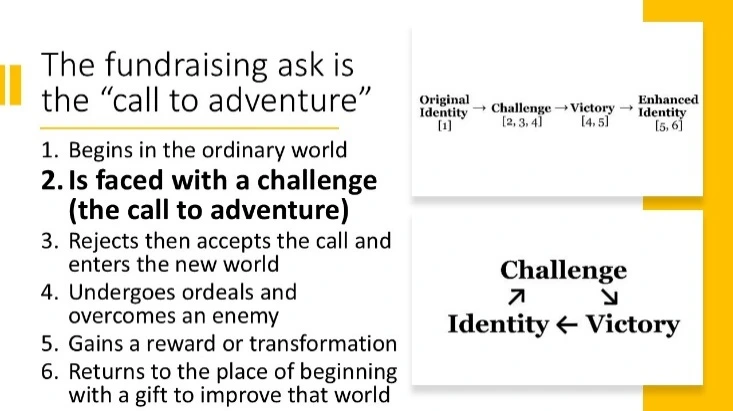
The fundraising ask is the “call to adventure.” It presents the challenge. It’s the point where the prospective hero is given a choice. Stay in the ordinary, small, self-focused world. (Reject the challenge.) Or go on an adventure to make an impact on the larger world. (Accept the challenge.)
What is the secret to a compelling fundraising ask? It’s this. The challenge must be part of the full story cycle. It must link to the donor’s original identity. (This comes from the donor’s history, people, or values.) It must promise a victory. (This is a specific, visualizable impact from the gift.) The promised victory must enhance the donor’s identity. (Externally, this is public reputation. Internally, this is private meaning.)
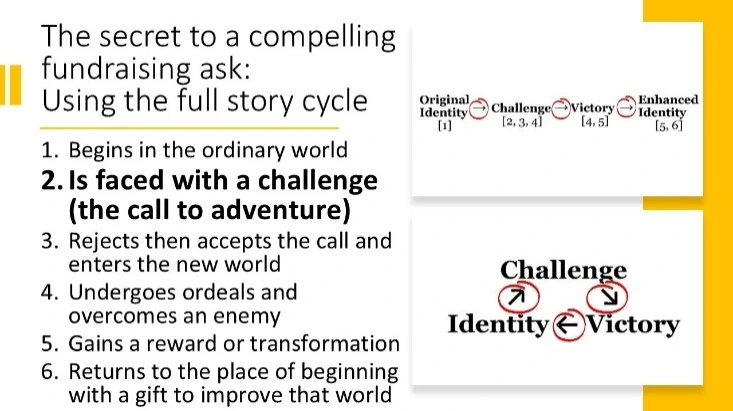
The story cycle ask
Theory is nice. But let’s get practical. How do we ask for money?
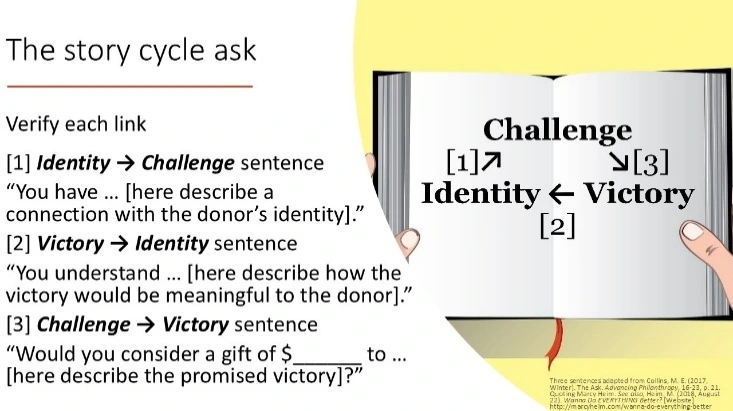
The compelling ask must be part of the full story cycle. To confirm this, the ask should verify each link.

The story cycle ask is as simple as 1-2-3.
[1] Identity → Challenge sentence
“You have … [here describe a connection with the donor’s identity].”
[2] Victory → Identity sentence
“You understand … [here describe how the victory would be meaningful to the donor].”
[3] Challenge → Victory sentence
“Would you consider a gift of $______ to … [here describe the promised victory]?”1321
This might sound like,
- [1] “You have been a friend of this library for over twenty years.” Identity → Challenge.
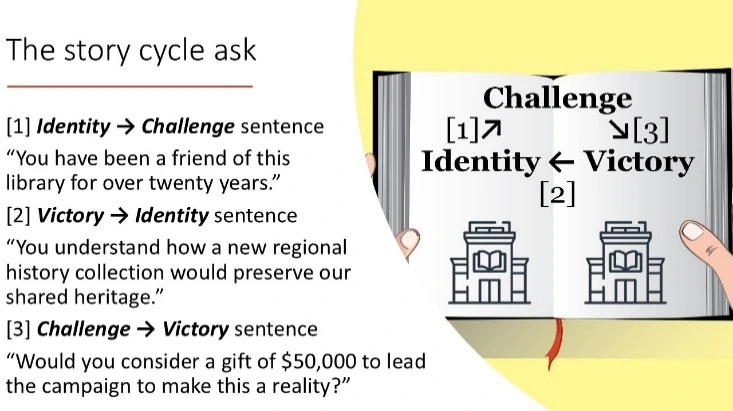
- [2] “You understand how a new regional history collection would preserve our shared heritage.” Victory → Identity.
- [3] “Would you consider a gift of $50,000 to lead the campaign to make this a reality?” Challenge → Victory.
- [1] “You have done so much to improve care for others since your own diagnosis with breast cancer.” Identity → Challenge.
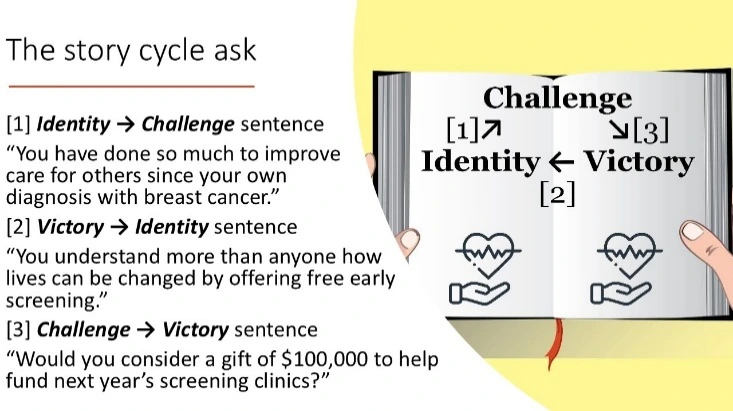
- [2] “You understand more than anyone how lives can be changed by offering free early screening.” Victory → Identity.
- [3] “Would you consider a gift of $100,000 to help fund next year’s screening clinics?” Challenge → Victory.
- [1] “You have always had such a heart for supporting the arts in our community.” Identity → Challenge.
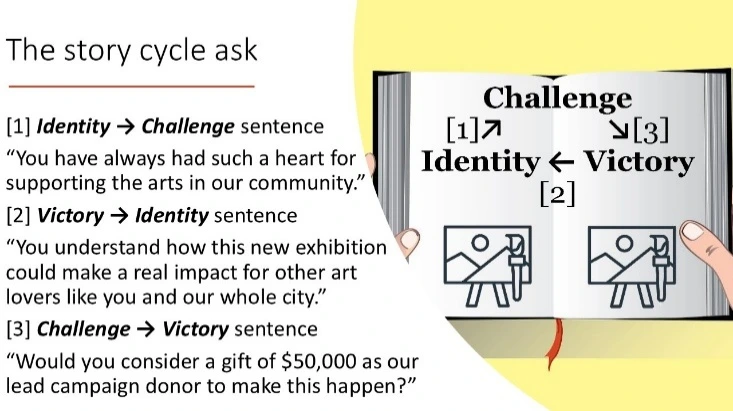
- [2] “You understand how this new exhibition could make a real impact for other art lovers like you and our whole city.” Victory → Identity.
- [3] “Would you consider a gift of $50,000 as our lead campaign donor to make this happen?” Challenge → Victory.
- [1] “You have been such a loyal alumnus of this department since you graduated years ago.” Identity → Challenge.
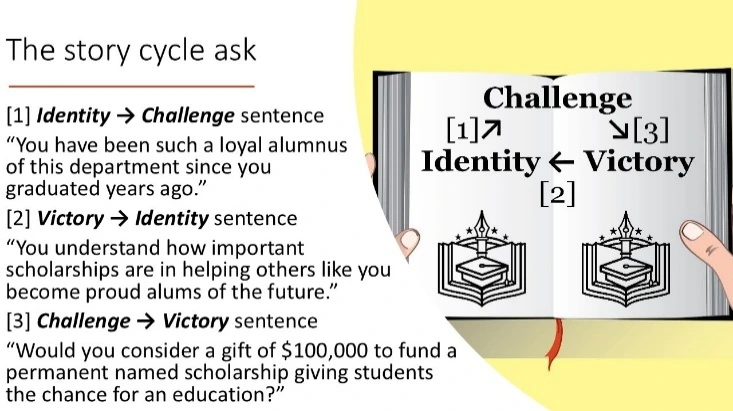
- [2] “You understand how important scholarships are in helping others like you become proud alums of the future.” Victory → Identity.
- [3] “Would you consider a gift of $100,000 to fund a permanent named scholarship giving students the chance for an education?” Challenge → Victory.
Foolproof
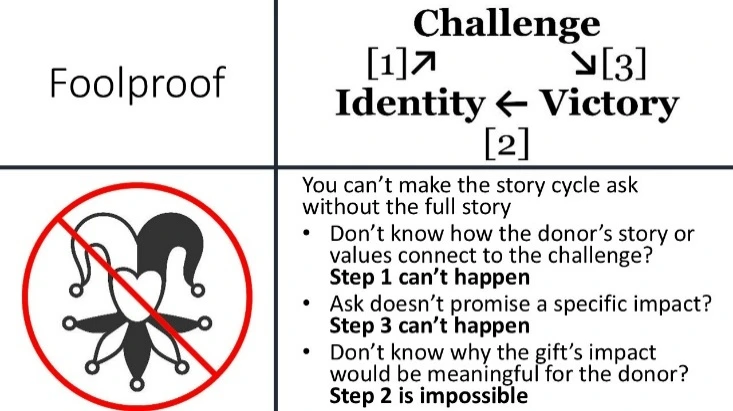
Making this story cycle ask is foolproof. Why? Because we can’t do it without the full story. It makes the missing pieces obvious.
Suppose we don’t know how the donor’s story or values connect to the challenge. Step 1 can’t happen. Suppose the ask doesn’t promise a specific impact. Step 3 can’t happen. Suppose we don’t know why the gift’s impact would be meaningful for the donor. Step 2 is impossible.
We can’t make this story cycle ask without each part. It’s foolproof because it prevents a “foolish” ask. Of course, the stronger each step is, the more compelling the ask will be.
Wheel within a wheel
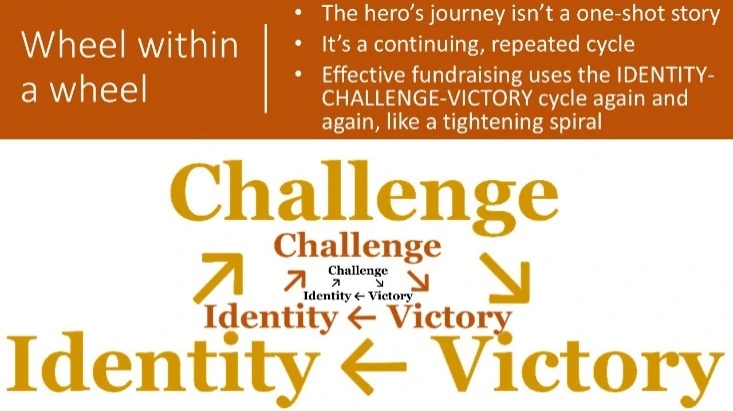
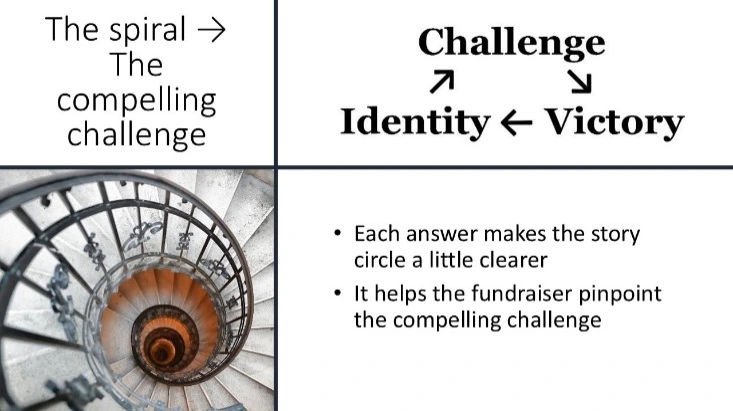
The hero’s journey isn’t a one-shot story. It’s a continuing, repeated cycle. It arises again and again. Effective fundraising uses the identity-challenge-victory cycle. It uses this cycle again and again. Like a spiral or mandala, the circle starts wide. Gradually, it narrows. It gets smaller, clearer, and more precise.
The early stages reveal the broad strokes of the circle. Questions can uncover link 1: Identity → Challenge. For example,
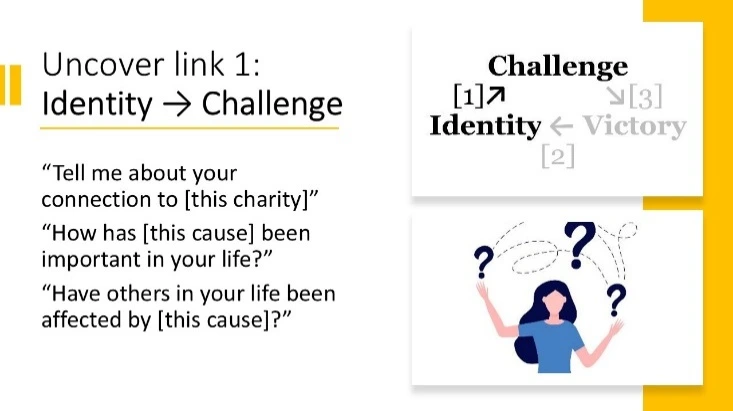
- “Tell me about your connection to [this charity].”
- “How has [this cause] been important in your life?”
- “Have others in your life been affected by [this cause]?”
Questions can uncover link 2: Victory → Identity. For example,
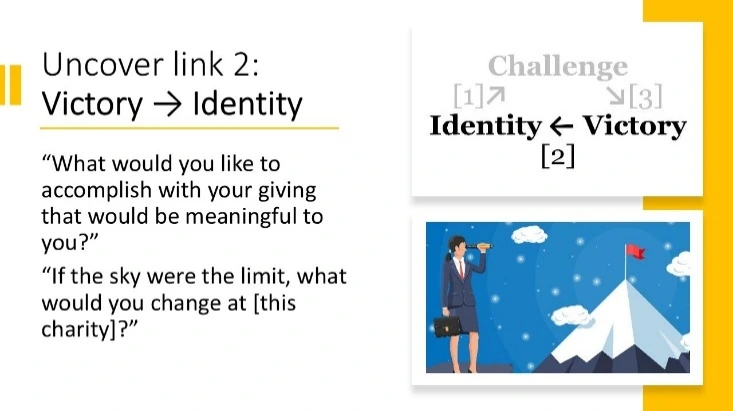
- “What would you like to accomplish with your giving that would be meaningful to you?”
- “If the sky were the limit, what would you change at [this charity]?”
Each answer makes the story circle a little clearer. It helps the fundraiser pinpoint the compelling challenge. Gradually, the circle takes shape. Cultivation leads to solicitation. This can take place over days or months.
The ask is preceded by the proposal. The proposal walks through each step of the circle.
- It includes the donor’s connections to the cause, the charity, or the project. (“Here is why you care.”)
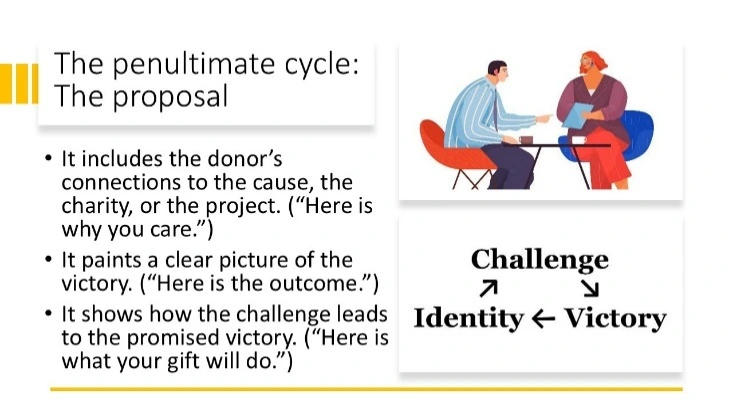
- It paints a clear picture of the victory. (“Here is the outcome.”)
- It shows how the challenge leads to the promised victory. (“Here is what your gift will do.”)
This circle is smaller. It takes less than an hour.
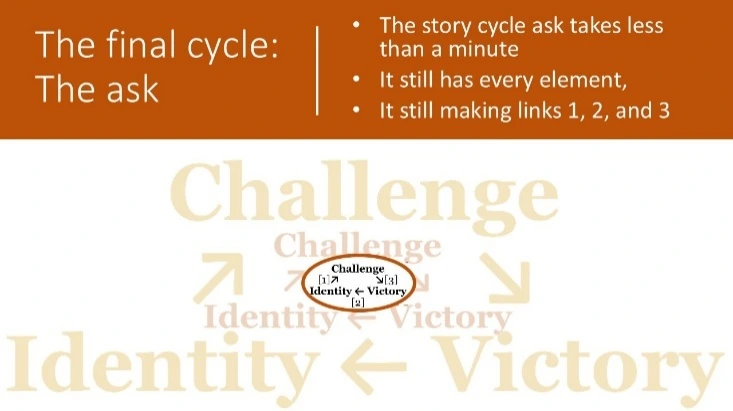
The ask is the final circle. It takes less than a minute. But it still has every element. It makes links 1, 2, and 3. It contains the entire story circle.
The guiding sage at the ask
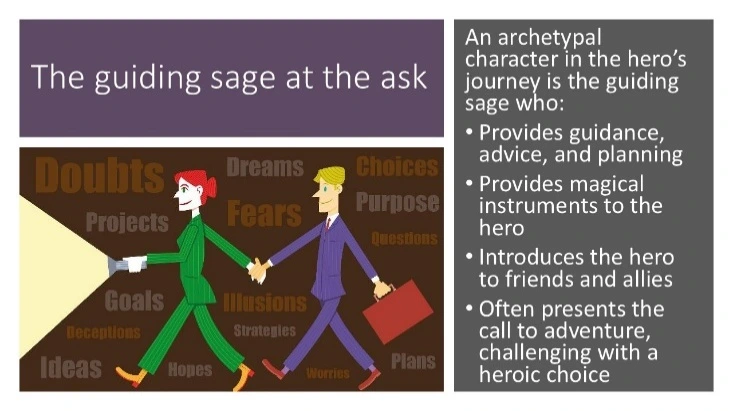
An archetypal character in the hero’s journey is the guiding sage. This wise guide helps the hero. She provides guidance, advice, and planning. She provides magical instruments to the hero. She introduces the hero to friends and allies. Often it is this guiding sage who presents the call to adventure. The sage challenges the hero with a heroic choice.
This is the role of the fundraiser. By embodying this primal role, the fundraiser can guide the donor. The nonprofit is the donor’s magical instrument. The donor uses it to achieve a compelling victory. At the ask, the guiding sage challenges with a heroic choice.
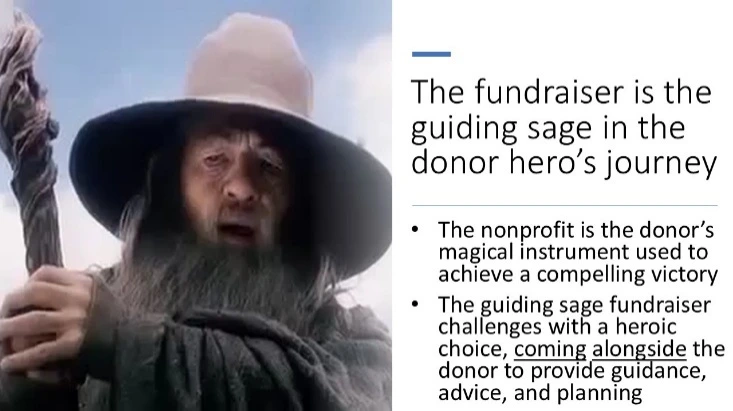
But even at the ask, the fundraiser stays in character. The fundraiser is a guiding sage. The ask is not an argument. It’s not a fight. The fundraiser provides guidance, advice, and planning. She comes alongside the donor.
Physical positioning at the ask
Even the fundraiser’s physical position can match this role. Facing directly across a table is a traditional conflict or negotiation position. A 90-degree angle, such as across a table corner, softens this. The fundraiser can improve either angle by using a focus object. This can be the proposal document.
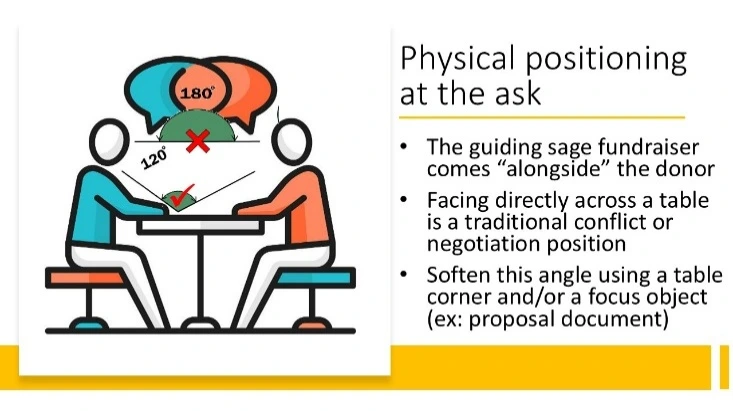
The focus object changes the positioning. It creates a triangle. Even if the fundraiser and donor are directly across from each other, they’re both above the proposal. Focusing on the object shifts away from a parallel (conflict) position: II. It shifts to an angled (merging) position: V.
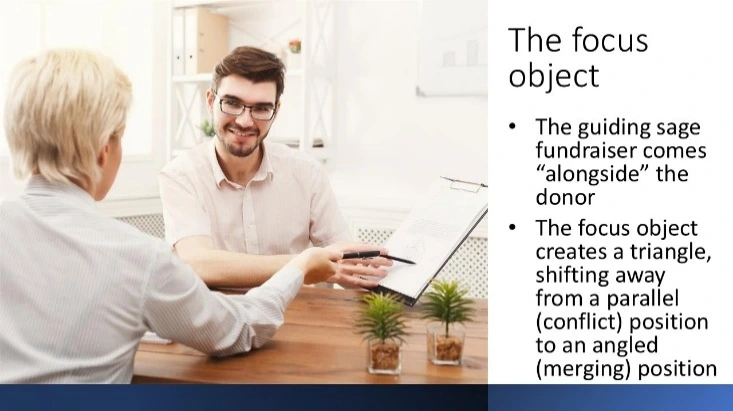
The fundraiser will walk through the proposal. She will turn the pages. She will mark on the proposal, circling and underlining. This places the fundraiser in the physical posture of advising. She is explaining. She is guiding.
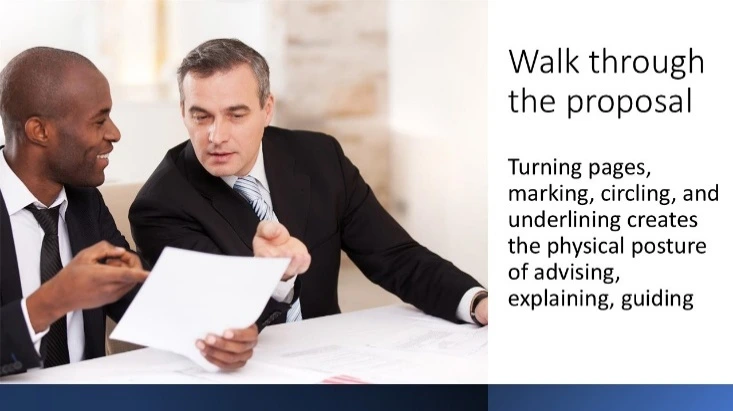
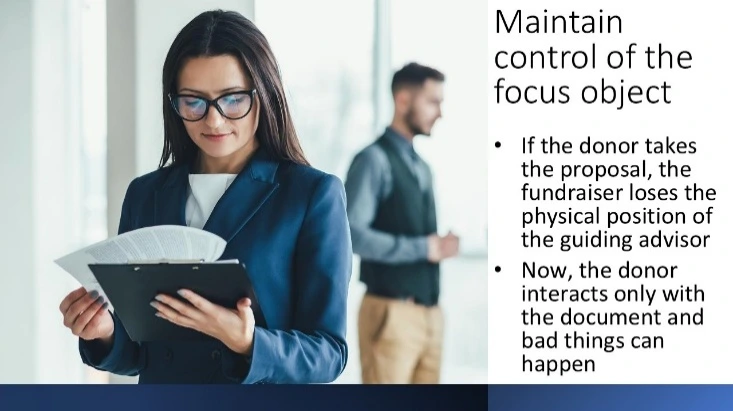
The fundraiser should maintain control of the focus object. If the donor takes the proposal, the fundraiser loses control. The fundraiser loses the physical position of the guiding advisor. Now, the donor interacts only with the document. The triangle is broken. The fundraiser becomes an outsider. The donor can quickly flip through, merely glancing at the pages. He can skip to the dollar ask, bereft of the full story. Bad things happen when the fundraiser loses the focus object before the ask.
In a less formal setting, a fundraiser might physically walk alongside a donor. She can point to where a project might take place. The focus object might be a room, a field, or a building.
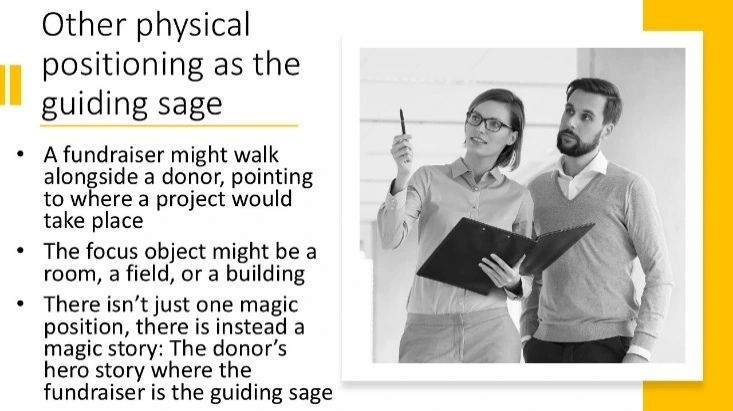
There isn’t just one magic position. There is instead a magic story. The story is the donor’s hero story. Within that story, the fundraiser has a magic role. The fundraiser is the guiding sage. The effective fundraiser fills this role in every way possible.
Lead up to the ask
Many experiences leading up to the ask can make it more compelling. They do so by confirming each link in the cycle.
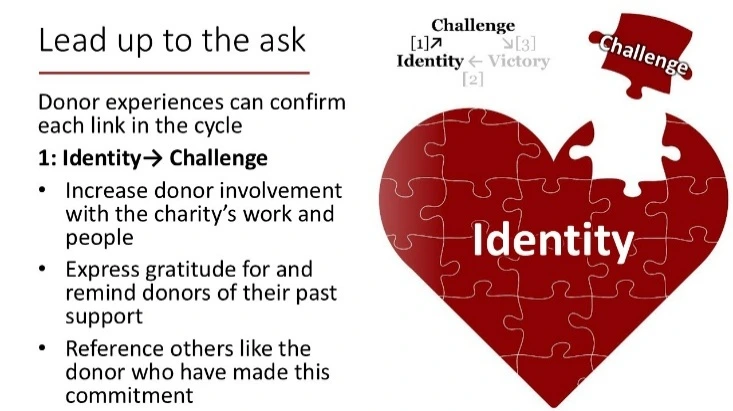
These lead-up steps can strengthen connections between the donor’s identity and the challenge. This is link 1: Identity→ Challenge. These lead-up steps can:
- Increase donor involvement with the charity’s work and people.
- Express gratitude for and remind donors of their past support.
- Reference others like the donor who have made this commitment.
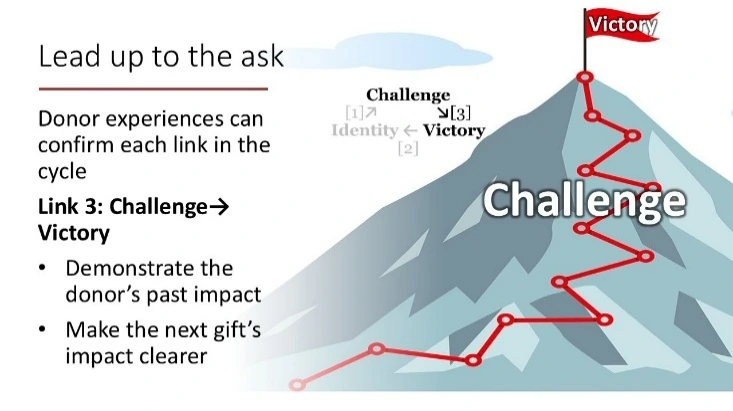
The lead-up steps can strengthen connections between the challenge and the victory. This is link 3: Challenge→ Victory. They can:
- Demonstrate the donor’s past impact.
- Make the next gift’s impact clearer.
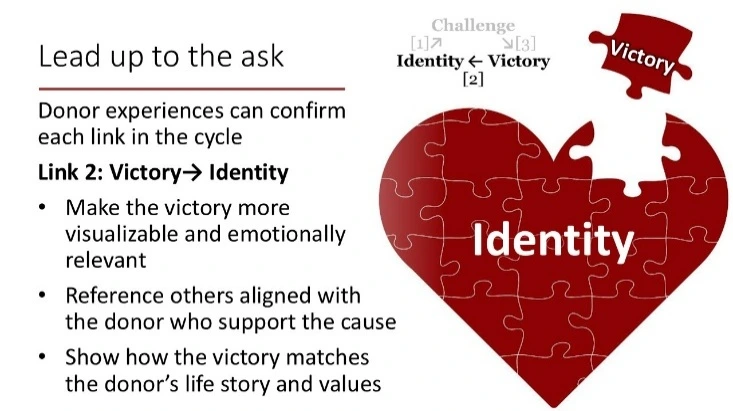
The lead-up steps can strengthen connections between the victory and an enhanced identity (public or private). This is link 2: Challenge→ Victory. They can:
- Make the victory more visualizable and emotionally relevant.
- Reference others aligned with the donor who support the cause.
- Show how the victory matches the donor’s life story and values.
The answer is story
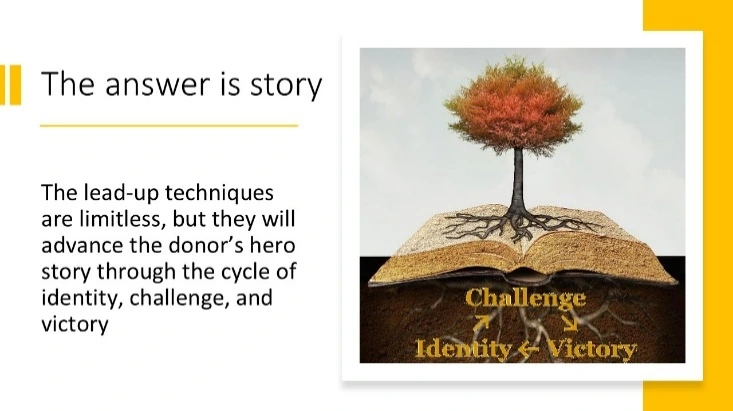
The lead-up techniques can be almost limitless. But the strategy starts with story. It starts with plot and character. It allows the fundraiser to be the donor-hero’s guiding sage. It advances the donor’s hero story. It moves the donor through the cycle of identity, challenge, and victory.
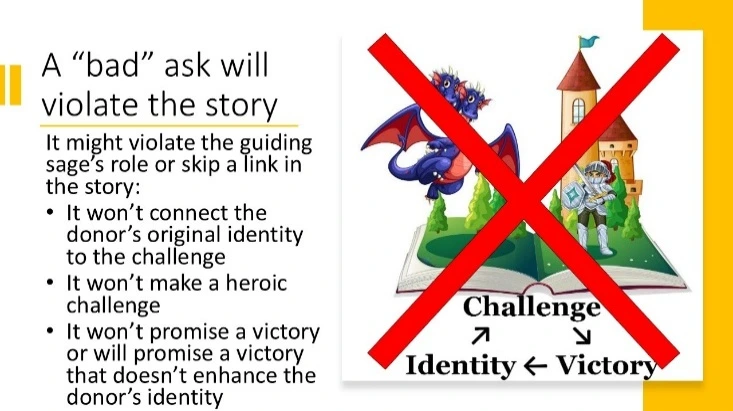
A bad fundraising ask won’t do this. It might violate the guiding sage’s role. Or it might skip a link in the story. For example,
- It won’t connect the donor’s original identity to the challenge, or
- It won’t make a heroic challenge, or
- It won’t promise a victory, or
- It will promise a victory that doesn’t enhance the donor’s identity.
Powerful story makes powerful fundraising. The most powerful fundraising story is the donor’s hero story. When the ask tells that story, the ask becomes powerful.
Notes and references
Campbell uses a three step circular illustration with this description,
“A hero ventures forth from the world of common day into a region of supernatural wonder: fabulous forces are there encountered and a decisive victory is won: the hero comes back from this mysterious adventure with the power to bestow boons on his fellow man.”
Campbell, J. (1949/2004). The hero with a thousand faces (commemorative ed.). Princeton University Press. p. 28.
I label these steps as follows:
The beginning point of “the world of common day” is “original identity.”
“Venturing forth into a region of supernatural wonder” is “challenge.”
“Fabulous forces are there encountered and a decisive victory is won” is “victory.”
“The hero comes back from this mysterious adventure with the power to bestow boons on his fellow man” is “enhanced identity.”
I apply this both to a scenario where the charitable gift serves only as the final step in the heroic life story and where the gift request itself constitutes the challenge that promises a victory delivering enhanced identity. In a conventional narrative arc, the steps of original identity, challenge, victory, and enhanced identity also serve as backstory, inciting incident, climax, and resolution, respectively.
↩Three sentences adapted from Collins, M. E. (2017, Winter). The Ask. Advancing Philanthropy, 16-23, p. 21. Quoting Marcy Heim. See also, Heim, M. (2018, August 22). Wanna Do EVERYTHING Better? [Website] http://marcyheim.com/wanna-do-everything-better
↩