
Understanding what a charitable gift is and when a charitable gift is made seems like an obvious and simplistic task. What could be easier? As shown in this chapter, what initially appears to be a simple concept can become quite complex. But, a fundamental competence required of anyone who will be advising donors about charitable gifts is to know what tax consequences such gifts will generate. Charitable gifts can generate income tax deductions. Applying that knowledge requires knowing what constitutes a charitable gift for tax purposes. Regardless of its size or its benefit to a charity, any transfer that does not meet the definition of a charitable gift for tax purposes will generate no charitable deduction. So, let's begin by looking at what is a charitable gift for tax purposes and then consider examples of transfers that are not charitable gifts for tax purposes.
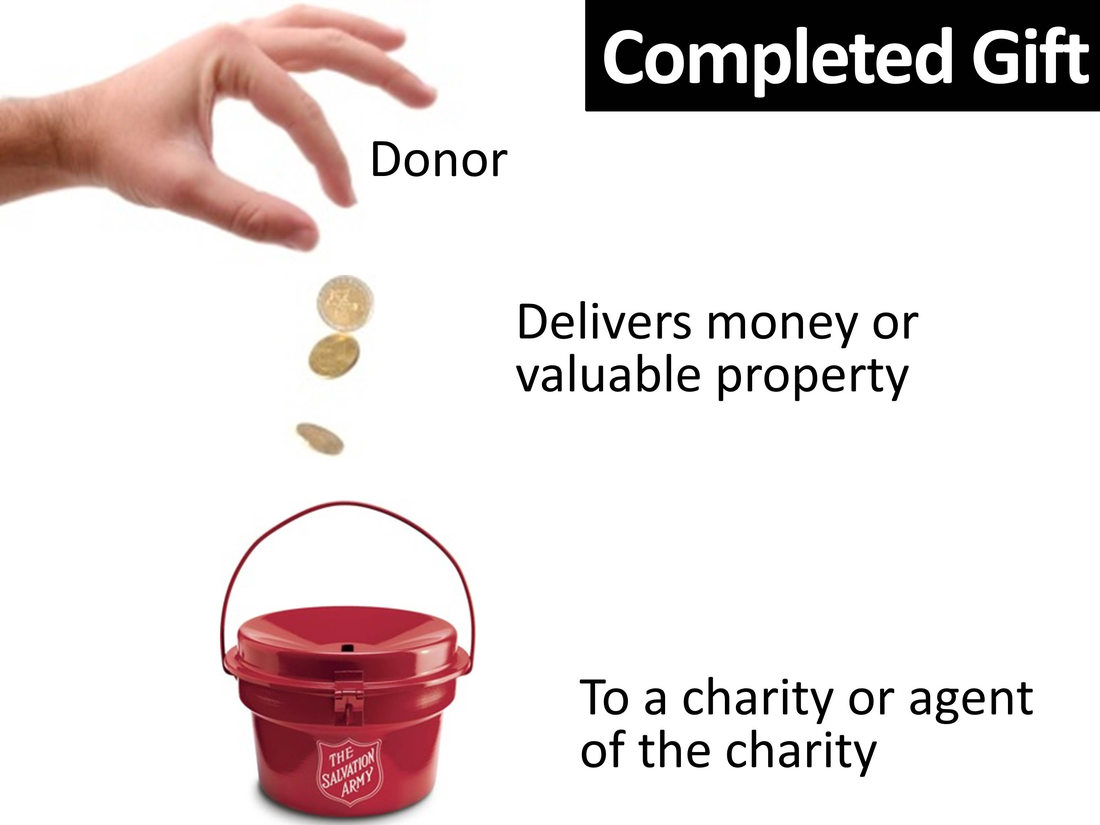
A deductible charitable gift occurs when the donor delivers money or valuable property to a charity or agent of the charity. That's it. There is nothing particularly complicated about the definition (except perhaps the phrase "agent of the charity" which simply means a representative of the charity). How then could things possibly become complicated when starting with such a simple definition?
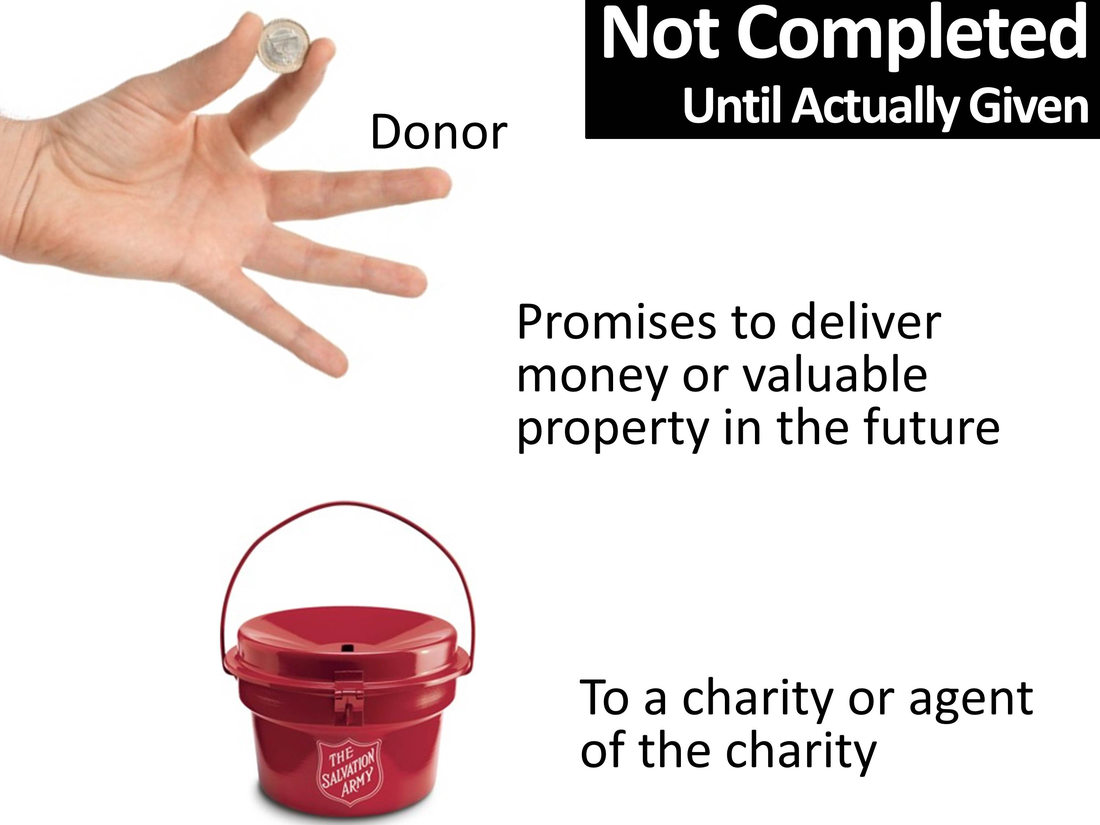
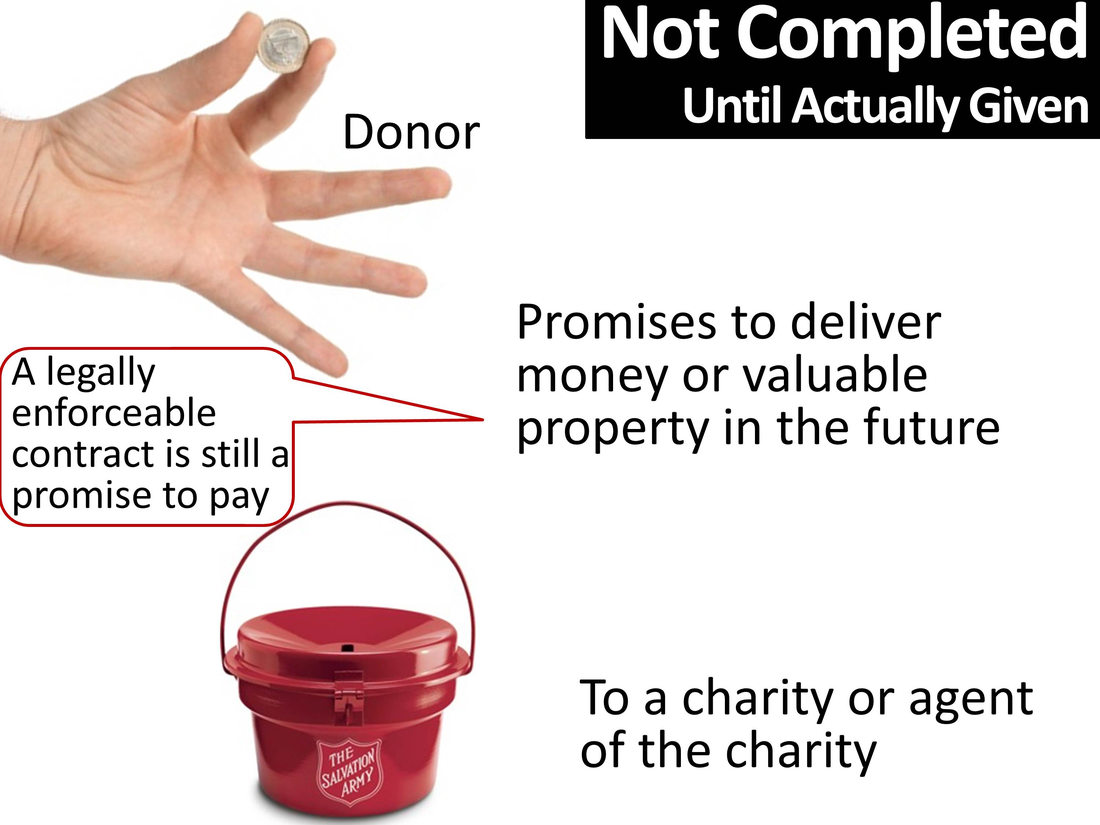
The first example of an action that is not a charitable gift for income tax purposes is a promise to deliver money or valuable property in the future. A promise is not a gift. Even if the promise is a legally enforceable written contract, it is still just a promise, so it is not a gift - at least not yet. Once the promise is fulfilled and the donor actually delivers money or valuable property to the charity (or agent of the charity), then - and only then - the definition for a gift is met.
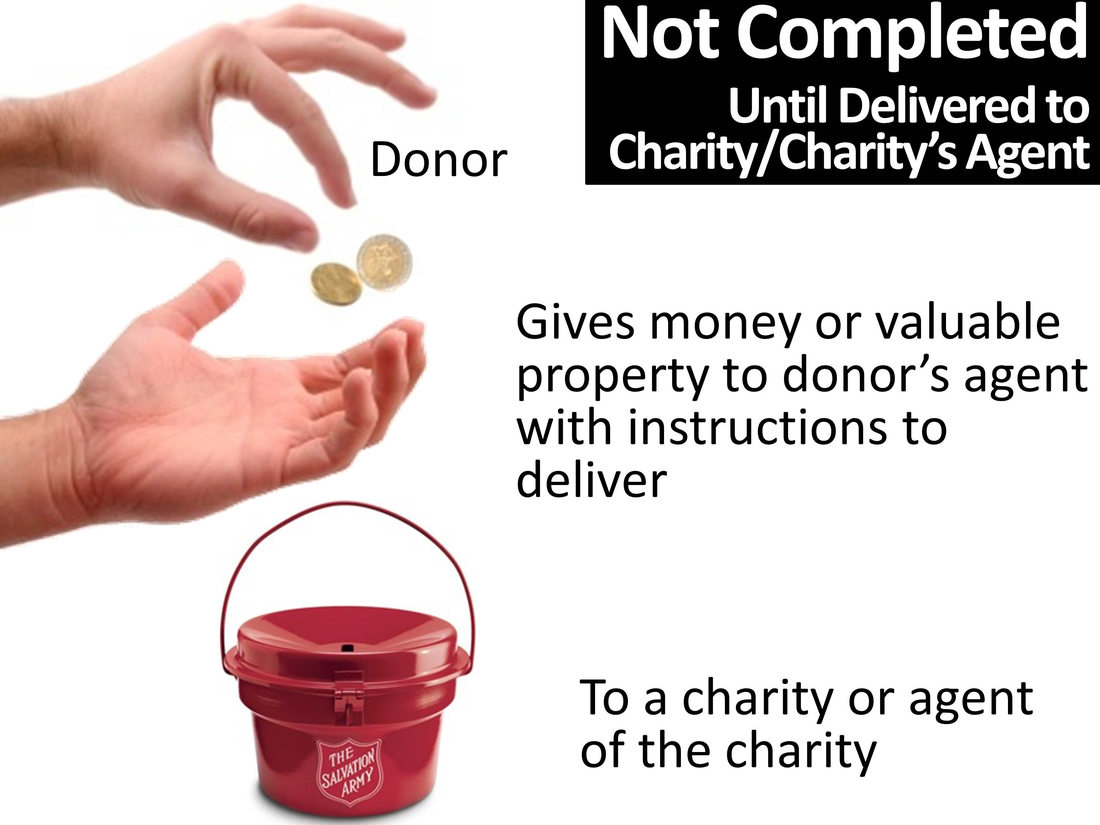
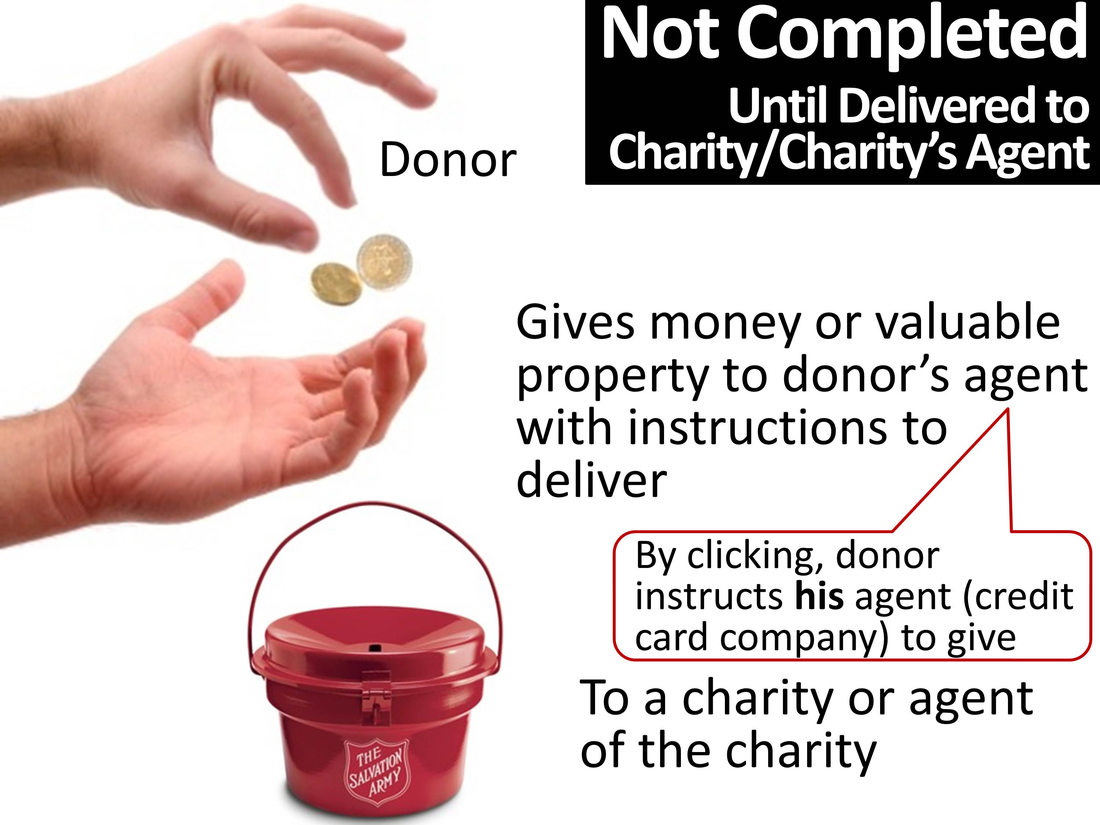
Another example of an action that is not a completed gift is when a donor gives money or valuable property to the donor's agent (i.e., the donor's representative) with instructions to deliver the gift to a charity or agent of the charity. Because the money or valuable property is still in the hands of the donor's representative, it has not yet become a completed gift. Once the money or valuable property is given to the charity (or the charity's representative/agent), then - and only then - is there a deductible charitable gift.
Another example that does not qualify as a charitable gift for tax purposes is when the donor delivers money or valuable property to the charity, but still retains prohibited control over the money or property, even after the transfer to charity. This retained control prevents the gift from being deductible until such time as the retained interests expire or are also given to the charity. This area is a bit more complicated because there are specific retained interests that are permitted by the tax code. Nevertheless, the general rule is that if a donor retains rights to control the money or property, or get it back, such a transfer is not (or, at least, not yet) a charitable gift.
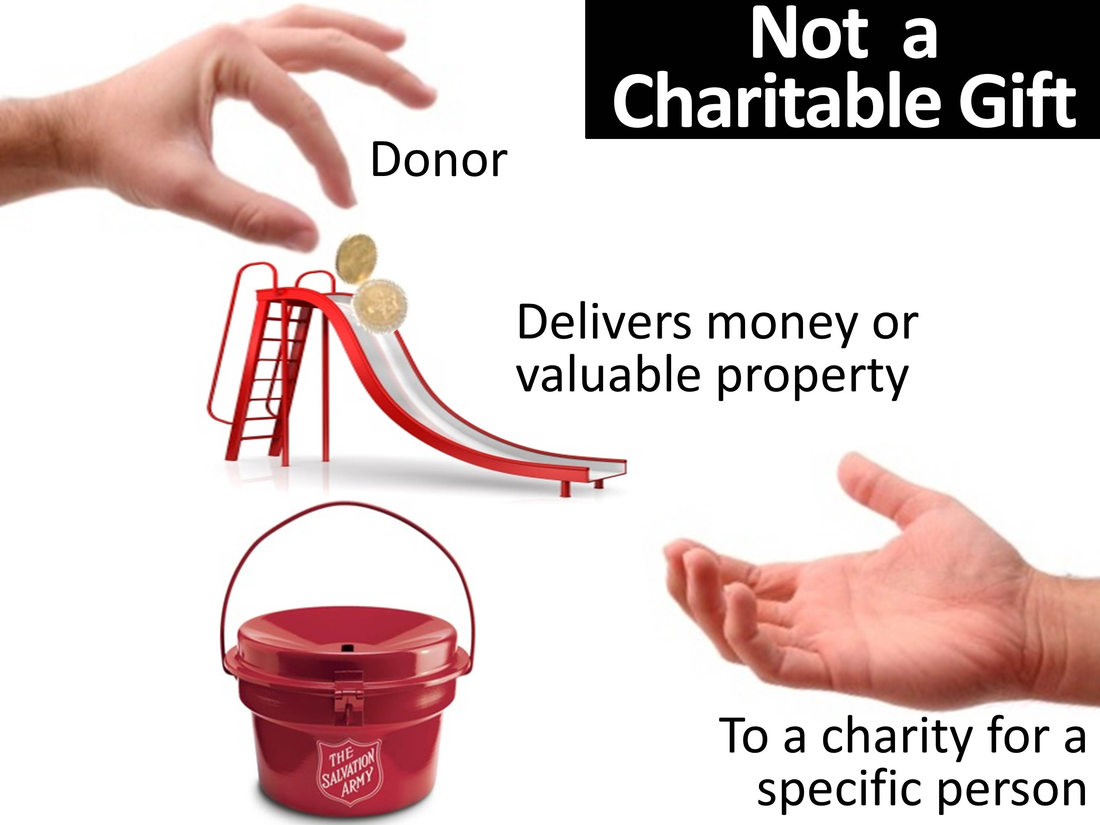
The last example of a transfer that is not a deductible gift is when a donor delivers money or valuable property to a charity for delivery to a specific person. A person is not a charity. Any person, even a person in serious financial or medical need, is not a charity. Giving money to a specific person is not a charitable gift for tax purposes. This fundamental rule cannot be avoided by simply giving money to a charity with the requirement that the money must then be delivered to a specific person. Such a transfer is treated as if it were a direct transfer to the person. Since a person is not a charity, the transfer is not a deductible charitable gift.

To this point, we have looked at the rules in their conceptual form. Let's now look at some examples applying these rules to actual gift scenarios. Suppose a donor puts a cash gift in a stamped envelope addressed to the charity. The donor then puts the envelope into a mailbox at the local United States Post Office on day one. On day two, this cash arrives safely at the charity. When did this transaction become a completed gift for tax purposes?
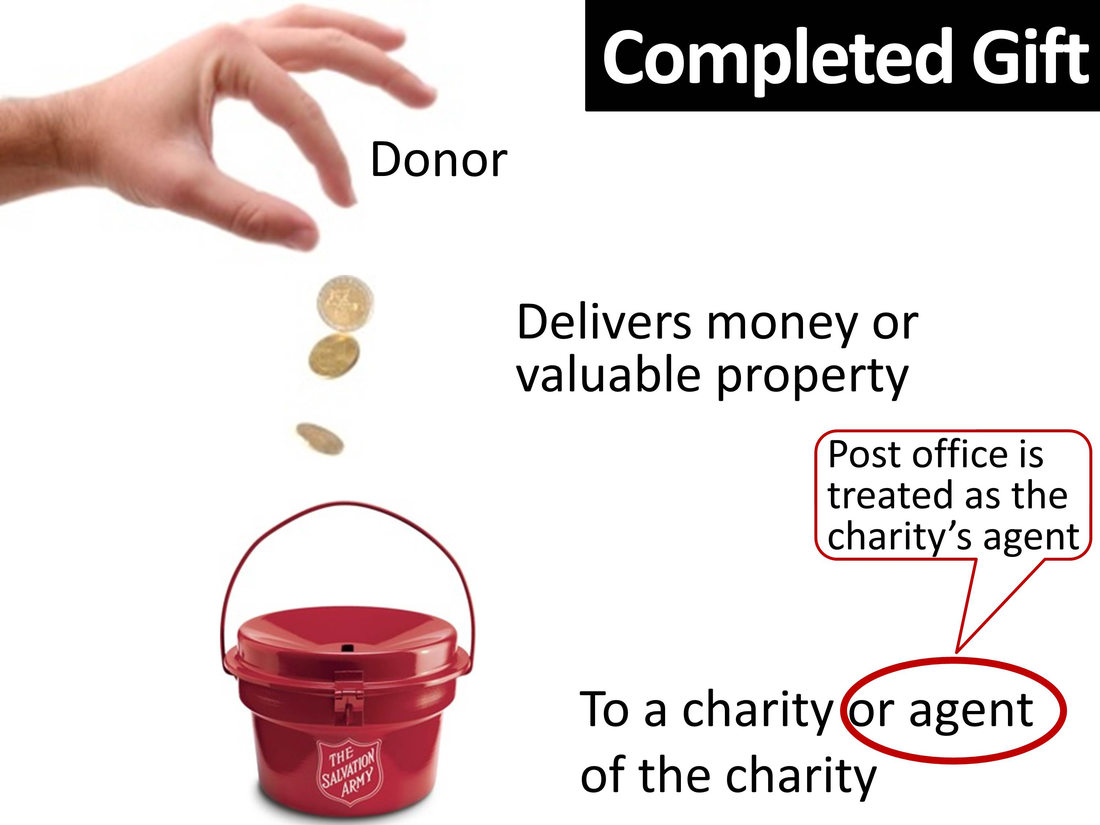
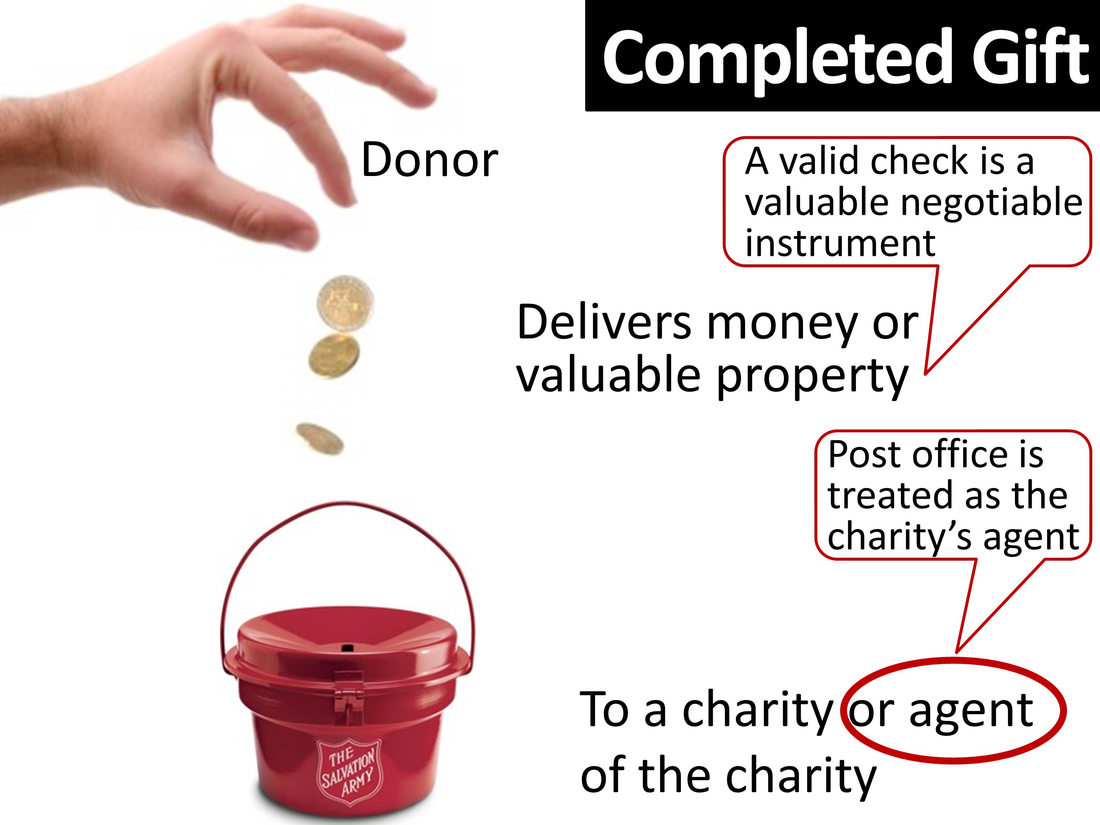
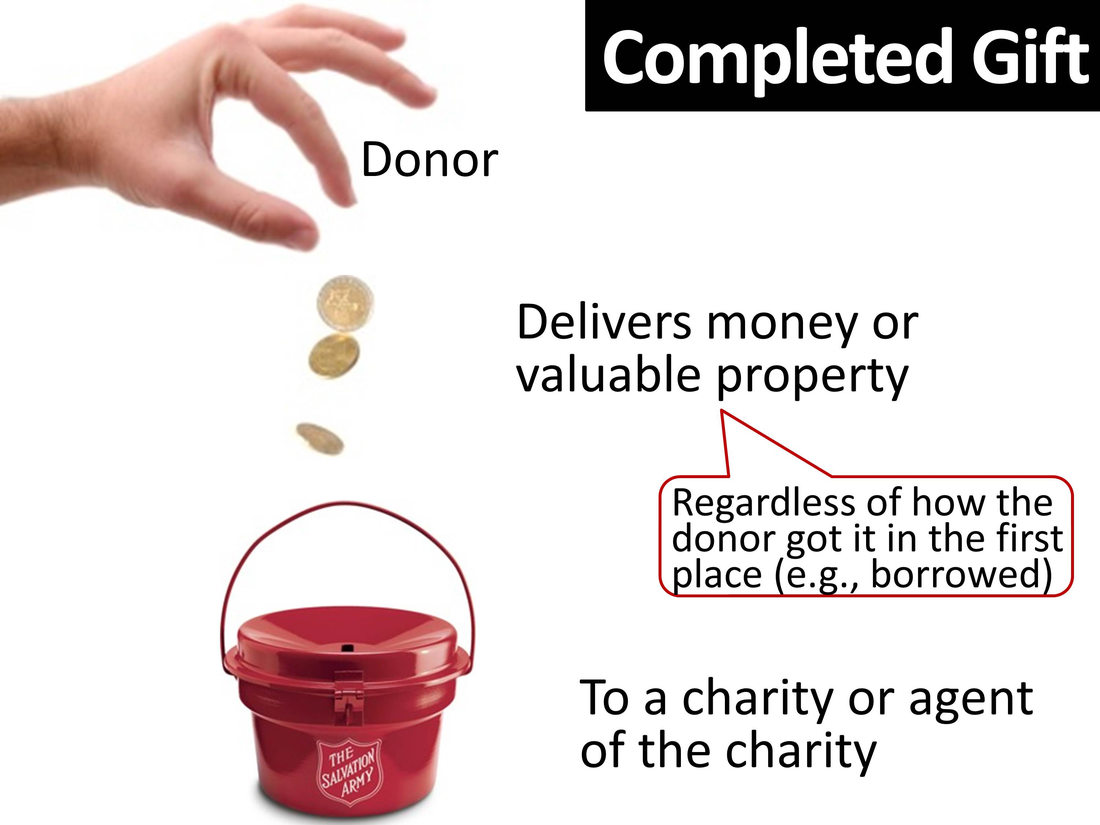
The answer, as always, is that the gift is complete when the donor delivers money or valuable property to the charity or agent of the charity. The tricky part is knowing that the United States Postal Service is considered to be an agent of the recipient. Even though the charity has not received the money on day one, the charity's agent has received the money. Consequently, the gift is a completed gift on day one. (Note that only the United States Postal Service is considered to be an agent of the recipient. If the gift had been delivered, for example, by FedEx or UPS, it would be considered as held by an agent of the donor until it arrived at the charity.)

Because the donor has delivered money to an agent of the charity (in this case, the United States Postal Service) on day one, the gift was a completed gift for income tax purposes on day one.

Next, consider another common situation. On day one, the donor writes a check to a charity. On day two, the donor puts the check in the United States Postal Service mailbox and the mail carrier takes it. On day three, the charity receives the check in the mail. On day four, the charity deposits the check. Finally, on day five, the charity's bank receives the funds and the charity is credited with the funds. On which of these days was the gift completed for income tax purposes?
The answer, as always, is that the gift is complete when the donor delivers money or valuable property to the charity or agent of the charity. The tricky part in this situation is to understand that a valid check is valuable property. Conceptually, the idea is that a valid check is not just a promise to pay; it is a valuable negotiable instrument (sort of like a corporate bond) making it valuable property even prior to its deposit.

Because a valid check is considered to be valuable property, and because the post office is considered to be the agent of the charity, the charity's agent receives valuable property on day two. Thus, the gift is complete for income tax purposes on day two.

Why is it important to know when, precisely, a transfer becomes a completed charitable gift for income tax purposes? Why is it important if the gift is complete on day one or day five? The first answer is that this is a learning tool to understand what is and what is not a deductible charitable gift. Understanding the moment at which the transfer becomes a deductible gift, creates a more precise understanding of the definition of a charitable gift for income tax purposes. Beyond this educational purpose, however, knowing the exact day can itself be quite important. There can be a big difference between one day and the next for tax purposes.
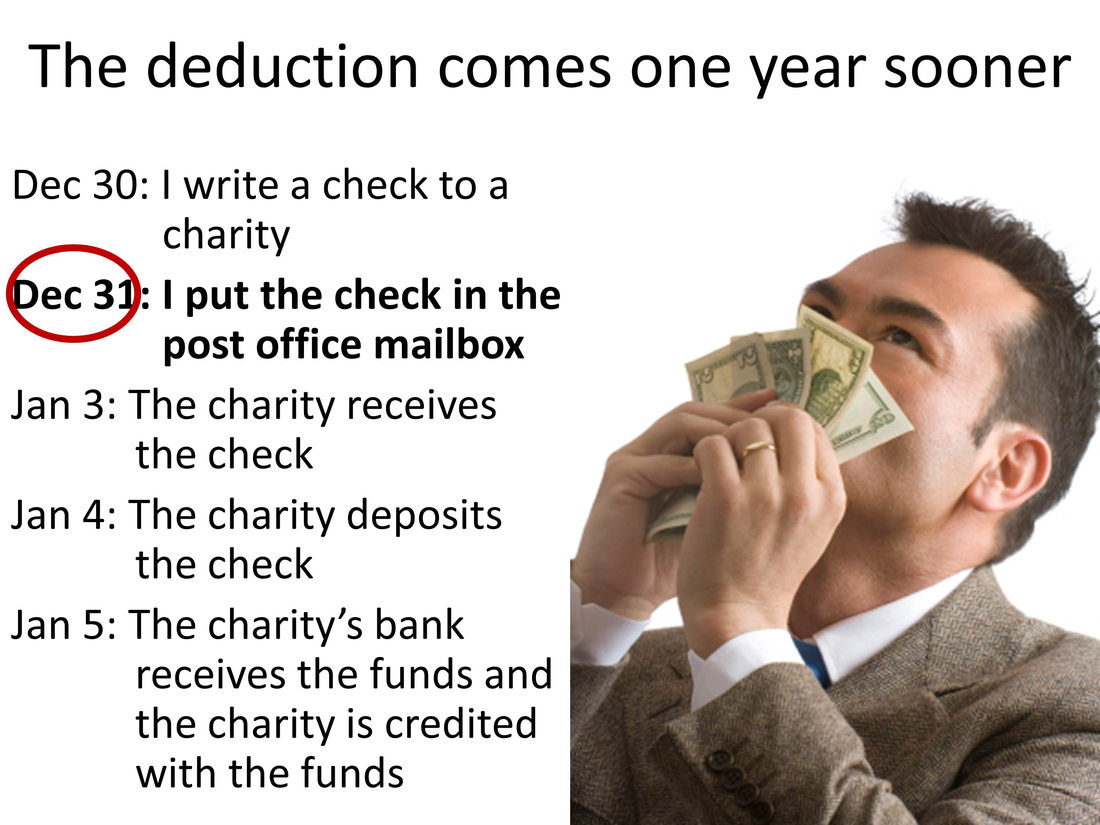
A gift completed on December 31 can be deducted one year earlier than a gift completed the next day. Waiting for an additional year can be a substantial consequence of knowing precisely which day a gift becomes complete for income tax purposes.
Indeed, much more substantial consequences may result when the tax circumstances are different in the different years. The deductible gift may not be usable in the later year due to, for example, charitable deduction income limitations, or use of the standard deduction. A single day can be the difference between a valuable deduction and a useless deduction.
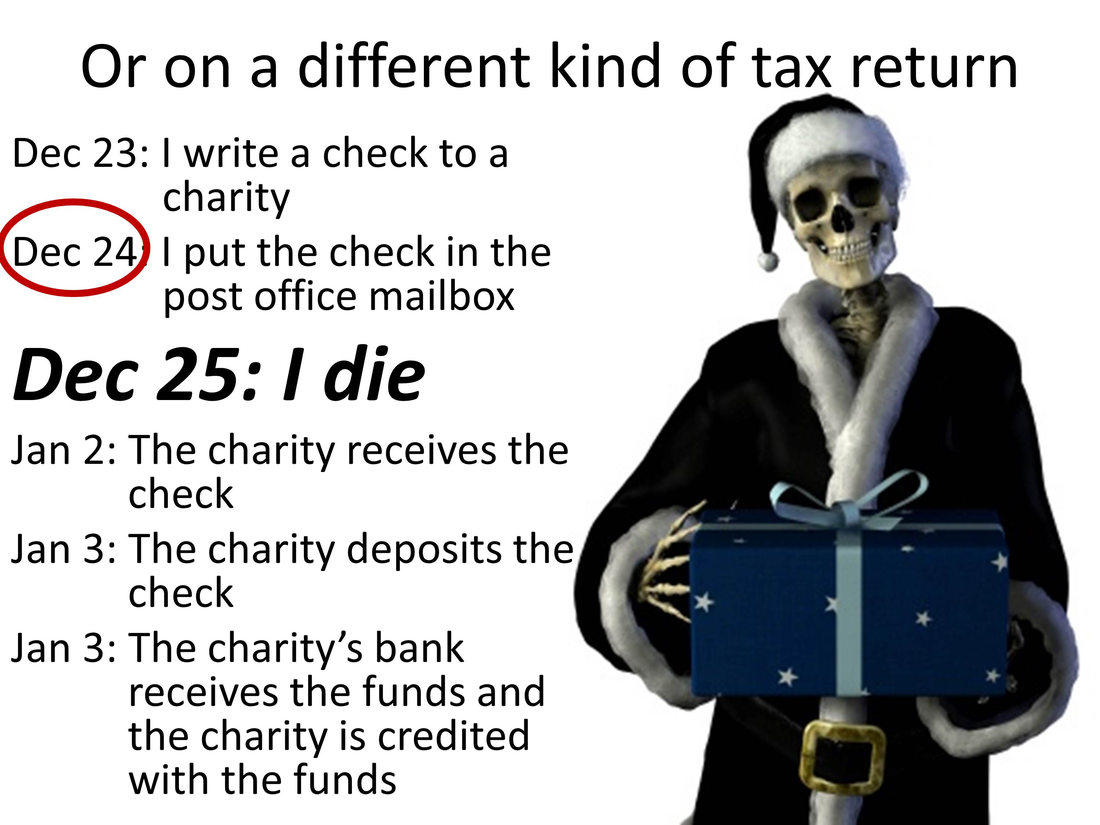
The difference in the date on which a charitable gift becomes complete for income tax purposes may also have significance if the donor happens to die during the process.
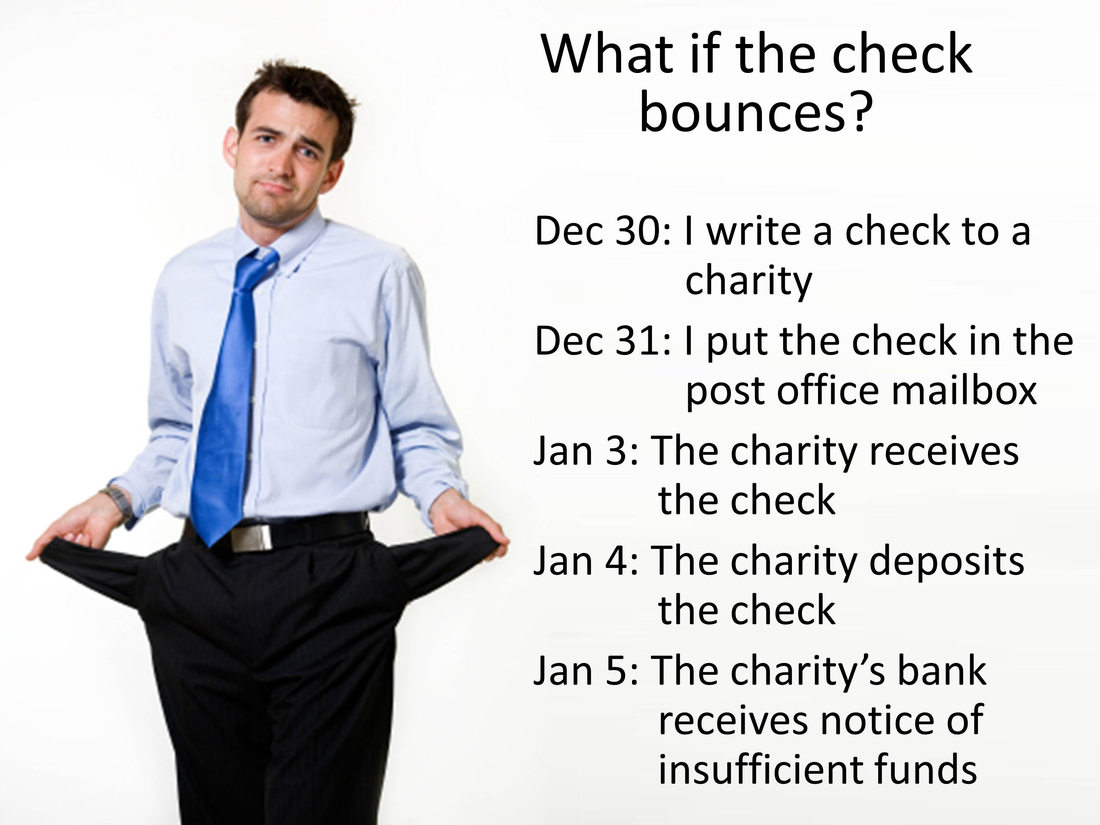
Now consider some additional examples of when a deductible charitable gift occurs. Suppose the scenario is identical to the previous example of a check mailed to a charity. However, in this case, the check bounces. How is this handled under the income tax charitable deduction rules?
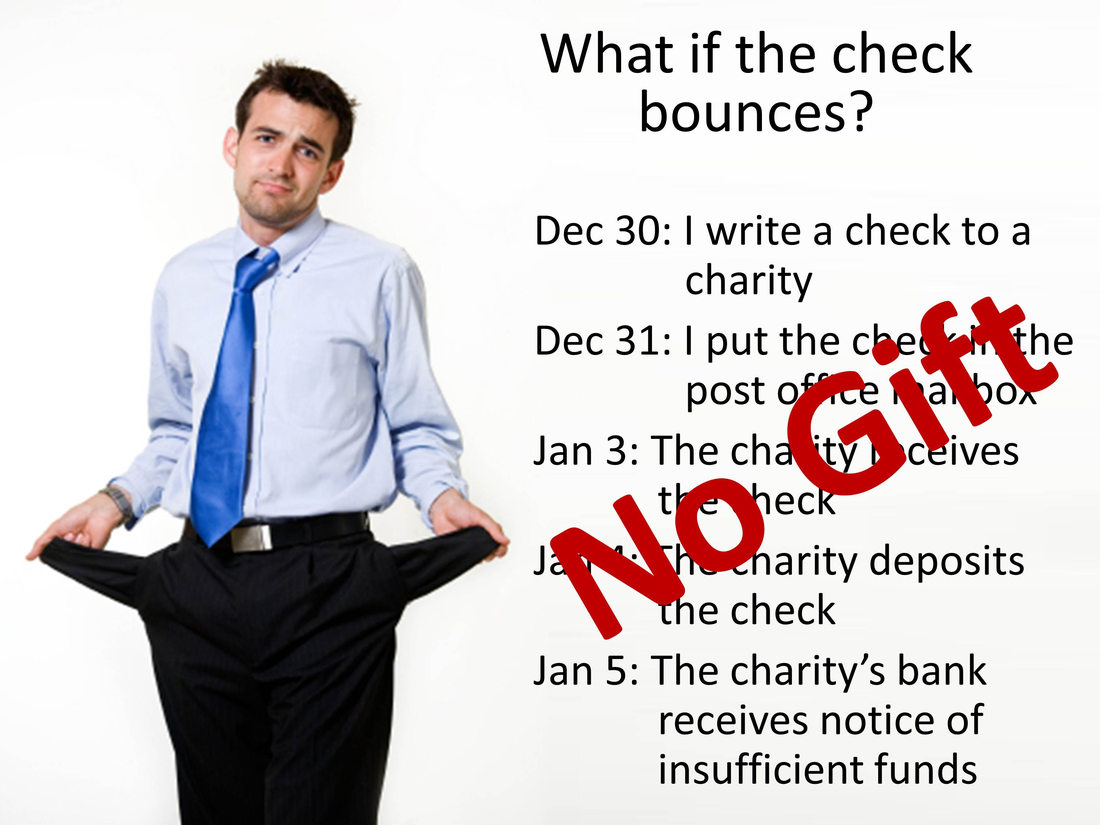
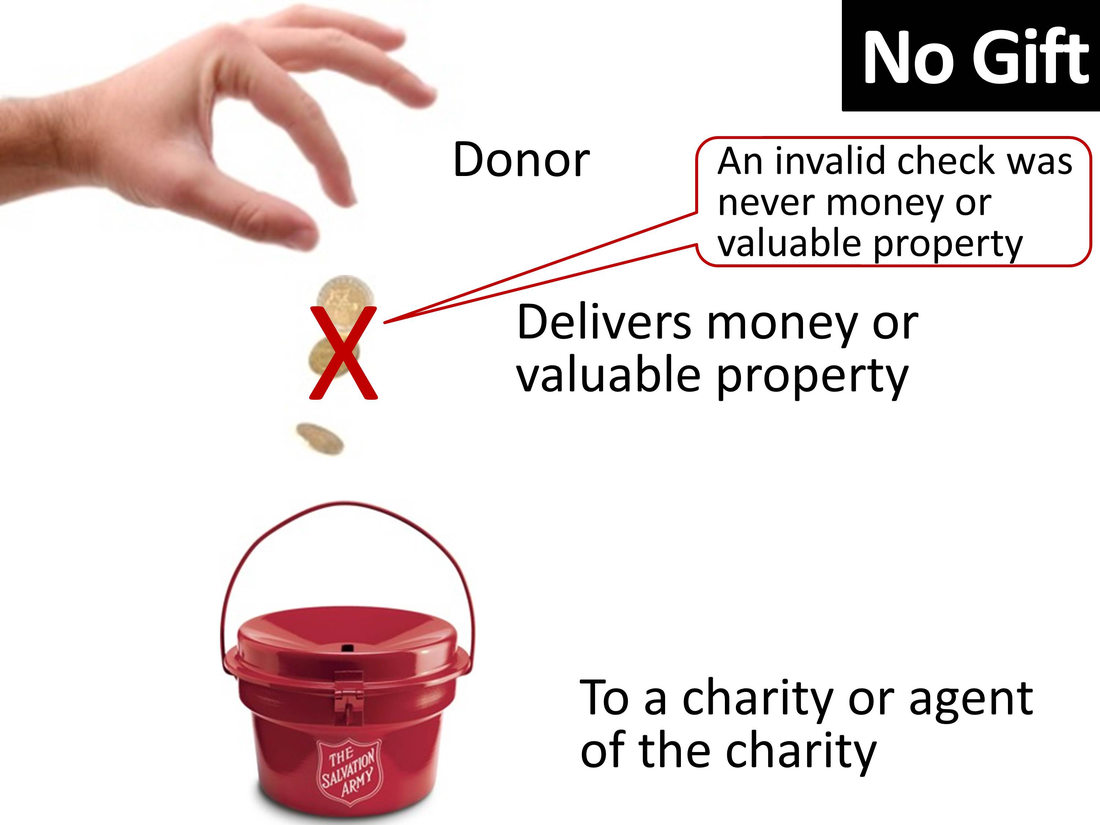
The answer, as always, is that the gift is complete when the donor delivers money or valuable property to the charity or agent of the charity. The key understanding in this case is that an invalid check was never considered to be valuable property. Because the donor never delivered valuable property to the charity, there was no charitable gift. (In a sense, the future knowledge that the check would bounce is attributed back to its date of origin, meaning that at no point was the check ever valuable property.)
Because the donor never delivered valuable property to the charity, at no point did a charitable gift occur for income tax purposes.
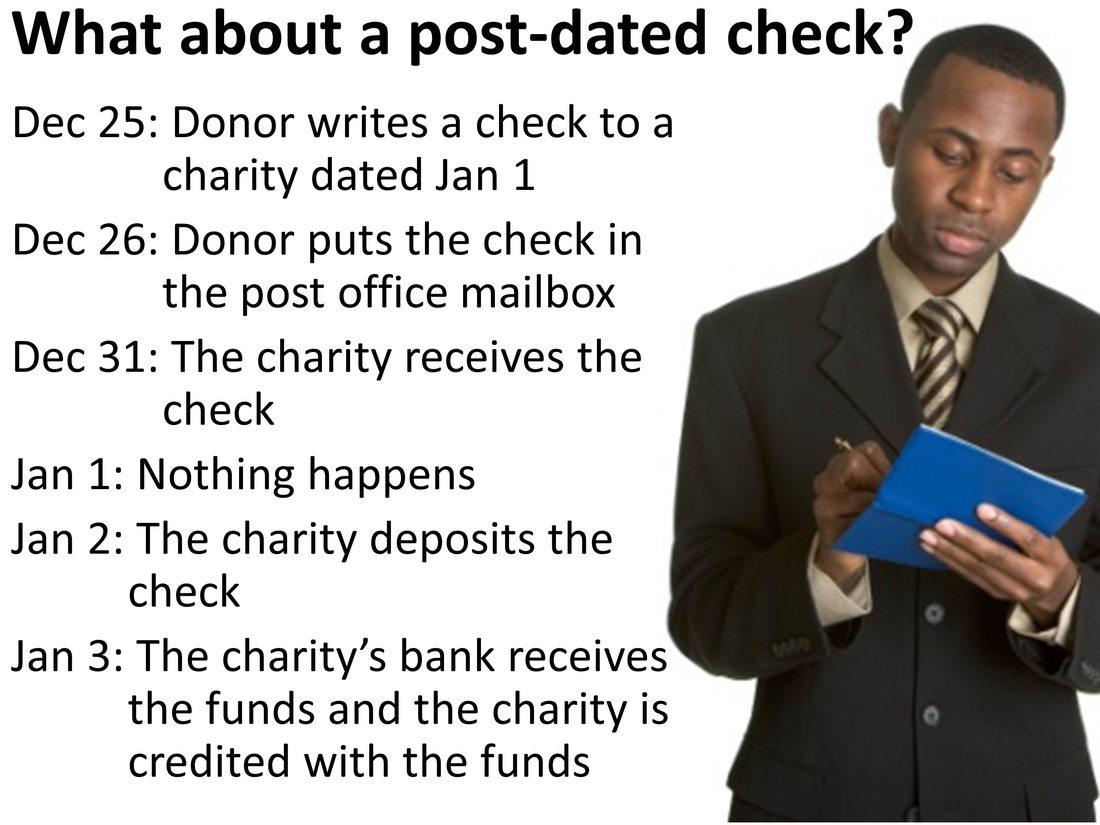
How then should a post-dated check be treated? In this case, the post-dated check is delivered to the charity's agent (the United States Postal Service) on December 26. However, the check cannot be deposited prior to January 1, because it is post-dated to that day. So, when is the gift completed?
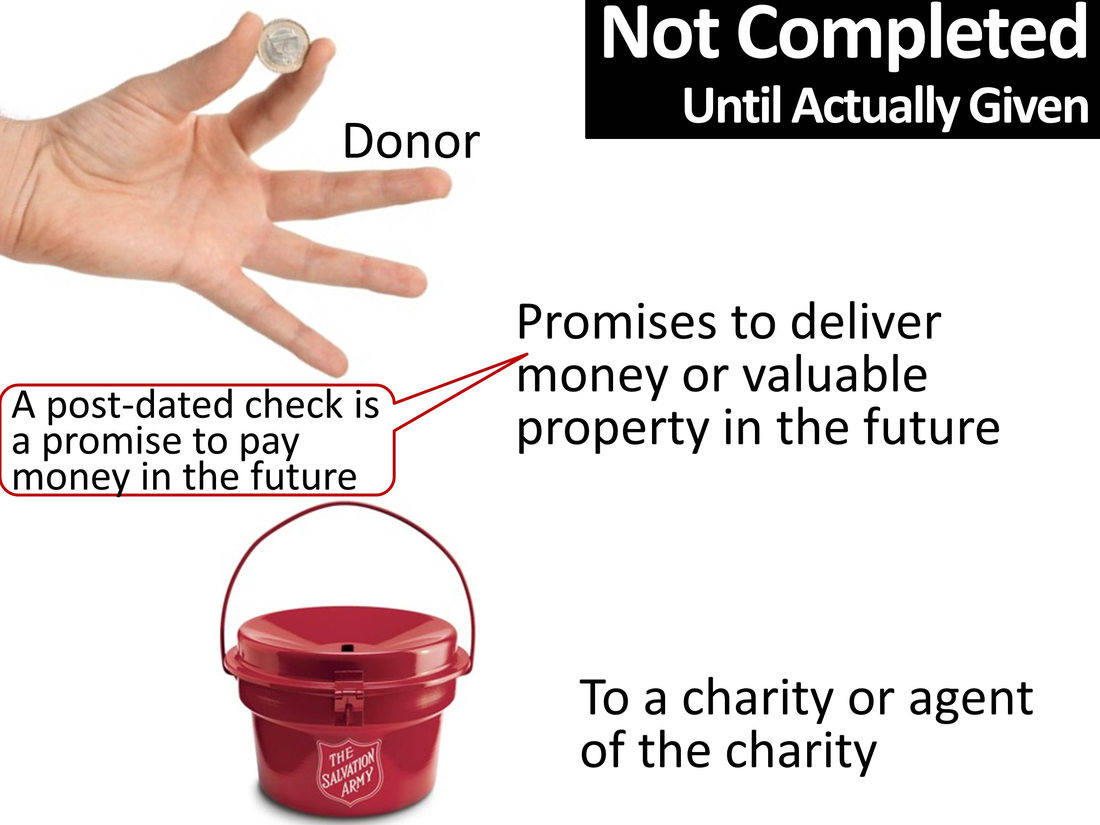
The critical piece of information in this scenario is to understand that a post-dated check is considered to be a promise to pay money in the future. Unlike a normal check, which is immediately considered to be valuable property, a post-dated check is considered to be only a promise to pay in the future. A promise to give money or property to a charity in the future does not constitute a deductible gift. Thus, the post-dated check is not a completed gift when it is transferred to the charity or the charity's agent. Once, however, the date of the check arrives, it immediately becomes valuable property. If, at that time, it has been delivered to the charity or the charity's agent, then the gift is complete.
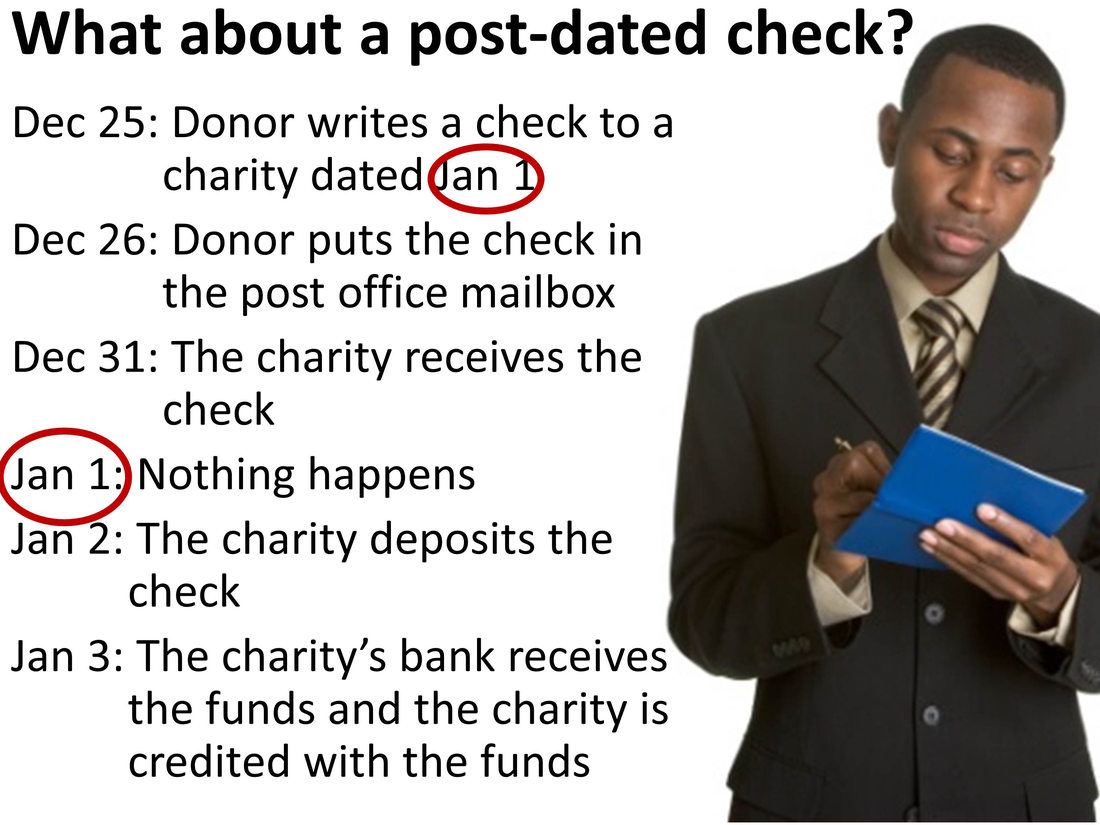
Thus, in this scenario, the gift is complete on January 1. That is the date on which the charity has received valuable property. On December 31, the charity did not have valuable property, but instead had only a promise to pay. On January 1, the promise to pay was converted to a valuable negotiable instrument, and thus the gift was complete.

What about a credit card gift? Suppose a donor makes a donation by credit card and the charity is credited with the funds. However, it is not until much later that the donor actually makes the payment on the credit card to pay for this transfer. At what point was the charitable gift completed?
The answer, as always, is that the gift is complete when the donor delivers money or valuable property to the charity or agent of the charity. In this case, the donor delivered money to a charity on the date of the credit card transfer. The fact that the donor borrowed this money is irrelevant. The donor delivered money to a charity, meaning that the gift is a completed gift. This is true even if the donor never pays the loan used to make the gift to charity.

Consequently, the gift in this scenario is a completed charitable gift for income tax purposes on December 31. When, or if, the credit card bill is later paid is not relevant to the timing of the gift.
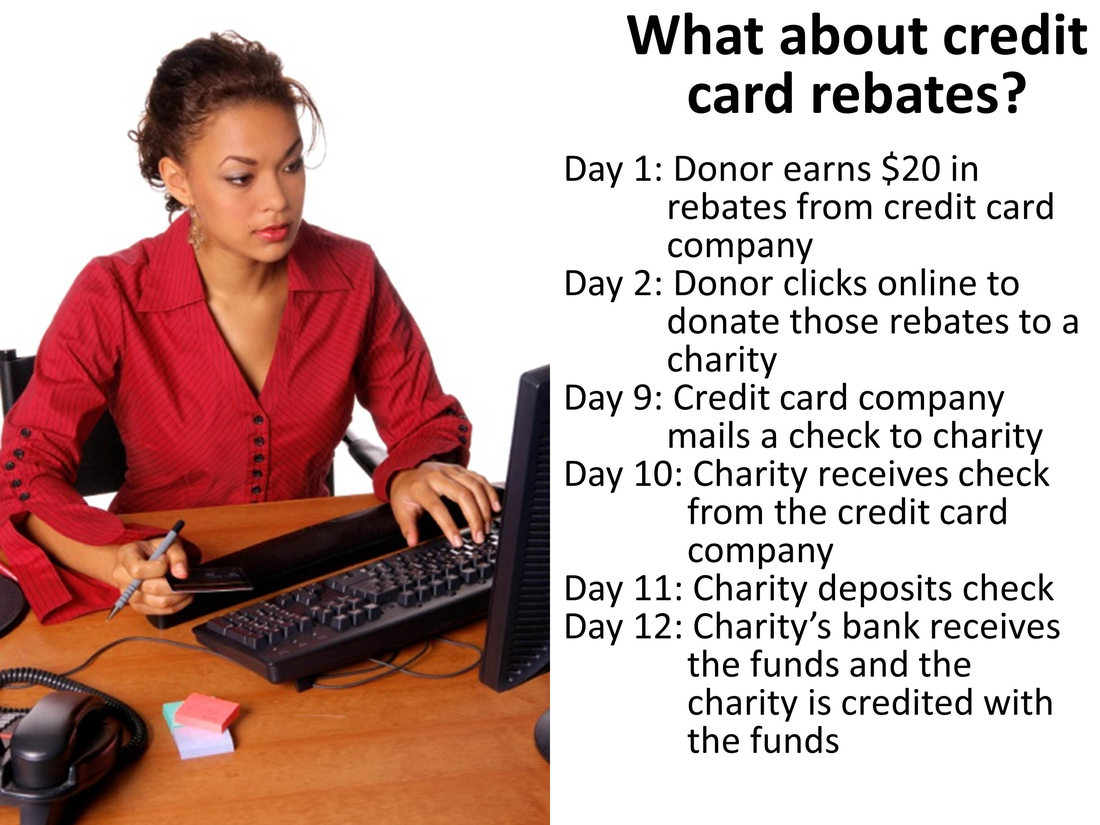
Let's now consider a slightly different example. In this case, the donor earns rebates from her credit card company. The donor clicks online to donate those rebates to a charity. Later, the credit card company mails a check to the charity. At what point is the gift complete?
The answer, as always, is that the gift is complete when the donor delivers money or valuable property to the charity or agent of the charity. This does not occur when the donor clicks online to donate the rebates, because neither the charity nor the charity's agent has yet received any money or valuable property. Instead, what has happened is that the donor has instructed her agent (the credit card company) to deliver money to a charity. This instruction is not a completed gift until the donor's agent actually delivers the money to the charity or the charity's agent.
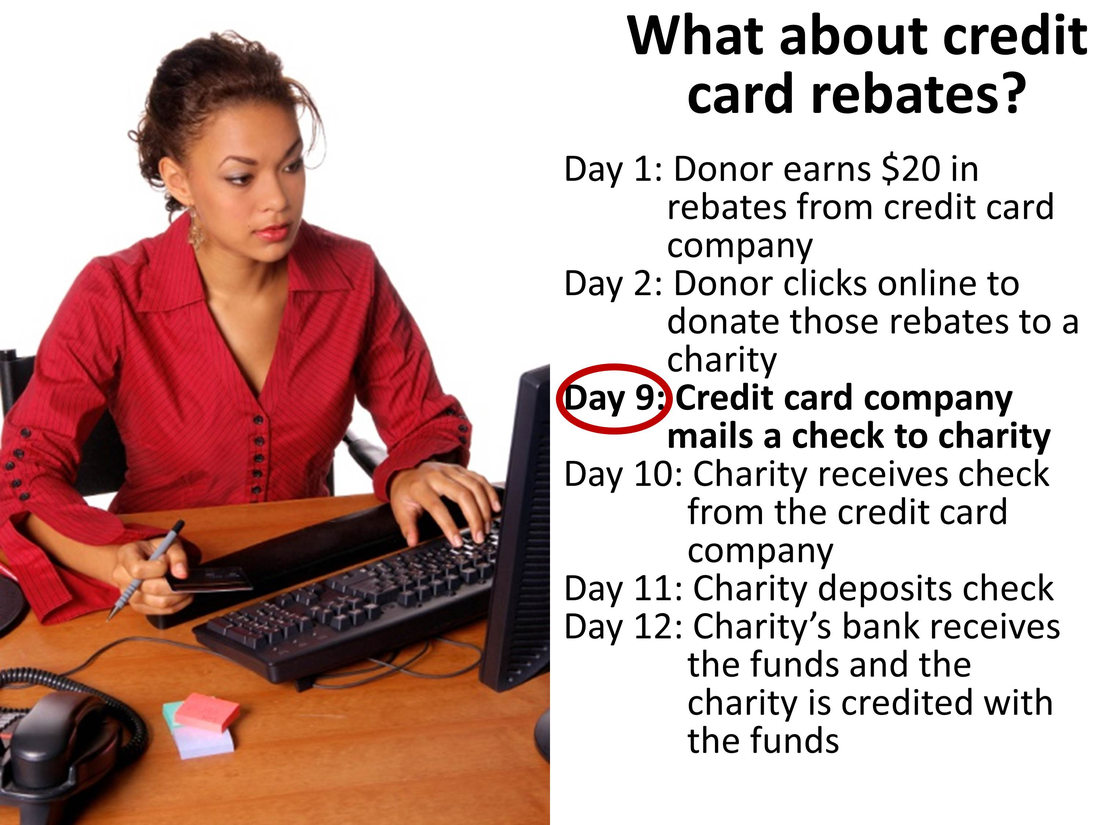
When the donor's agent (the credit card company) delivers a check to the United States Postal Service (the charity's agent), addressed to the charity, the gift is complete. Thus, on day nine, the donor's agent has delivered valuable property to the charity's agent, making the gift complete for income tax purposes.
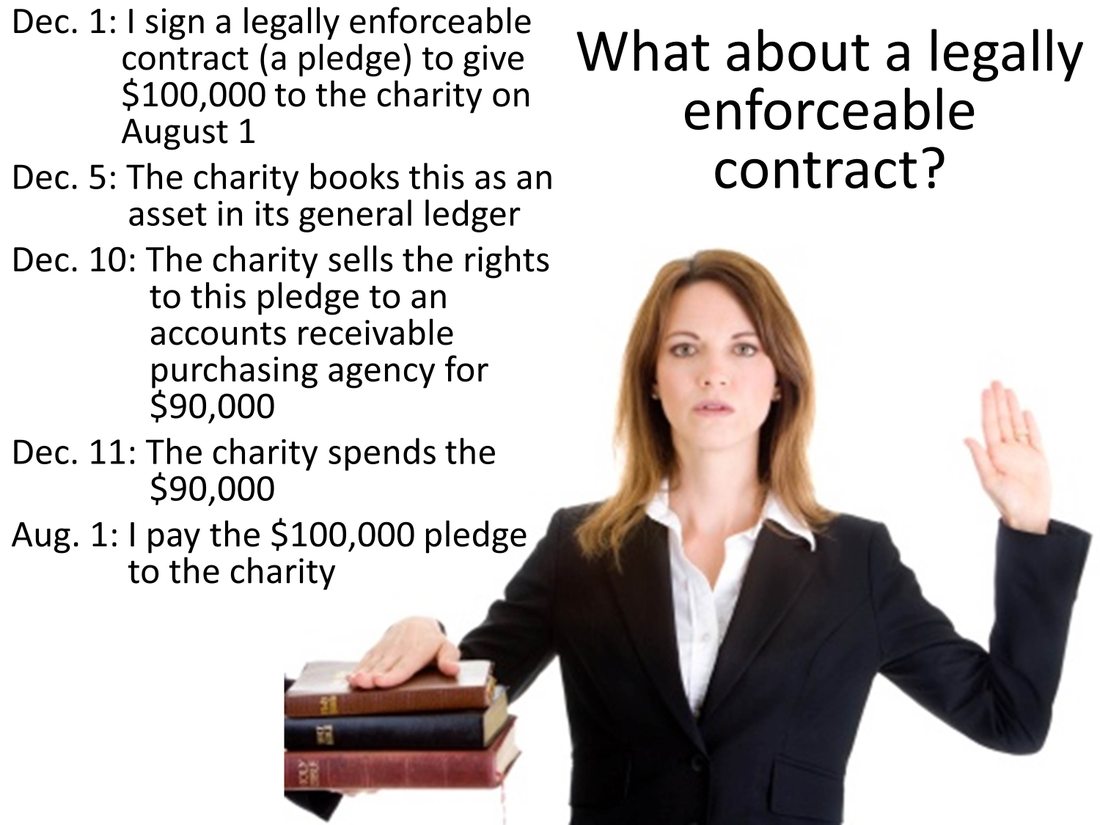
What about a legally enforceable contract? In this case, the donor signs a legally enforceable contract (in the form of a pledge to donate). As is required by accounting rules, the charity books this legally enforceable contract as an asset in the charity's general ledger. The charity, in this case, then sells the right to collect on this pledge to an accounts receivable purchasing agency. As a result, the charity receives cash from the accounts receivable purchasing agency and then spends the cash. Only later does the donor actually fulfill the pledge by making the agreed payment. Given that the charity has already received and spent money resulting from the pledge, when does the charitable gift actually occur for income tax purposes?
The answer, as always, is that the gift is complete when the donor delivers money or valuable property to the charity or agent of the charity. Prior to the donor fulfilling her pledge and actually transferring money to the charity, there is no gift. Although it is true that the charity has received money, the charity has not received money from the donor. The only thing the charity has received from the donor is a promise to pay money in the future. And, a promise to pay money in the future to a charity is not a completed gift until the money is actually given.
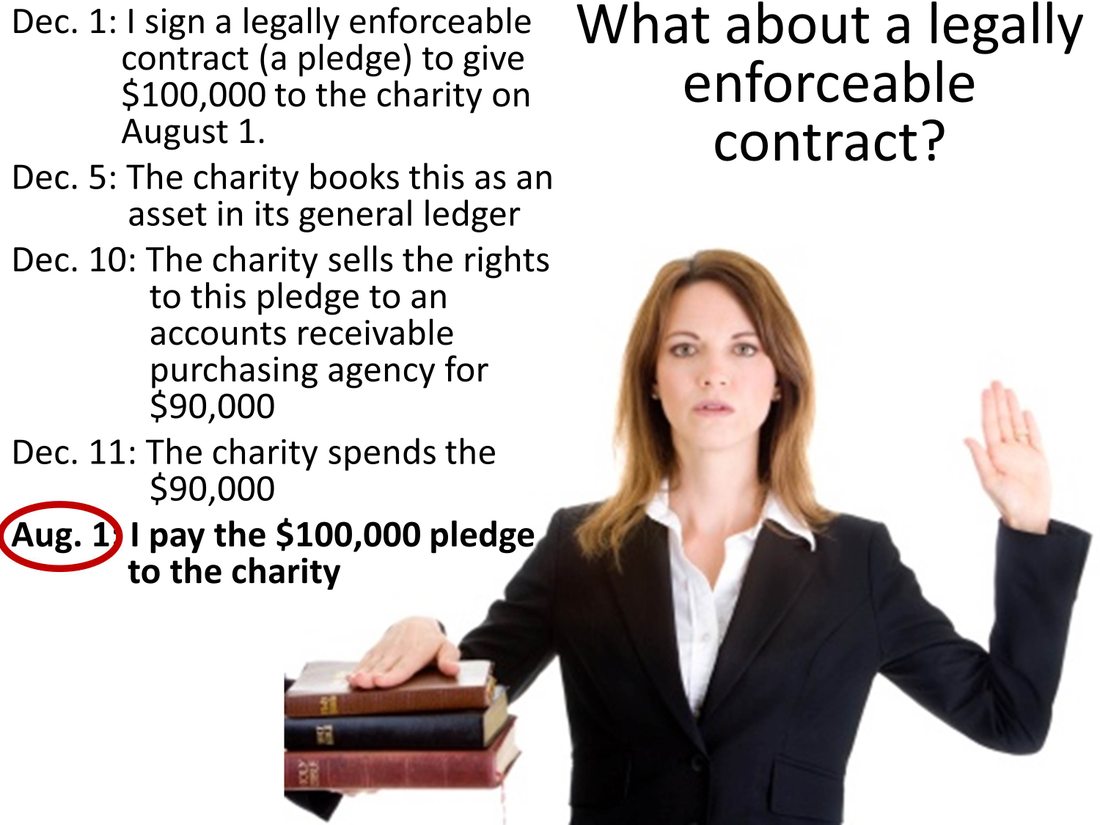
Consequently, there is no charitable gift until the donor actually pays the pledge by transferring money to the charity. Whatever the charity happens to do with the pledge in the meantime is irrelevant to the issue of when the charitable gift occurs.
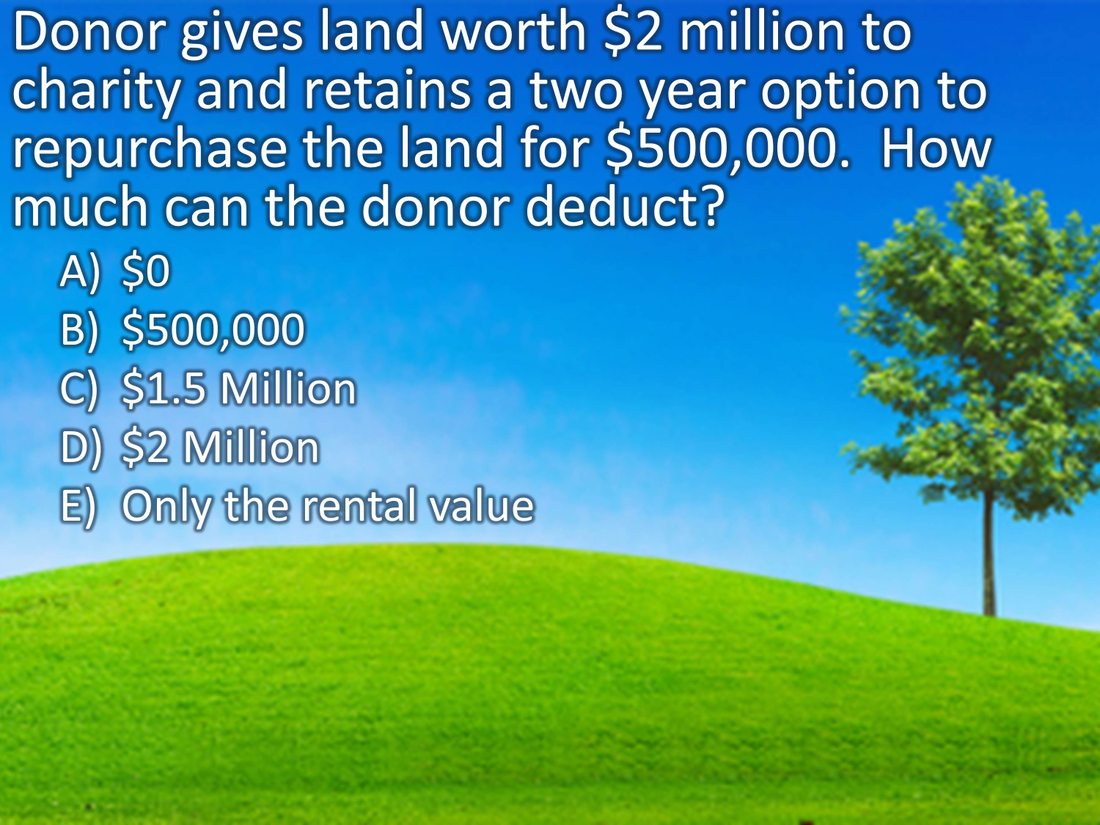
Suppose a donor gives land worth $2 million to a charity, but keeps the right to repurchase the land for $500,000 during the first two years after the gift. How much can the donor deduct immediately after making this transfer of land to the charity? Can the donor deduct $2 million (the value of the land given to the charity), $500,000 (the minimum payment the charity will receive regardless of what happens), nothing, or some other amount?
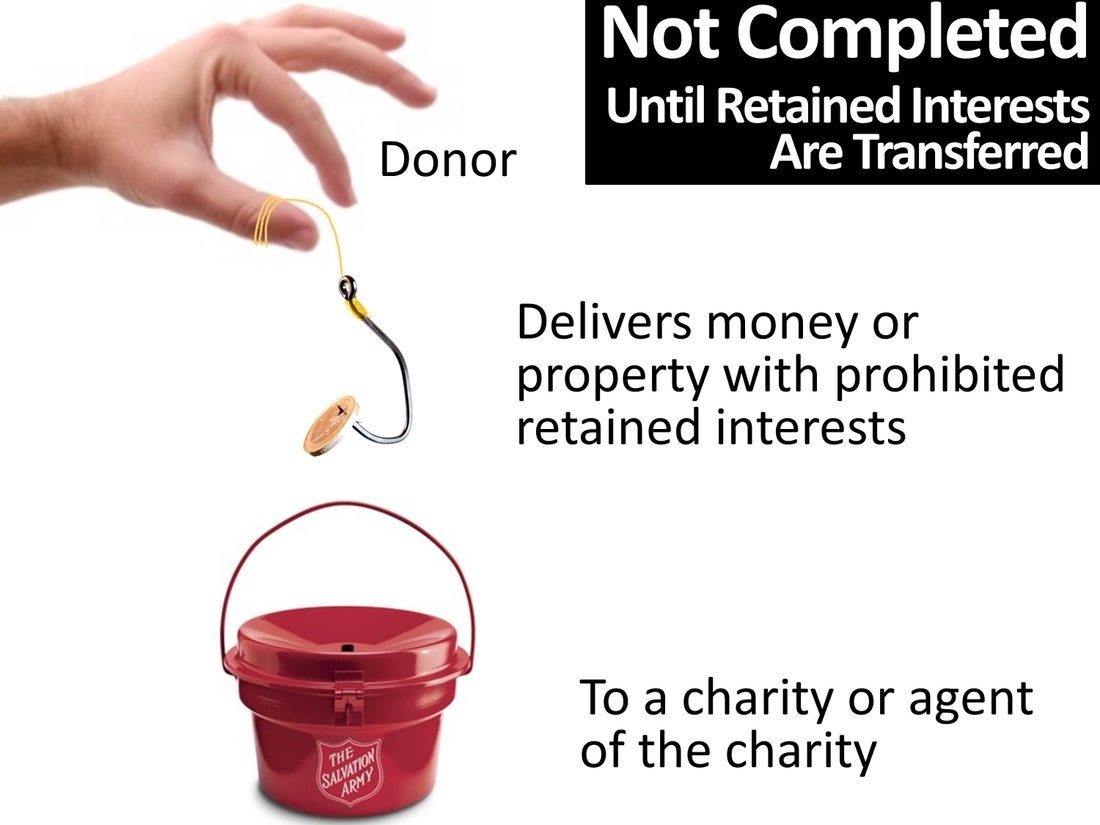
In this case, the donor has delivered valuable property to a charity, but has kept a prohibited "retained interest." The donor has made a transfer of the property, but the donor can get that property back if the donor so chooses. The deduction for this type of retained interest transfer is not calculated based upon the difference between the value received by the charity and the value retained by the donor. Instead, there simply is no deduction so long as the prohibited retained interests remain. Thus, for tax purposes, the donor has made no gift at the point of the initial transfer due to the donor's retained interests in the property.
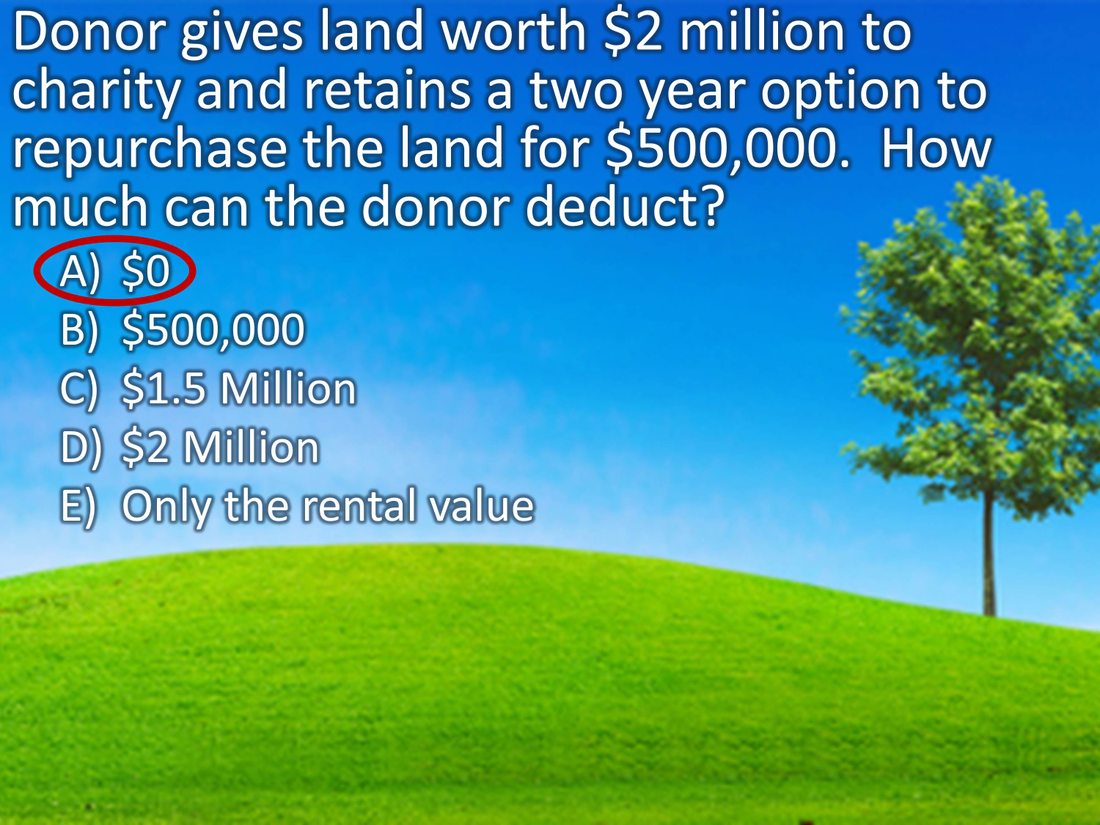
Because the donor has retained prohibited interests, there is no charitable deduction at the time of the initial transfer of the land to the charity.
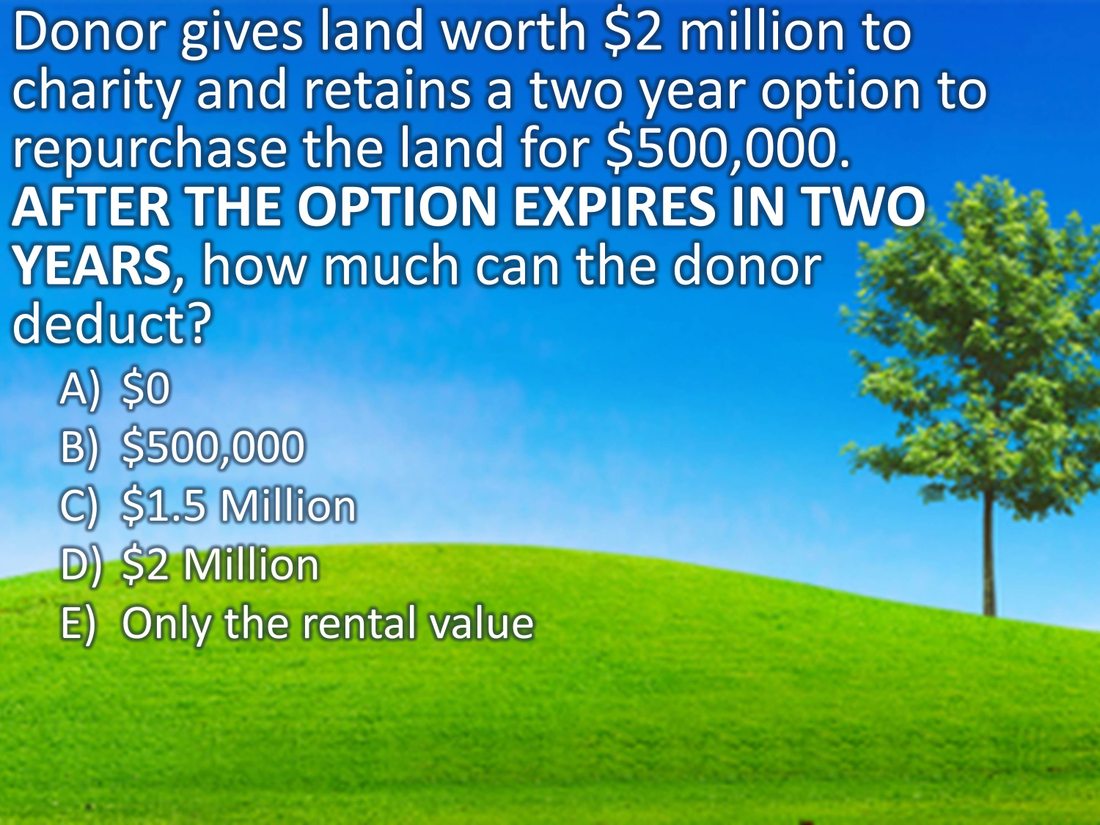
Now consider that same scenario two years later. Assuming that the donor has not exercised the option to purchase the land, that option to purchase the land expires. Does this have any effect on the donor's ability to take a charitable deduction?
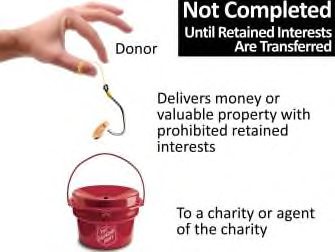
The donor initially delivered property to the charity with a prohibited retained interest. That transfer is not considered to be a charitable gift until all prohibited retained interests expire or are given to the charity. Two years later, the donor's prohibited retained interest expires. Thus, at that point, the donor has no retained interests in the property and the gift is finally a completed charitable gift.
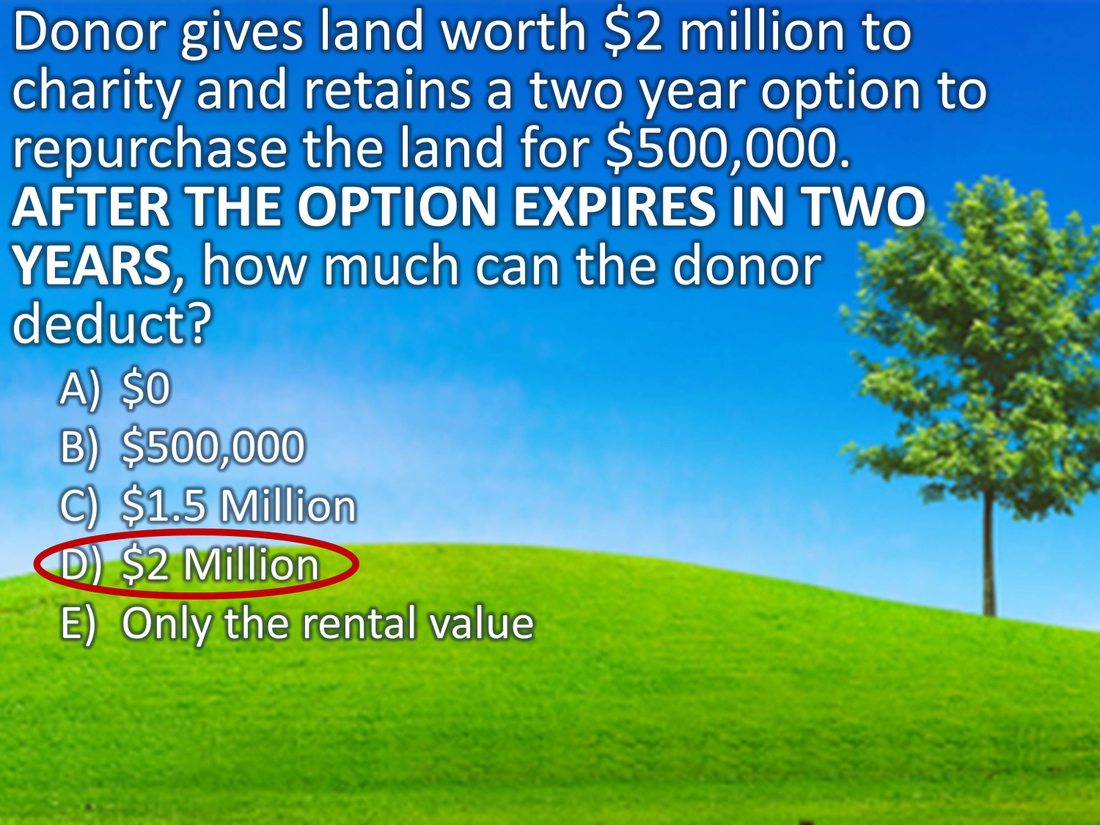
Because the donor no longer has any retained interests, the charity becomes the sole owner of the property. The value of that transfer is the value of the property, in this case $2 million. Thus, the donor may deduct a $2 million charitable gift, but not until all prohibited retained interests either expire or are transferred to the charity.
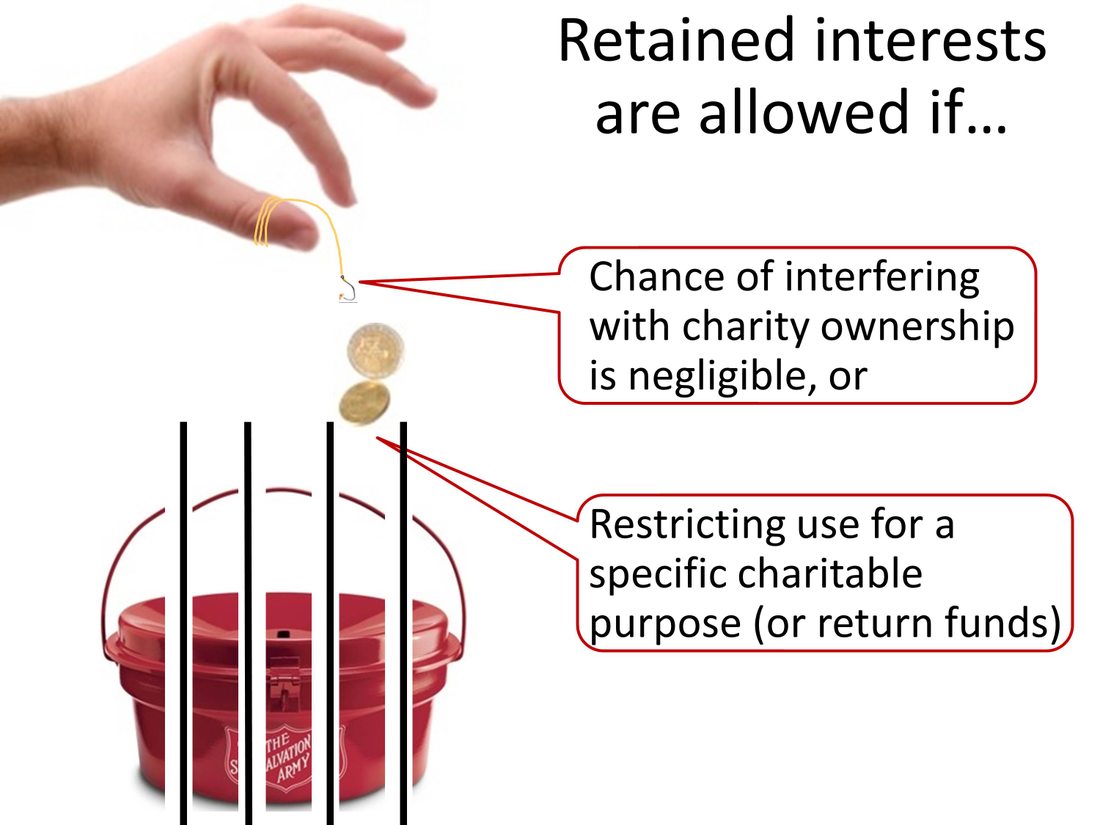
There are some types of restrictions on charitable gifts that do not interfere with the charitable deduction. These are restrictions where the chance of interfering with the charity ownership is negligible, or where the donor restricts the use of the charitable funds for a specific charitable purpose. The donor is allowed to restrict the use of funds for a specific charitable purpose and can even retain the right to receive the money back if the charity does not use the funds for that purpose. Indeed, this is a common legal result of putting a restriction on a charitable gift. The charity's penalty for violating the restriction is that the donor then has the right to demand the return of his or her gift.
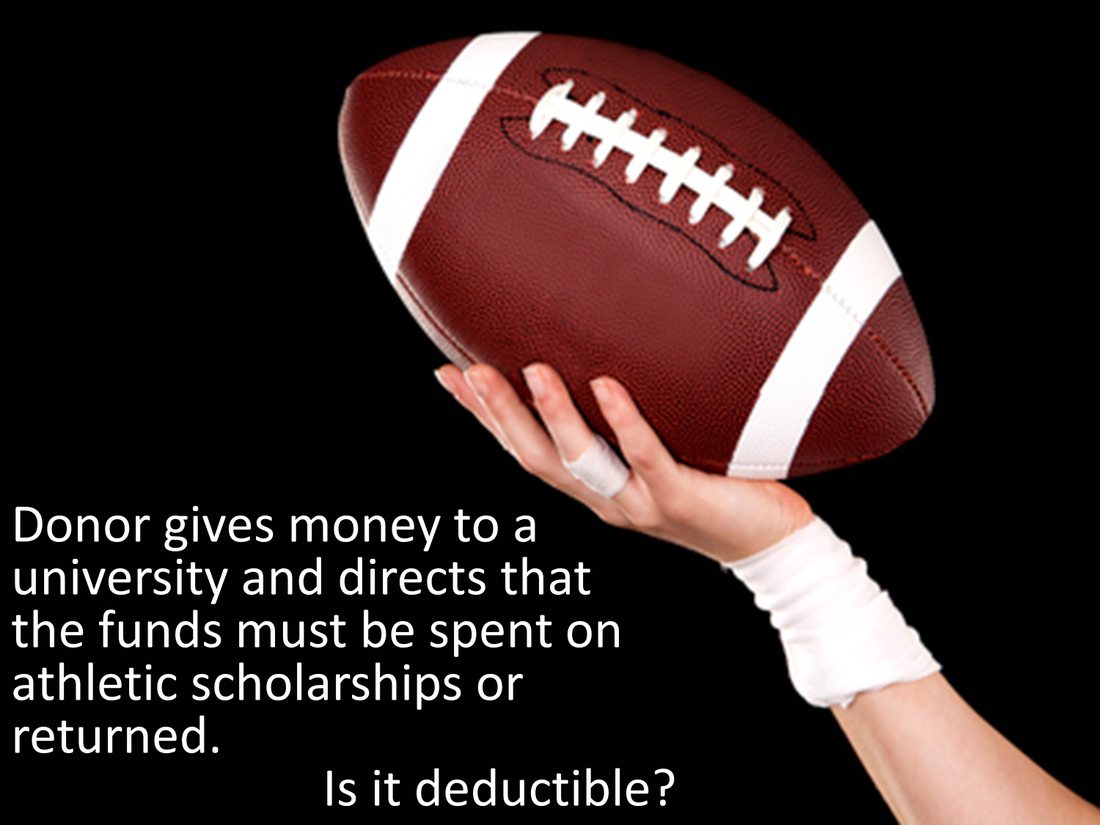
So, let's take a look at a common scenario. Suppose a donor gives money to a university and directs that the funds must be spent on athletic scholarships. This use is considered to be a charitable use of the funds. Suppose under state law, if the university fails to use the funds for the designated charitable purpose, the donor has the right to demand the return of the funds. What is the effect on the charitable deduction given that the donor retains this level of control over the gift?
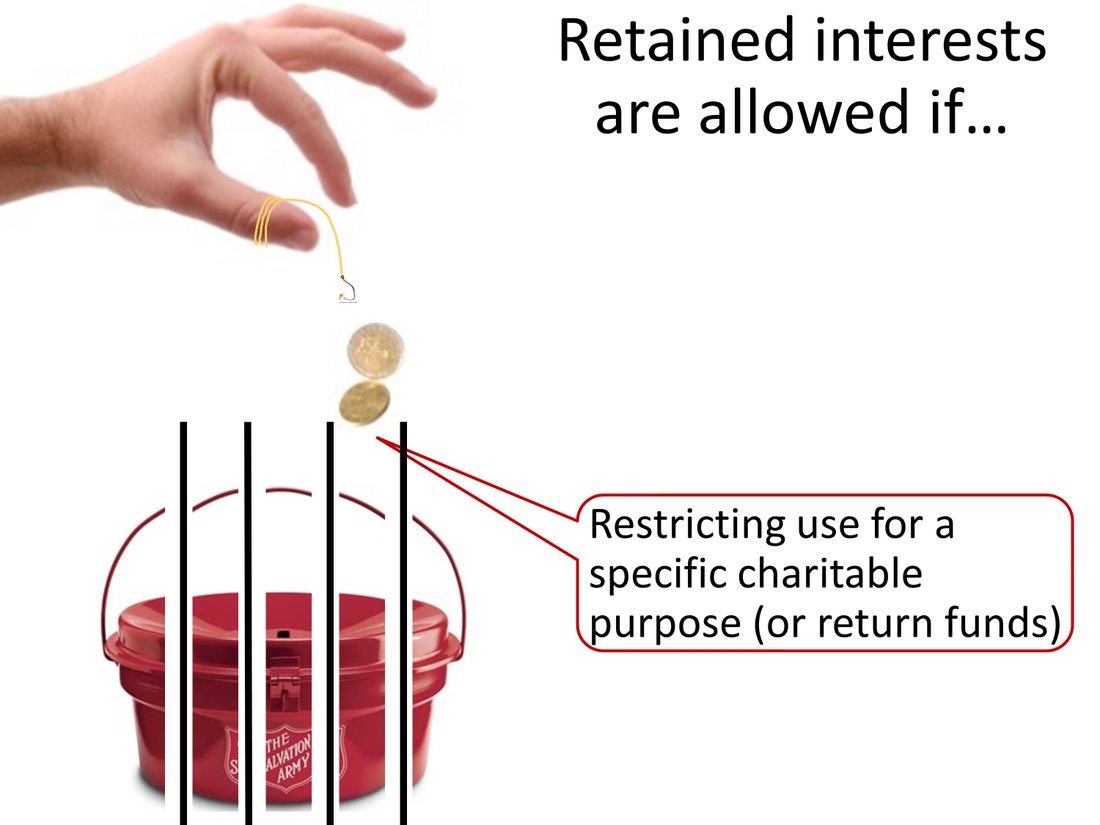
This retained control by the donor is perfectly acceptable because it is restricting the gift to be used for a specific charitable purpose. The retention of this right has no impact on the timing or amount of the charitable gift deduction. The gift is deducted just as it would be if the gift were given with no restrictions.
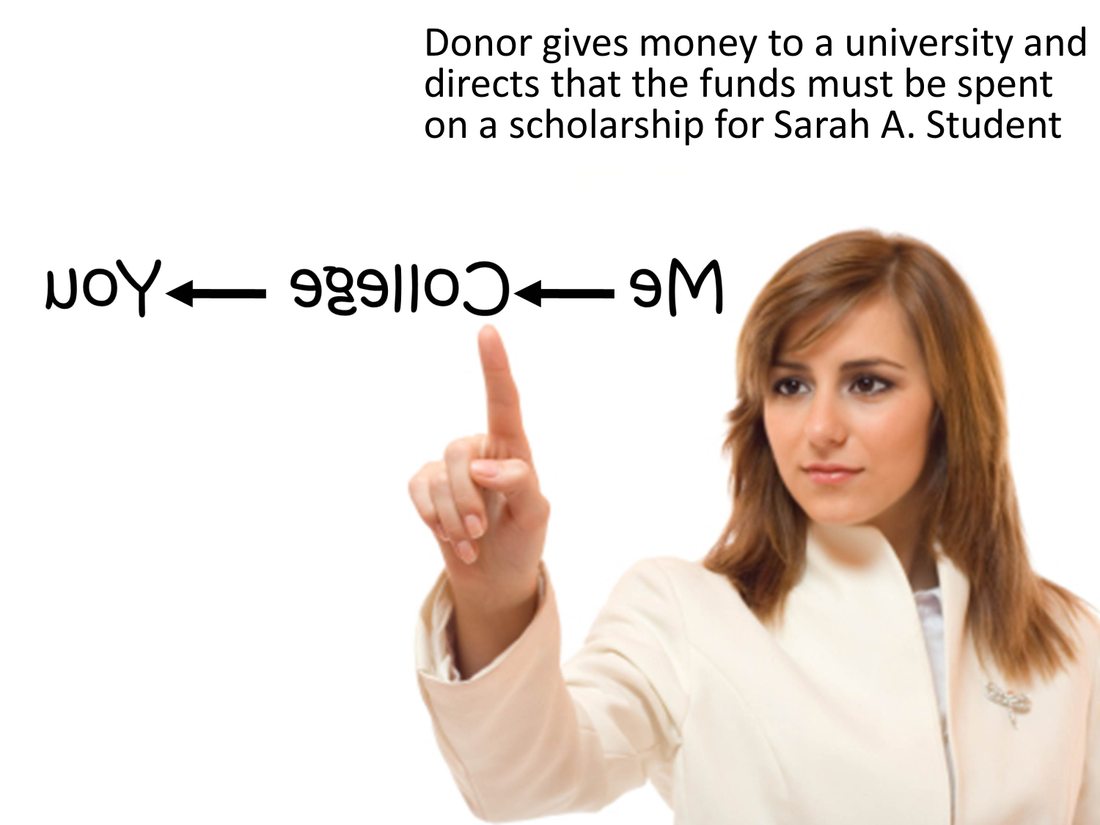
Suppose instead of limiting the use of the funds to athletic scholarships, the donor gave money to the university, and directed that the funds must be spent on a scholarship for a specific student.
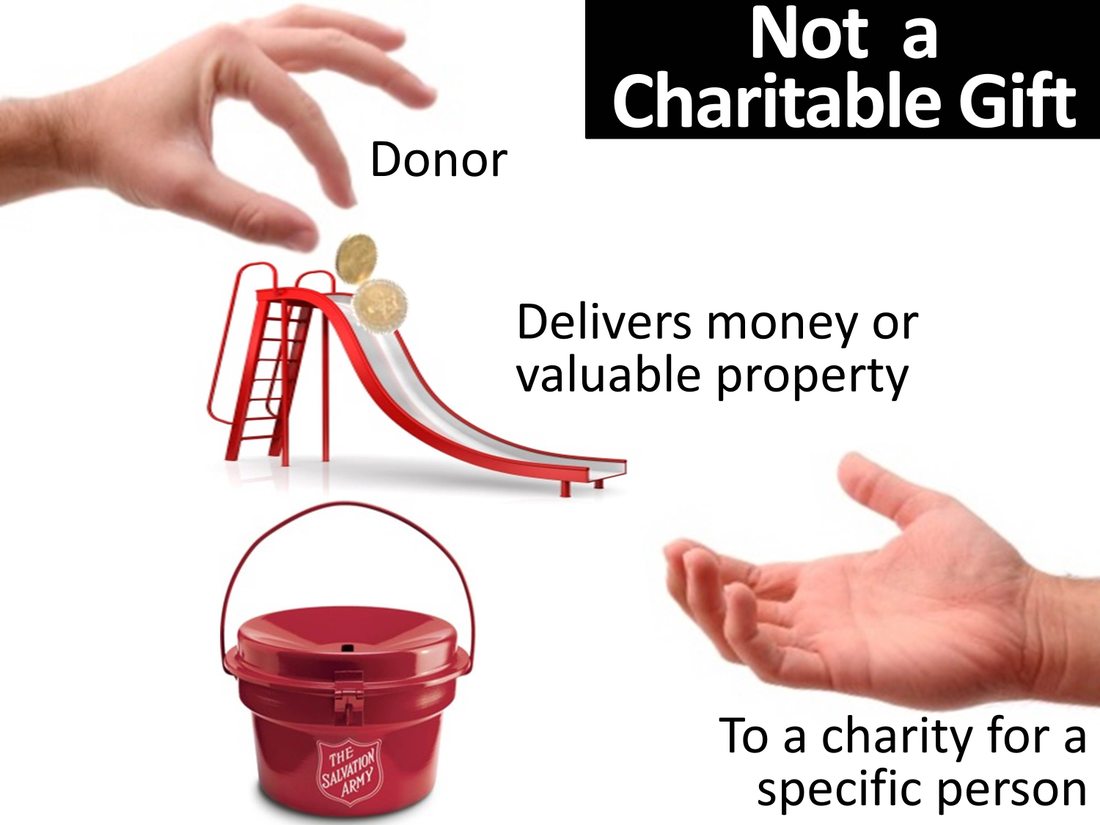
In this case, the transfer is not a charitable gift. A person is not a charity. A transfer to a specific person, even a financially needy person, is not a charitable gift. Requiring the charity to transfer the funds to a specific person makes this a transfer to a specific person, and therefore not a charitable gift.
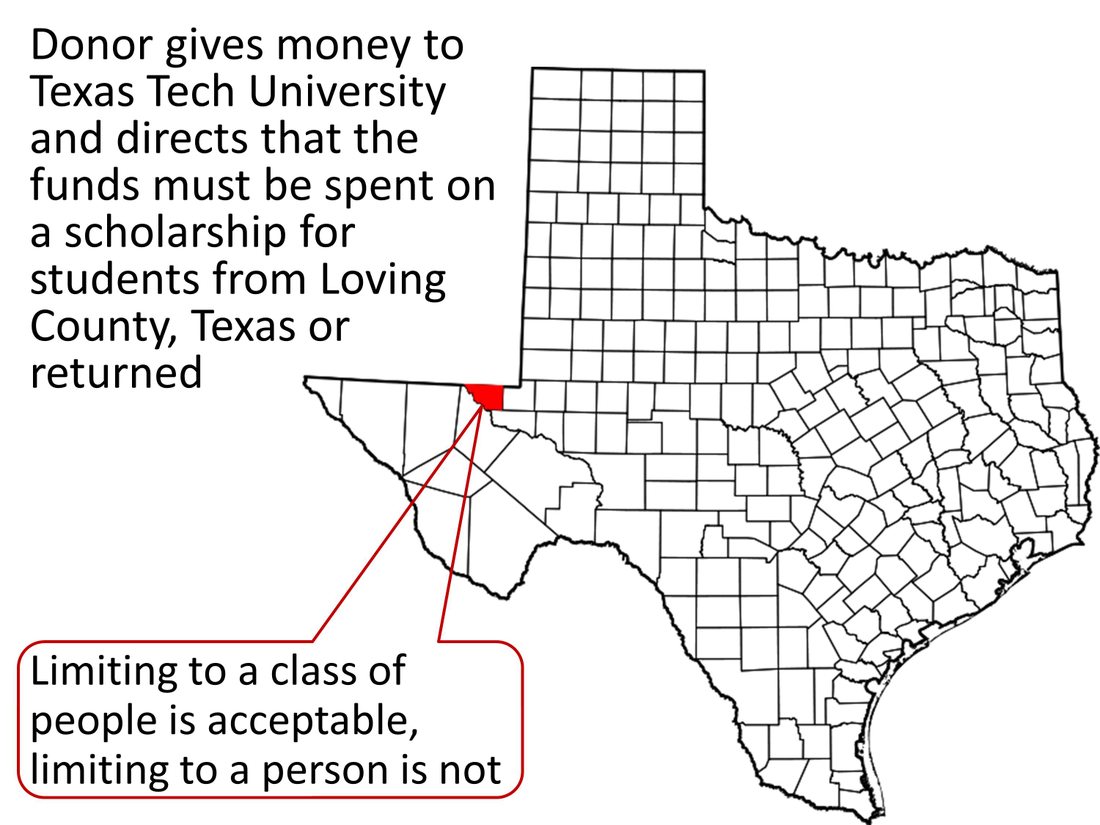
Note that the donor can restrict the beneficiaries to certain groups, but not to a specific individual. Thus, it is permissible for a donor to restrict his gift to funding scholarships for athletes, or even for students from a particular county. These are categories of people and not specific individuals. (Of course, if the donor restricted recipients using such categories that only one specific person could qualify, this cannot be used as a sneaky way to avoid the tax consequences of restricting the gift to a specific individual. This would still be, in reality, restricting the gift to be used for a specific person.)

Suppose that the donor intended to transfer the funds to benefit a specific individual, but did so in a more subtle manner than blatantly retaining a legally enforceable right. Could this softer approach result in both a transfer to a specific individual and a charitable deduction? This issue was addressed in a federal appeals court case where the donor to a university included the following note with his gift: "I am aware that a donation to a scholarship fund is only deductible if it is unspecified, however, if, in your opinion, and that of the authorities, it could be applied to the advantage of [specific named student], I think it would be constructive." The college received the gift and applied the money to the student's account. What was the tax result?
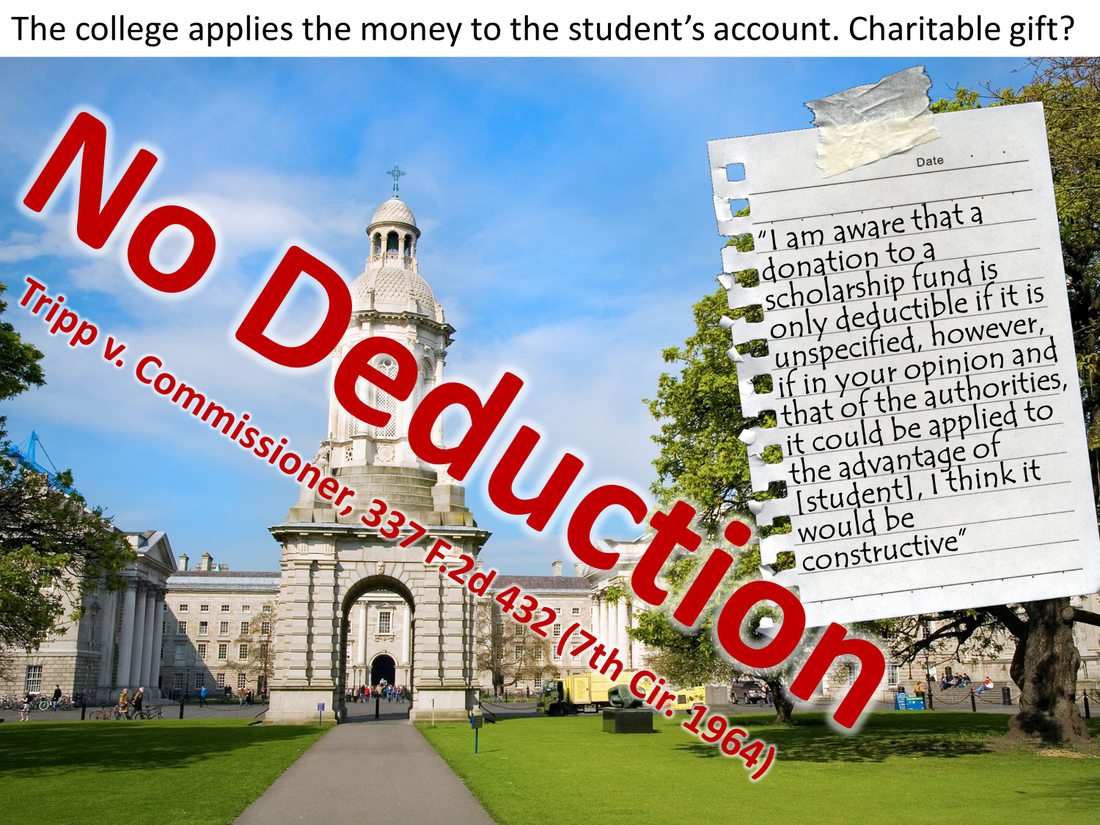
The donor's deduction was disallowed. Although not based upon mandatory legally enforceable rights, the court recognized this as a soft way to both take a charitable deduction and benefit a specific individual. Such a combination was not consistent with the goals of the charitable tax law, and thus the gift was not deductible.
This chapter ends by examining a special exception to the previous timing rules. The exception applies only to charitable gifts from C-corporations. (A C-corporation is the normal, standard corporation form, as contrasted with the closely-held S-corporation.)
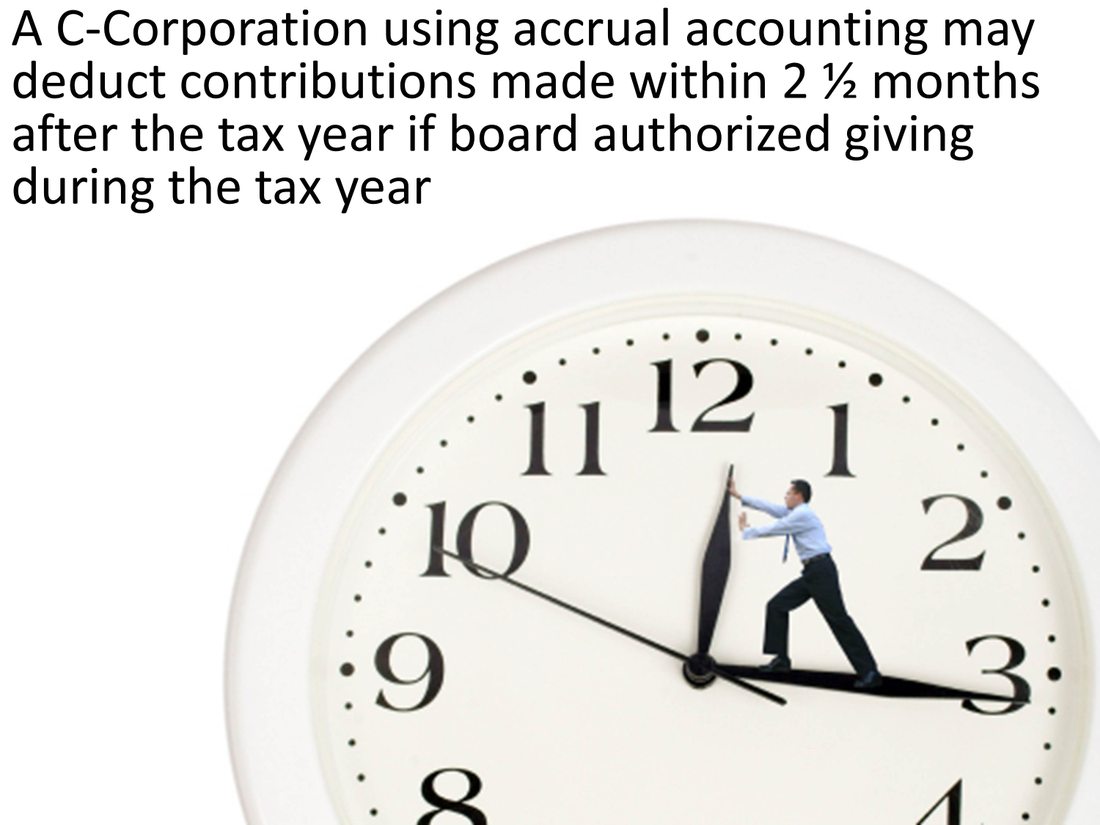
This special rule for C-corporations allows them to make a charitable gift within 2 ½ months after the end of the tax year and treat the charitable gift as if it was made in the prior tax year. This exception is allowed only for C-corporations using accrual accounting and only where the board authorized the giving during the tax year.

The motivation for allowing this exception to the normal timing rules is that such corporations are limited to deducting a maximum of 10% of their net income for charitable gifts. Calculating the corporation's net income for the year (especially when on an accrual accounting basis) is a difficult process. This difficulty would otherwise prevent corporations from making deductible charitable gifts up to the maximum, because of the uncertainty in knowing the corporation's net income for the year prior to the end of the year. By giving C-corporations on an accrual accounting basis this extra 2 ½ months, the tax code permits sufficient time to both calculate the net income for the previous year, and make charitable transfers up to the 10% of net income limit. However, the board must have committed to making such gifts in the previous taxable year. So, the charitable transfer idea cannot have been a new one that occurred after the end of the tax year, but must have already been authorized.

This ends the section on elements and timing of a charitable gift. As in other areas of charitable planning, it starts with a simple rule. In this case, the rule is that a deductible charitable gift occurs when the donor delivers money or valuable property to a charity or agent of the charity. However, when that rule is applied to a variety of complex scenarios its interpretation can become challenging. Nevertheless, understanding what is deductible and when it is deductible is a fundamentally necessary skill for anyone who will be advising donors about charitable transactions. Thus, there is practical value in understanding the intricacies of the elements and timing of a deductible charitable gift.