Charitable Remainder Trusts are the most powerful and flexible charitable planning vehicles available to donors and charitable planners. These instruments offer enormous potential tax advantages along with enough freedom to address the needs of even the most exacting client with highly peculiar preferences. Unlike Charitable Gift Annuities, Charitable Remainder Trusts are typically individually created to precisely match the plans and preferences of the individual donor. This flexibility does come at a cost, specifically the cost of individually constructing and annually maintaining the trust. But, for large transactions these costs can be relatively inconsequential. Despite the unique nature of most individually-crafted Charitable Remainder Trusts, all must comply with the broad framework from the Internal Revenue Code.
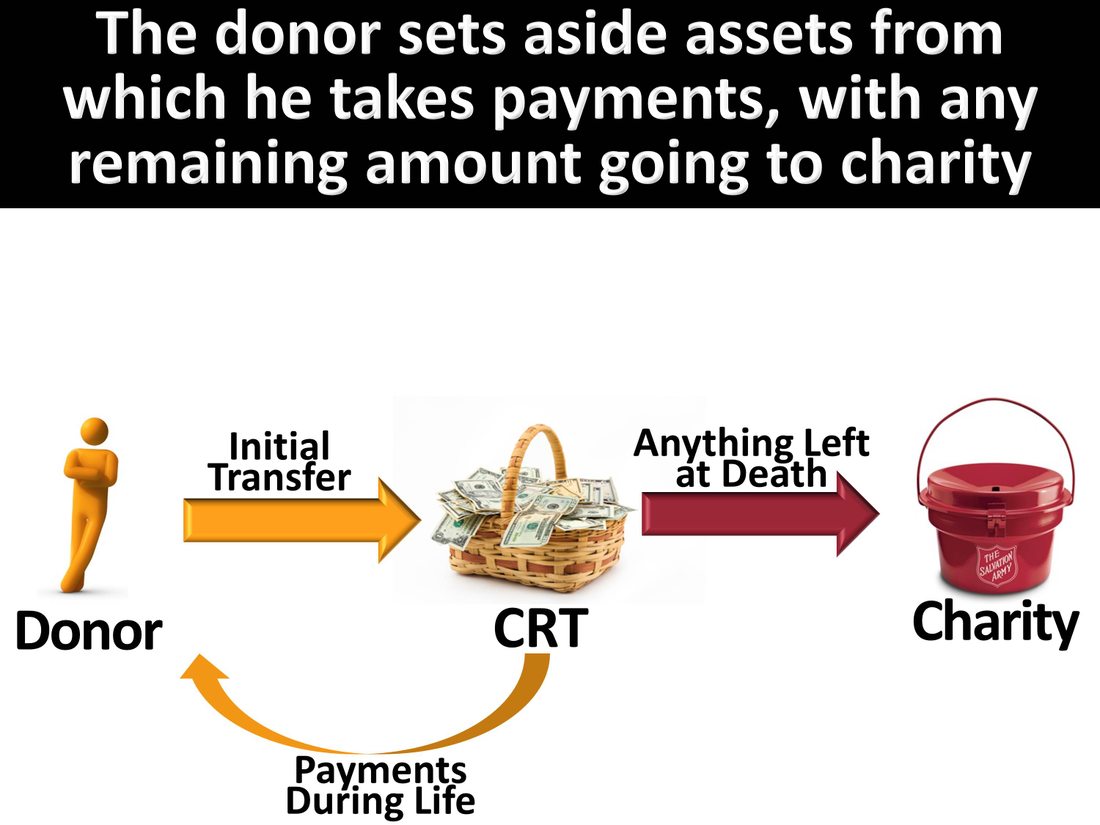
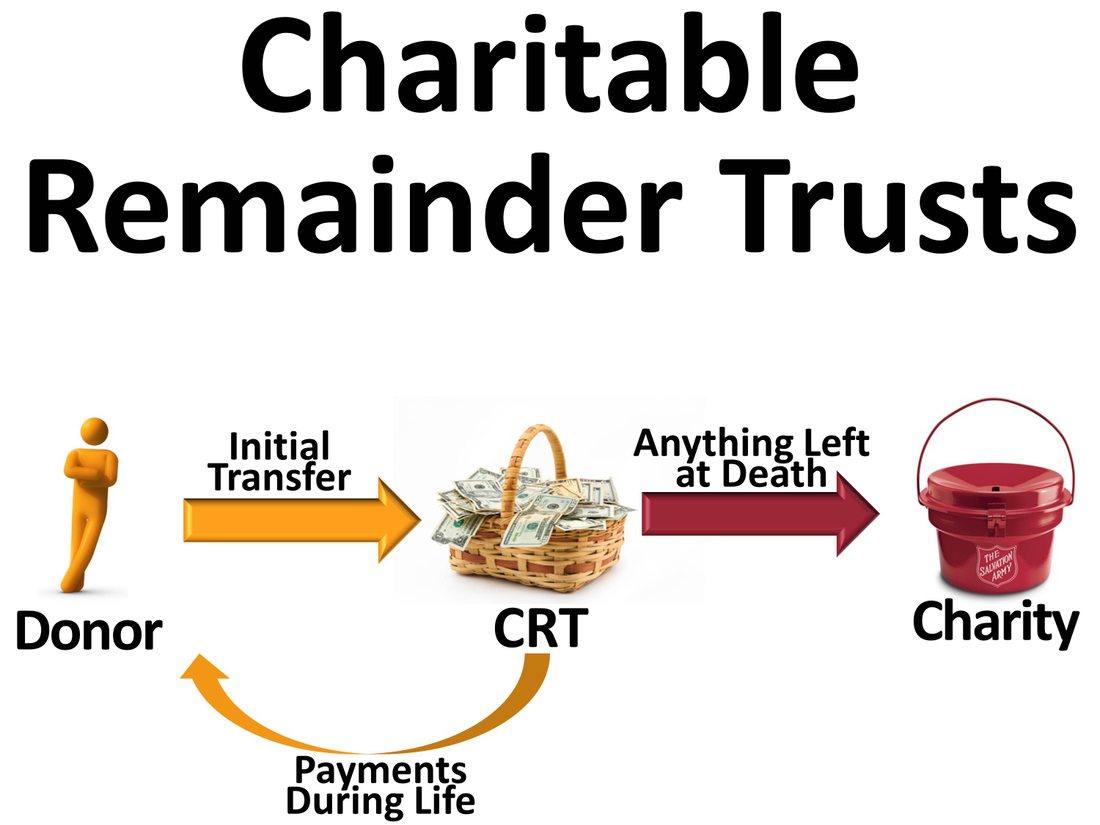
The most common form of a Charitable Remainder Trust is one where the donor places assets into a trust from which he receives payments for life, with any remainder going to charity at death. In the accompanying image, the Charitable Remainder Trust (CRT) is pictured as a basket holding cash. A trust is, essentially, a basket - with instructions - that holds money or other assets. The Charitable Remainder Trust is no exception. The Charitable Remainder Trust is a special kind of trust "basket," because it is itself a charitable entity. Consequently, the trust pays no taxes on income or capital gains from typical investments. The Charitable Remainder Trust differs from the Charitable Gift Annuity in that it is typically a donor-created vehicle. Whereas Charitable Gift Annuities are issued, administered, and managed by the charity, the charitable beneficiary of a Charitable Remainder Trust may not even know of its existence until receiving the final distribution check.
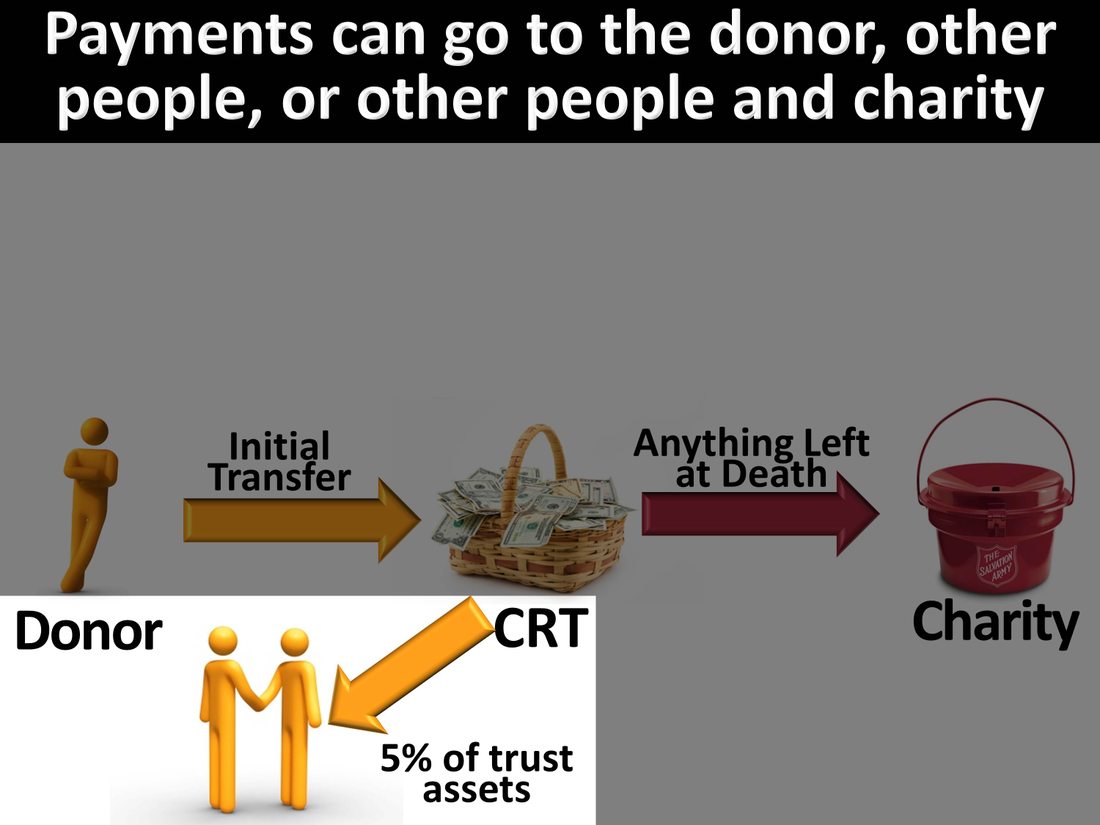
Although the most common form of the Charitable Remainder Trust is one where the donor sets aside assets from which he or she takes payments with any remaining amount going to charity at death, there are other varieties. For example, the payments need not go to the donor, but could instead go to someone else selected by the donor. The payment recipients (a.k.a. annuitants) could even be a combination of the donor, the donor's friends or family, or other charities. (However, at least one beneficiary must be non-charitable.)
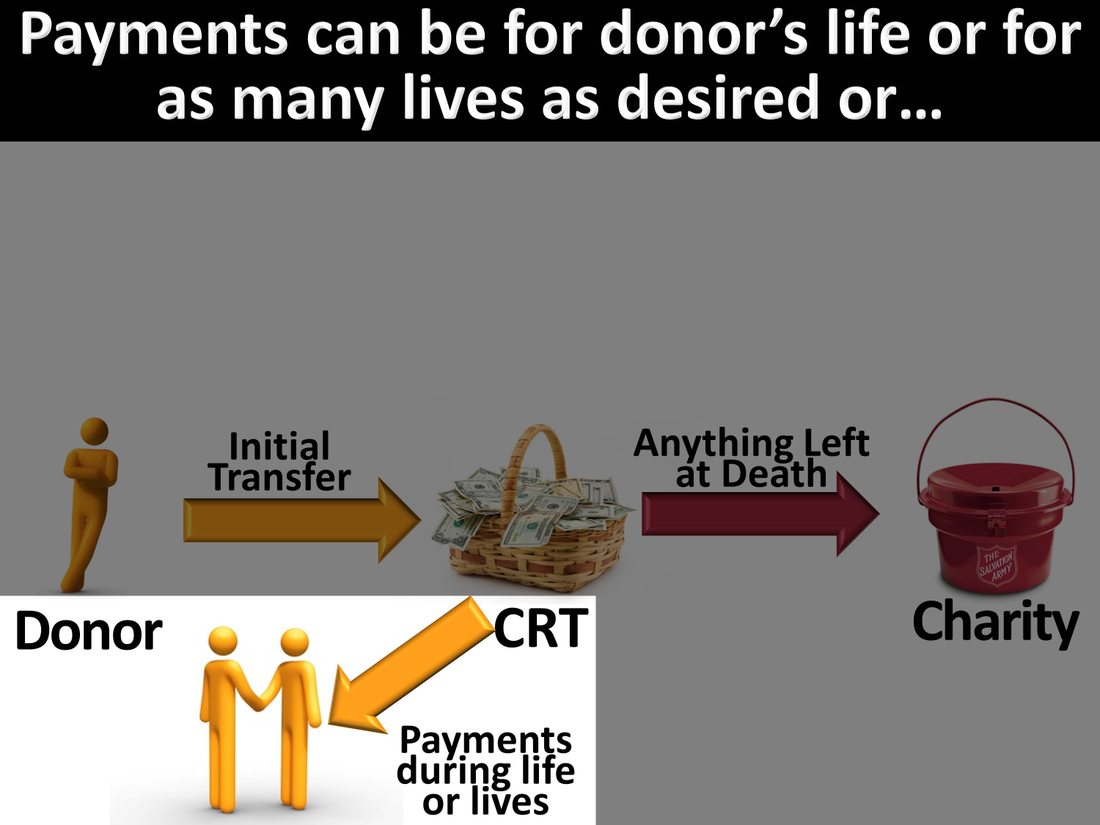
Although payments are typically made for the donor's life (or the joint lives of the donor and the donor's spouse), a Charitable Remainder Trust can pay for any number of lives. Where the Charitable Gift Annuity is limited to a maximum of two lives, no such limitation exists for Charitable Remainder Trusts. (The only requirement being that the individuals were alive at the creation of the Charitable Remainder Trust. This would prohibit a trust that would pay for the lives of "any of my grandchildren, whether currently living or born in the future.")
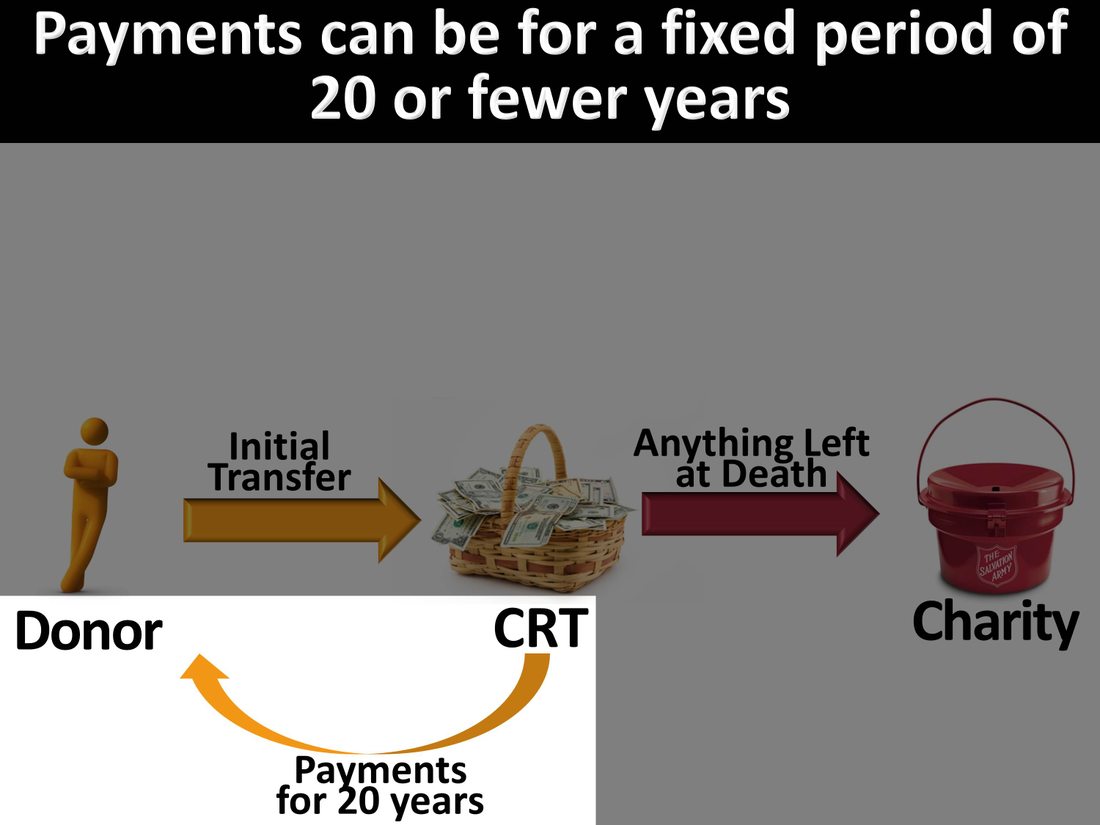
Alternatively, a Charitable Remainder Trust can pay for a fixed period of years. However, the fixed period of years cannot exceed 20 years. Thus, Charitable Remainder Trusts can be made to last much longer by selecting payments for a number of lives, rather than a fixed period of years. Additionally, the terms can be combined. Thus, the payment could be made for the donor's life or 20 years whichever is longer [Treas Reg. 1.664-3(a)(5)(ii)]. This option provides a lifetime annuity with a 20-year minimum payment regardless of actual life span of the measuring life.
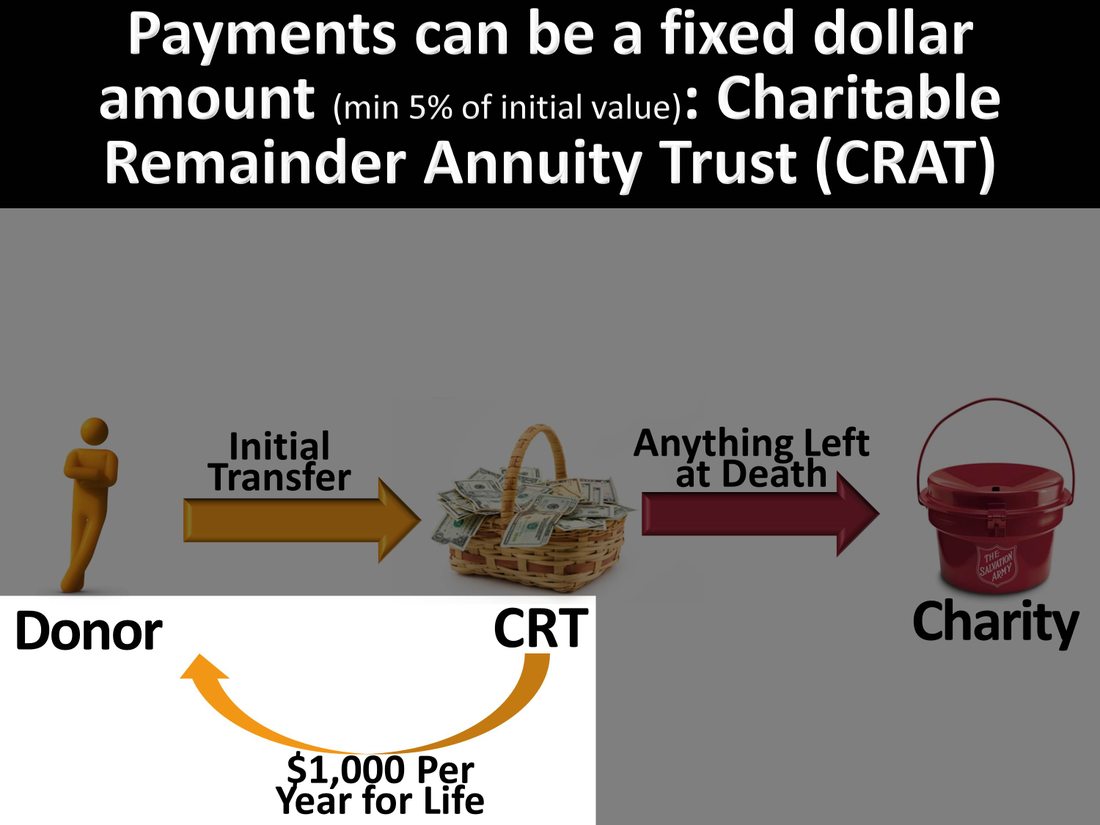
There are two types of Charitable Remainder Trusts. The first is a Charitable Remainder Annuity Trust (CRAT). The Charitable Remainder Annuity Trust pays a fixed dollar amount each year (or more frequently) for the life of the trust. In this way the Charitable Remainder Annuity Trust is very similar to a Charitable Gift Annuity. One difference is that the Charitable Remainder Annuity Trust is backed by the assets in the trust, where a Charitable Gift Annuity is backed by the issuing charity. If the assets in a Charitable Remainder Annuity Trust are exhausted (either due to poor investments or exceptional longevity of the annuitant) the annuity payments will cease. Similarly, if a charity becomes bankrupt, the Charitable Gift Annuity payments may be reduced or cease altogether, depending upon competing creditor claims and remaining assets. The relative security of annuity payments from a Charitable Remainder Annuity Trust as compared with a Charitable Gift Annuity depends upon the underlying investments in the trust or the financial strength of the issuing charity, respectively.
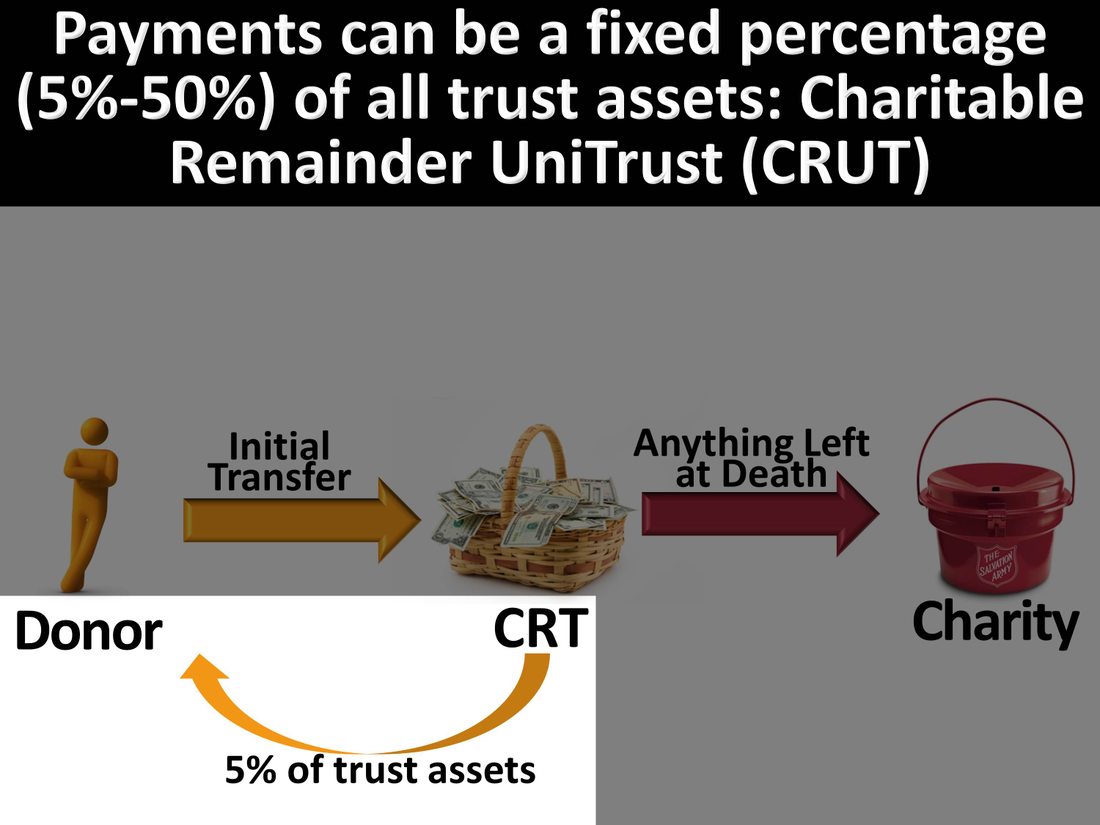
Alternatively, payments can be a fixed percentage (between 5% and 50%) of all trust assets. This type of Charitable Remainder Trust is referred to as a Charitable Remainder Unitrust (CRUT). This is the more common type of Charitable Remainder Trust. Unlike the Charitable Remainder Annuity Trust, the Charitable Remainder Unitrust allows the recipient to benefit from investment growth within the trust. The annuity payments in a CRAT are for a fixed dollar amount, but over time inflation can reduce the purchasing power of that fixed dollar amount. If inflation also results in higher interest rates for investments held by the CRUT, then its payments could increase over time, helping to maintain the purchasing power of the payments. Both the CRAT and CRUT are subject to investment risk. The risk in a CRAT is that the payments will cease due to exhaustion of all CRAT assets. The risk in a CRUT is that the payments will become smaller and smaller. The CRUT payment doesn't normally cease, because its payment is a percentage of the value of all assets currently in the trust. For example, if a 10% payout CRUT were established with $100,000 and the money was held in a non-interest bearing account, the first payment would be $10,000 ($100,000 x 10%), the second would be $9,000 ($90,000 x 10%), the third would be $8,100 ($81,000 x 10%), the forth would be $72,900 ($72,900 x 10%), and so forth. The payments would never actually cease, but would just become smaller and smaller over time. (Although after 132 years the payments would fall to less than one penny, so perhaps then the trust payments would necessarily cease.) A CRUT does not risk complete exhaustion like a CRAT unless the underlying investments became completely worthless due to market events.
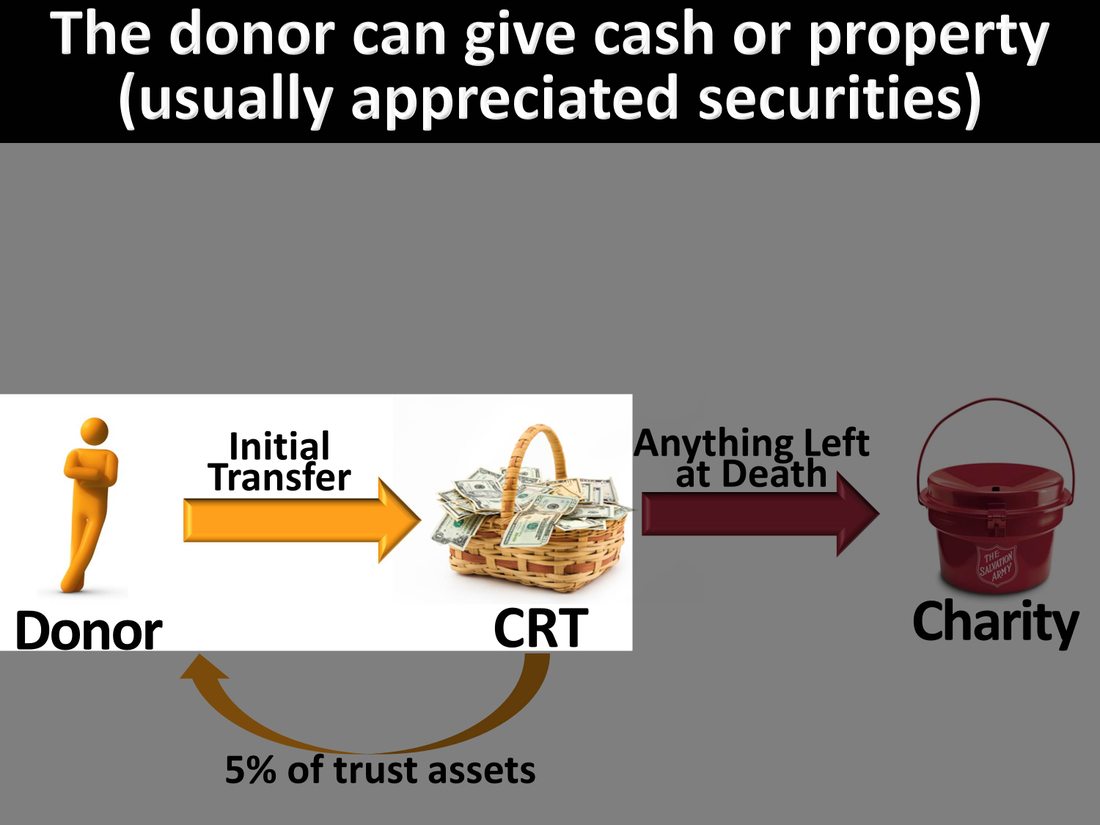
A donor can transfer cash or property to a Charitable Remainder Trust. Most commonly, this transfer is of appreciated property. As we will see later, the attraction for transferring appreciated property is that such transfers can avoid capital gains taxes, but still allow the donor to receive payments from the undiminished proceeds of the sale of the transferred property. Transfers to Charitable Remainder Trusts can include cash, shares of stock (other than subchapter S corporation shares), bonds, limited partnership interests, real estate, tangible personal property, and almost any other asset.

The donor creates the rules in a Charitable Remainder Trust, so long as those rules fit within the general guidelines for Charitable Remainder Trusts established by the Internal Revenue Code. This enormous flexibility, however, ends after the trust is created. A Charitable Remainder Trust is an irrevocable trust. Once the rules are created, the rules cannot normally be changed. This irrevocability is what allows the Charitable Remainder Trust to become a charitable entity (i.e., it cannot later be made less charitable). Irrevocability also allows the donor to take a tax deduction for his or her transfer to the trust.
The importance of irrevocability arises in other areas of charitable planning as well. A donor receives no income tax deduction for having a charitable beneficiary in his or her will because the donor could, at any point, remove all charitable beneficiaries. In contrast, when the donor transfers a remainder interest with retained life estate in a home or farm to a charity, the donor can take an immediate tax deduction, even though the charity will not become full owner of the property until the death of the donor. The key difference between a will and a remainder deed is that the will is revocable, and the transfer of a remainder deed is not.
Although the donor loses the ability to change the rules of the trust once it is created, the trust rules can still provide for ongoing donor influence in several areas.
In many cases, the donor may act as trustee of the Charitable Remainder Trust and continue to manage the assets and investments. There are certainly guidelines that must be followed to ensure that the donor is not receiving any additional benefit from the trust or engaging in self-dealing, but there is no prohibition against a donor managing his or her own Charitable Remainder Trust. Alternatively, the donor may instead choose who the trustee will be and keep the ongoing power to appoint or remove trustees. The donor could select a friend, a family member, a trust company, or even a charity to serve as trustee of the trust.
However, some plans will require the use of an independent trustee. For example, the donor may not act as trustee if the trust allows for payments to be withheld or shifted amongst various non-charitable recipients. This keeps too much power with the donor, and causes the trust to be treated as simply the property of the donor.
Although the donor may not keep any rights to change which non-charitable beneficiaries receive payments (or the amount of those payments), the donor is permitted to decide which charity will receive the remainder interest at the termination of the Charitable Remainder Trust. The Internal Revenue Code requires only that the remainder interest ultimately goes to some charity. The donor could even choose for the remainder interest to go to a private foundation. Thus, the donor could establish a Charitable Remainder Trust payable to a university, retain the right to change the charitable beneficiary, and later establish his own private family foundation and declare that foundation as the new charitable beneficiary. (If the donor keeps the right to name a private foundation as the charitable beneficiary, charitable deductions resulting from transfers to the trust will be subject to the income limitations for gifts to private foundations.)
This flexibility to change charities is available, but not required. It is perfectly acceptable to have a Charitable Remainder Trust where the remainder beneficiary cannot be changed (unless, for some reason, the remainder beneficiary no longer qualifies as a charity at the time of the termination of the trust). Indeed, most charities will not agree to act as trustee of a Charitable Remainder Trust unless they are named irrevocably as the remainder beneficiary.
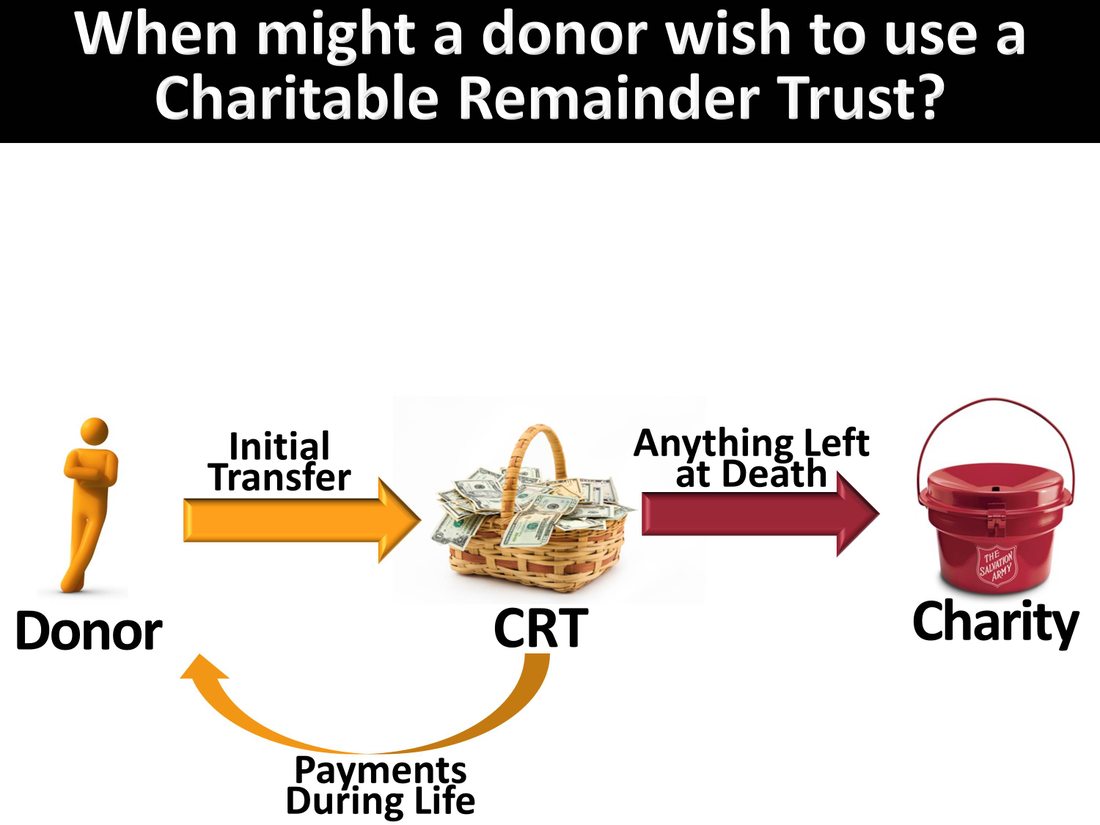
Given the flexibility of the Charitable Remainder Trust, it can be a useful tool for donors with a variety of financial goals and circumstances. The ability to take payments from the proceeds of highly appreciated assets - undiminished by capital gains taxes at their sale - accompanied by tax free growth of investments inside of the Charitable Remainder Trust along with receiving an immediate tax deduction for a post-mortem transfer make this an enormously attractive vehicle for the charitably-inclined donor with appreciated assets. Several common financial planning scenarios correspond almost exactly with the terms available in a Charitable Remainder Trust.

A donor who wants a fixed annual payment from investment assets and also wants to make a post-mortem gift to charity is an ideal candidate for a Charitable Remainder Annuity Trust. The Charitable Remainder Annuity Trust not only provides for fixed annual payments and an ultimate transfer to charity but, as compared with using a standard investment account and will, can produce enormous tax benefits.

The Charitable Remainder Unitrust is well suited for the donor who wishes to retain control of his or her investments. Not only can the donor retain control, but with the Charitable Remainder Unitrust, the donor also receives larger payments when assets grow in value. Where a wealthy client has a pre-existing desire to leave a bequest gift to charity at death, the use of a Charitable Remainder Trust will often be, by far, the most tax advantageous way to accomplish the client's other financial goals.

Although the most common form of Charitable Remainder Trusts pay for a life or lives, in some cases the fixed term trust can be ideal. If a client desires to make a substantial lifetime transfer to charity, but still has specific income needs for a fixed amount of time, the fixed term Charitable Remainder Trust can be an excellent solution. Such fixed-term payments can help to address a temporary income need due to early retirement or to a known obligation such as college tuition for a child or grandchild.

Although it is quite common for clients' to have financial planning needs that correspond with the allowable terms under a Charitable Remainder Trust, such needs could also be addressed without the use of the trust. For example, a donor could simply set aside money into a special account, withdraw annual sums from the account, and designate a charity as the "pay on death" designee. Functionally, this would work exactly like a Charitable Remainder Trust, except that the donor would retain 100% control and freedom. So, given this simple alternative, why would a donor choose to use a Charitable Remainder Trust? The answer is simple: tax benefits.

At its core, the Charitable Remainder Trust is attractive not just for its correspondence with the donor's pre-existing plans and goals, but rather for the special tax advantages that are otherwise unavailable. The wide range of tax benefits generated by the Charitable Remainder Trust is what drives its widespread use.
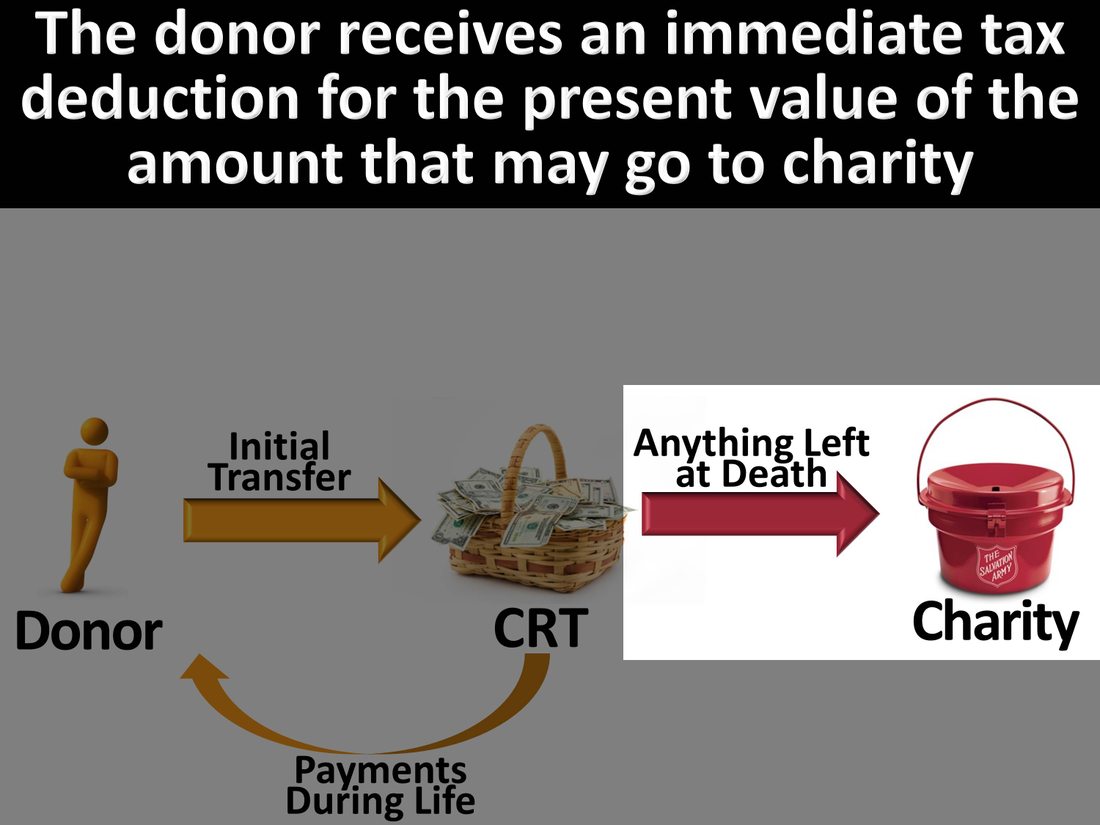
An initial and obvious benefit from using a Charitable Remainder Trust is that the donor receives an immediate income tax deduction for a transfer that will not go to charity for many years. Without using a Charitable Remainder Trust, the donor could still set aside an asset, take payments from the investment for 20 years, and donate whatever is left to the charity. But, the donor would have to wait 20 years before receiving a charitable income tax deduction. Even worse, if the donor wanted to take payments from the investment for life, donating whatever remained to charity at death, then the donor would never receive any charitable income tax deduction. The Charitable Remainder Trust allows a donor to immediately take a deduction in both of these scenarios even though the ultimate charitable beneficiary may not see funds for many years. This ability to create a large charitable income tax deduction where none would have existed before (or in some cases to pull forward those deductions by two decades) is very powerful. Additionally, as discussed later, the valuation of the deduction for post-mortem transfers is actually much higher than is actuarially appropriate given that wealthy donors, on average, live much longer than the typical person. Results from the Health and Retirement Study reported in American Charitable Bequest Demographics indicate that wealthy bequest donors live 5-7 years longer than poor non-donors do. Additionally, those who purchase lifetime annuities live longer than others of their age because the annuity-purchasing group typically excludes those who are seriously ill or known to be approaching death. Both of these factors point to the reality that Charitable Remainder Trust donors will, on average, live substantially longer than others of their same age. For tax deduction valuation purposes, this means donors will receive a deduction based upon their receiving payments for a much smaller number of years than will typically be the case (i.e., the tax deduction is greater than is actuarially appropriate).
Regardless of the actuarial discussion, there is no doubt that the income tax deduction available for making a post-mortem charitable transfer by a Charitable Remainder Trust is greater than that for making the same transfer by will. This is obvious because a charitable transfer by will generates no charitable income tax deduction. The Charitable Remainder Trust donor does give up some freedom in exchange for the tax deduction; he cannot later decide to give the charity's share to a non-charitable beneficiary. In contrast, a will - although generating no charitable income tax deduction - can be completely changed at any time prior to death.
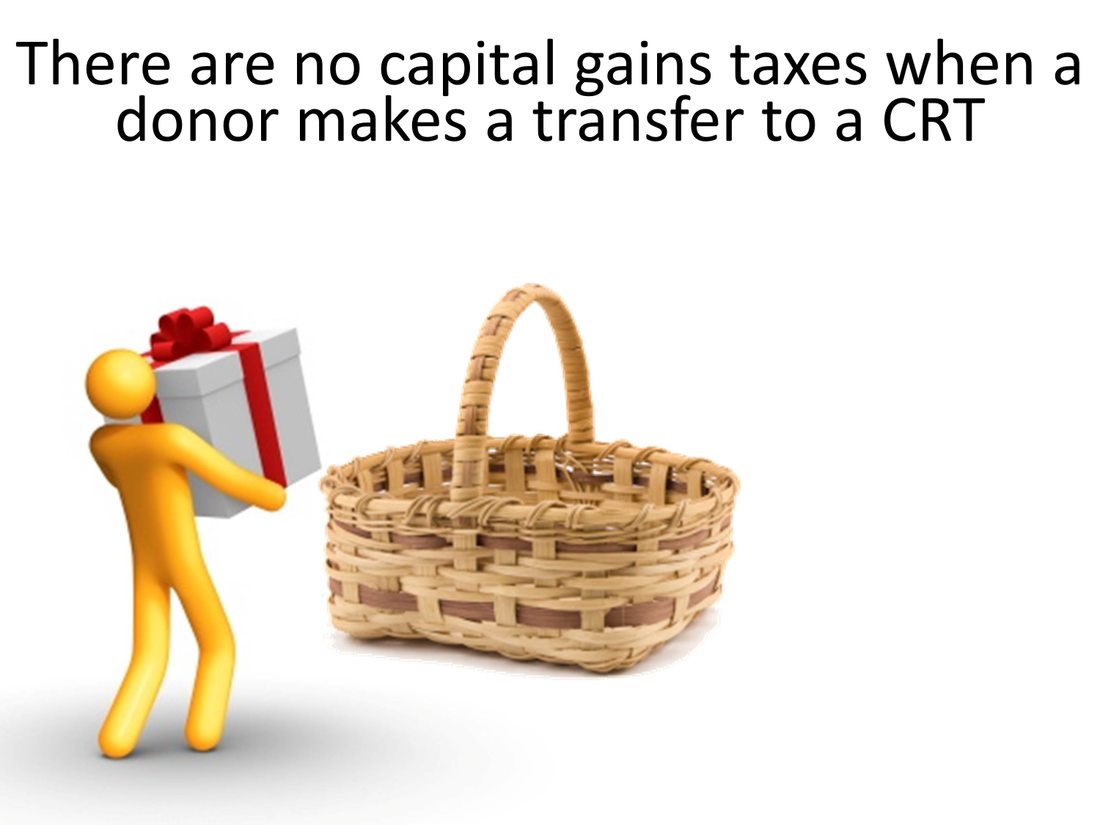
One of the great sources of tax advantages available from a Charitable Remainder Trust relates to the postponement or avoidance of capital gains taxes. Critical to this advantage is the reality that donors may transfer highly appreciated assets to a Charitable Remainder Trust without triggering recognition of capital gain. This is simply another application of the general principle that donors can give highly appreciated property to a charity, recognize no capital gain, and in many cases take a tax deduction based upon the full fair market value of the property. This fundamental tax benefit is why donors normally should give appreciated property, rather than cash (especially where the appreciated property is a fungible asset such as publicly traded stock where replacements can be immediately repurchased with a higher cost basis). The Charitable Remainder Trust takes this basic advantage and applies it to a scenario where the donor not only makes a gift, but also receives a stream of payments from the gift.
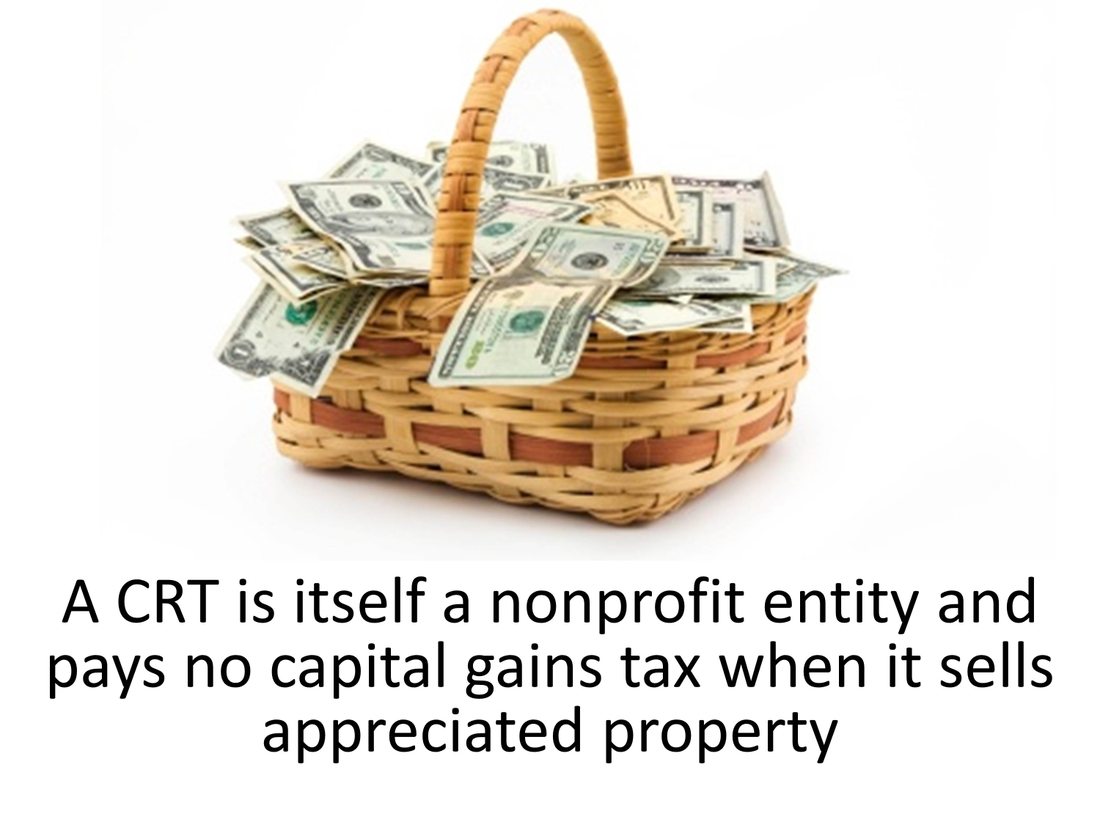
The capital gains tax advantage from a Charitable Remainder Trust is not limited to the ability to transfer appreciated assets into the trust without generating capital gain. The Charitable Remainder Trust is itself a nonprofit entity. As such, the trust can have capital gains and earn income while paying no taxes. This creates two dramatic tax advantages. First, the donor can take payments from the full sale value of the highly appreciated asset, undiminished by capital gains taxes. (Whereas, a sale outside of the Charitable Remainder Trust would immediately cut the remaining amount available to invest.) Second, all future investment growth taking place inside the Charitable Remainder Trust occurs without taxation, excepting only potential taxation on the payments received by the donor. This makes the trust a perfect environment for the tax-free growth of assets, similar to a qualified retirement plan.
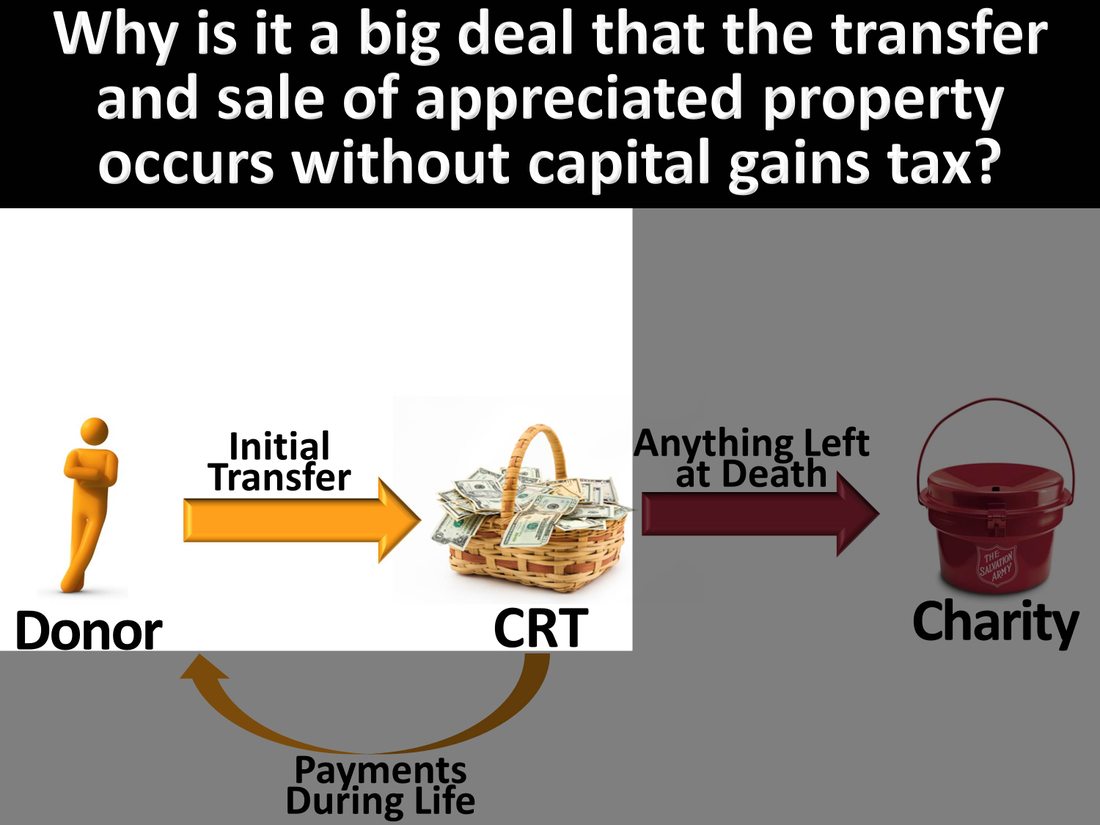
Without looking at the numbers in a few scenarios, it may not be immediately obvious why the ability to receive payments from the full sale amount of a highly appreciated asset can make such an enormous difference. So, let's turn to some examples to demonstrate this power.

We begin with a common financial planning dilemma. A client holds a low-basis, highly appreciated asset. Unfortunately, this asset generates little income. It is often the case that such an asset may be a substantial part of the client's wealth. Wealth is often built in the form of entrepreneurial and business-building activity. A client owning such a business may have a very valuable asset, but one which is difficult to convert into a reliable investment income stream. This may be true because the business is in a growth phase where it is important to reinvest earnings rather than pay out dividends. Or, this may be true because getting the business to reliably generate income requires the active participation of an owner who wishes to retire. Such entrepreneurial businesses have often been built over a long period of years such that the founder has little or no cost basis in the business.
Although business building is perhaps the most common scenario, there are others that can leave clients with low-basis assets the produce little or no income, such as owning farmland that has become developable land due to exurban growth, or highly appreciated artwork or collectibles, or investment property that has been fully depreciated out and is valuable for redevelopment purposes, but generates little current income. The natural reaction of most financial advisors seeing clients with income needs whose wealth is highly concentrated in such non-income producing assets is to convert them to diversified income-generating investments. But, such conversion requires a sale, and a sale creates capital gains tax liability. Such a sale can leave the client with much less wealth.
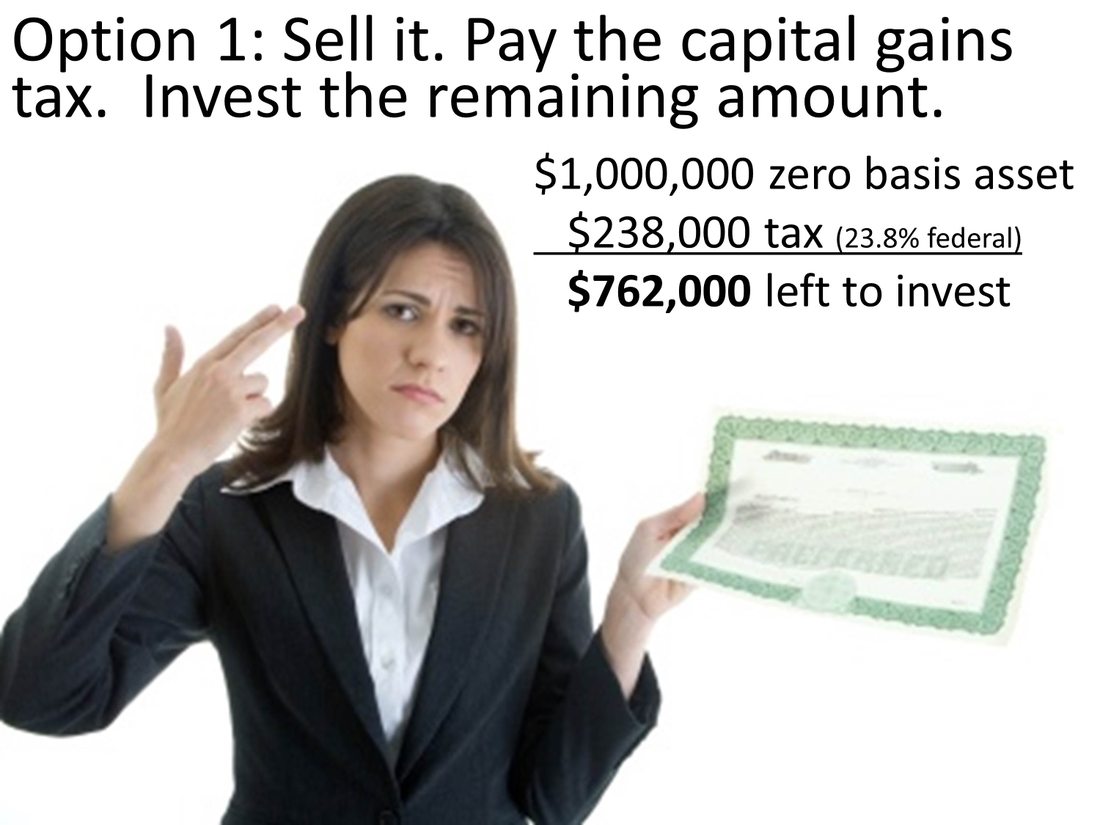
Suppose a client has a $1,000,000 asset with a zero basis. We will use a zero-basis scenario to show the most extreme case, but this is certainly not outside the realm of possibility. For example, a zero-basis asset may be a business built up by the owner over many years without significant up-front cash investment, a completely depreciated asset, or perhaps collectibles acquired or received as a gift where there is no documented purchase price. Although the owner wishes to convert this non-income producing asset into a diversified income-producing portfolio, that conversion process requires a sale. The capital gains taxes resulting from that sale significantly reduce the remaining assets available for investment. Thus, the usually good advice of diversifying investments and matching income needs with income production of investments is thwarted by the tax cost of selling the low-basis asset. This can keep the owner tied to undesirable investments because any sale would result in the loss of nearly a quarter of the value of the asset, just from the federal capital gains taxes alone. These federal taxes include the capital gains tax with a top rate of 20% and the 3.8% Affordable Care Act surtax.
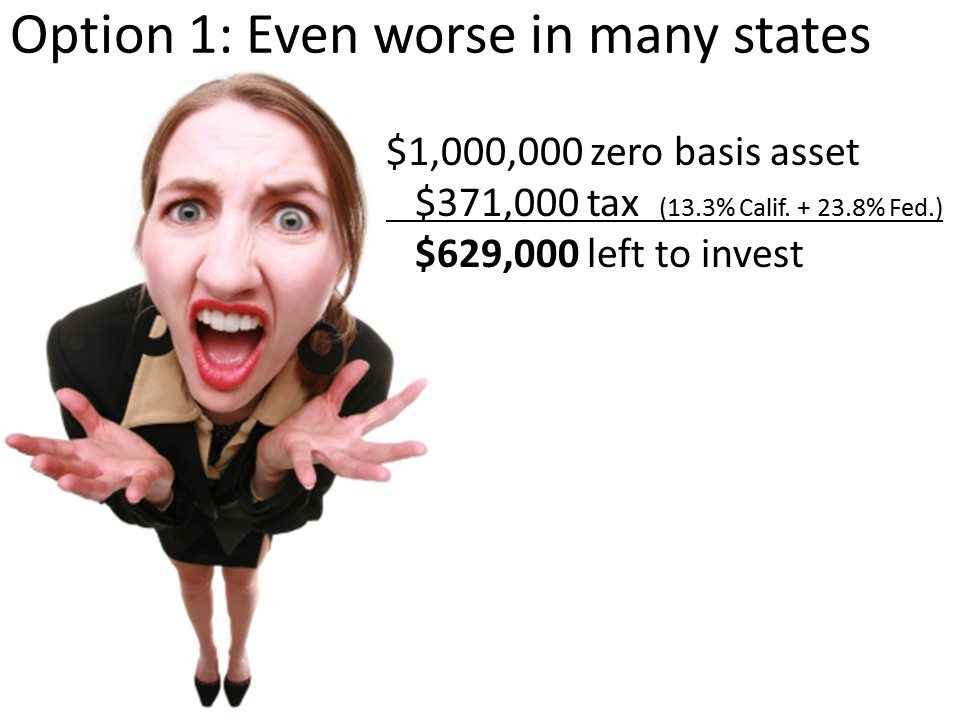
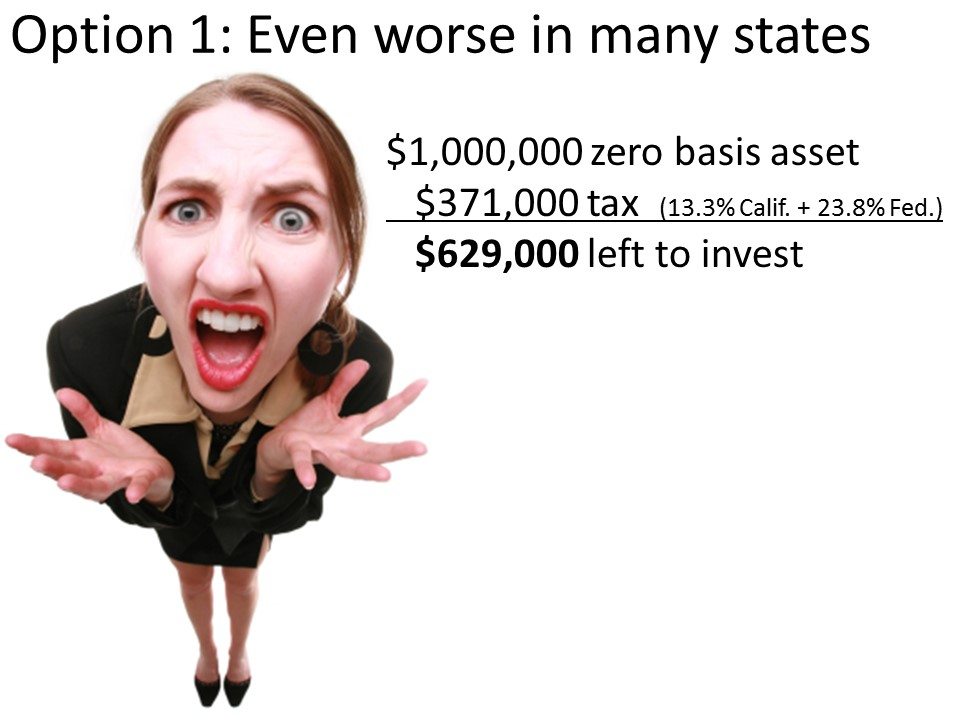
Of course, most owners live in states that also impose a state-level capital gains tax. (Currently, 42 of 50 states impose capital gains taxes.) Although state capital gains taxes may be deducted from the federal tax return, this is capped at $10,000 making additional deductions often useless. Thus, the addition of state capital gains taxes can make the prospect of a sale even more disheartening for owners. As an example, owners at the top tax rates in California will face, even with a full federal deduction, a combined rate of 37.1% (i.e., 23.8+13.3%). When capital gains taxes are taking more than 37% of the value of any gain, the option of selling even an underperforming highly appreciated asset can become unfeasible.
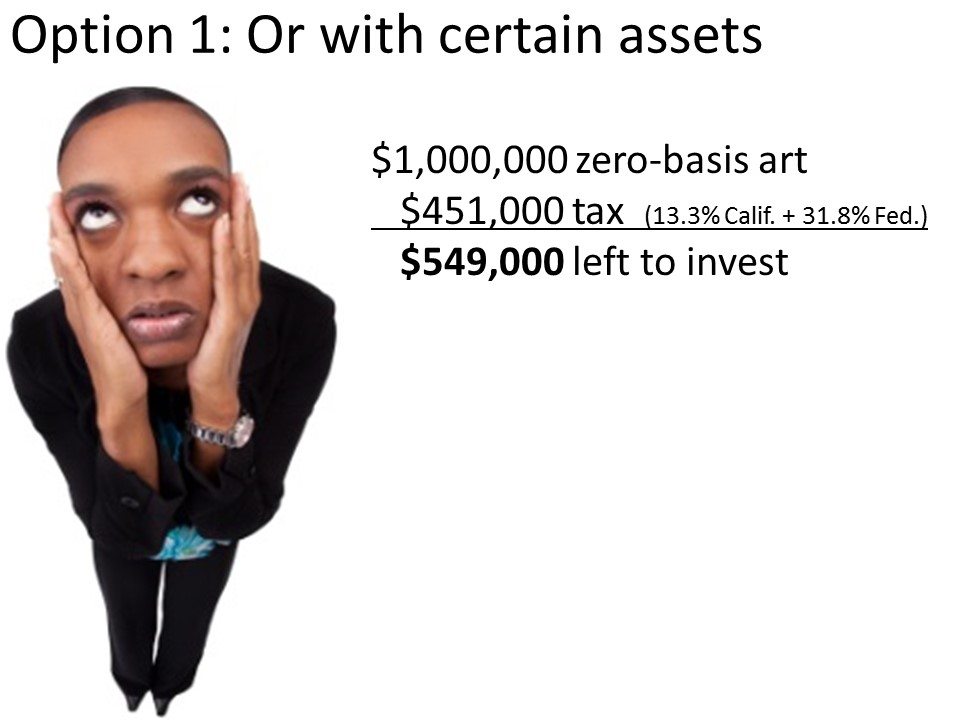
Beyond this, some assets are subject to even higher capital gains tax rates. For example, capital gain from the sale of collectibles - such as artwork - has a top federal tax rate of 28% in addition to the 3.8% affordable care act surtax, rising to 31.8%. Combining this with the top 13.3% state tax in a state like California increases the top rate to 45.1%.
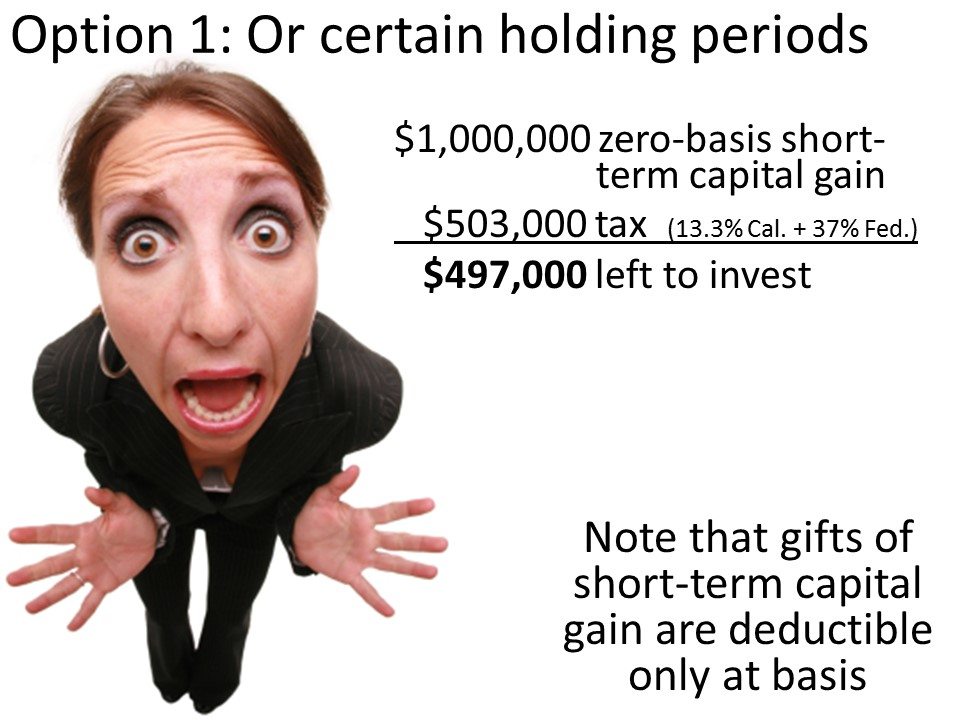
Perhaps the worst capital gains tax result comes from selling a short-term capital gain. A short-term capital gain results from the sale of an asset held for one year or less. This is taxed as ordinary income resulting in a top rate of 37% combined with the state income tax rate. For a taxpayer in California this results in a top combined rate of 50.3%. Although the prospect of losing more than half of the value of the asset due to a sale may be rare, it shows the potentially dramatic impact of capital gains taxes. In this particular example, because the underlying asset is short-term capital gain property any charitable gift would be valued based upon the lower of basis or fair market value. Thus, a zero-basis short-term capital gain asset would generate no deductible charitable gift. However, the ability to avoid losing more than half of the asset to taxation may be sufficiently attractive, even without the addition of a charitable income tax deduction.
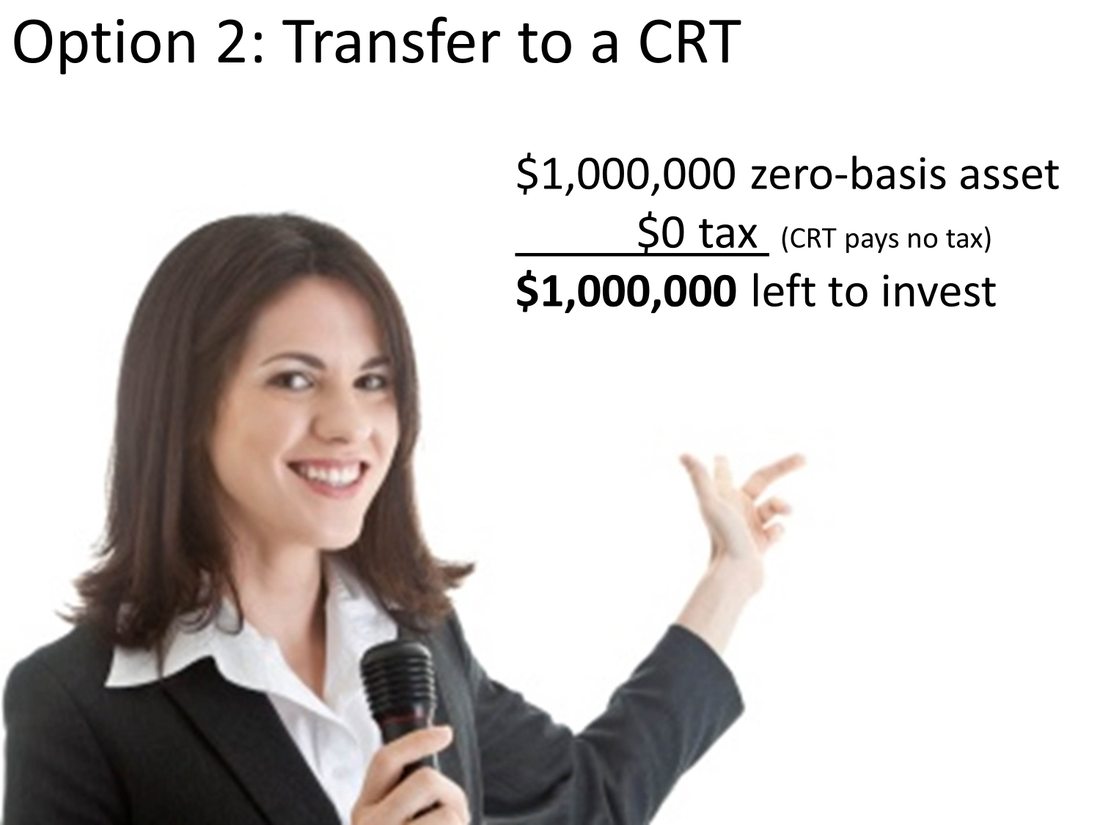
The Charitable Remainder Trust provides an alternate path for an owner to be able to sell and earn payments from the highly appreciated asset. Critically, this path results in no reduction of the investment asset due to its sale. The ability to convert the asset into a diversified, income-producing portfolio while leaving the full value of the asset completely undiminished by capital gains taxes is potentially quite attractive.
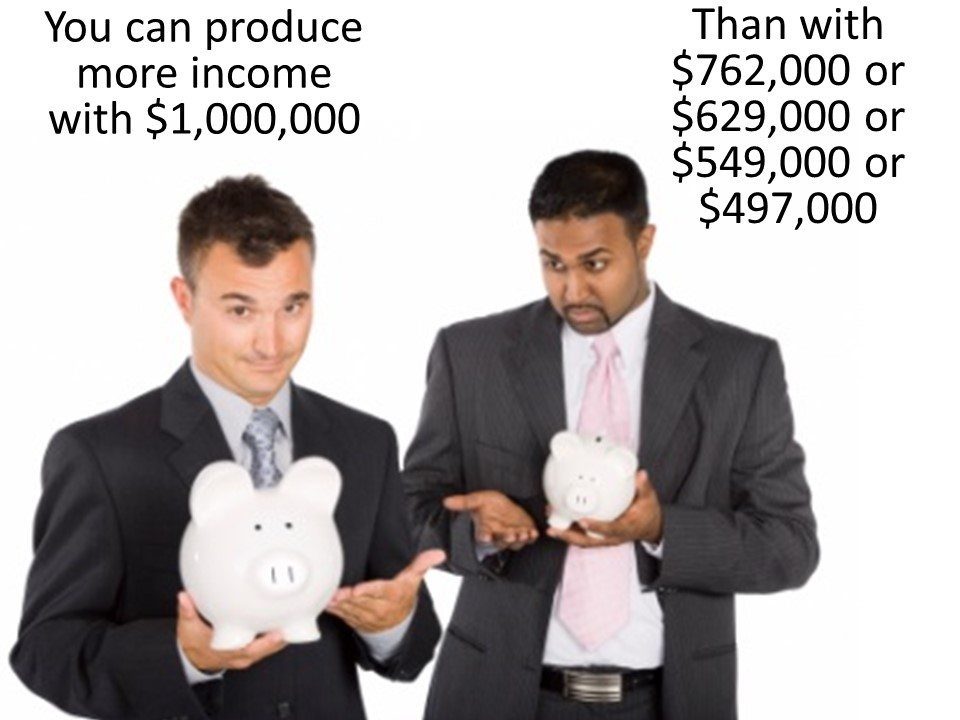
Whether capital gains taxes would cause the owner to lose a quarter, a third, or more than half of the value of his or her asset, avoiding this reduction can result in a much higher level of investment income. The Charitable Remainder Trust offers the attractive option of being able to sell and reinvest a highly appreciated asset with no reduction by capital gains taxes. At a minimum, these capital gains taxes will be deferred to future years, often spreading across the lifetimes of one or more recipients. However, in many cases, the capital gains taxes are not simply deferred, but are completely avoided. Thus, the use of the Charitable Remainder Trust can produce a much higher level of income than would otherwise be available to the owner of a highly appreciated non-income producing asset.
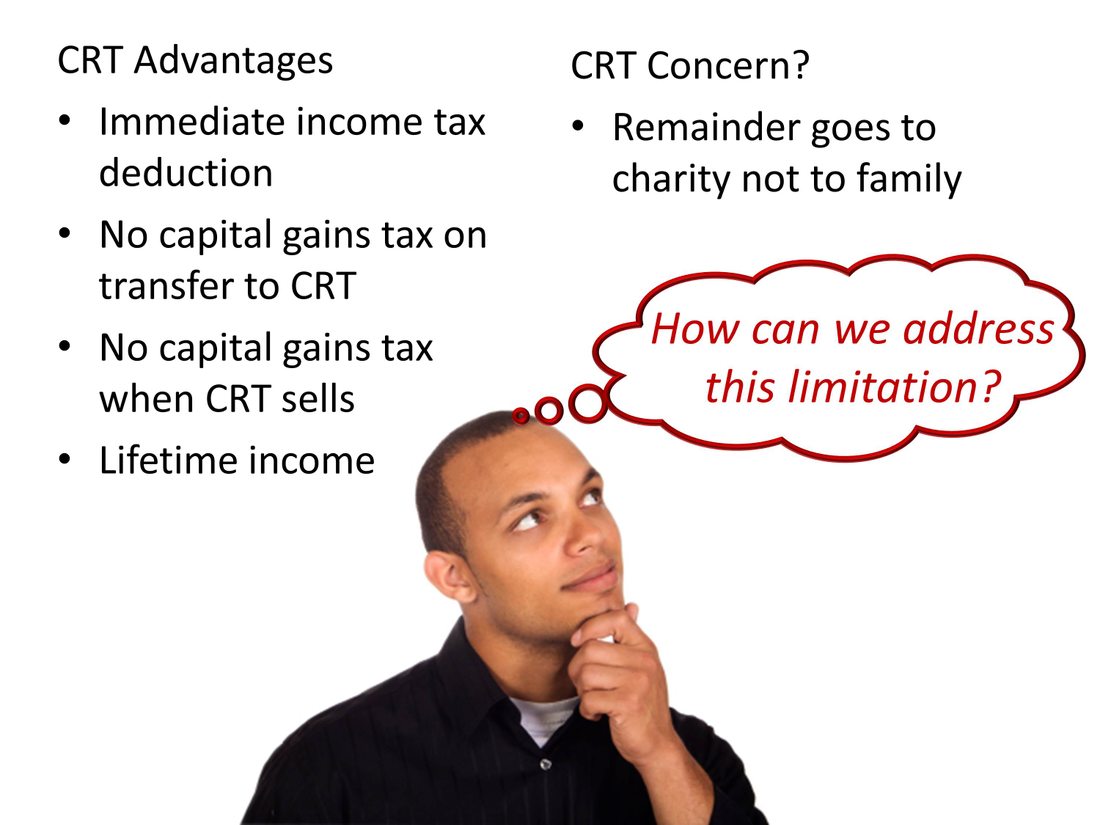
The advantages to using a Charitable Remainder Trust include receiving an immediate income tax deduction, avoiding capital gains taxes on the transfer or sale of underlying assets, and the enjoyment of lifetime payments based upon the full value of the investment asset, undiminished by initial capital gains taxes. These advantages do come with one primary cost. That cost is the requirement that any remainder amount is transferred to a charity. For a donor who already had the intention of leaving assets to charity at death, this result is perfectly appropriate. However, some donors may be particularly concerned about their surviving family members losing the ability to inherit the remainder interest. This might be addressed by giving heirs a lifetime payment stream from the Charitable Remainder Trust. Aside from this, there is another option that will provide the heirs with a lump sum inheritance to replace some or all of the asset that they will no longer be inheriting.

It is common to combine a Charitable Remainder Trust with an Irrevocable Life Insurance Trust as a means to replace the inheritance of the wealth being donated to the charity. The use of the Irrevocable Life Insurance Trust is a method to make the life insurance death benefit pass to the heirs with no estate taxes. In this way, the heirs may lose the rights to inherit an asset which would have been subject to estate taxes but in replacement they receive a tax-free life insurance benefit. Consequently, even a smaller life insurance benefit may be more attractive to the heirs because it passes free from estate taxes. The Charitable Remainder Trust transaction conveniently generates two potential sources to pay for the purchase of life insurance. First, the Charitable Remainder Trust creates an immediate income tax deduction. This allows the donor to take the value of this deduction (i.e., the taxes the donor would have had to pay but for the deduction) and use it to purchase life insurance. Additionally, the Charitable Remainder Trust creates a regular income stream, part of which can be dedicated by the recipient to pay for the purchase of life insurance. This method also allows the donor to transfer a much larger asset to charity, but then use proceeds from the Charitable Remainder Trust to satisfy the needs of heirs through "wealth replacement" by life insurance. Thus, even the primary disadvantage of Charitable Remainder Trusts to the heirs can be softened or eliminated through the use of a combination Charitable Remainder Trust - Irrevocable Life Insurance Trust (CRT-ILIT).
As with Charitable Gift Annuities, the taxation rules for Charitable Remainder Trusts can become complex. This is due to the multi-faceted tax dimensions of a Charitable Remainder Trust transaction. The Charitable Remainder Trust creates an immediate charitable income tax deduction as well as a stream of payments that can be treated as ordinary income, capital gain, and/or return of principal. With the exception of the valuation process for a fixed annuity, the tax treatment of a Charitable Remainder Trust is different than for an otherwise similar Charitable Gift Annuity. The Charitable Gift Annuity rules will not apply to payments received from the Charitable Remainder Trust.
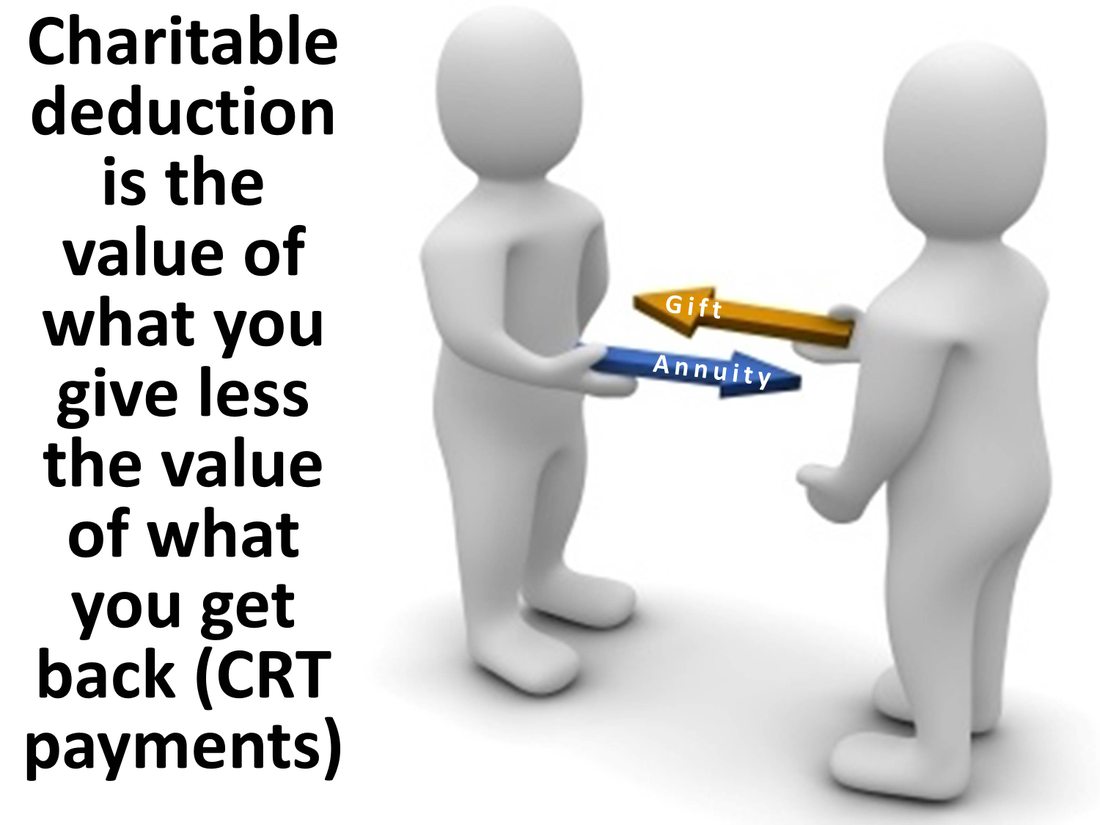
Just as with any bargain sale or quid pro quo transaction, the charitable deduction is simply the value of what the donor gave less the value of what the donor received back. In this case, what the donor receives back are the payments from the Charitable Remainder Trust. (This is still the process for valuing the gift, even if the donor chooses to have the payments made to someone else.)
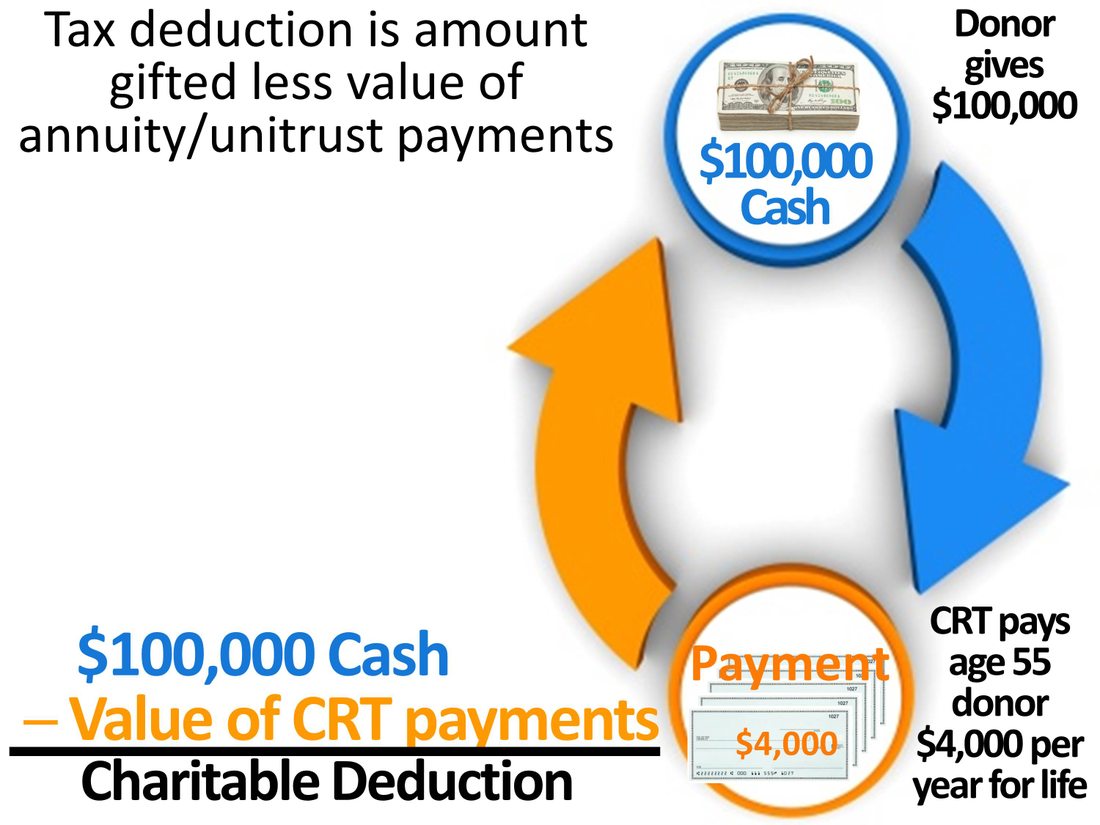
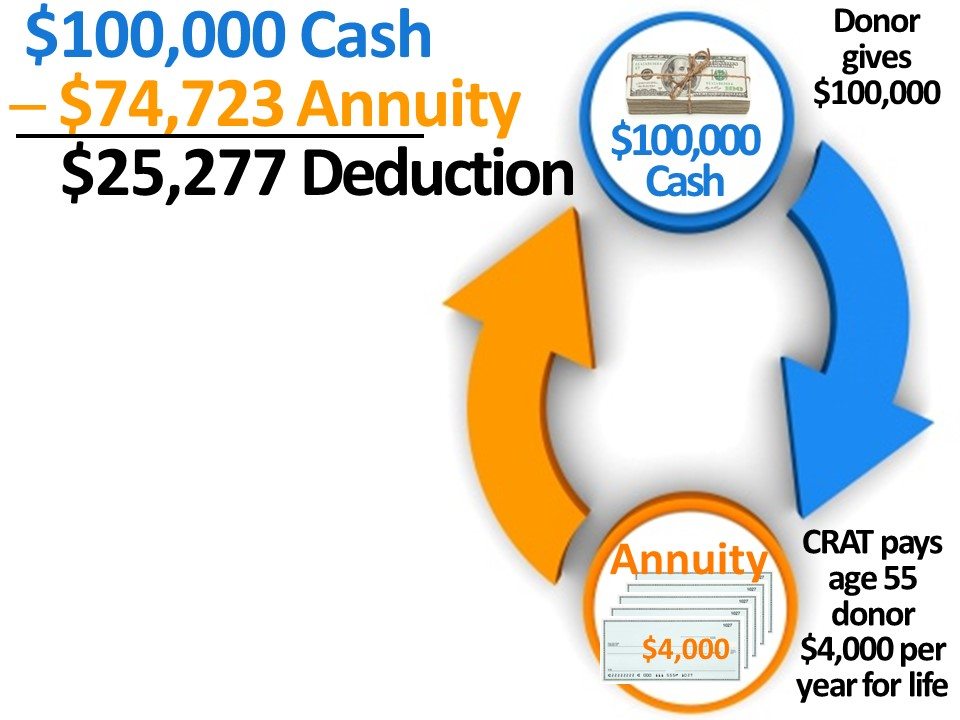
Consider a simple example, using numbers identical to the Charitable Gift Annuity example from that chapter, of a donor who gives $100,000 of cash to his Charitable Remainder Trust and, in exchange, receives the right to collect $4,000 per year for life from the trust. Just as with a Charitable Gift Annuity, the charitable income tax deduction is the amount gifted less the value of the annuity payments. In this case, the fixed annuity amount is $4,000 per year. However, the same concept applies if the donor were receiving a fixed percentage payment of, say, 5% of trust assets per year. The charitable income tax deduction is still the difference between what the donor gave and the value of what the donor received back. The only difference between the Charitable Remainder Annuity Trust and the Charitable Remainder Unitrust is the calculation process for valuing the payments.
So how do we value the payments that are scheduled to come from the Charitable Remainder Trust? Naturally, we do not know in advance how long the annuitant might live. Nor do we know what the future returns of the Charitable Remainder Trust will be. But, we cannot wait until after the death of the donor (or some fixed period of years) before we calculate the value of the charitable income tax deduction. Consequently, the value of the payments are based upon the premise that the annuitant will live to his or her life expectancy as of the date of transfer, and that the investments in the Charitable Remainder Trust will always return exactly the §7520 interest rate as of the date of the transfer. Of course, if the annuitant lives longer or shorter than expected or the investment returns differ from the initial §7520 interest rate, the actual payments to the annuitant may vary widely. This ultimate reality does not affect the valuation of the payments for purposes of the charitable income tax deduction.
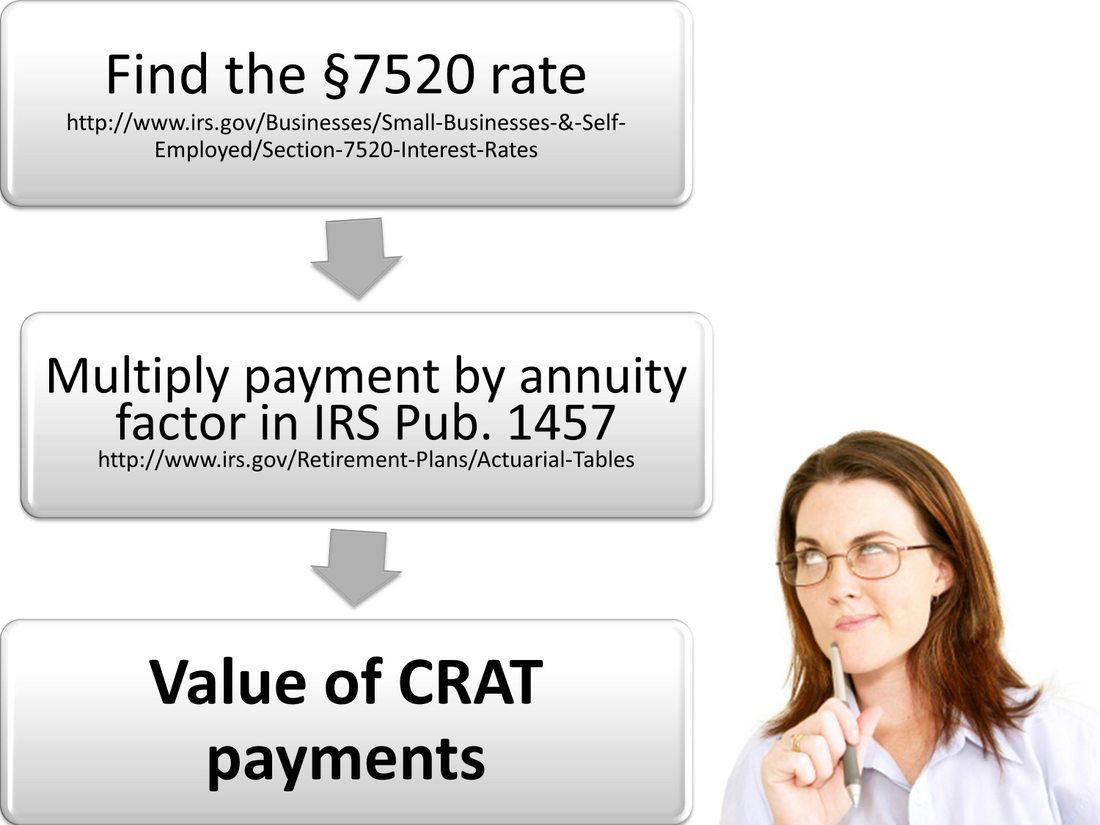
The process of valuing payments from a Charitable Remainder Annuity Trust is identical to the process for valuing payments from a Charitable Gift Annuity. The first step is to find the §7520 rate, which is available at www.irs.gov/Businesses/Small-Businesses-&-Self-Employed/Section-7520-Interest-Rates and at a variety of other planned giving websites. With this rate, the one-life or two-life annuity tables can be used to identify the appropriate annuity factor (tables are located at www.irs.gov/Retirement-Plans/Actuarial-Tables ). Multiplying this annuity factor times the payment (with a possible adjustment from Table K for payments starting earlier than, or given more frequently than 12 months) gives the valuation of the annuity for purposes of the charitable income tax deduction.
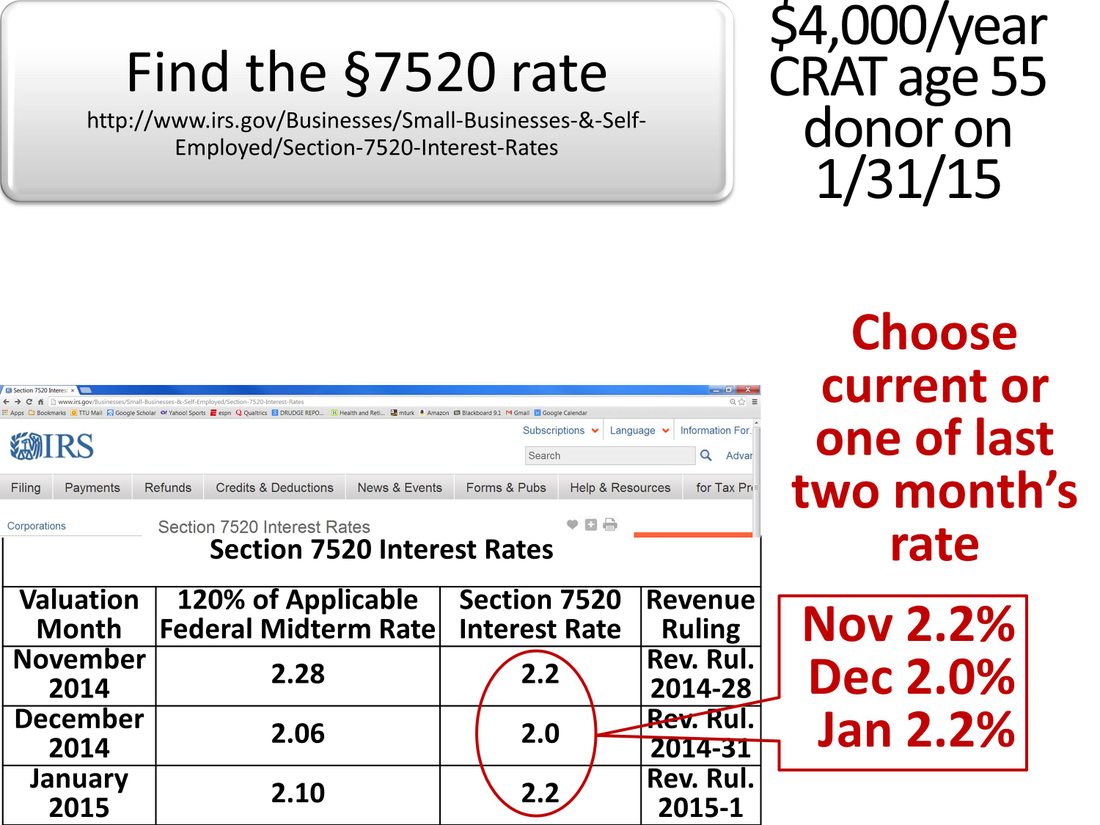
As with Charitable Gift Annuities, the donor is allowed to choose the current §7520 rate or either of the previous two months for the annuity calculation. Additionally, because the next month's §7520 rate is released towards the end of the previous month, the donor may have a choice among four different rates if the transaction can be briefly postponed. In our example of a Charitable Remainder Annuity Trust where the age 55 donor contributes $100,000 and receives a $4,000 per year annuity on January 31 of 2015, the available rates were 2.0% and 2.4%. On that date, the donor would also have known of the upcoming §7520 rate for February and could have postponed the transaction if that rate had been more advantageous. In either case, the donor in this example has the choice of using the 2.0% or 2.2% §7520 rate. Which is preferable?
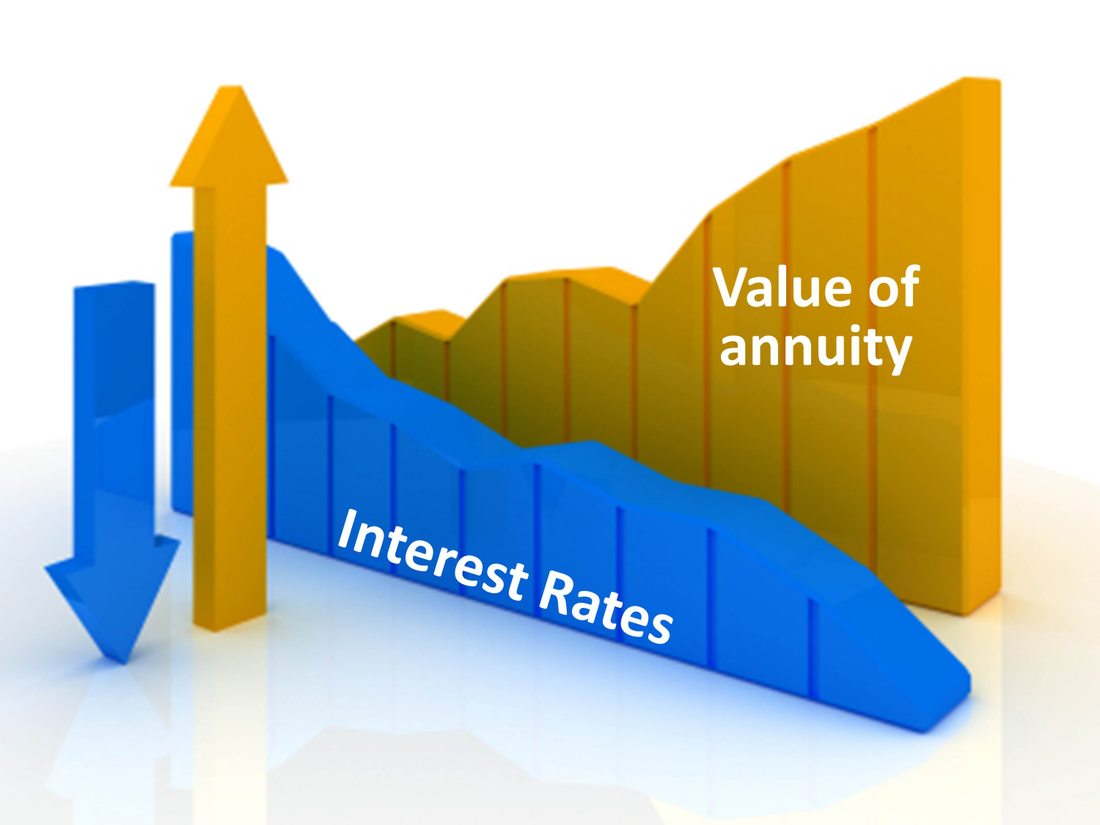
The theory is the same as that used with Charitable Gift Annuities. As interest rates increase, the value of a fixed dollar annuity decreases. Because the charitable tax deduction is the difference between the $100,000 transfer amount and the value of the fixed dollar annuity, the donor will want the highest interest rate as this produces the lowest calculated value for the annuity.
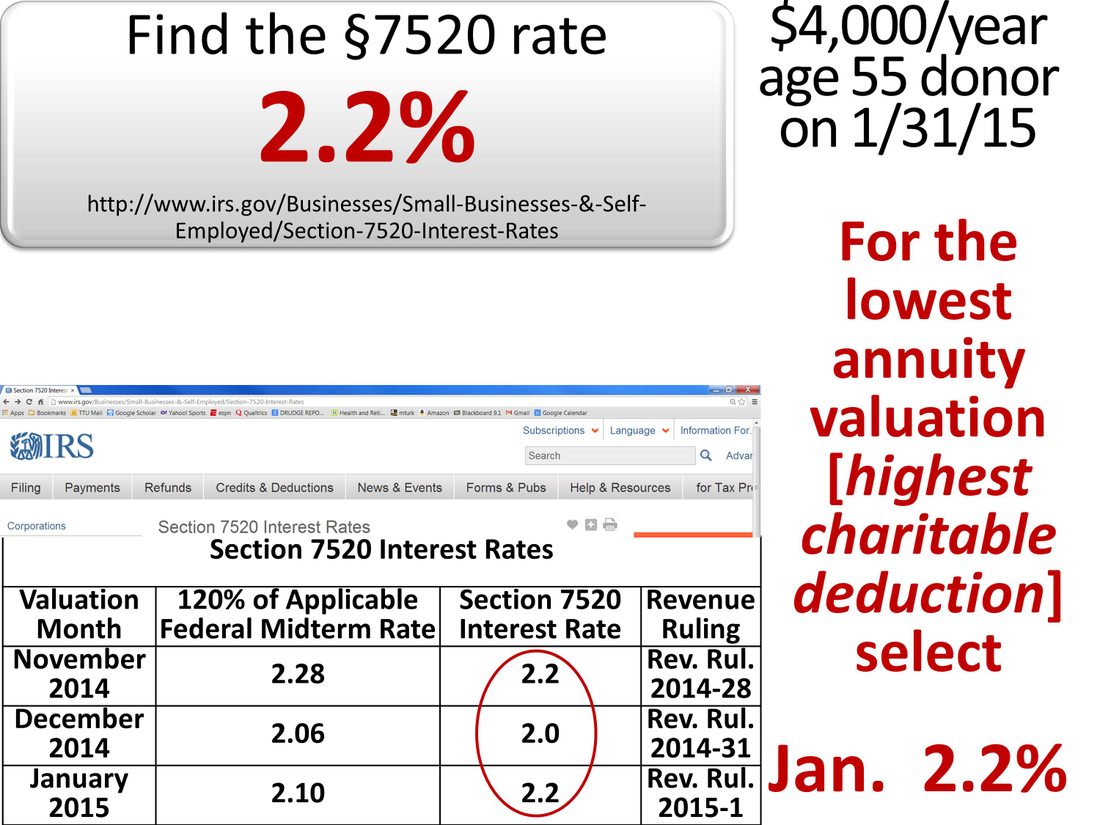
In this case, the donor is benefited by choosing the highest interest rate available, which is the 2.2% §7520 rate from January. This higher rate results in a relatively lower valuation of the annuity payment stream and consequently a relatively higher valuation of the charitable income tax deduction.
Although the higher interest rate results in a larger charitable income tax deduction it also results in a lower total investment portion, which will be counted as tax-free return of capital when returned. In cases where the charitable tax deduction could not be fully used, this could lead to a circumstance where the lower rate would be preferred. Such a scenario is much less likely with Charitable Remainder Trusts than with Charitable Gift Annuities. A Charitable Gift Annuity donor who lives to his or her life expectancy will receive all of his or her investment back as tax-free portions of the annual payments. In contrast, the tax characterization for payments to a Charitable Remainder Trust donor is quite different. It is quite possible for a donor not to receive any of his or her investment back as tax-free repayment of principal in a Charitable Remainder Trust, which makes this strategy far less attractive for Charitable Remainder Trusts than for Charitable Gift Annuities. The rules for counting payments as return of investment will be discussed in more detail later in this chapter.
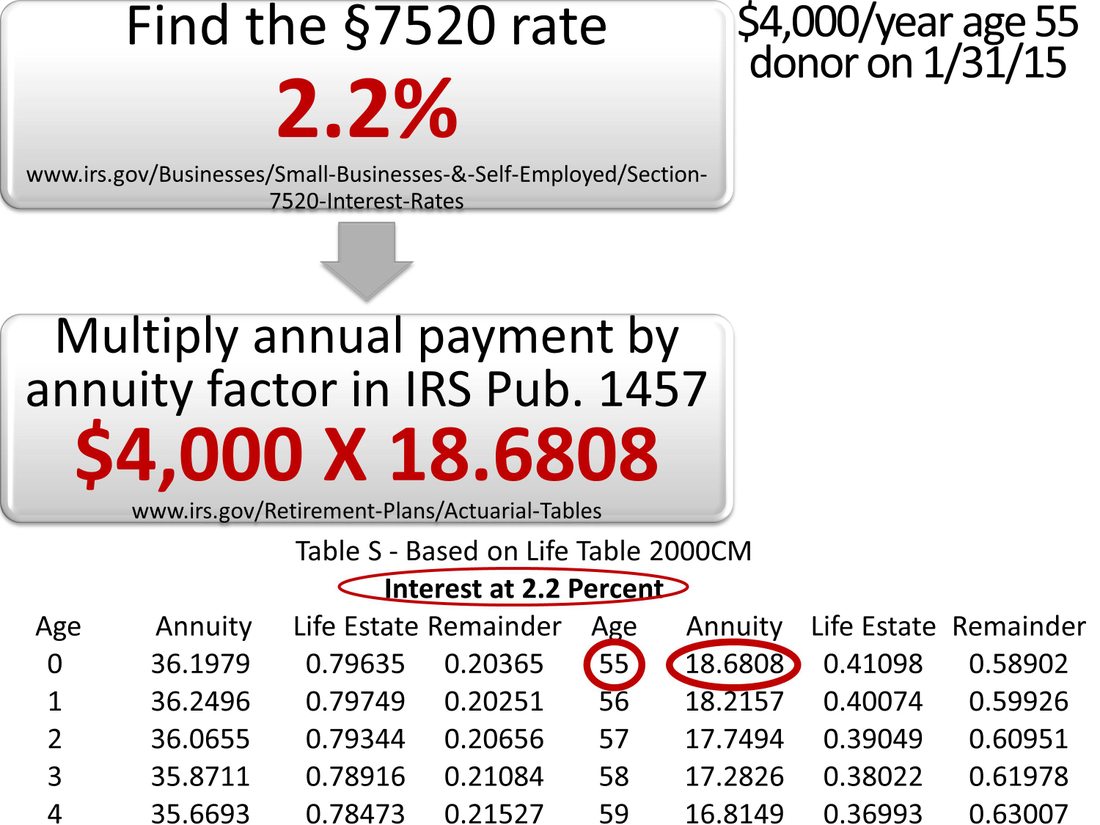
Once the §7520 rate has been selected, we can now move to the appropriate section of the single-life Table S. Once we are in the section of the single-life table S for a 2.2% interest rate, we see that the annuity factor for an age 55 donor is 18.6808. Multiplying this annuity factor times the $4,000 per year annuity payment gives the valuation for the annuity payments of $74,723.20.
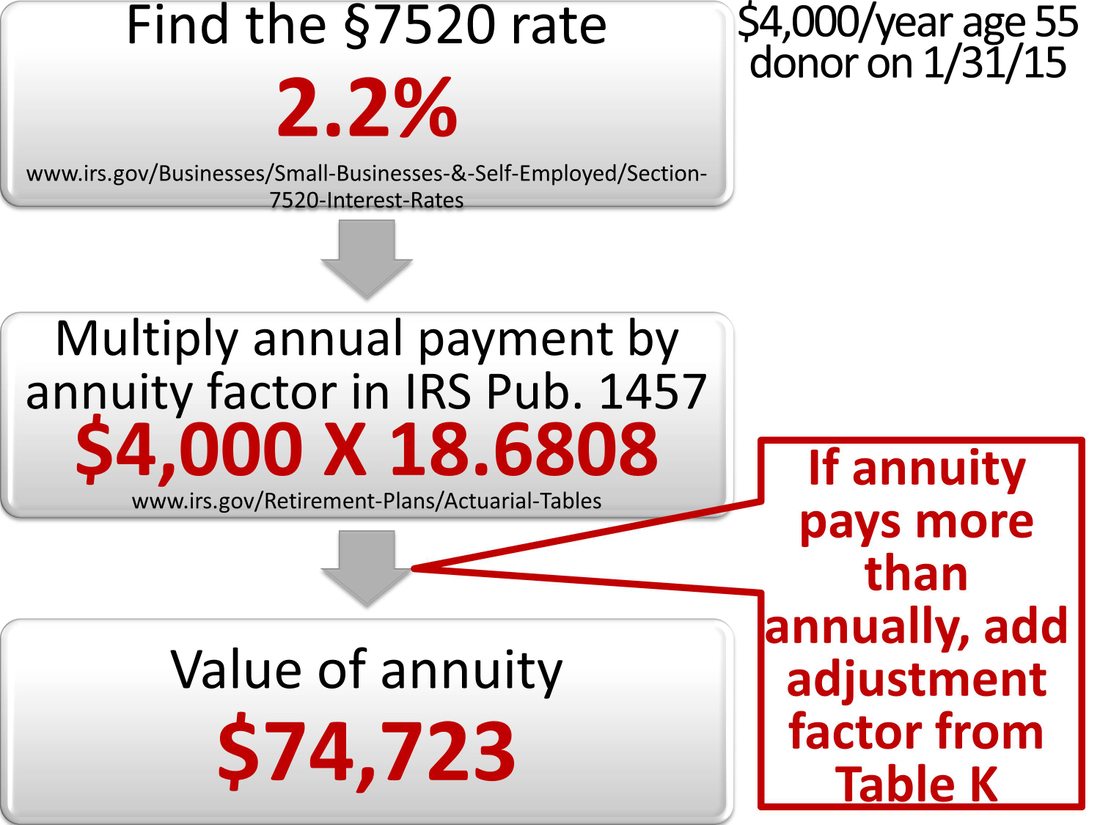
If this annuity payment were to be made annually on the anniversary of the initial transfer, the $74,723.20 valuation would be correct. If the annuity made its first payment prior to the anniversary of the initial transfer, or made payments more frequently than annually, the valuation would have to be increased by an adjustment factor taken from Table K from the same website. In that case, the annuity would be worth less (more) if the annuitant would receive the payments later (earlier) because payments received earlier could presumably be invested to earn additional interest.
Just as with a Charitable Gift Annuity, the calculation of the charitable income tax deduction is simply the amount of the transfer, $100,000, less the value of the annuity, $74,723.20, for a total deduction of $25,276.80.
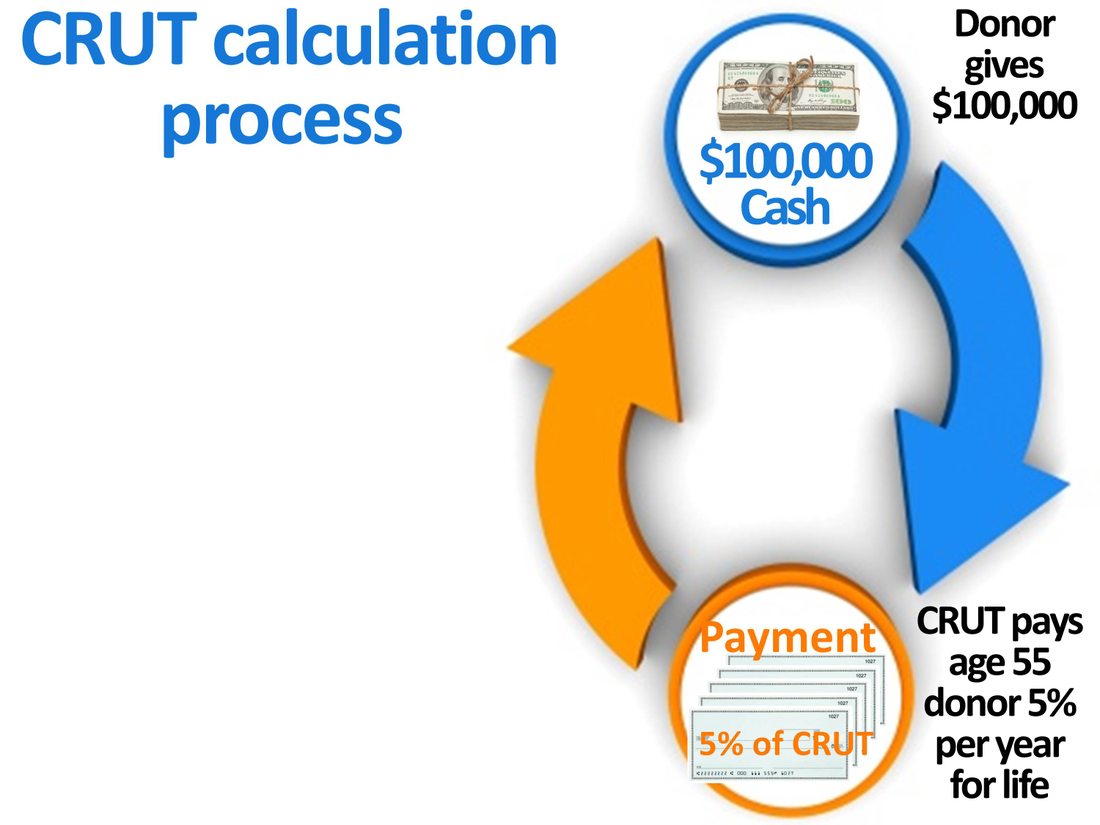
Now suppose the donor is receiving not a fixed dollar payment, but rather receiving 5% of all assets inside the Charitable Remainder Trust as of the anniversary date of the initial transfer. This is a unitrust, not an annuity trust. The process for calculating the charitable income tax deduction resulting from a transfer to a Charitable Remainder Unitrust differs slightly from the calculation for a Charitable Remainder Annuity Trust. The concept, however, is identical in that the deductible gift is the difference between the transfer and the value of the payment stream promised to the annuitant.
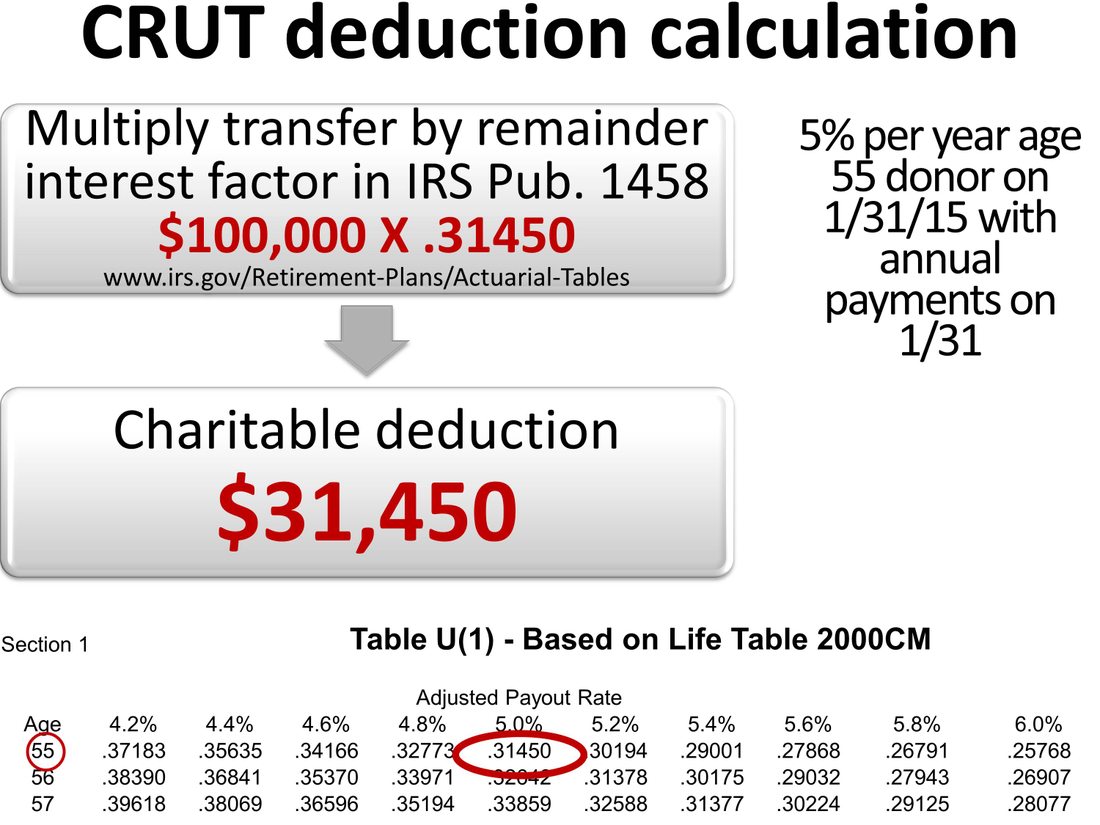
There are actually fewer steps for calculating the charitable deduction for a Charitable Remainder Unitrust than for a Charitable Remainder Annuity Trust. To calculate the deduction for the age 55 donor receiving a 5.0% payout rate, simply multiply the initial transfer amount by the remainder percentage found in table U of the same website (www.irs.gov/Retirement-Plans/Actuarial-Tables). This remainder interest is .31450 which, when multiplied by the $100,000 initial transfer, results in a charitable deduction of $31,450.
Notice that we did not use the §7520 interest rate in the calculation of the charitable income tax deduction for a Charitable Remainder Unitrust. How is this possible? As interest rates rise, the amount remaining at the expiration of the annuitant's initial life expectancy would also rise. But, the present value discounting of that larger future value also increases due to the higher interest rate and this difference exactly offsets the increased remainder amount in present value terms. Let's look at an example. Suppose an annuitant had a 20 year life expectancy and received 5% of the value of the trust at the end of each year. If we used a 0% interest rate, then the amount remaining in 20 years would be $35,849. Because the interest rate was 0% the present value of that amount would also be $35,849. If instead we used a 10% interest rate, then the amount remaining in 20 years would be a much larger $241,171. But, the present value of $241,171 received in 20 years using a 10% interest rate is the same $35,849. Because the charitable income tax deduction is based on the present value of the predicted transfer to charity, changes in the interest rate have no effect on this deduction.
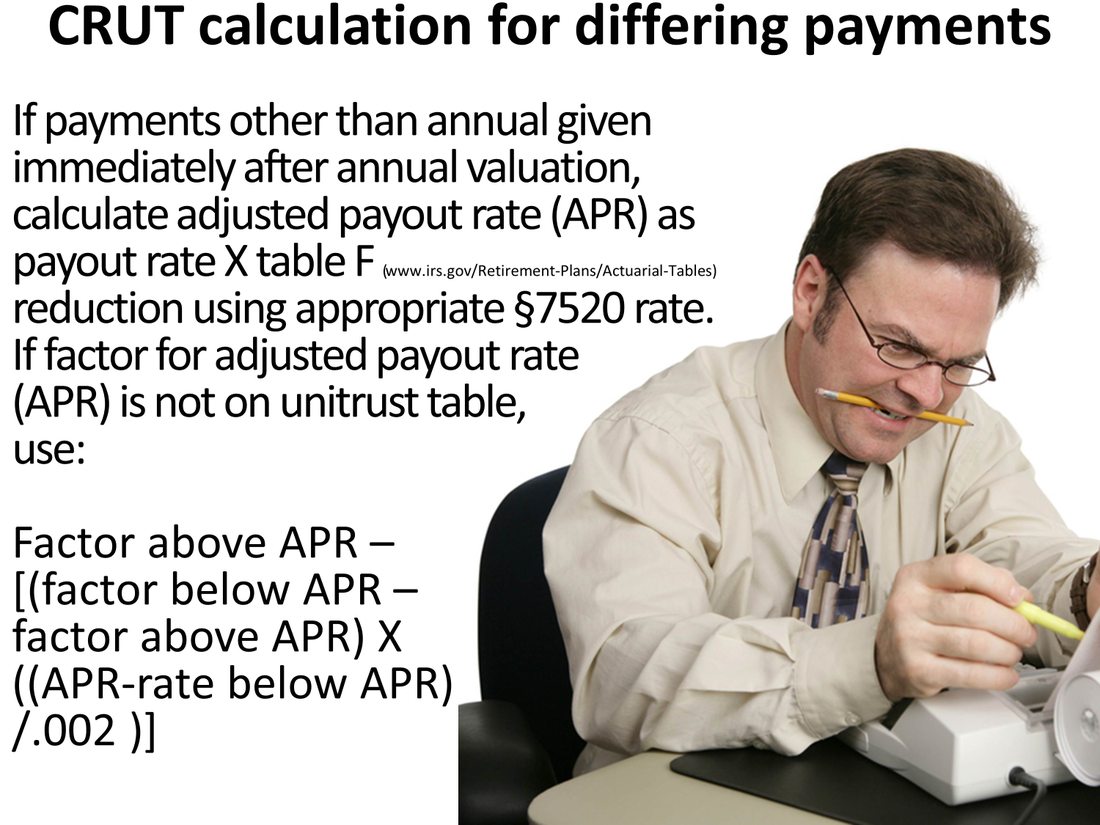
The standard calculations for valuing the tax deduction for gifts to a Charitable Remainder Unitrust are based on the assumption that payments to the annuitant will be made immediately each year after the annual valuation. When the payments are postponed, for example by being paid out monthly over the course of the following year, the annuitant receives a reduced benefit. For annuity trusts and Charitable Gift Annuities the valuation of this change in benefit due to intra-year timing of the distribution is calculated using table K. For unitrusts this adjustment is made using table F (linked at the same website at www.irs.gov/Retirement-Plans/Actuarial-Tables), which generates an adjusted payout rate. For example, a 6% payout rate, if paid quarterly beginning with the first payment immediately after the annual valuation when the §7520 rate is 2.4% generates an adjusted payout rate of 6% x .991168 or 5.947008%. This creates a problem because Table U contains remainder factors for 6.0% and 5.8%, but not for 5.947008%. Calculating the remainder factor (i.e., the charitable tax deduction) requires interpolating between the factor for 6.0% and the factor for 5.8%. The formula for this interpolation, where APR is the Adjusted Payout Rate is
(Table U factor at rate below APR) - [(Table U factor at rate below APR - Table U factor at rate above APR) X (APR - Table U rate below APR)/.002 )].
So, if the annuitant were age 55 in the previous example (where the adjusted payout rate was 5.947008%) then the present value of the charity's remainder interest would be
.26791-[(.26791-.25768) X ((.05947008-.058)/.002)] = .26039.
As expected, this remainder interest factor (.26039) for the 5.947008% rate is between the factor for the 6% rate (.25768) and the 5.8% rate (.26791).
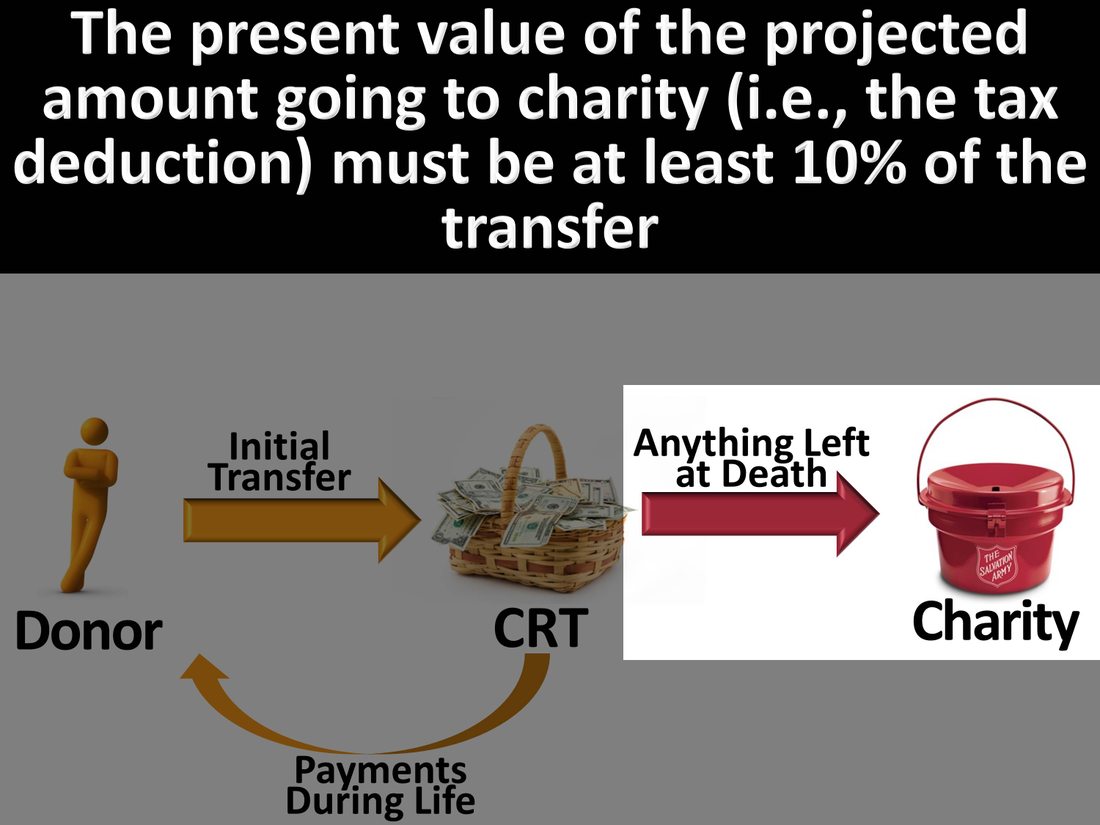
A contribution to a Charitable Remainder Trust is required to have a minimum of 10% of the present value projected to go to charity at the termination of the trust. This requires that an amount significantly larger than 10% of the original amount be projected to go to charity at termination, because the charity is required to wait a substantial amount of time before receiving any funds. In other words, in order to generate a present value of 10%, the future value projected to go to the charity will necessarily be larger. Because the charitable income tax deduction resulting from a transfer to a Charitable Remainder Trust is the present value of the amount projected to go to charity (when the transfer is valued at fair market value), this means that the charitable income tax deduction for a transfer to charity must be at least 10% in such a case. If the amount projected to go to charity has a present value of less than 10% (when the transfer is valued at fair market value), the trust will not qualify as a Charitable Remainder Trust. This means that there will be no deductible gift. The general rule is that gifts where the donor keeps a retained interest of a different type than that given to charity are not deductible. The Charitable Remainder Trust is an exception to this rule. If a trust no longer qualifies as a Charitable Remainder Trust, then no exception applies and the gift is not deductible. Additionally, because the trust will no longer qualify as a charitable trust, it will be required to pay taxes on any realized capital gains or income resulting from trust investments. (In practice, such trusts can include language permitting the trustee to amend the trust - e.g., increasing the charitable share - for purposes of guaranteeing that the Charitable Remainder Trust rules are met.) Thus, it is essential that the trust is projected to give a large enough amount to charity that would generate at least a 10% tax deduction were the transfer to be valued at fair market value. It is important to note that all of these calculations are based upon the amount projected to go to charity. The amount that is actually transferred to charity is irrelevant to the tax calculation. This amount can be greater or less depending upon the return on the underlying investments and, in cases where the trust payments continue for a life or lives, the longevity of the annuitant.
The amount projected to go to charity - and the tax deduction based on the present value of that amount - depend upon the longevity of the annuitant (who is typically the donor). The longer an annuitant lives, the longer a charity will have to wait to receive any funds. To the extent that the annual payments to annuitant(s) exceed the earnings of the trust, greater longevity will also result in a smaller nominal amount being left to the charity. (In the case of a Charitable Remainder Annuity Trust, it is possible for the trust to completely exhaust, leaving no money for the charity, because the payments remain the same regardless of the funds remaining in the trust. Total exhaustion of a unitrust is less likely because payments become smaller as the trust amount becomes less.)
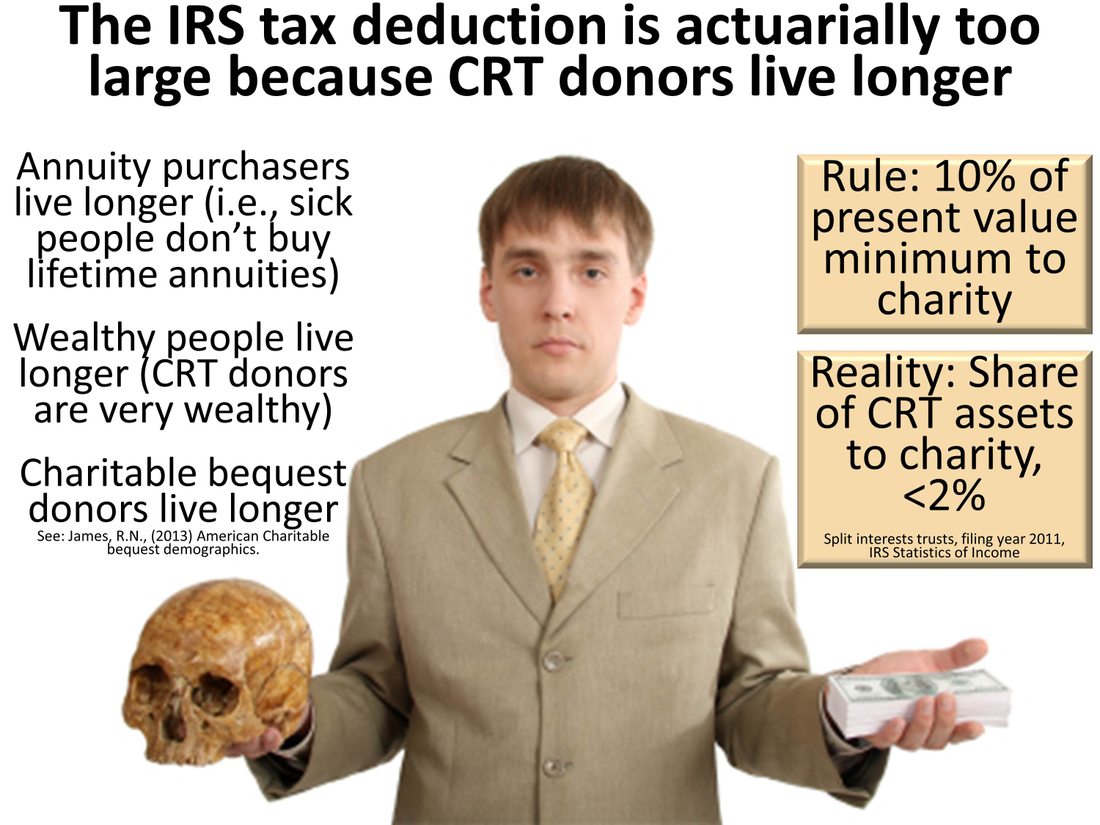
The calculation used by the IRS to project the life expectancy of the annuitant systematically under-projects typical donor-annuitant life expectancy. Consequently, the tax deduction generated from transfers to Charitable Remainder Trusts is, actuarially, much larger than it should be. The source of this misprojection is that the IRS calculations are based upon normal life expectancy for a typical person of the annuitant's age. However, donor-annuitants, on average, live much longer than typical people of their same age. This is due to three reasons.
First, annuitants self-select for health. In other words, people who know that they have a substantially greater risk of death generally don't purchase annuities. Clearly, it makes no financial sense for a person with a known terminal illness to purchase a lifetime stream of payments. Because this "sick" group is largely excluded, the resulting life expectancy of annuity purchasers is, on average, longer. (Unlike the IRS, commercial annuity companies use a special life expectancy table when pricing commercial annuities that reflects this selection bias.)
Additionally, those who establish Charitable Remainder Trusts are typically quite wealthy. On average, wealthy people live longer than others of their same age. This may be due to factors such as the access to medical care and health promoting environments that money can purchase as well as physical and mental capabilities that help to both generate wealth and result in a longer life.
Finally, recent evidence suggests that those with charitable bequest plans live even longer than those of their same wealth decile (see American Charitable Bequest Demographics). Charitable Remainder Trusts typically make a transfer of the donor's assets at the death of the donor, making them a form of general charitable bequest planning. The reason for this additional longevity among those with a charitable bequest plan has not been identified, but may relate to the importance of purpose and social connectedness in both giving and longevity.
The net result of this combination of factors is that donor-annuitants will live, on average, much longer than IRS projections. Consequently, donors will receive a larger tax deduction than might be justified by reality. One potential indicator of this reality is the share of Charitable Remainder Trust assets actually distributed to charity. In 2011, for example, Charitable Remainder Trusts held over $99 billion in assets, but made charitable distributions of only $1.9 billion, or less than 2% (Rosenmerkel, L. S., 2013, Split-Interest Trusts, Filing Year 2011, IRS Statistics of Income). Arguably, this may be a "temporary" experience due to the relatively recent establishment of some Charitable Remainder Trusts. However, given that such trusts were authorized in the tax code in 1969, to have such a small portion of assets going to charities some 42 years later suggests the potential for additional causes of this result, such as actuarially inappropriate valuations.
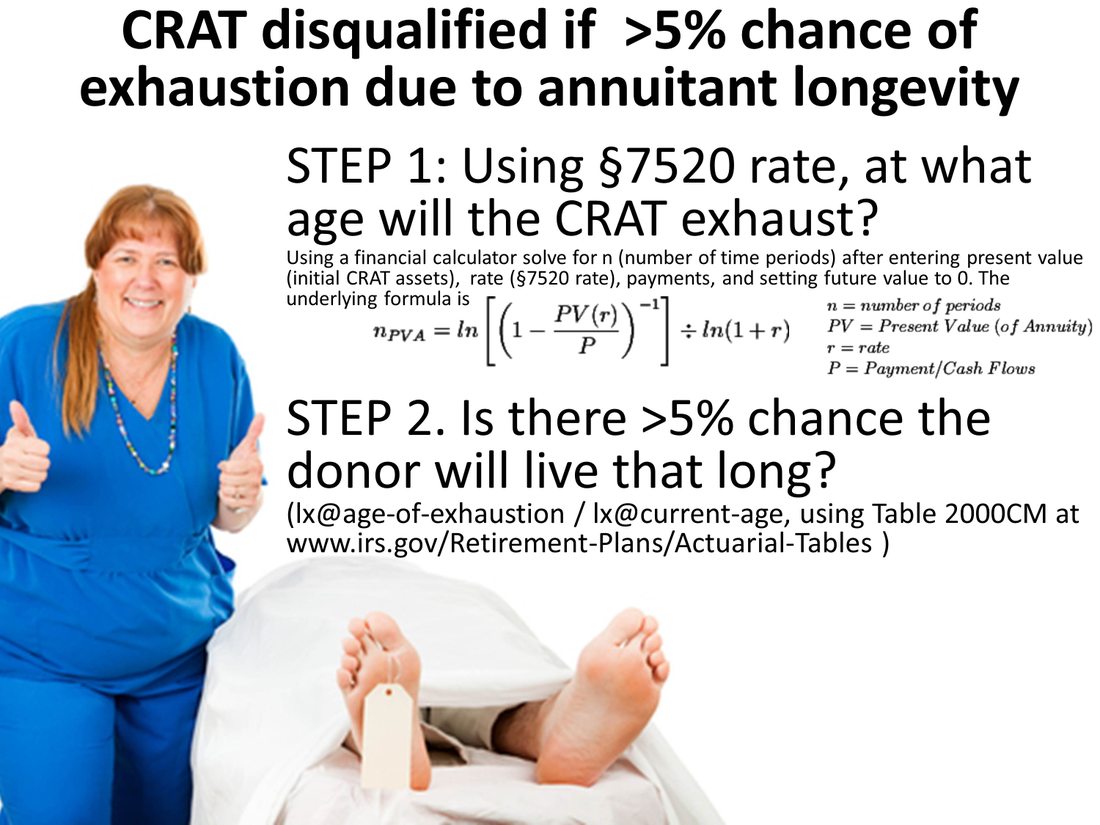
Both the Charitable Remainder Unitrust and the Charitable Remainder Annuity Trust are required to project that an amount with a present value of at least 10% of the initial transfer should go to charity at termination. However, the Charitable Remainder Annuity Trust has an additional requirement. Unlike a Charitable Remainder Unitrust, as the assets in a Charitable Remainder Annuity Trust grow smaller and smaller, the payment remains at its original dollar level. Because the payments do not become smaller as the assets in the Charitable Remainder Annuity Trust become smaller, there is a greater risk of total exhaustion of all funds in the Charitable Remainder Annuity Trust, especially where the annuitant lives much longer than expected. In the event of exhaustion, the donor would have enjoyed dramatic tax benefits with no actual charitable transfers ever taking place. This is a very bad result from the perspective of the goals of tax policy. To provide some protection against this disturbing outcome, a Charitable Remainder Annuity Trust will be disqualified if there is greater than a 5% chance of exhaustion due to annuitant longevity unless it uses the alternative safe harbor language provided by the IRS in 2016.
Determining if there is a greater than 5% chance of exhaustion, first requires, a standard time value of money calculation determines at what age the CRAT would exhaust. Using a standard financial calculator this is done by solving for n (the number of time periods), after entering the interest rate (initial §7520 rate), present value (the initial transfer amount), payments per time period (the charitable remainder annuity payment), and a future value of zero (the point of exhaustion). This amount of time (n time periods) is added to the annuitant's current age to identify the age at which the Charitable Remainder Annuity Trust would exhaust. Next, to determine if there is a greater than 5% chance that the annuitant will live to that age, divide the number of people alive at the annuitant's projected age of exhaustion by the number of people alive at the annuitant's current age, according to IRS Table 2000 CM. This table is located at www.irs.gov/Retirement-Plans/Actuarial-Tables, and the relevant numbers are labeled as Lx. If this ratio is greater than .05, the trust does not pass the test.
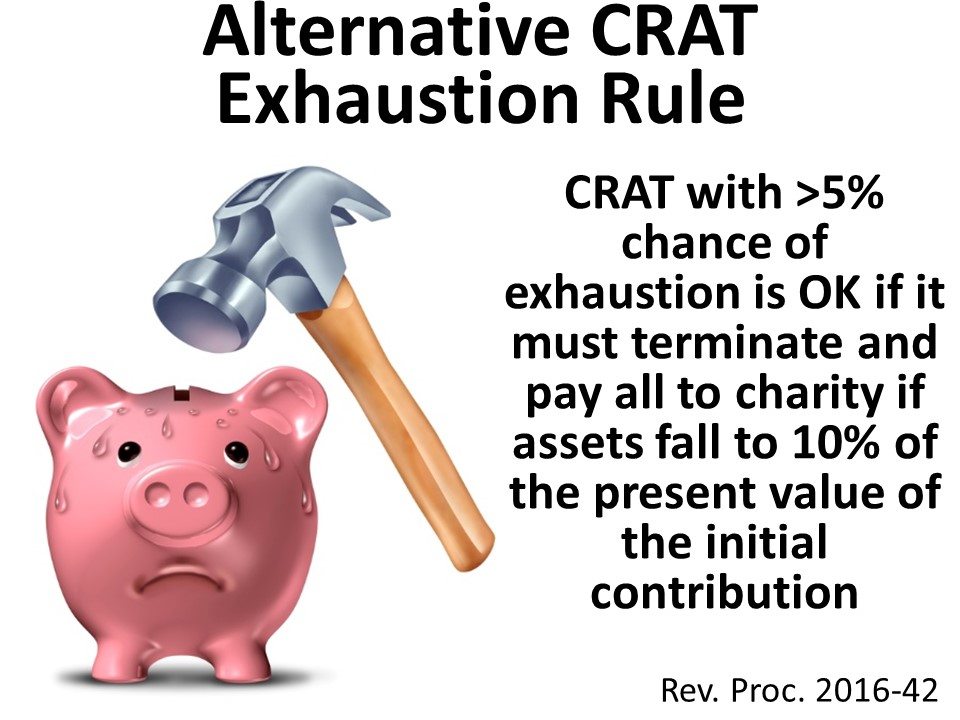
For such trusts, there is an alternative solution. The trust will not be disqualified if it requires termination and transfer of all remaining assets to charity whenever those assets fall to an amount that would have had a present value of 10% or less of the initial contribution using the initial §7520 interest rate. In other words, if the trust ever falls to an amount that would have had an initial present value of 10% or less at the time of the initial contribution, it must immediately distribute everything to charity. This alternative is particularly important during low interest rate environments when it might be otherwise impossible to avoid the 5% exhaustion disqualification for all but the oldest donors.
A trust intended to be a Charitable Remainder Trust can be disqualified for a number of reasons, such as being projected to leave too little to charity or having too great of a risk of exhaustion. But, what happens if the trust fails to qualify as a Charitable Remainder Trust under the tax code? A disqualified trust doesn't just disappear. Its failure to comply with the tax requirements for a Charitable Remainder Trust typically won't change the fact that the trust was created under state law, is irrevocable, and may be holding the assets transferred by the donor. So, what happens then?

Although the trust continues to exist as an irrevocable trust, it does not qualify for treatment as a Charitable Remainder Trust under federal tax law. Consequently all of the charitable tax benefits are lost. The donor receives no tax deduction for transferring assets to the trust. Additionally, the trust itself is not a tax-exempt entity. Thus, whenever the trust sells an appreciated asset, the trust must pay capital gains taxes on that sale. This means that the donor loses the ability to defer recognition of capital gains taxes. Whenever the trust earns income of other types, it must also pay taxes on that income. This means the trust can no longer grow assets in a tax-free environment. In fact, trusts are subject to a "compressed" tax rate schedule, meaning that trusts pay the highest marginal income tax rate (37%) at a much lower level of income ($15,650 in 2025) than individual taxpayers do. As a result, the disqualification of a Charitable Remainder Trust would be a tax disaster for most donors. Because of this dramatically negative result, such trusts are typically drafted with language that allows the trustee to amend the terms of the otherwise irrevocable trust if such changes are required to allow the trust to qualify as a Charitable Remainder Trust under the federal tax law.
We have considered the charitable income tax deduction generated for the donor transferring funds to a Charitable Remainder Trust, and the tax treatment of gains recognized or income earned by the trust itself. There is one additional source of tax consequences for transfers to a Charitable Remainder Trust. This comes from the payments made from the Charitable Remainder Trust to the annuitant(s). When an annuitant receives a payment from the Charitable Remainder Trust, how should the annuitant report the payment on his or her taxes?
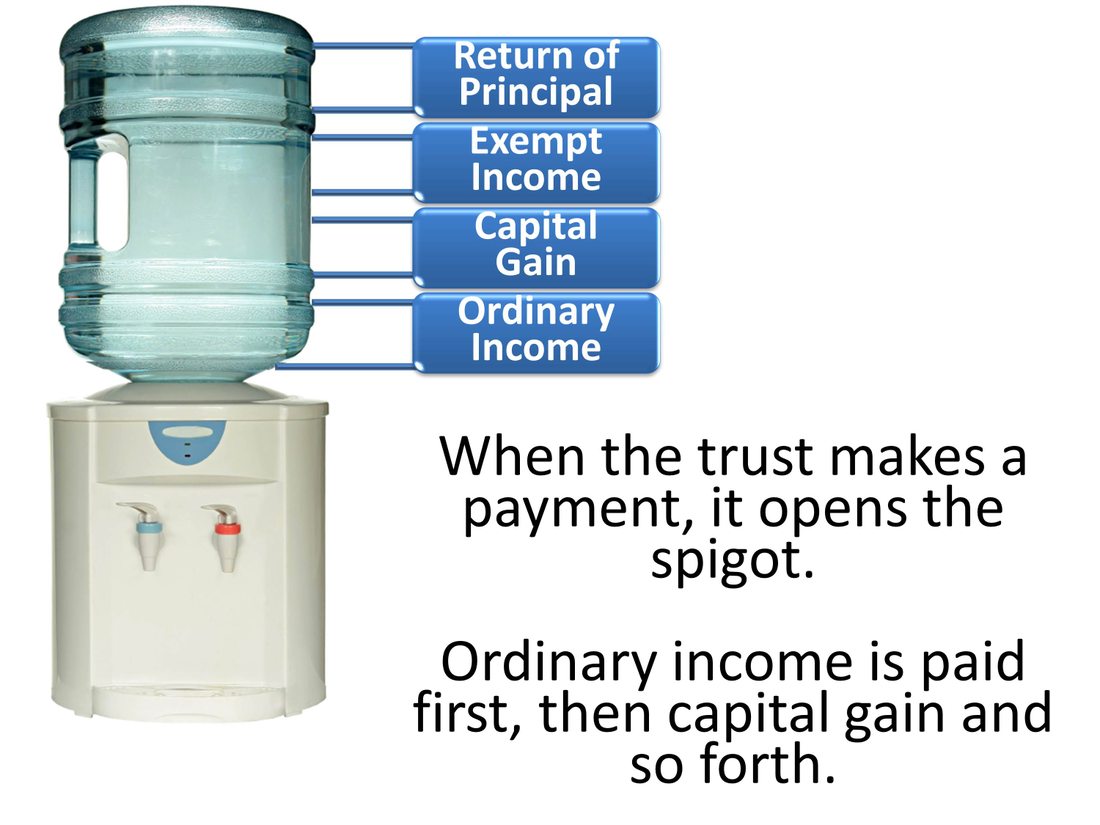
The tax treatment of payments coming to an annuitant depends in part on the tax characteristics of the money held by the Charitable Remainder Trust. The trust may be holding a variety of asset types including ordinary income, capital gain, exempt income, and initial principal (e.g., the basis in property initially transferred to the trust). So when a trust is holding all of these types of assets, how do we determine which asset type the annuitant receives? The fundamental rule is referred to as "worst in, first out" (WIFO). In other words, the annuitant receives the asset type that would normally generate the highest tax rates first. Assets with lower tax rates will be distributed only after there are no remaining assets with higher tax rates.
An easy way to visualize this rule is to think of the Charitable Remainder Trust assets as liquid inside a water cooler where the assets with the heaviest taxation are on the bottom and those with lighter taxation at progressively higher levels. When a payment is made from the trust, it is like opening the spigot at the bottom of the water cooler. The liquid with the heaviest taxation comes out first, and those with lighter taxation will come out only after those assets with heavier taxation have been completely drained. For example, all ordinary income will be paid out before any capital gain income. All capital gain income will be paid out before any tax exempt income. And distribution of tax-free return of principal will occur only when there are no other types of assets to distribute.
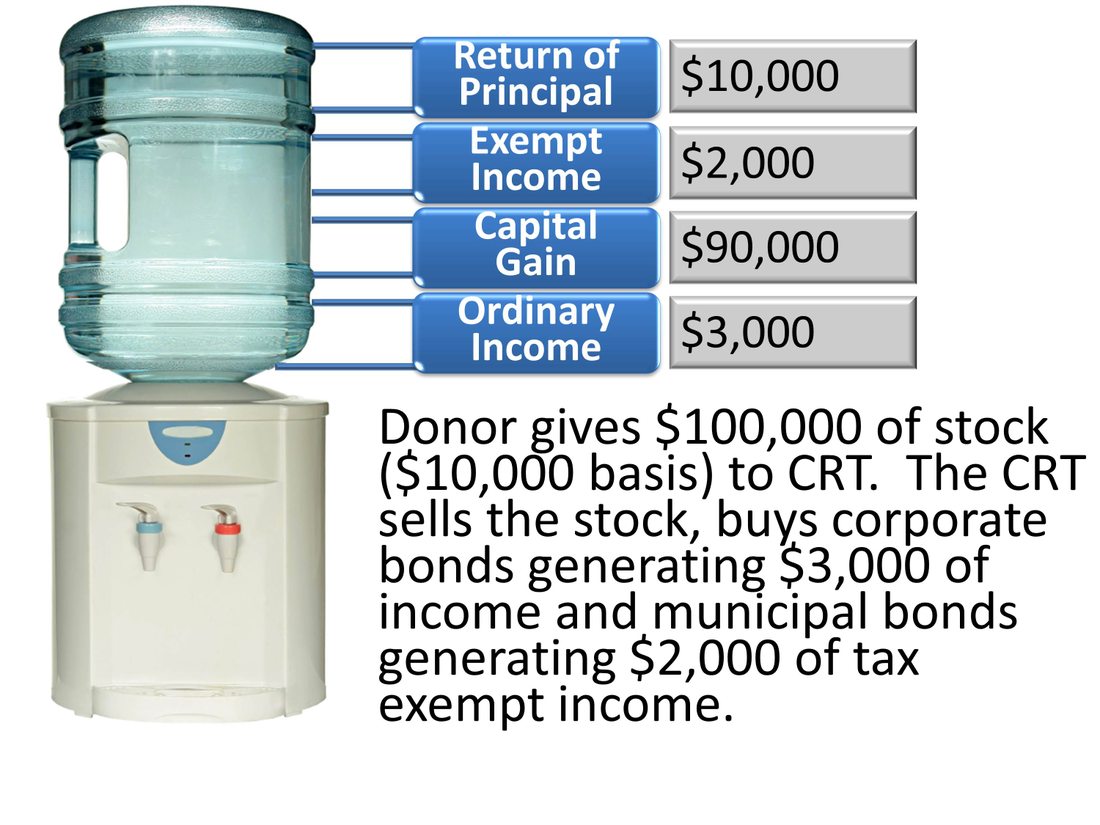
Let's consider an example to demonstrate how the WIFO (worst in, first out) rule works. Suppose a donor gives $100,000 of stock, which she initially purchased for $10,000, to a Charitable Remainder Trust. After receiving the stock, the Charitable Remainder Trust trustee sells the stock for $100,000 and buys corporate and municipal bonds. During the first year of the trust, the corporate bonds generate $3,000 of income and the municipal bonds generate $2,000 of tax exempt income. Assuming that the Charitable Remainder Trust makes annual payments, what type of assets will be included in the trust at the end of the first year when the first payment is about to be made? The donor's $10,000 basis is included in the trust as an asset that could be paid to the annuitant as tax-free return of investment. At the next level, the trust has earned $2,000 of tax-exempt income from its investments in municipal bonds. Next, the trust has $90,000 in capital gains from the sale of the stock for $100,000 (because the stock was purchased by the donor for $10,000). Finally, the trust has $3,000 of ordinary income earned from the corporate bond investments. The trust itself is a tax-exempt entity. Thus, the trust pays no taxes on any capital gain or income earned. However, if capital gain or ordinary income is distributed to an annuitant, then the annuitant will be taxed on that distribution based on the type of income/gain being distributed.
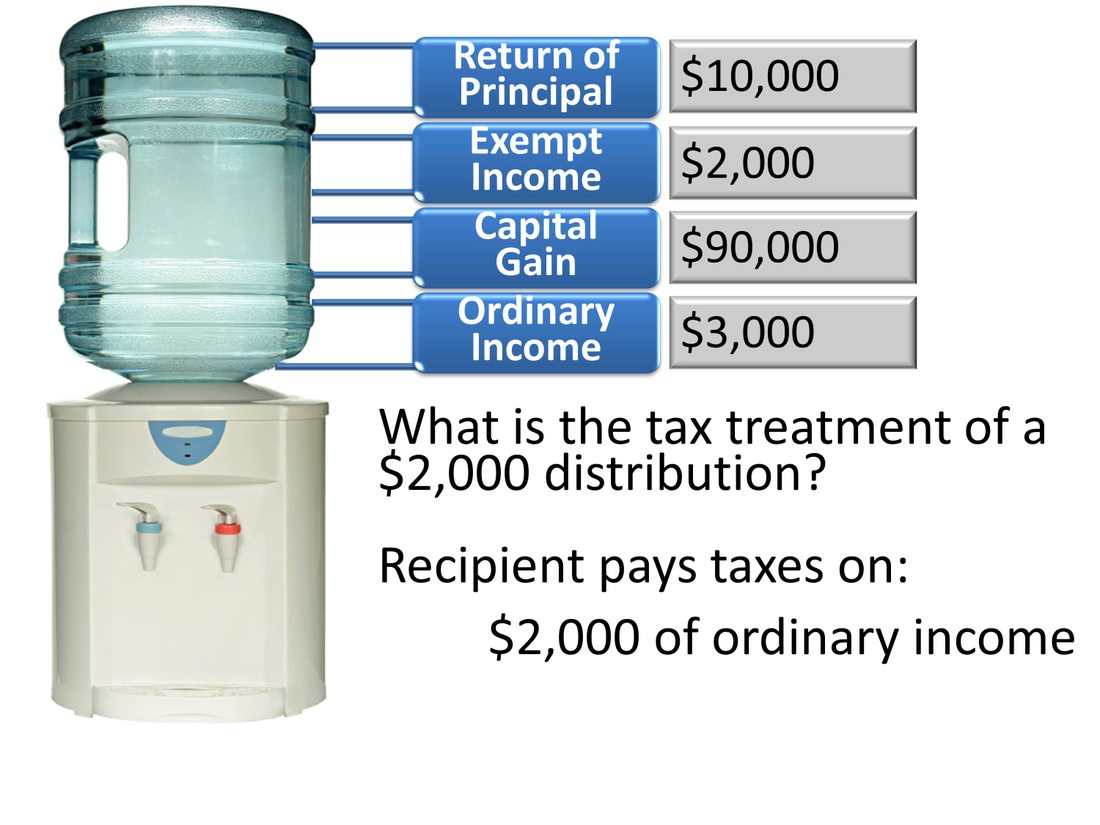
Suppose this Charitable Remainder Trust were required to pay $2,000 to the annuitant. How would the annuitant report this $2,000 payment on her taxes? In this case, the trust is holding $3,000 of ordinary income (earned from its investment in corporate bonds). Because all ordinary income must be paid out prior to the payment of other types of income, the entire $2,000 payment will count as ordinary income to the annuitant.
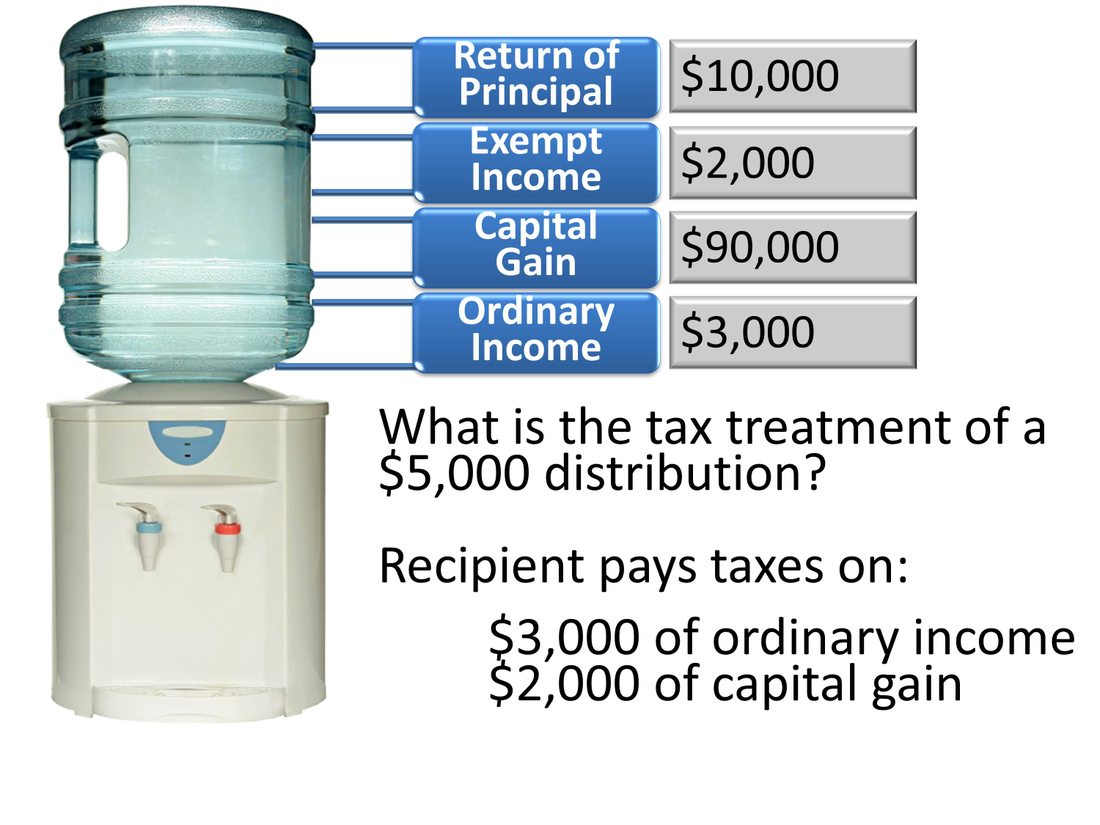
Suppose instead that the Charitable Remainder Trust were required to distribute $5,000 to the annuitant. How would the annuitant report this $5,000 on her tax return? Because the trust is holding $3,000 of ordinary income (earnings from the interest payments on corporate bonds), this amount must be paid out first. The remaining $2,000 would be paid from the $90,000 of capital gain held by the trust. The ordinary income is paid first because it normally receives the worst tax treatment (i.e., it generates the highest tax rates for the typical taxpayer). The capital gain is paid next because it is worse than either exempt income from the municipal bonds or tax-free return of investment from the donor's basis in the gifted property.
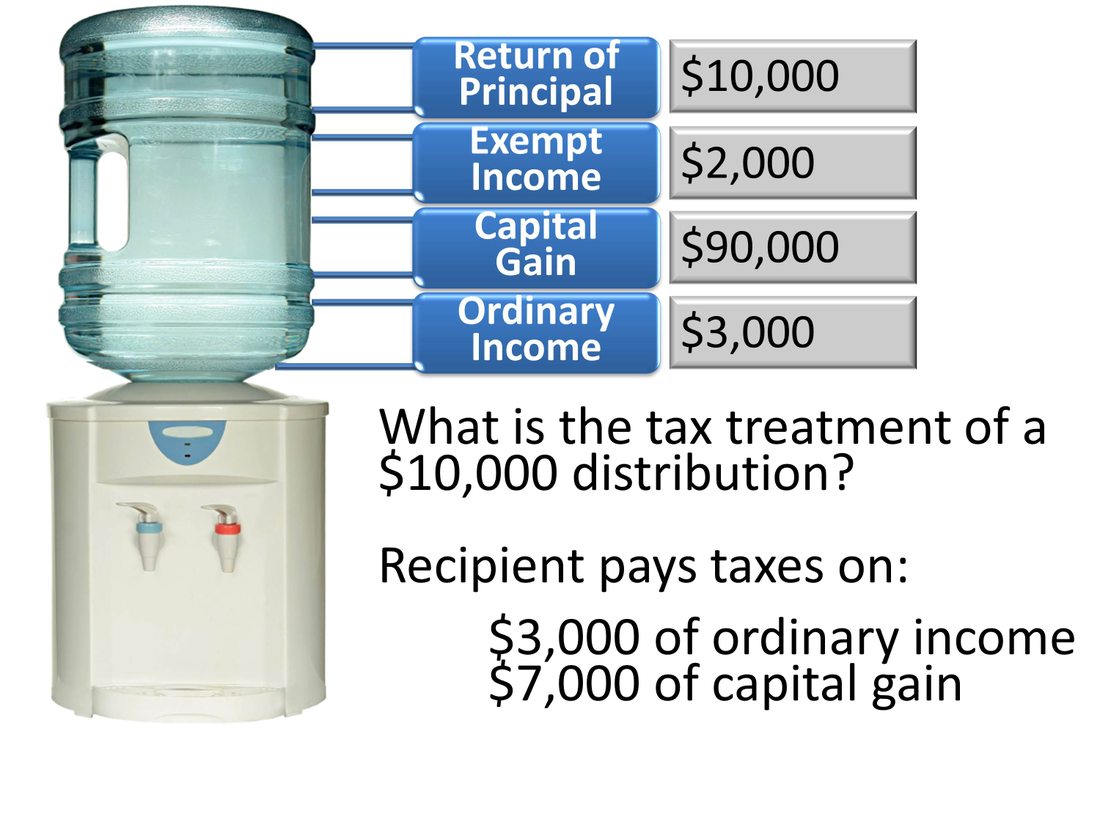
The WIFO concept (worst in, first out) dictates that all capital gain must be paid out before any payments are made from the exempt income or original basis. Thus, the distributions to annuitants would have to completely pay out all $90,000 of capital gain income to the annuitant before the annuitant could receive any form of exempt income or tax-free return of basis. Thus, it likely would make no sense for this particular Charitable Remainder Trust to invest in municipal bonds. The tax-exempt nature of municipal bonds does not affect the Charitable Remainder Trust itself, because the Charitable Remainder Trust is a tax-exempt entity and pays no tax on income earned. The tax-exempt nature of municipal bonds could benefit the annuitant if this tax-exempt income were paid to the annuitant, but such payments are highly unlikely, given the relatively large amount of capital gain yet to be distributed.
There are, of course, other more detailed distinctions in income type than those presented in this example. However, where the tax treatment of assets differs, the general WIFO rule typically applies. Thus, investment income recognized prior to December 31, 2012 - and thus not subject to the 3.8% healthcare surtax - would be paid out only after similar income earned after 2012. Similarly, a capital gain recognized after 2012 (and subject to the additional tax) would be paid out prior to any capital gain recognized in 2012 or earlier.
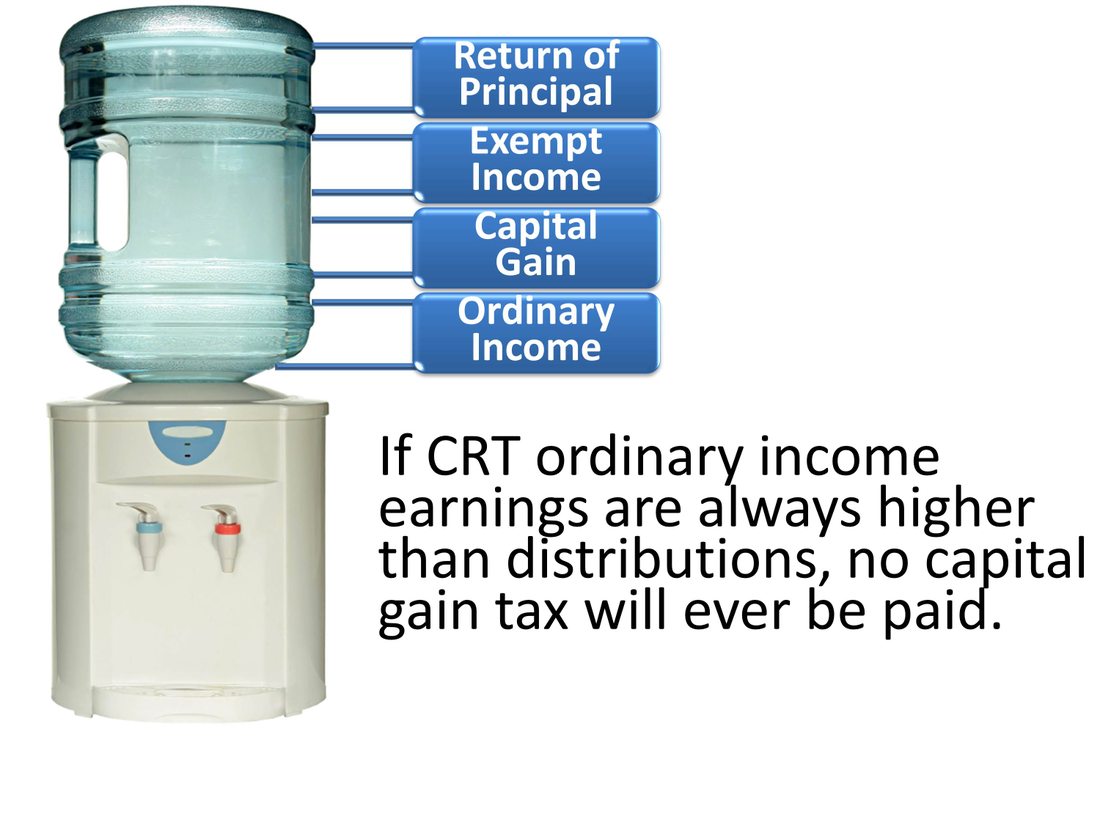
This tax treatment of distributions from Charitable Remainder Trusts means that capital gains taxes deferred through the use of a Charitable Remainder Trust might never be paid. If the trust's total ordinary income earnings are greater than its distributions, then no capital gains payments will ever be made. In this way the capital gains tax deferral can very often become complete capital gains tax avoidance.
In contrast, a Charitable Gift Annuity purchased with appreciated property can defer recognition of the capital gain, but will not avoid the tax. Conceptually, this could be phrased as a benefit of the Charitable Remainder Trust because the trust offers not just capital gains tax deferral but actual capital gains tax avoidance. But, in reality, the Charitable Remainder Trust annuitant avoids the capital gains tax only by paying the higher ordinary income tax. As compared with purchasing a Charitable Gift Annuity with appreciated property, the "advantage" of capital gains tax avoidance means paying higher ordinary income tax and never receiving tax-free return of investment.

To this point we have reviewed the standard Charitable Remainder Trust configurations. There are, however, a variety of different Charitable Remainder Trust structures that have received support from the IRS and tax courts. These special types of Charitable Remainder Trusts can be particularly attractive when dealing with special types of assets or specific income needs.
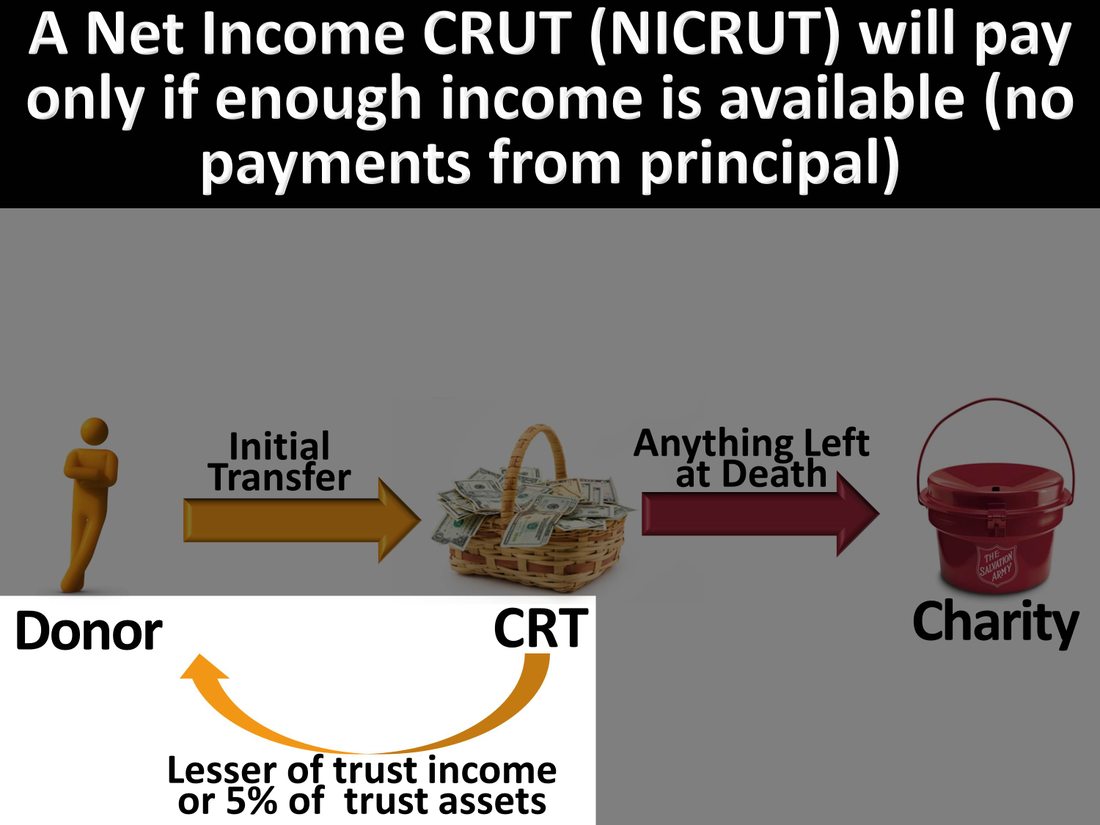
One of the earliest alternative forms of Charitable Remainder Trusts was the Net Income Charitable Remainder Unitrust (NICRUT). This trust operates like a standard Charitable Remainder Unitrust, with the exception that payments to the annuitant will be limited to the lesser of trust income or the unitrust percentage. This net income restriction can only reduce payments to the annuitant (and thus increase the charitable remainder) as compared with a Charitable Remainder Unitrust. However, the addition of this net income restriction does not increase the charitable income tax deduction for contributing to the trust.

Given that a Net Income Charitable Remainder Unitrust can only reduce payments to the annuitant, but does not increase the charitable income tax deduction, why would any donor voluntarily choose to accept such a limitation?

The attraction for including a net income limitation relates to the contribution of difficult-to-sell assets to the trust. A standard Charitable Remainder Trust requires that the payments must be made to the non-charitable beneficiary. But, if a trust was holding only a single, large, difficult-to-sell asset, this forced payment could mandate an immediate sale of the asset (or some part of it) in order to make the required payments to annuitants. For a trust established with, for example, valuable artwork, developable land, or closely-held stock, an immediate forced sale could dramatically diminish the sale price. In this case, the annuitant can be financially better off to forego his or her annual payments until the asset is sold at an appropriate price. This is not an option in the standard Charitable Remainder Trust, but can be achieved with the addition of a net income limitation on payments.
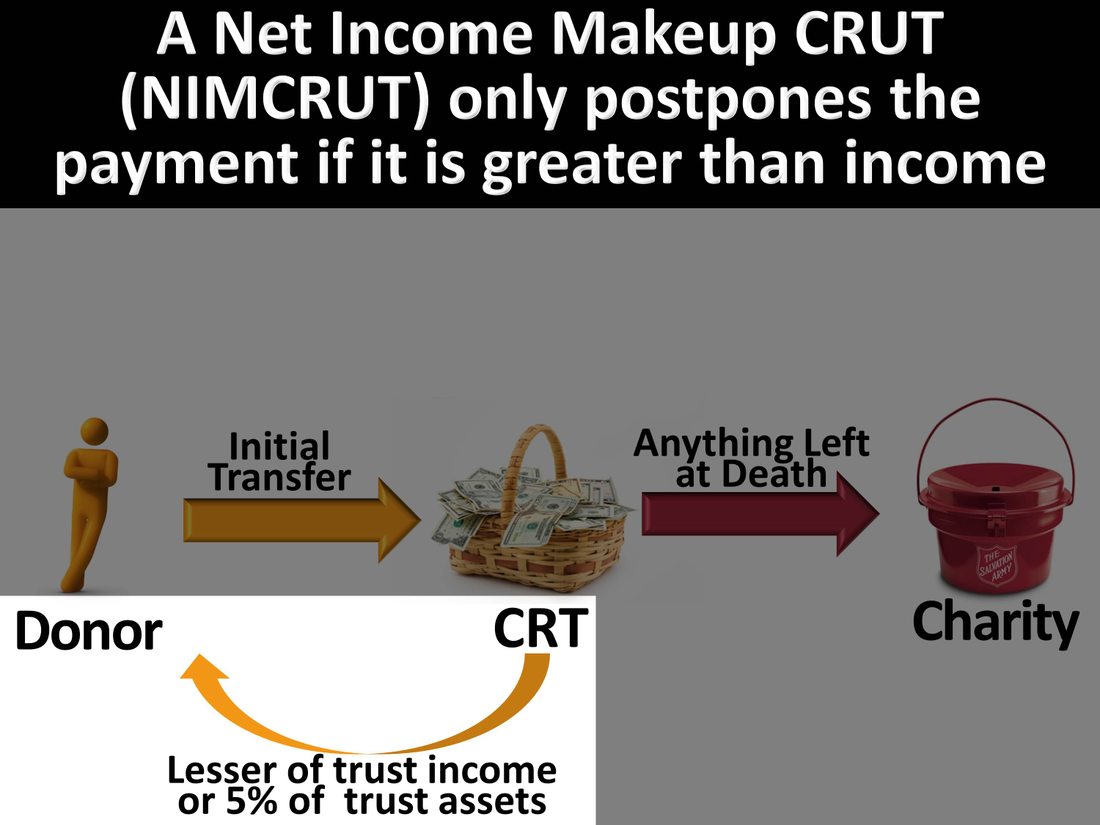
Today, use of the Net Income Charitable Remainder Unitrust has fallen due to competition from newer alternatives that address the same basic problem of asset illiquidity. The Net Income Makeup Charitable Remainder Unitrust (NIMCRUT) has a similar provision limiting payments to net income, but also has the added provision that previously foregone payments (due to insufficient income) can later be made up whenever income is larger than the regular payments. Thus, although payments are still limited to net income, a payment in a particular year may be larger than the standard percentage amount in order to make up past payments that were missed.
Although the annuitant of a NIMCRUT may still receive less than in a standard Charitable Remainder Unitrust, any missed payments come with an "IOU" from the trust promising to pay the missed payment to the extent that future net income exceeds the standard payment. The annuitant is still not entitled to any more payments than under a standard Charitable Remainder Unitrust, but now any payments missed due to low income could conceivably be made up in some future year. Thus, the annuitant may receive more under a NIMCRUT than under a NICRUT, but would never receive more than if no net income provisions were included in the trust. Once again, the IRS support of this addition rests on the reality that the charitable remainder amount can be no less (and may be larger) than that of a standard Charitable Remainder Unitrust. As with a NICRUT, the calculation of the charitable income tax deduction for a transfer to a NIMCRUT ignores the net income provision, despite the potential for the charity to receive a relatively larger amount.
Although the NIMCRUT represents an improvement from the NICRUT for the annuitant (because missed payments could be made up in the future), this improvement only applies where future income exceeds the standard payment amount. If future income never exceeds the standard payment amount, then the IOU from the trust will never be paid, and the NIMCRUT will be no better than a NICRUT. Further, it can easily be the case that the NIMCRUT pays less than the standard Charitable Remainder Unitrust if future income is insufficient to make-up all previous underpayments due to the net income provision. This difficult reality led to the creation of the next generation of Charitable Remainder Trust variation, referred to as a "flip-CRUT."
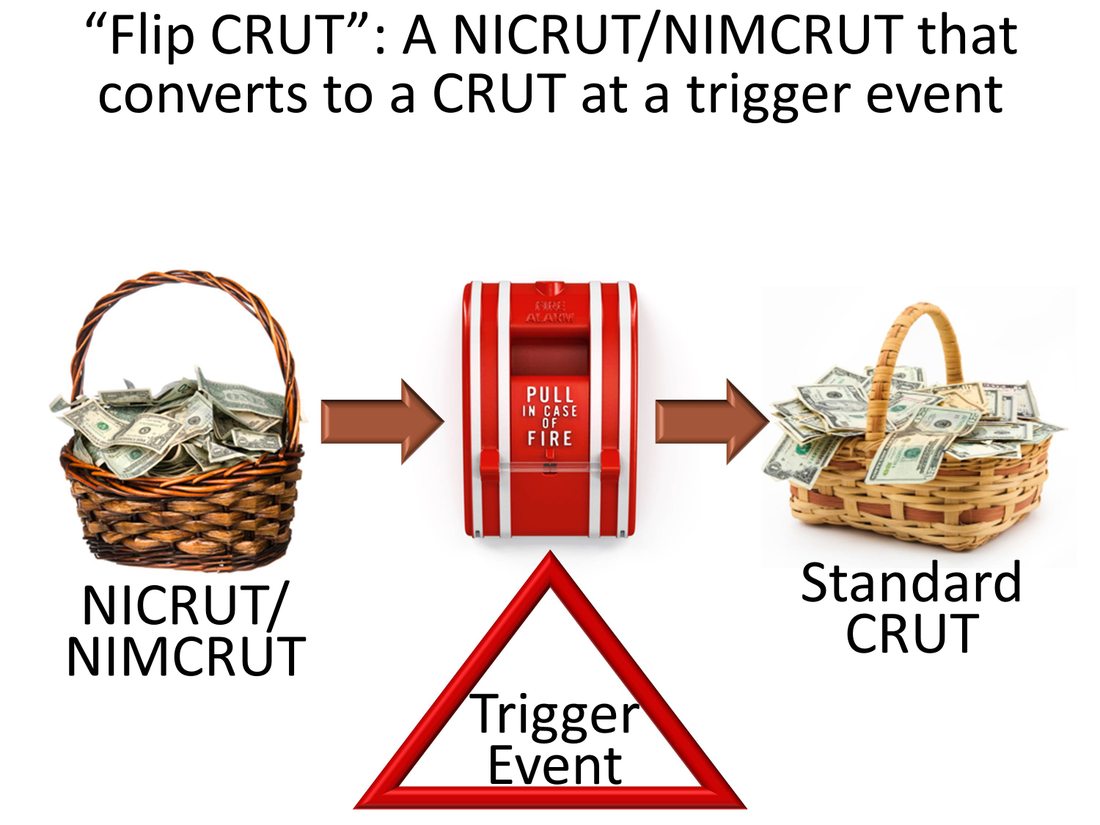
The flip-CRUT is a NICRUT or NIMCRUT that, upon the occurrence of a trigger event, converts to a standard Charitable Remainder Unitrust for the remainder of the life of the trust. Once again, the charitable income tax deduction remains unchanged as compared with a standard Charitable Remainder Unitrust. This combination allows for the trust to hold a difficult-to-sell item for any length of time without forcing a sale due to mandatory payments. But, once the item is sold, the trust can "flip" to a standard Charitable Remainder Unitrust with no net income limitations.

Common trigger events permitted to generate such a "flip" from a NICRUT/NIMCRUT to a standard CRUT include the sale of a difficult-to-value asset or the annuitant's reaching a specific age. Thus, a flip-CRUT can be used both for difficult-to-sell assets and to address retirement planning needs where the annuitant may want to postpone receiving payments until reaching a retirement date.
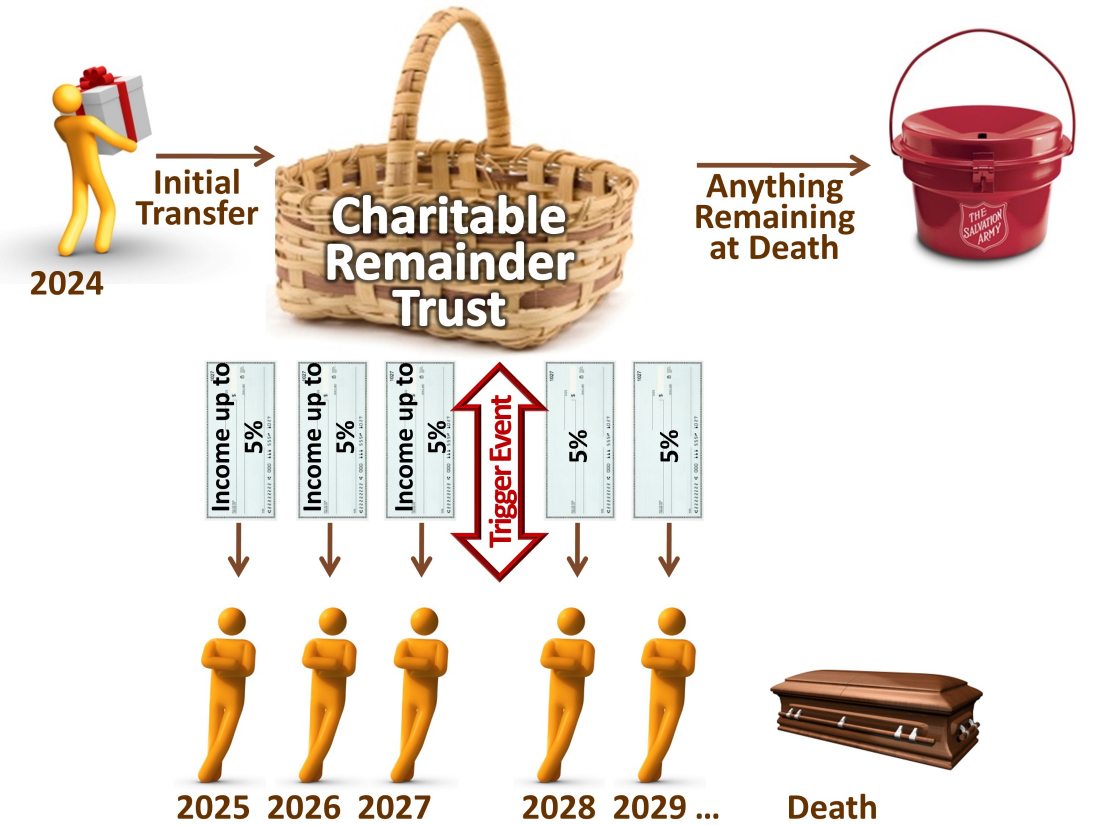
In a flip-CRUT, prior to the trigger event the annuitant receives the lesser of the fixed percentage of trust assets or income from the trust. Once the trigger event occurs, the annuitant receives a fixed percentage of trust assets for the remainder of the duration of the trust without regard to the trust's income. (Note that once a trust is converted to a standard CRUT as a result of the trigger event, there will be no "make-up" of any past missed payments. Prior to the trust flipping, a make-up payment could have been possible if the flip-CRUT was initially a NIMCRUT, but no make-up payments are allowed once the trust converts to a standard CRUT.)
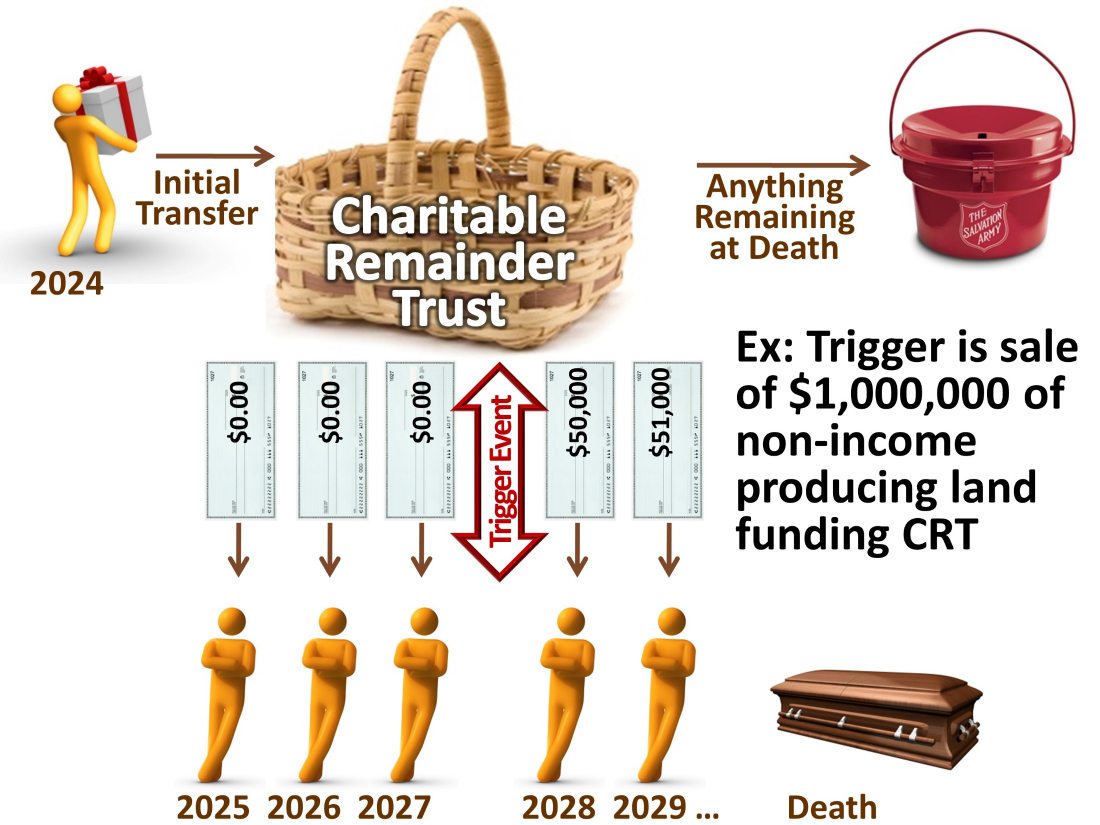
Suppose, for example, that the donor funded a 5% flip-CRUT with a non-income producing piece of land worth $1,000,000. Before the land was sold, the trust would receive no income, and thus would make no payments to the annuitant. However, once the land was sold, the trust would convert to a standard CRUT and the annuitant would receive 5% of the trust assets each year for the duration of the trust. This 5% is fixed and would not change regardless of how much income is earned in a particular year.
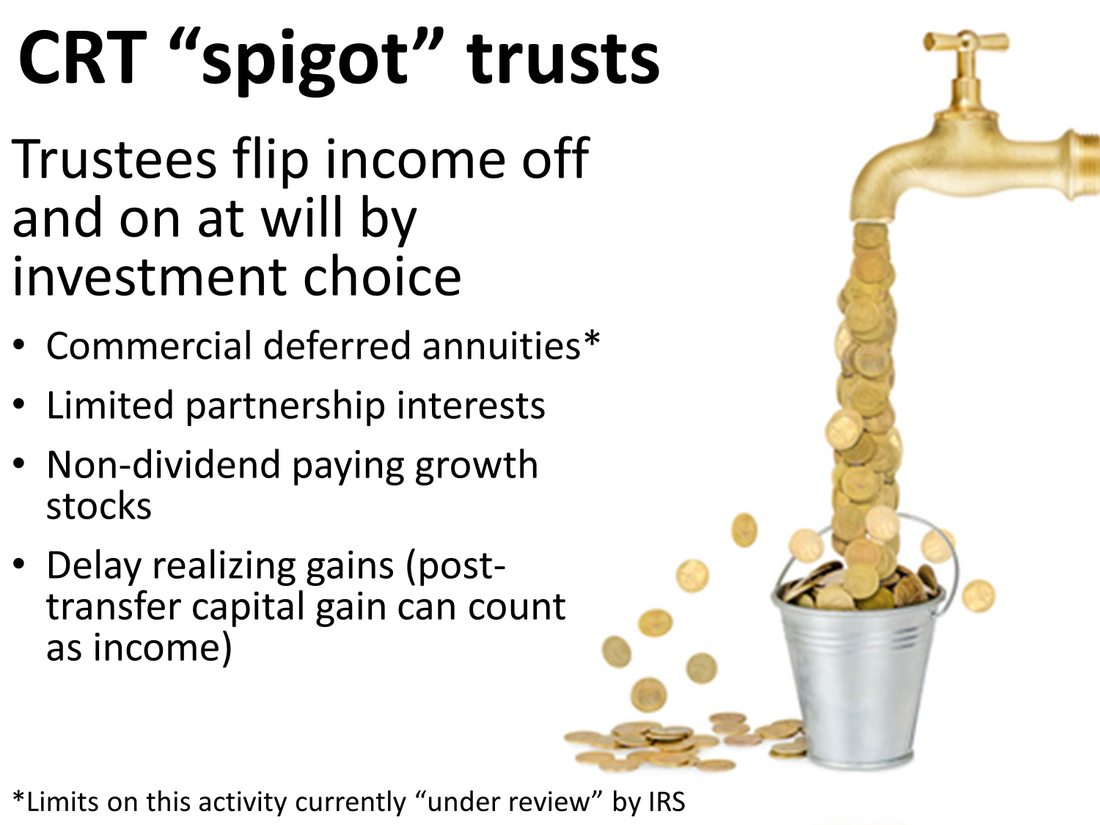
When Charitable Remainder Trust payments are limited to income (either permanently or for a time prior to "flipping" into a standard CRUT), the trustee can gain substantial control over the payment stream simply by changing the underlying investments. There are a variety of investments that offer opportunities for appreciation, but produce little or no income. Examples include non-dividend paying growth stock or limited partnership interests, artwork and collectibles, and developable land. When such investments held by a NICRUT or NIMCRUT generate no income, no payments would need to be made.
Why is this attractive? Consider a situation where the donor wishes to create a source of retirement income for himself, but first wants the assets to accumulate in a tax-free environment for several years. The donor can create a flip-CRUT converting from a NIMCRUT to a standard CRUT upon the donor's reaching age 65. Prior to age 65, the donor/trustee can invest in non-income producing assets, insuring that he will receive no payments and recognize no income. Upon reaching age 65, the trust becomes a standard CRUT and the donor can immediately take a percentage of all assets, regardless of the income received by the trust. But what about all of the missed payments? One clever approach is to design the NIMCRUT phase where post-contribution capital gains are specifically defined as income. In the year prior to the retirement date (and "flipping" of the trust), the trustee could sell all of the investment assets, recognize large capital gains and use these gains to pay all outstanding IOUs (payment make-up provisions). The net effect can be to preserve all of the payments, but postpone their distribution until the desired ages. The distribution need not be so drastic as to make all sales and make-up payments in the final year. These sales and the resulting make-up distributions could be timed over several years to smooth the annuitant's receipt of income. Through the use of these techniques, however, the donor/annuitant can design an income stream that matches his or her retirement and tax planning goals.
Commercial deferred annuities are an investment which can be designed to generate no income recognition by the trust prior to a decision by the trustee to withdraw funds. This can be an ideal investment allowing the income "spigot" to be turned off and on at will. The annuity can accrue income that is not distributed to (or recognized by) the trust until payment is requested by the trustee. Once income is desired, the annuity can immediately be paid to the trust, creating a flood of income that can be used - in the case of a NIMCRUT - to make up past foregone payments. (This relies in part on a special provision in the income tax code which treats payments from an annuity contract as entirely ordinary income if the annuity is owned by a trust.) However, this particular approach generates more concerns than other investments. Specifically, there is limited concern that the use of this investment may constitute "self-dealing". Although an early Technical Advice Memorandum (TAM 9825001) provided some encouragement and guidelines, since 1997 this practice has been under review by the IRS, and the IRS has specifically stated that it will not make any additional rulings related to the use of commercial deferred annuities in a NICRUT or NIMCRUT. Thus, the tax outcome for this particular arrangement is modestly less secure, given the lack of final regulations.

One creative approach to Charitable Remainder Trust planning is to design a flip-CRUT that converts on the sale of an economically insignificant, but difficult-to-value, asset. The traditional flip-CRUT is designed around the sale of a substantial difficult-to-value (and hence, often difficult-to-sell) asset. However, the difficult-to-value asset need not be a substantial one. It can, in fact, be a single share of a closely-held company. In this case, the asset itself is economically insignificant, but allows the trustee to "flip" the trust from a NIMCRUT to a standard CRUT at will by selling the asset. Commentator Conrad Teitell labels this a "flex-CRUT" because it is so flexible.
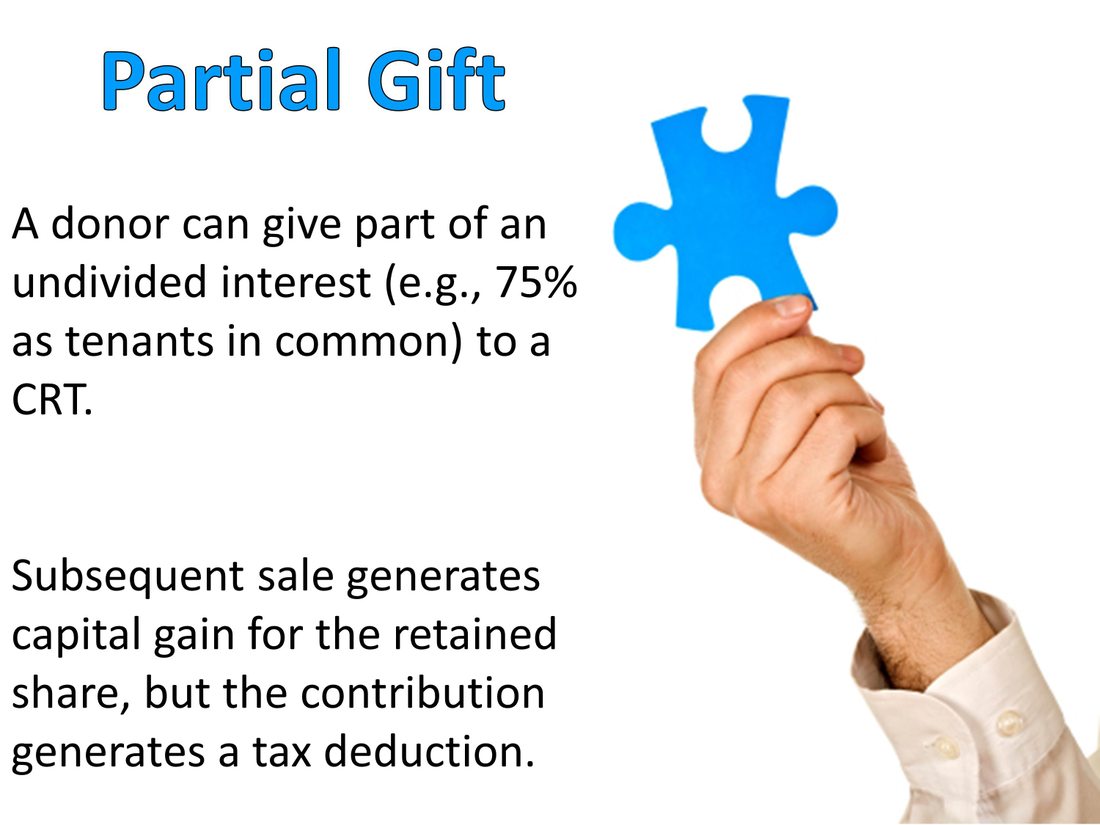
The typical Charitable Remainder Trust transaction involves the transfer of a substantial, highly appreciated asset to the trust. It may be the case that the donor's wealth is substantially tied to one property and the donor may not wish to contribute the entire property to a Charitable Remainder Trust. In such cases, a donor can choose to contribute an undivided share of the property to the Charitable Remainder Trust. Typically, this transfer would be made prior to a sale in an effort to shelter some of the recognition of capital gain. Although the donor would still recognize capital gain on his share of the property at its sale, the share of the property owned by the Charitable Remainder Trust would not generate an immediate capital gains tax. Further, the donor might choose to make several contributions of undivided interests to a Charitable Remainder Trust in order to spread out the charitable income tax deductions over a longer period of time. For example, by donating 10% undivided interests each year for 10 years, the donor creates 10 years' worth of charitable income tax deductions rather than one large deduction in the first year. This may help to co-ordinate the charitable deductions with the income limitations on such deductions. Although charitable income tax deductions exceeding income limitations may be carried over for up to five years, spreading out the transfers may result in larger deductions due to the appreciation of the underlying property.
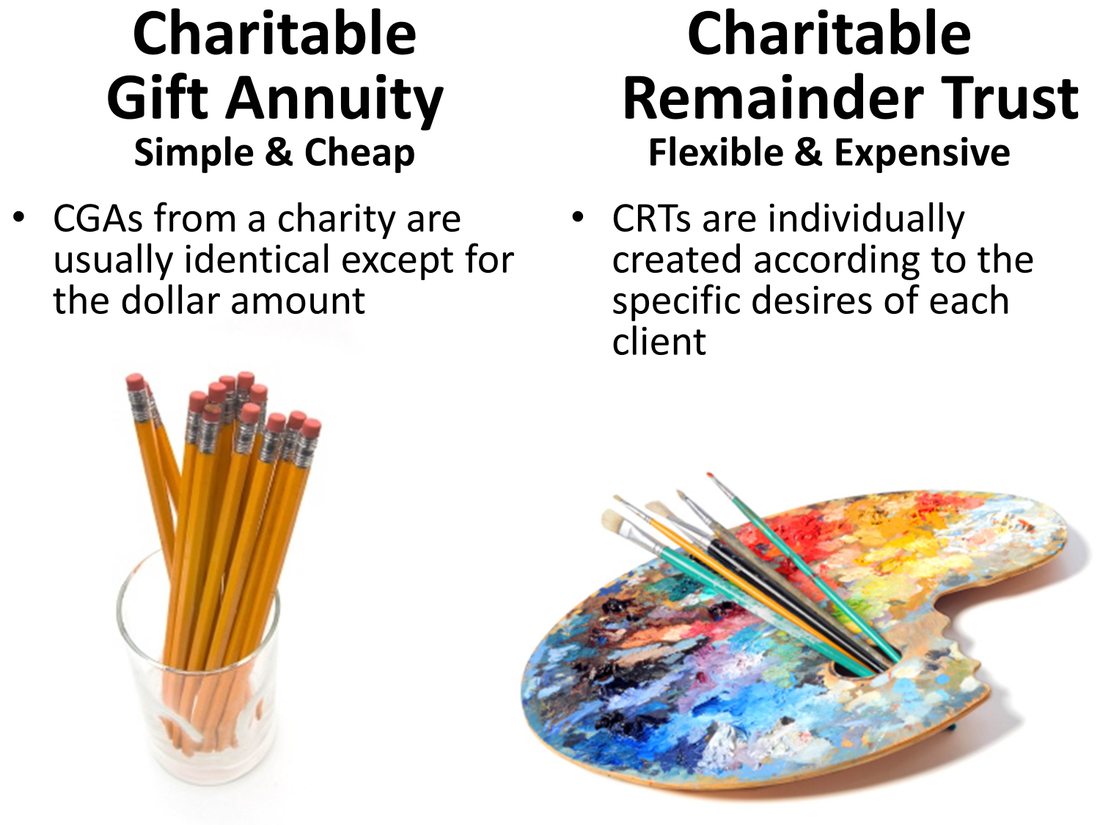
Comparing Charitable Remainder Trusts to Charitable Gift Annuities is much like comparing the artist's paint palette with a number 2 pencil. Charitable Gift Annuities are relatively simple, standardized agreements, often contained in a one or two page form document. For most charities, all of their Charitable Gift Annuity agreements are identical except for the payment amount and named annuitant. In contrast, Charitable Remainder Trusts are individually created to the specifications of the donor. Although Charitable Remainder Trusts must comply with the IRS guidelines, within those guidelines, there is enormous freedom and flexibility.
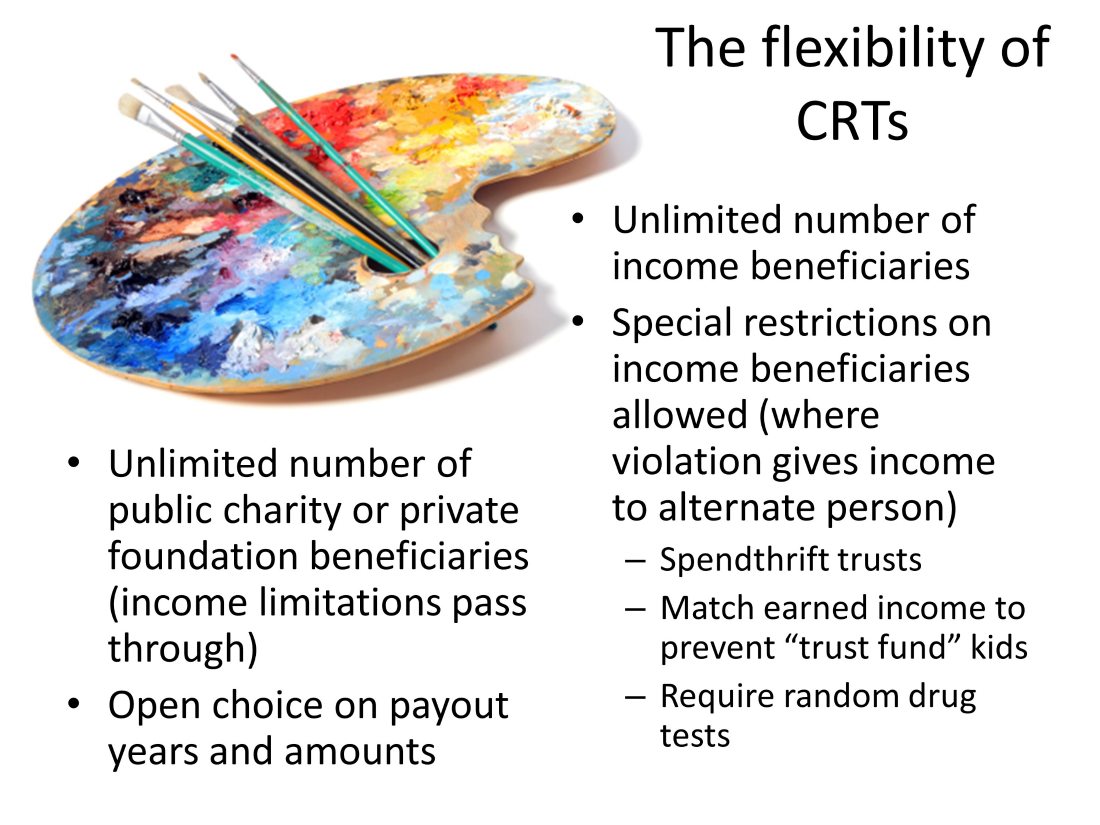
Some examples of the flexibility of Charitable Remainder Trusts (as contrasted with typical Charitable Gift Annuities) include the ability to name an unlimited number of public charity or private foundation beneficiaries and the ability to change the named charitable beneficiary whenever desired. There are, of course, consequences of different choices. For example, gifts to a Charitable Remainder Trust where the remainder could possibly be paid to a private foundation will be subject to the income limitations and property valuation rules applicable to gifts to private foundations. The donor can create a Charitable Remainder Trust that will pay to any number of beneficiaries for any number of lives (where Charitable Gift Annuities are limited to a maximum of two lives). The donor can create a Charitable Remainder Trust that will pay for a fixed number of years, up to 20. (Charitable Gift Annuities may pay for one or two lives but not for a fixed number of years.) If the Charitable Remainder Trust employs an independent trustee (i.e., not controlled by the donor), the trust can also create restrictions as to when certain annuitants will receive payments. Although the Charitable Remainder Trust must still make the required payments (of a fixed dollar or fixed percentage amount), the trust document may change the recipient of those payments. This "sprinkling" power (although it can be administered only by an independent trustee and not by a donor-trustee) can create amazing planning opportunities. For example, the payments can contain a "spendthrift" provision protecting them from being attached by creditors. Thus, for annuitants other than the donor, the payments can be protected from divorce, lawsuits, or bankruptcy. If the donor wishes to prevent his annuitant children (or grandchildren) from becoming lazy "trust fund" kids, he could limit the payments to a particular beneficiary to some multiple of their earned income. (Any un-claimed annuity payment would still need to be paid to other beneficiaries so that the total payment distributed was still fixed.) The donor could even require that annuitants pass a drug test in order to receive annuity payments. Almost any rules that can be imagined by the donor and administered by an independent trustee that are not against public policy can be included in a charitable trust document. Its flexibility is almost limitless.

As a famous example of such flexibility, we can examine the Charitable Remainder Trust from the estate of hotelier Leona Helmsley. Typically, the provisions of Charitable Remainder Trusts are not publicly available, because these are private documents. However, in this case, the Charitable Remainder Trust was a testamentary trust (i.e., created in the will). Because the will is a public document, the provisions of this testamentary trust also became public. This trust required that the grandchildren beneficiaries must visit the grave of their father at least once each calendar year in order to receive their annuity payment. Because this trust was to be administered by an independent trustee (and not by the donor herself), such "sprinkling" powers are acceptable. In the event that a beneficiary did not comply with the rules, that beneficiary would lose his payment and the payment would go to another named beneficiary.

Any trust, including a Charitable Remainder Trust, can be thought of as a basket. Like a basket, a trust holds things. In particular, trusts hold title to valuable assets and administer those assets in accordance with the instructions found in the trust document. However, certain types of assets can create problems when owned by a Charitable Remainder Trust.
Subchapter S corporations are closely held (100 or fewer shareholders) corporations that are taxed in ways similar to partnerships. A Charitable Remainder Trust cannot hold subchapter S Corporation shares. This is not due to any restriction from the rules of Charitable Remainder Trusts, but rather due to the shareholder requirements of subchapter S corporations. Shareholders in such corporations must normally be natural persons. Although there are exceptions to this rule, a Charitable Remainder Trust is not one of them. (One exception allows public charities to hold subchapter S stock, thus allowing a Charitable Gift Annuity in exchange for such shares.)
What options are available for the donor who wishes to transfer the ownership of a business to a Charitable Remainder Trust, when the business is a subchapter S corporation? The corporation itself can contribute appreciated assets to a Charitable Remainder Trust and receive income for up to 20 years (lifetime income is not available for non-persons). Both the charitable income tax deduction and subsequent income payments pass through to the shareholders and no capital gain is immediately recognized upon the sale of the asset. This is not a perfect solution, however, because it cannot be used to transfer "substantially all" corporate assets to a Charitable Remainder Trust, and payments cannot be made for annuitant lifetimes. Of course, a donor who controls the corporation could change its corporate form to a C-corporation by ceasing to make the S-corporation election, but such conversion has its own tax consequences that may be independently unattractive.
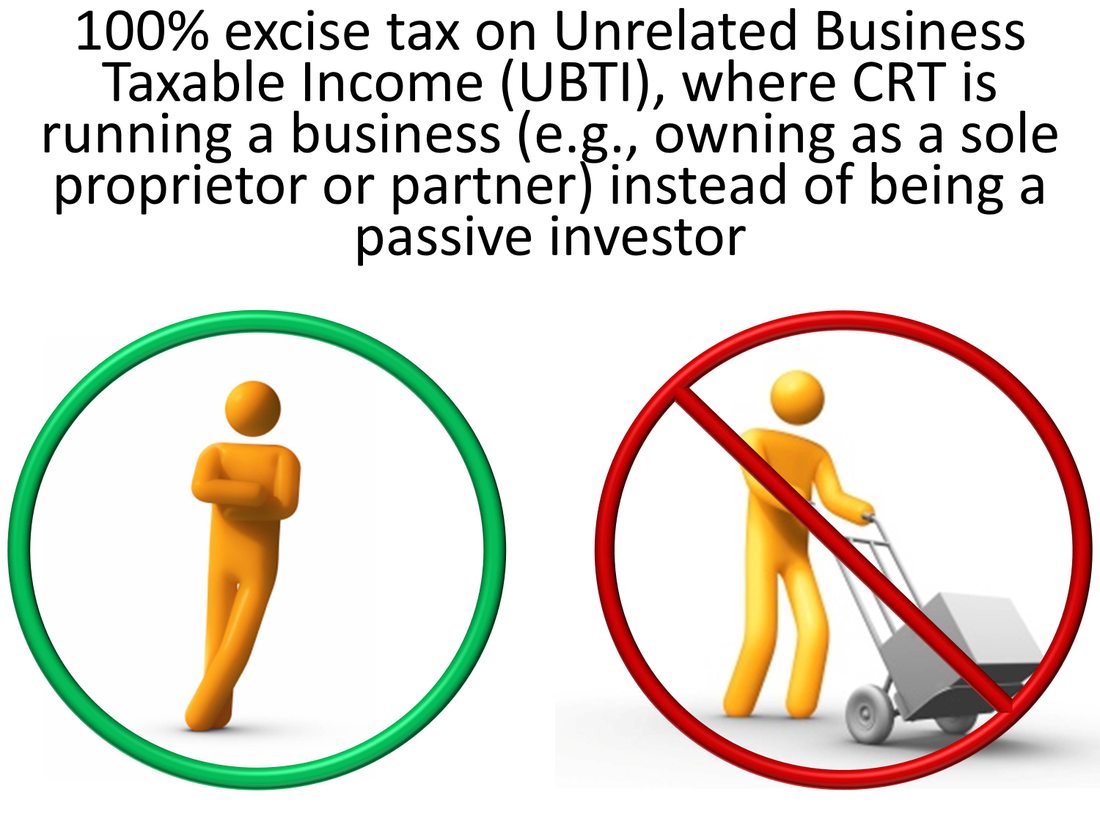
One of the most extreme forms of taxation comes when a Charitable Remainder Trust receives unrelated business taxable income (UBTI). Unrelated business taxable income is generated when the trust earns money by engaging in the operation of a business rather than simply being a passive investor. Such income is taxed at a 100% rate. Simply put, the IRS takes all of it.
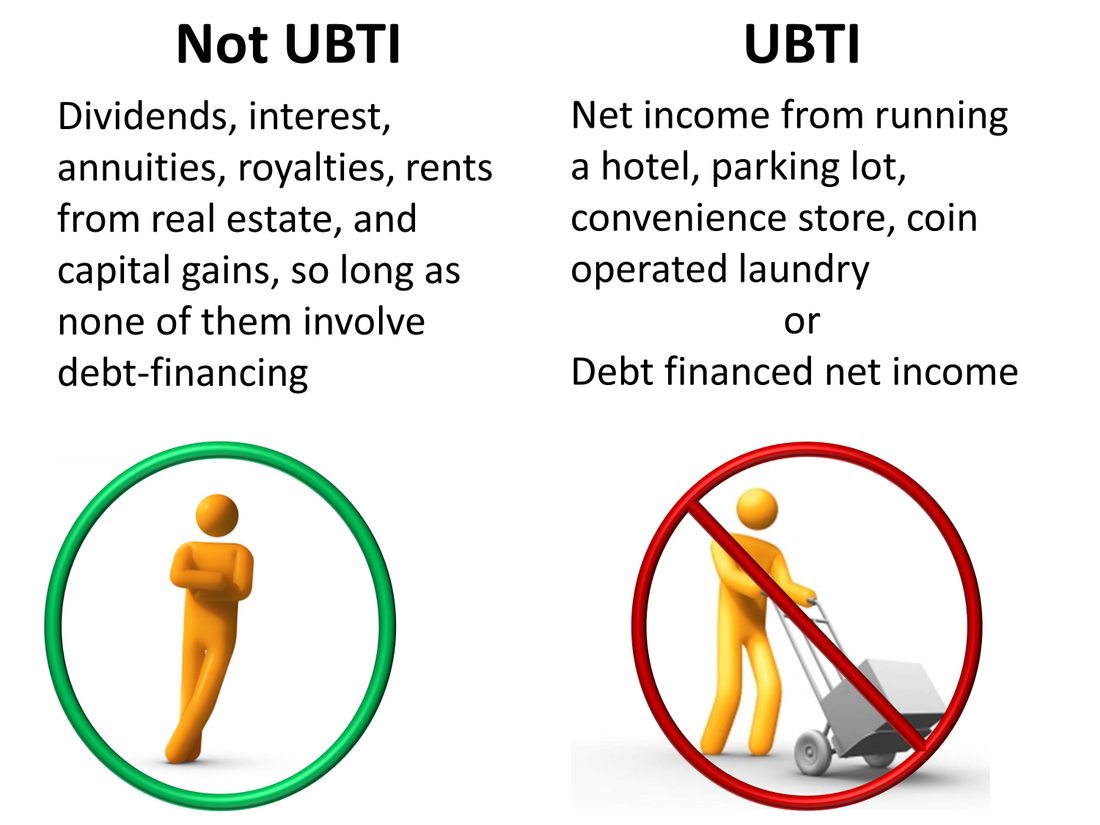
Typical investments do not generate unrelated business taxable income, because they are passive. Dividends, interest, annuities, royalties, rents from real estate, and capital gains are not unrelated business taxable income, so long as none of them involve debt financing. Conversely, if any of these sources of income are generated from debt-financed investments, then the income does qualify as unrelated business taxable income. Although rents from real estate will not be unrelated business taxable income - so long as there is no debt on the real estate - active management of businesses involving real estate, such as running a hotel, parking lot, convenience store, or coin-operated laundry, will create unrelated business taxable income. The key distinction is that when the trust is actively participating in the operation of the business, the resulting income is unrelated business taxable income. (Of course, the trust can be a shareholder in a corporation that engages in such activities, because then the trust is simply a passive investor rather than a manager.)

The extreme taxation of unrelated business taxable income in Charitable Remainder Trusts can produce surprising results. Consider a situation where a Charitable Remainder Trust receives a gift of a $1 million house transferred from a donor who had a $100,000 basis in the house. The trustee decides to authorize $100,000 of improvements to the house in order to get it in top condition to sell. Because the trustee has no other trust assets, he obtains the $100,000 by taking out a mortgage on the house. As a result of making the improvements, the house is later sold for $1.2 million and the mortgage is paid off at the sale. Clearly, the $100,000 investment was a good idea because it increased the value of the home by $200,000, right? Unfortunately, no.
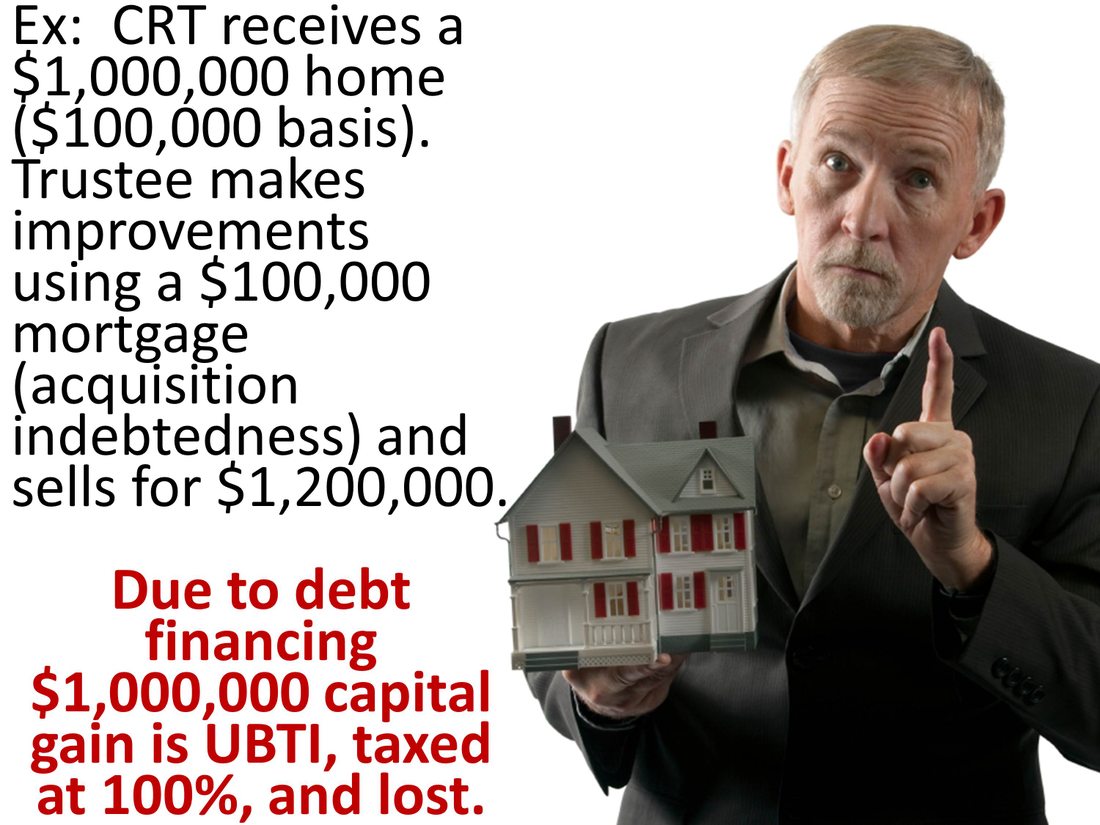
Remember that dividends, interest, annuities, royalties, rents from real estate, and capital gains are not unrelated business taxable income, so long as none of them come from debt financing. However, in this case we have a capital gain from debt-financed property (due to the $100,000 mortgage). Thus, the capital gain becomes unrelated business taxable income. Unrelated business taxable income in a Charitable Remainder Trust is taxed at 100%. Consequently, the entire capital gain must be forfeited as a tax payment. Although an extreme example, this shows the importance of avoiding unrelated business taxable income in a Charitable Remainder Trust.
The Charitable Remainder Trust, like a private foundation, has strict rules against engaging in transactions with disqualified persons. Rather than reviewing these transactions to determine if they were beneficial to the charity or the Charitable Remainder Trust, all such transactions are simply prohibited. As a result, the Charitable Remainder Trust is not permitted to sell, lease, loan, or allow any use of assets by the trust's creator, contributor, trustee or their ancestors, descendants, or spouses. For example, a donor could not contribute a house to a Charitable Remainder Trust and allow his daughter to live in the residence prior to its sale. This would be a use of assets by a descendent of a contributor to the Charitable Remainder Trust and would thus be a prohibited act of self-dealing. Self-dealing can result in disqualification of the Charitable Remainder Trust.
One of the defining characteristics of a Charitable Remainder Trust is that it is an irrevocable trust. However, in some cases exceptions to this irrevocability have been allowed. For example, the IRS has previously allowed for the premature termination of a Charitable Remainder Trust, with a distribution of the assets based upon the present value of all interests. Note that this has been allowed previously, but is not a universally guaranteed option. For example, the IRS would not want to authorize such divisions where the lifetime annuitant was aware of some health condition that substantially shortened his or her life expectancy. In that case the calculated present value of the annuitant's interest, based on normal life expectancies, would substantially overstate the value of the annuitant's share. Nevertheless, if both the annuitant and remainder beneficiary agree, such division might be possible. The actual termination and distribution would likely require the intervention of a state court in order to circumvent the irrevocable nature of the trust agreement, because the trust itself is an entity created by state law. Federal law establishes only the federal tax treatment of the trust, but cannot create or dissolve the trust.
Another example of creativity that received approval by the IRS in a private letter ruling dealt with the charity's immediate need for funds to construct a building. Normally, a Charitable Remainder Trust would not be useful for such needs. The Charitable Remainder Trust typically pays nothing to the charity for many years or a lifetime. As a creative way around this limitation, the Charitable Remainder Trust was authorized to segregate funds and pledge them as collateral for a loan taken out by the charity. The lender was protected by the ability to seize the funds in the event of non-payment. The charity was able to immediately build the building while planning to pay off the loan with the charitable gift received from the Charitable Remainder Trust at its termination. In this way, the donor was able to see the impact of his gift immediately.
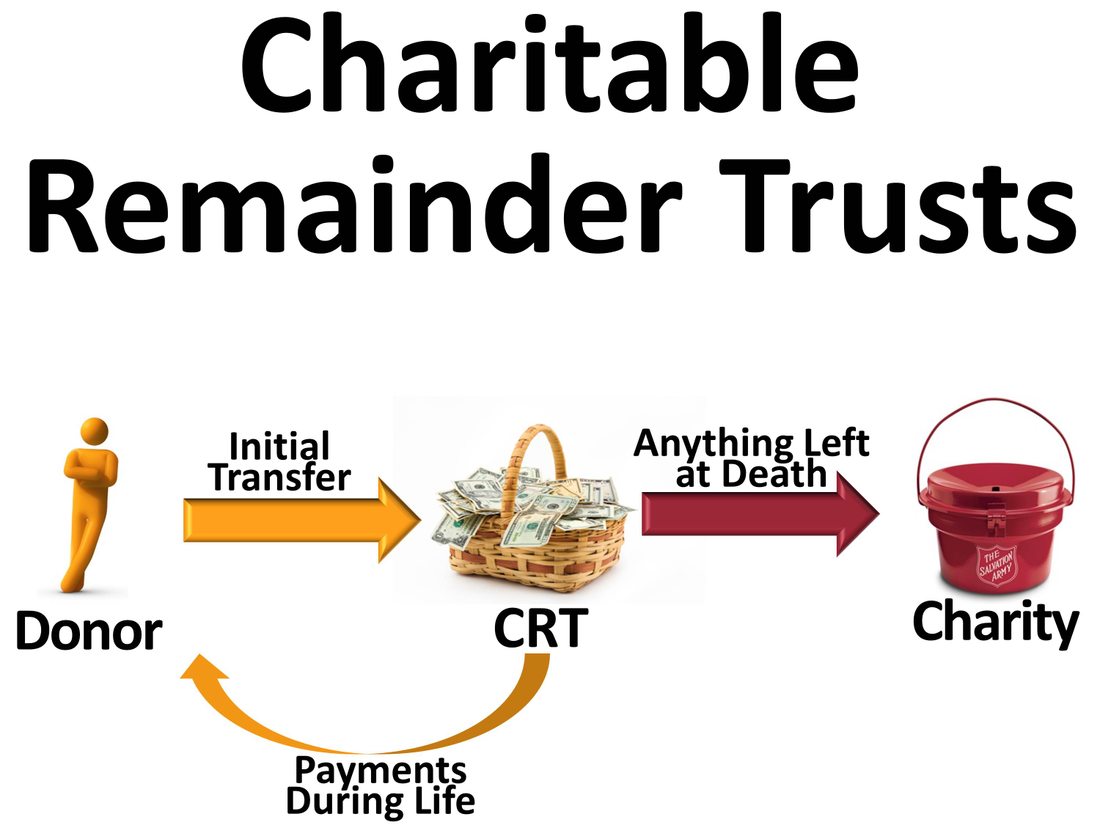
Charitable Remainder Trusts are, fundamentally, the most powerful complex tool available to gift planners. Charitable Remainder Trusts can be part of even more powerful, and more complex, planning when combined with other trusts. For example, a Charitable Remainder Trust can pay its remainder interest to a private family foundation with some part of the value of the charitable income tax deduction and annual payments used to purchase estate-tax-free life insurance through an Irrevocable Life Insurance Trust. The flexibility and possibilities from Charitable Remainder Trusts are almost limitless. This chapter simply paints the broad outlines for what is possible. As complex as these arrangements can become, fundamentally, their purpose is to (1) trade a charitable gift for income and (2) reduce taxes. Consequently, investigating the use of these instruments is warranted whenever a donor would like to make a substantial gift, receive income, and avoid income and capital gains taxes.