
Planning with life insurance creates many potentially positive opportunities for donors, advisors, and charities. Yet, there can be bad outcomes from using life insurance as well. Some tax rules create negative consequences in certain cases. Some charities have had bad experiences and bad results working with life insurance professionals who promised more than they delivered. These potential pitfalls are no reason to ignore the benefits of life insurance, but rather should be a motivation to become more acquainted with the details of using life insurance in charitable planning in order to produce the best outcomes.
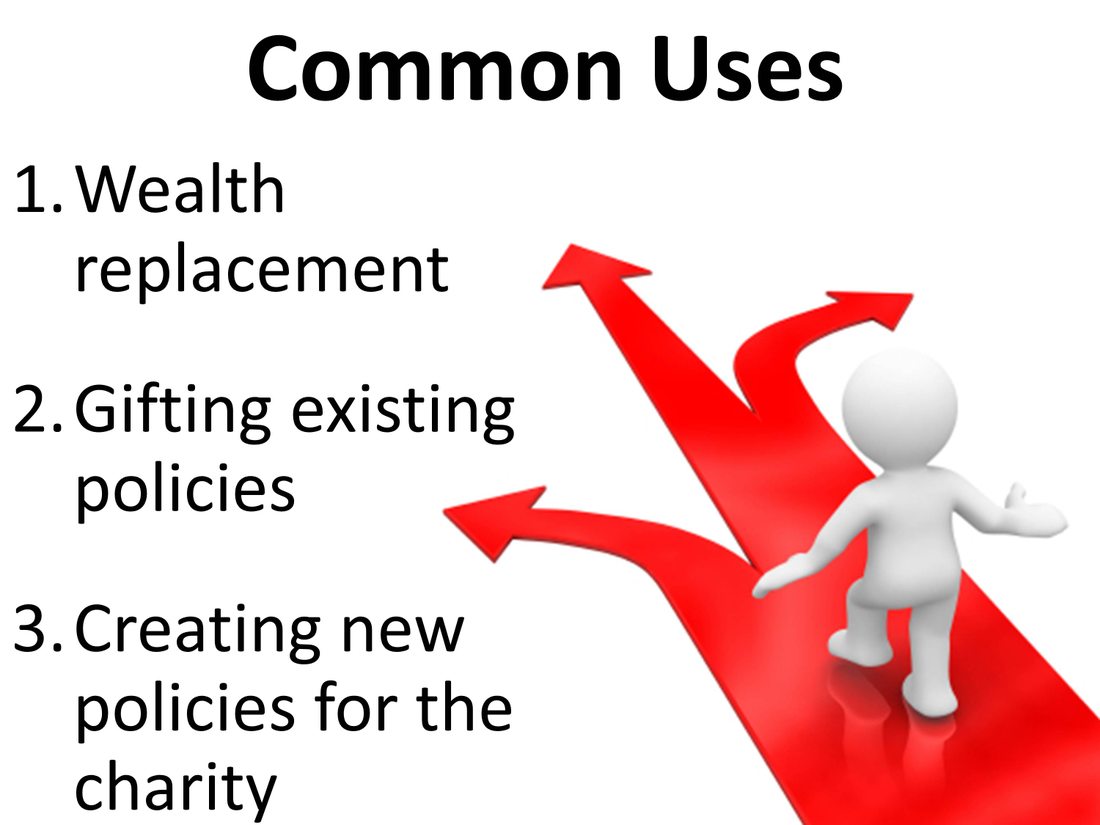
Many sophisticated charitable planning techniques such as Charitable Gift Annuities, Charitable Remainder Trusts, Charitable Lead Trusts, gifts of remainder interests in homes or farms, or bequest gifts in wills or trusts, all directly impact estate planning, typically reducing the heirs' inheritance. It is not surprising then that another common estate planning tool, life insurance, can frequently be useful as a means to replace some or all of the heirs' inheritance lost due to charitable planning. Further, existing life insurance policies may have accumulated substantial value over time, making them a potential candidate as a charitable gift. Finally, some donors may desire to fund a large posthumous gift for charity by creating and making premium payments on a new charity-owned life insurance policy. Thus, charitable planning commonly employs life insurance in three different ways: wealth replacement, gifting existing policies, and creating new policies for charity. These three uses for life insurance involve dramatically different tax and planning issues. Consequently, each type of application will be reviewed separately.

Potentially the most powerful use of life insurance in charitable planning is as a "wealth replacement" for heirs or other non-charitable beneficiaries. Life insurance generates a pool of money (wealth) at the death of the insured. For younger families this wealth can be especially important as a way to replace the income (or services) lost by the unexpected death of a family member. In charitable planning, life insurance does not replace income, but instead replaces wealth. Charitable planning often involves the transfer of substantial assets (wealth) to charity either during life or at death. Life insurance provides a mechanism to replace all or part of the wealth gifted to charity. This alternate source of wealth benefits the heirs or beneficiaries who might otherwise have inherited the assets donated to charity. Importantly, life insurance can replace wealth in a tax-advantaged way after charitable planning has removed the wealth in a tax-advantaged way, resulting in the possibility of multiple layers of tax benefits.

The most powerful layer of tax benefits in these multi-layered charitable plans comes from the charitable instruments themselves. As reviewed in other chapters, charitable planning devices such as Charitable Gift Annuities, Charitable Remainder Trusts, or gifts of remainder interests in homes and farms can generate wonderful tax benefits in income, capital gain, estate, and generation skipping taxes. Despite these enormous tax benefits, advanced charitable planning techniques all have one thing in common; ultimately, they transfer assets to charity. Clearly, this means that such techniques should be limited to those who truly have charitable desires. Yet even among the charitable, these philanthropic desires are often not the only goal in a donor's plan.
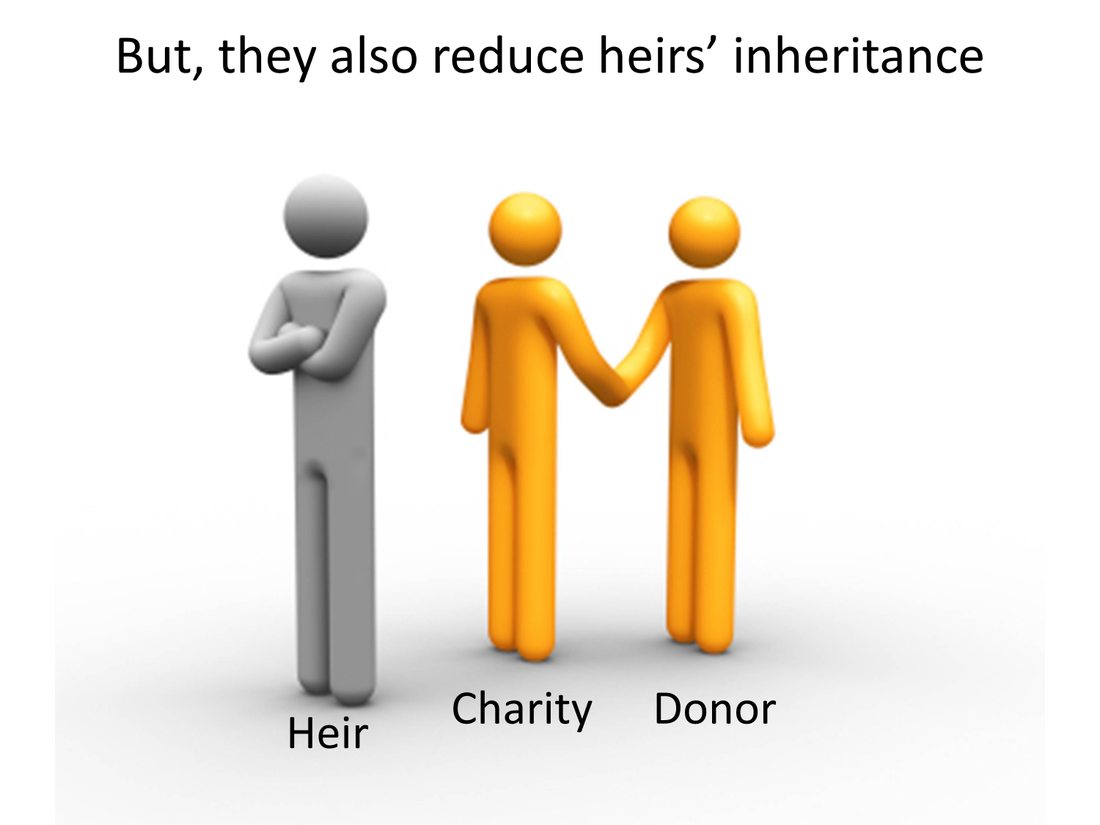
Donors must often balance their charitable desires in estate planning against the desire to benefit family members or other non-charitable beneficiaries. The donor's desires to benefit his or her family may set the limit for any potential charitable estate gifts (or other charitable planning techniques that diminish the remaining estate such as Charitable Gift Annuities). Life insurance can help balance these competing desires in a way that can increase both the gift to charity and the inheritance for other beneficiaries.
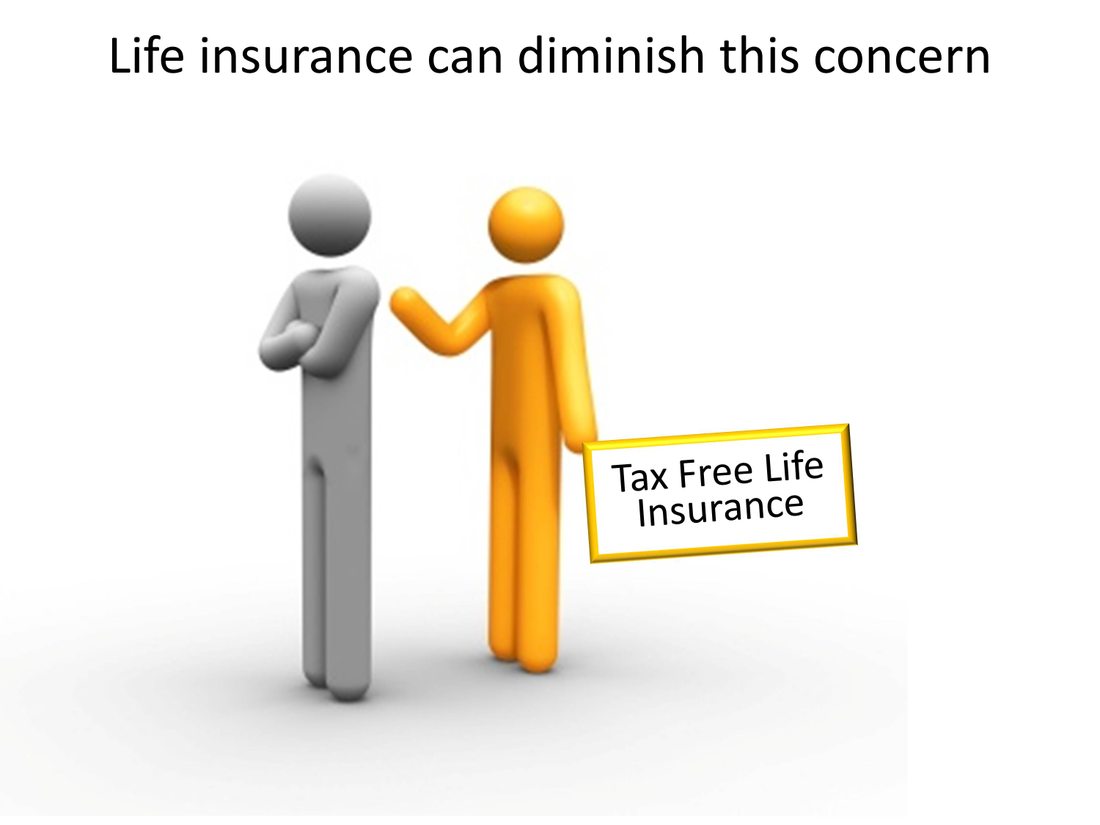
Not only can life insurance provide an alternative or supplemental inheritance to substitute for part or all of the wealth transferred to charity, but also, with certain types of planning, it can provide an inheritance that is not subject to estate taxes. For estates subject to the 40% estate tax rate, the ability to receive tax-free inherited dollars is understandably attractive. Thus, the heirs may do well to trade a smaller amount of tax-free insurance in exchange for giving up a larger inheritance when the larger inheritance would have been taxable. Combining this with the tax advantages of charitable planning can create a win-win scenario where the donor is able to provide more for both charity and heirs through creative planning.
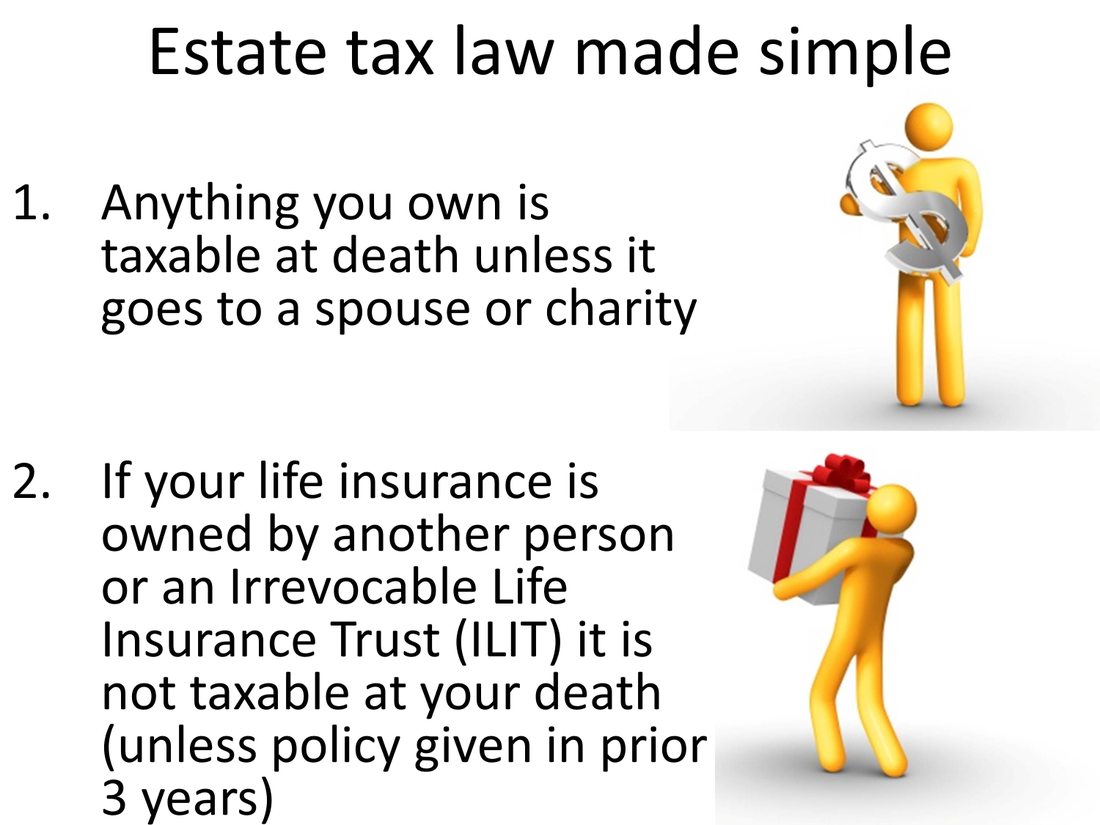
How is it possible for life insurance proceeds to avoid estate taxation? In simple terms, the estate tax applies to everything owned by the decedent at death except assets transferred to a spouse or a charity. Thus, proceeds from life insurance owned by the decedent will be subject to estate taxation. However, if the decedent does not own the life insurance, then it is not normally subject to estate taxes at the decedent's death. This is true whether the life insurance is owned by another person, such as another family member, or by an artificially-created legal entity, such as an irrevocable trust. The exception to this rule is that if the decedent first owned the life insurance policy and then transferred it to another person (or legal entity), the policy will still be included in the decedent's estate for three years after the transfer. However, if the other person (or legal entity) originally purchased the policy then this waiting period does not apply.
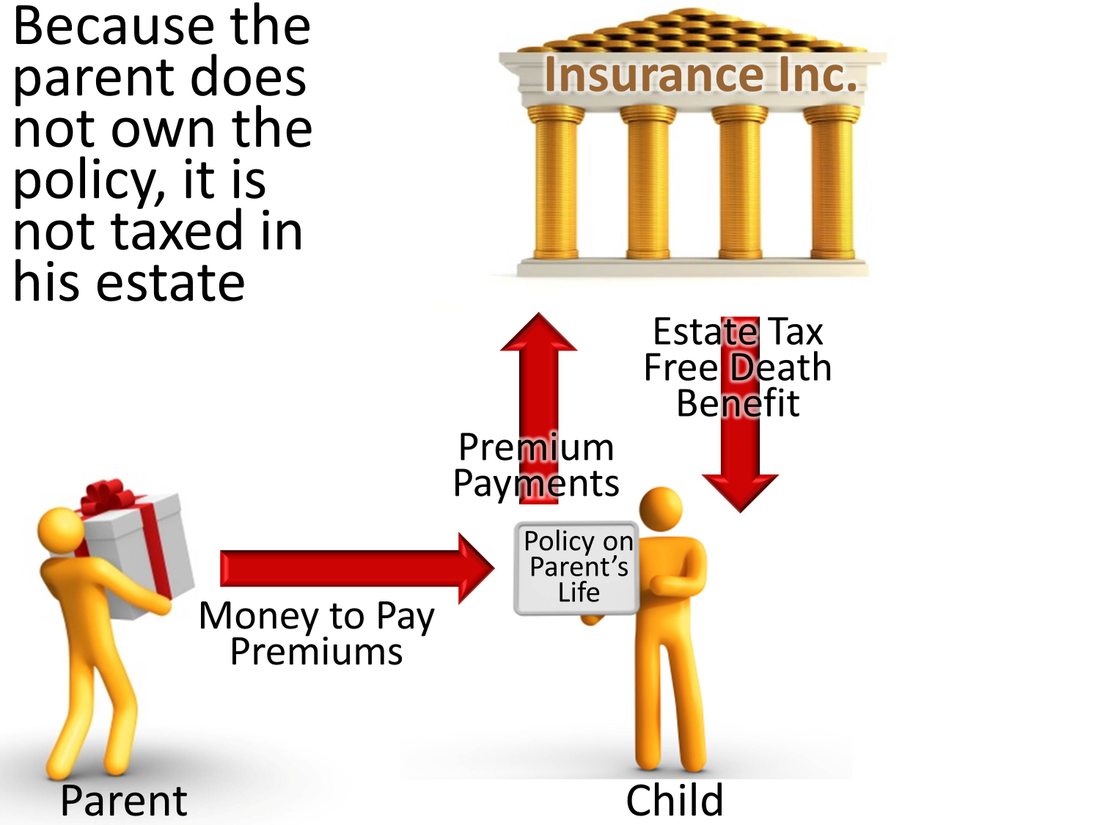
How would this work if another family member, such as a child of the insured, purchased the policy? The parent gives money to the child in order to allow the child to purchase a life insurance policy on the parent's life. Because the parent has not transferred the life insurance policy to the child, but has instead simply given funds to allow the child to purchase the policy, the parent has never owned the life insurance policy. Since the parent has never owned the policy, it will not be included in the parent's estate. (If the parent had owned the policy and then given it to the child, the policy would still be in the parent's estate for three years after the date of transfer.) Upon the parent's death, the life insurance policy then pays its death benefit to the child. The child receives these life insurance proceeds free from estate taxation, because the life insurance policy was never in the parent's estate.
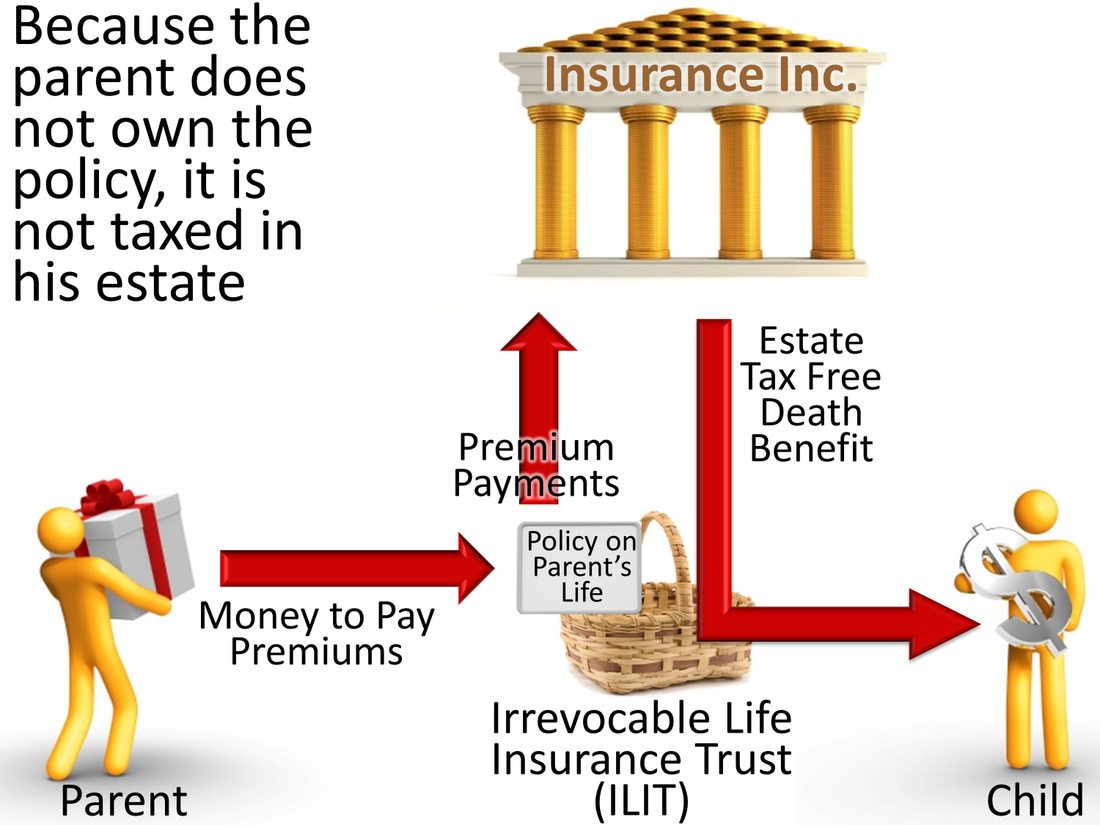
The same concept applies if the policy is owned, not by a child, but by a separate tax-paying legal entity not controlled by the parent, such as an irrevocable trust. Trusts designed for this purpose are referred to as ILITs (Irrevocable Life Insurance Trusts). The ILIT is, for tax purposes, a separate person. Thus, when the parent dies, the life insurance policy and its death benefit are not included in the parent's estate because another "person," the ILIT, owns the policy. The ILIT then receives the policy proceeds and distributes them to the child (or to whomever the ILIT document names as beneficiary).
An ILIT allows for distribution to multiple beneficiaries and ensures that money given for premium payments will be used for premium payments. By using an ILIT, the parent can establish rules for precisely where and how the money will be distributed. Because the child does not own the ILIT, the child's creditors, lawsuits, or divorce often cannot reach the ILIT assets. Although the parent cannot continue to directly control the ILIT after its creation, the parent can establish all rules that the ILIT trustee must follow in purchasing, paying for, and distributing the proceeds from the life insurance policy. This high level of control, without risk from potentially interfering family conflicts, is often attractive to those planning their estates.
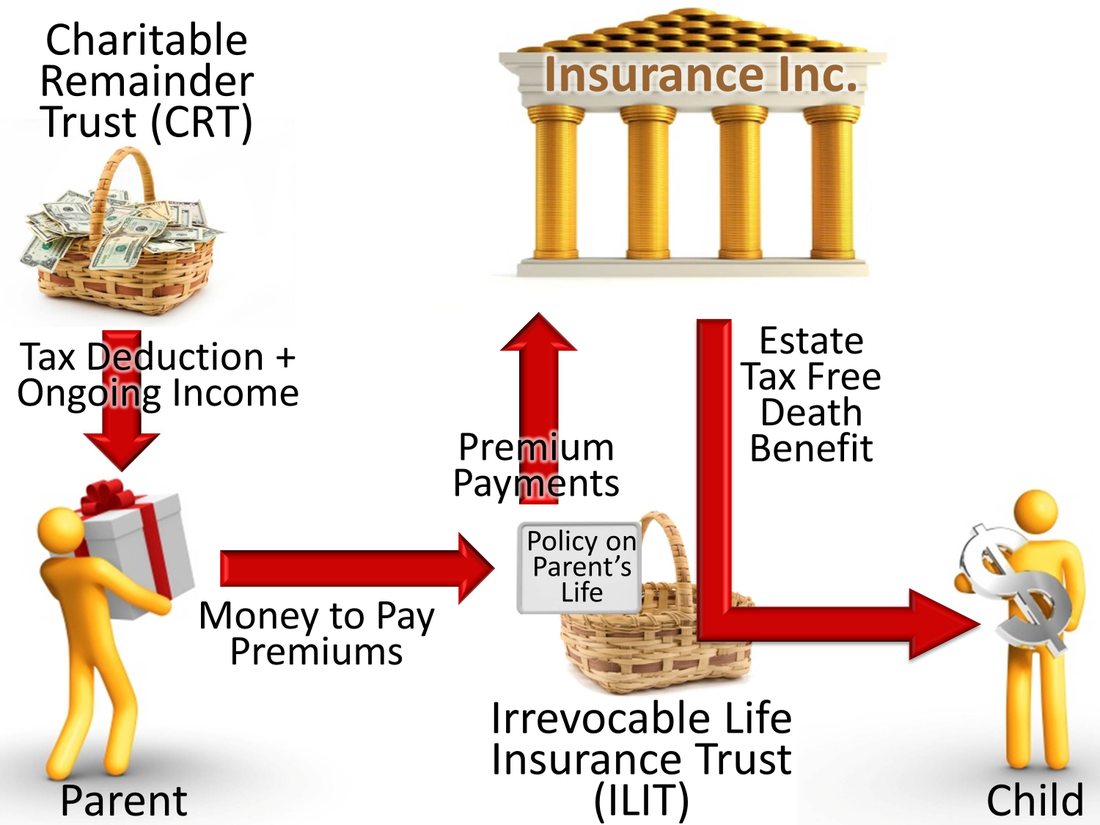
The ILIT is not, by itself, a charitable planning technique. Instead, the ILIT often serves as an attractive addition to charitable planning. The immediate tax deductions and lifetime income typically generated by Charitable Gift Annuities and Charitable Remainder Trusts provide a natural source of funding for this type of life insurance planning. At the same time, these gifts also reduce the remaining estate for heirs, increasing the potential interest in using life insurance as a means of replacing this donated wealth. Other charitable planning techniques, such a gifting a remainder interest in a home or farmland while retaining the life estate, do not generate ongoing income, but do generate an immediate tax deduction. In this case, the donor may consider using the money saved from the reduced tax liability to purchase life insurance.

Although the Charitable Remainder Trust, Charitable Gift Annuity, or gift of a remainder interest in a home or farmland reduces donor assets, the heirs may prefer to receive proceeds from an ILIT owned life insurance policy. The estate tax may have cut the value of other assets by up to 40%. The ILIT-owned life insurance policy generates a tax-free death benefit. In this way, the donor gives the taxable inheritance to charity and replaces it with a non-taxable inheritance funded by the increased income and tax benefits generated through the planned charitable gift.
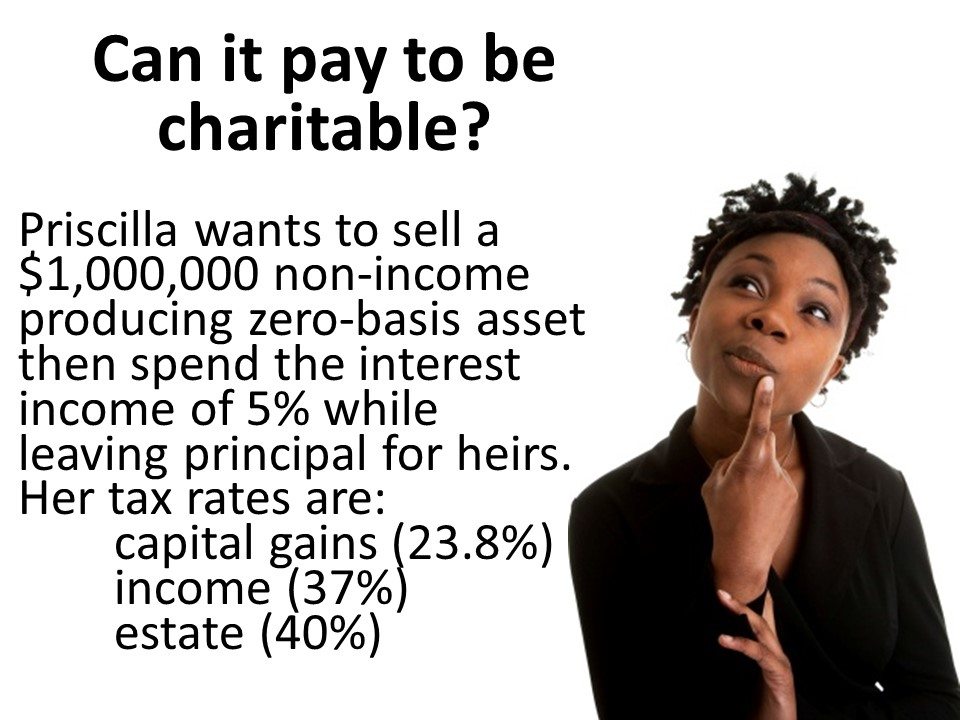
Combining charitable planning with life insurance planning can generate a range of tax benefits. The value of these benefits depends upon the tax circumstances of the donor. To see the potential power of these strategies, consider the case of a donor with a highly appreciated asset who is at the top federal tax rates for capital gains, income, and estate taxes. The donor has a $1,000,000 non-income producing zero-basis asset that she would like to sell, reinvest, and spend the interest income of 5% per year. (Low basis assets are a common financial planning challenge, especially with family businesses that started without a large initial cash investment.) She would like to leave the principal for heirs, but also has charitable interests. How can charitable planning make a charitable gift more affordable?
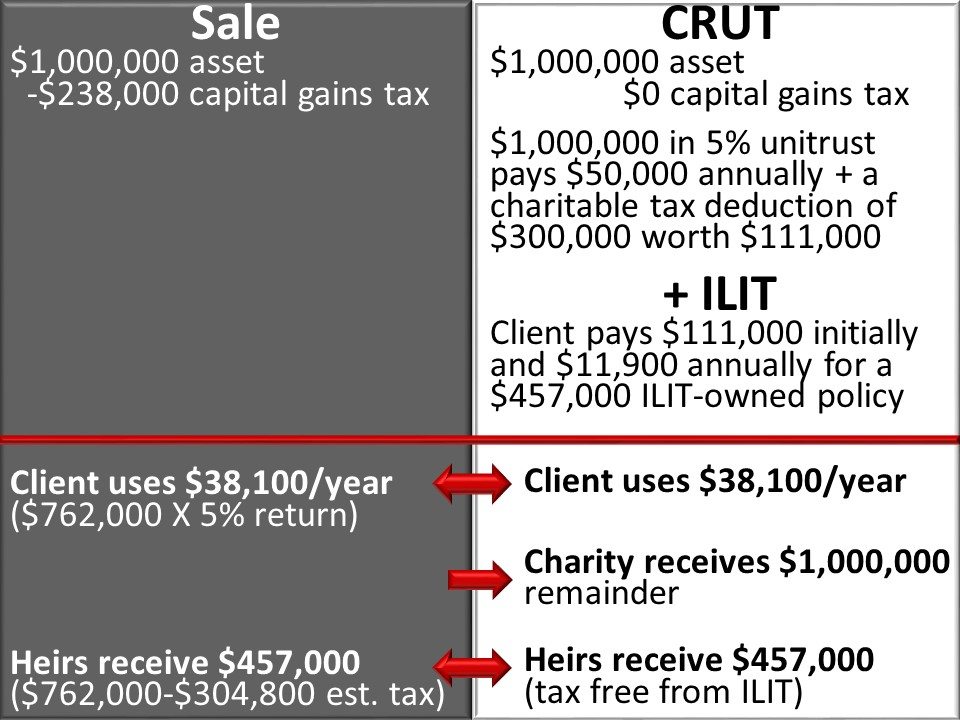
The traditional approach to the client's goals would be to sell the non-income producing asset, invest it, spend the interest earned, and leave the principal to the donor's heirs. This results in no charitable gift and substantial taxation. First, the sale of the appreciated asset generates a $238,000 federal capital gain tax (including ACA tax). Instead of having $1,000,000 to invest, only $762,000 remains after the taxes are paid. Earning 5% per year on this remaining amount generates $38,100 each year for the client to spend. The heirs inherit the entire principal, but due to a 40% estate tax on the principal, the heirs receive only $457,000 of the $762,000 principal.
As an alternative, the client could transfer the $1,000,000 asset to a Charitable Remainder Unitrust paying her 5% of the trust assets for the remainder of her life. In this case, the Charitable Remainder Trust sells the $1,000,000 asset. As a non-profit entity, the trust pays no capital gains tax. This leaves the entire $1,000,000 available to generate income for the client. The payments from the trust, earning 5% annually, will be $50,000 per year as compared with $38,100 in the non-charitable approach. In addition to the higher payments, the transfer to the Charitable Remainder Trust generates a tax deduction. The exact amount of the deduction will depend upon the prevailing interest rates and age of the donor, but suppose the deduction is 30% of the transfer, i.e., $300,000. This $300,000 deduction can lower the donor's federal income taxes by $111,000.
Although the donor receives a large income tax deduction and greater income than with the first plan, the donor has partially disinherited her children who now have no claim on the asset. This is great for the charity which will receive the $1,000,000 at the donor's death, but not as attractive for the heirs. To address this problem, the donor could purchase insurance using the value of the tax deduction and all or part of the increase in income. Although the amount of life insurance this will purchase depends upon prevailing interest rates and the donor's age and health, it is possible that an $111,000 initial premium plus an annual premium of $11,900 would purchase a $457,000 life insurance policy. (Note that as interest rates rise, the charitable deduction may decrease, but the cost of the insurance also decreases.) Because an ILIT owns the life insurance policy, the heirs receive the $457,000 tax free. This is identical to the after-tax benefit received from the $1,000,000 asset, which, after paying for capital gains taxes and estate taxes, left only $457,000 for the heirs. In other words, in the charitable planning scenario, the charity receives a $1,000,000 gift without any net cost to the donor or the donor's heirs. Of course, this is an extreme scenario in that the donor has a highly appreciated zero-basis asset and faces the highest federal tax rates. However, the charitable scenario actually becomes even more attractive if the donor lives in a state that charges taxes on capital gains in addition to the federal taxes on capital gain. Nevertheless, this example shows the potential power of combining charitable planning with life insurance planning as a way to benefit all parties.

Life insurance can also be used in less complex transactions. As an example, suppose a potential donor owns $100,000 of farmland that he would like to use for the rest of his life. At his death, he would like to leave the property to his favorite charity, but he is concerned about reducing his heirs' inheritance too much. How might charitable planning help in this situation?
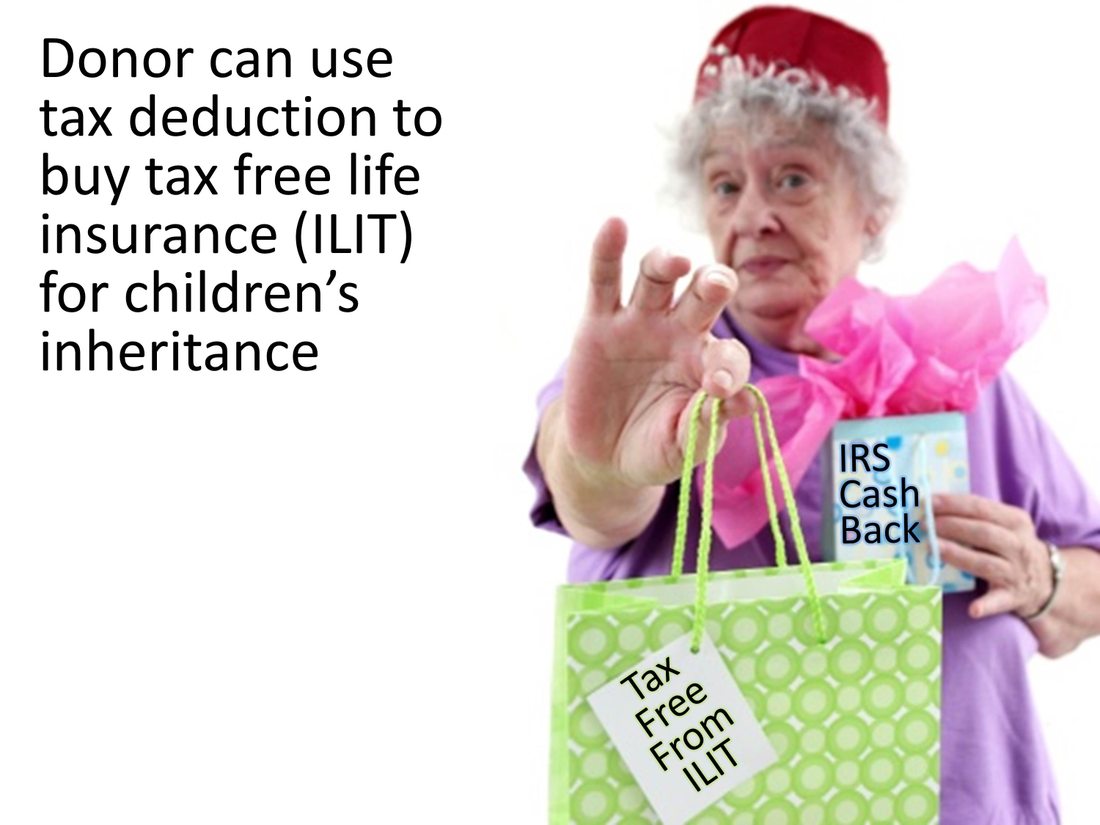
Pairing life insurance with income-producing charitable planning vehicles like Charitable Remainder Trusts or Charitable Gift Annuities is a common combination, because these gifts generate income that can be used to pay premiums. However, life insurance can also be combined with other charitable planning techniques that produce valuable tax deductions. For example, gifts of remainder interests in homes or farmland generate charitable income tax deductions but require no cash. The value of these deductions can be used to purchase insurance to help offset the heirs' loss of the inheritance of the home or farmland. If estate taxes are a concern, the donor is able to use the value of the tax deduction from the IRS to purchase a tax-free inheritance (using an ILIT) for heirs in partial replacement of the taxable inheritance donated to a charity.
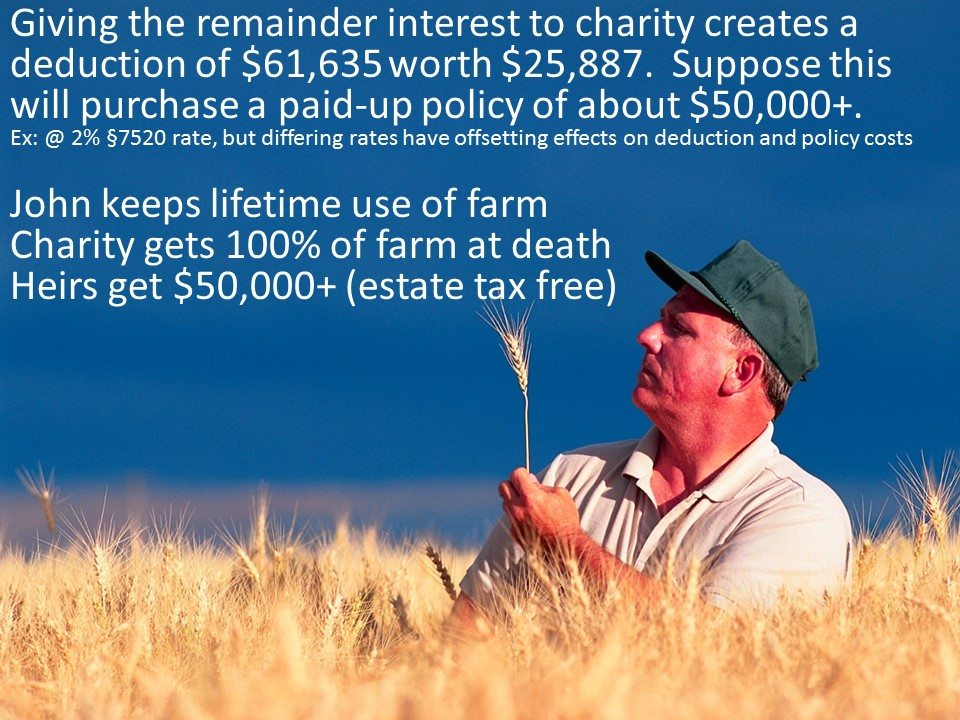
By giving the remainder interest in his farmland to charity, the donor generates an immediate income tax deduction. If the donor was age 55 and the §7520 rate was 2.0%, this gift would create an immediate deduction of $61,635. Assuming the donor could use this deduction at the top federal tax rate and a 5% state tax rate (no additional deductions due to having reached the $10,000 cap), it would lower his tax bill by $25,886.70 Depending on the donor's health, this amount might purchase a $50,000 single premium life insurance policy. Other donors would be in different situations, but many would be roughly similar. If the §7520 rate was higher, the deduction would be lower, but the cost of life insurance would also be lower. If the donor were older, the deduction would be greater, but so would the cost of life insurance. With charitable planning, the donor is able to make the gift to charity, but also provide a substantial inheritance to his heirs. Here, the tax benefits from charitable planning fund the entire replacement inheritance. Of course, if the estate would be subject to estate taxes and the donor purchased the life insurance through an ILIT, the heirs are that much better off. The same transaction could be structured without life insurance. A donor could transfer the value of the tax deduction as a gift to an irrevocable trust for the benefit of the heirs (still using "Crummey" powers if necessary for estate tax planning). Through investment of these funds, $50,000 or more would be available for heirs if the donor lived to his life expectancy. The primary advantage of life insurance is that it removes the risk of an unexpectedly early death, guaranteeing the larger amount. Along with this, however, it also removes the potential benefit of an unexpectedly long life where the asset could have grown in value for several more years.
Ultimately, charitable planning can generate income and tax benefits that would not otherwise be available. The ILIT provides a mechanism to convert these additional income and tax benefits into estate tax-free wealth for heirs. The use of the benefits in this way can help to balance a donor's competing desires for charitable and family estate transfers.
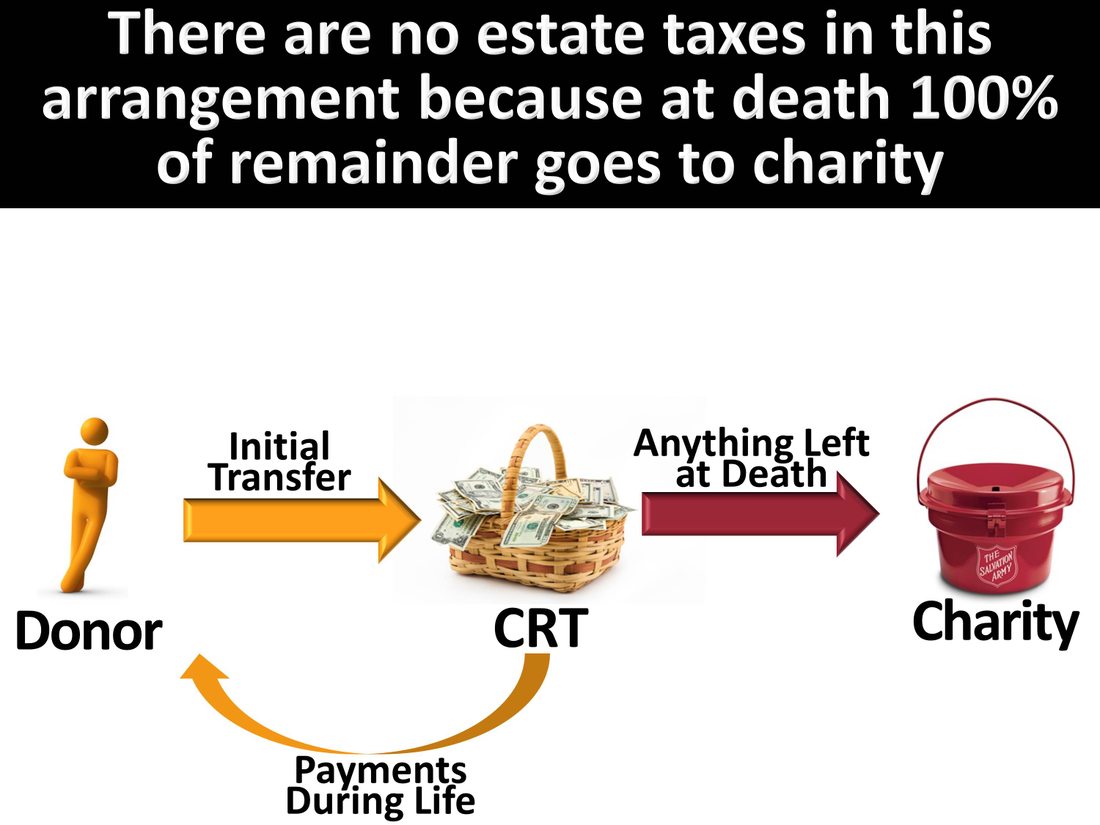
No gift or estate taxes result from the typical Charitable Remainder Trust arrangement. The donor receives an income for life and then at death any amount remaining in the trust goes to charity. Although the assets in the trust are included in the donor's estate, they generate no taxation because these assets go to charity. However, there are other Charitable Remainder Trust arrangements that can have different tax consequences.
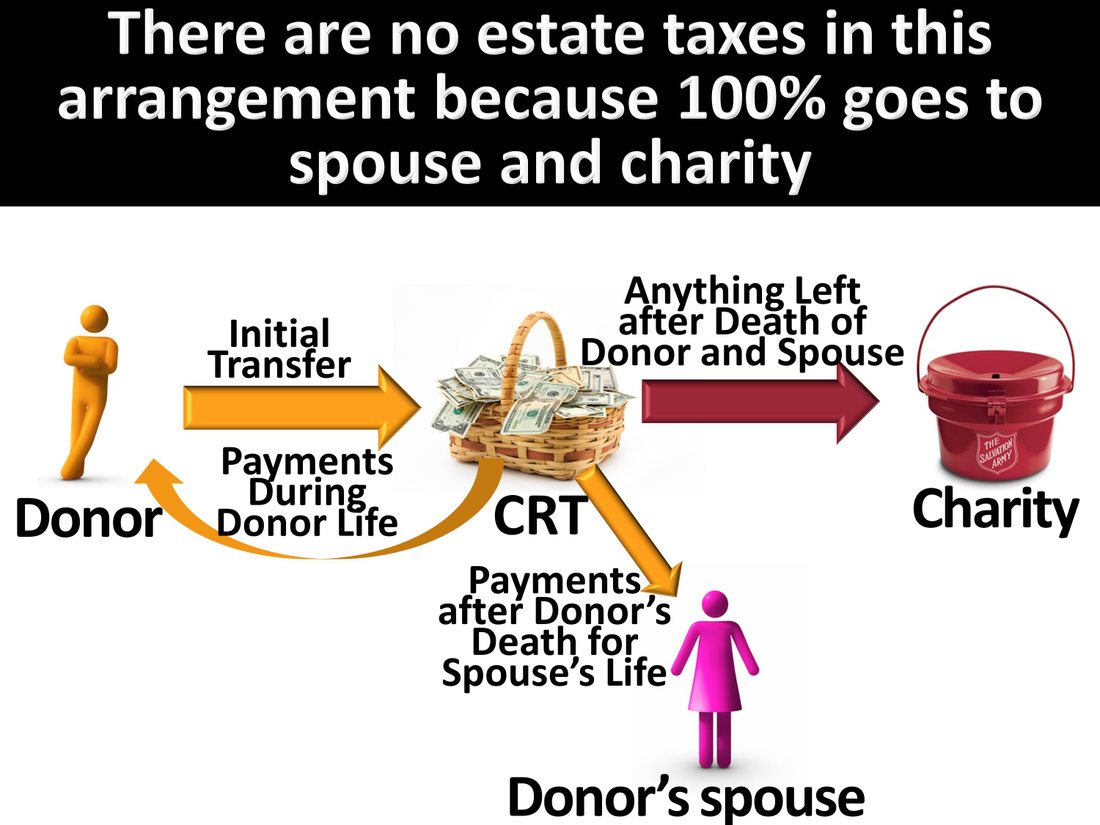
A donor may also establish a Charitable Remainder Trust that makes payments not only for the donor's life, but also for the life of the donor's spouse. This is a common arrangement for Charitable Remainder Trusts. It generates no estate taxation because all interests go to the charity and the spouse, both of which are non-taxable recipients due to the unlimited marital and charitable estate tax deductions.
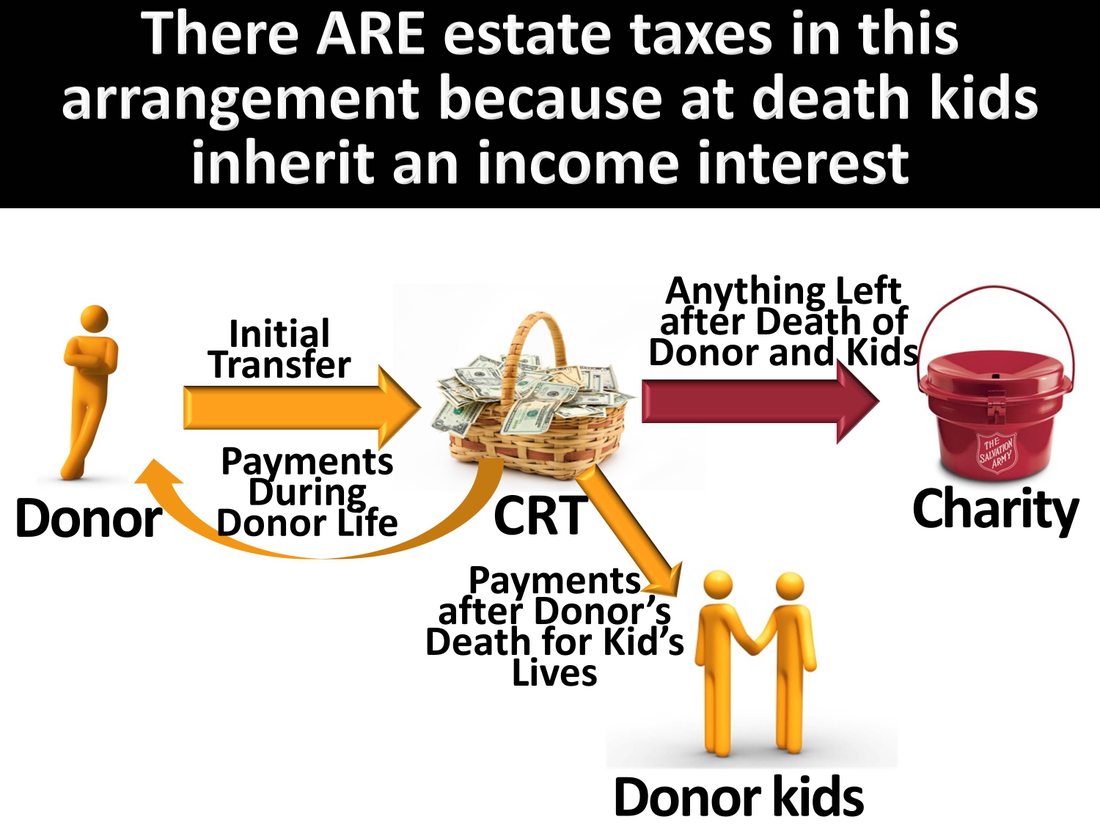
In contrast to the previous examples, if the donor chooses to make his children (or any other non-spouse) beneficiaries of the trust this arrangement will generate estate taxation. At the donor's death, the estate must pay taxes on the present value of the children's annuity or unitrust interest. As before, the Charitable Remainder Trust assets are included in the donor's estate. However, in this case not all of those assets are going towards marital or charitable gifts. The children inherit this benefit and, consequently, it is subject to estate taxation.
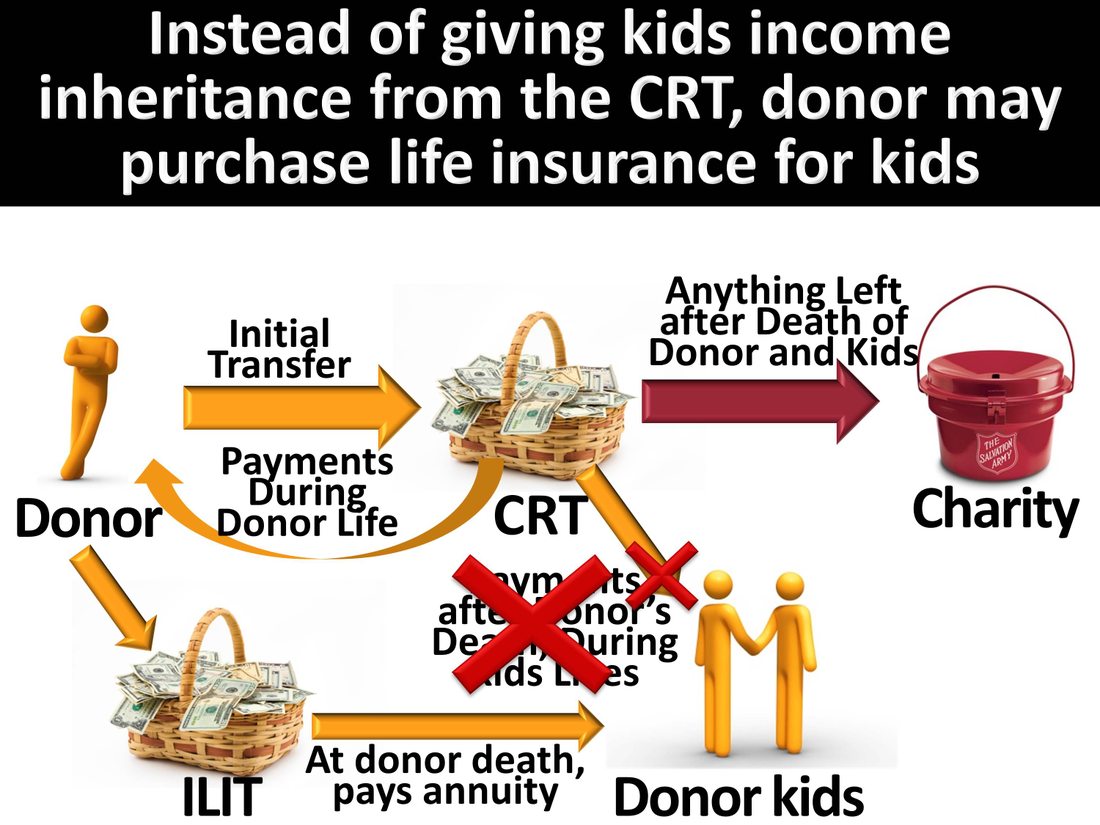
Because of the estate tax results from simply naming the children as secondary beneficiaries of the Charitable Remainder Trust, it may make sense to consider using an ILIT to accomplish the same purposes. In this case, the Charitable Remainder Trust provides no payments to the children. Instead, the ILIT purchases life insurance on the donor's life and then receives the death benefit at the donor's death. The ILIT then purchases annuities for the children that pay income to them for their lives. The net result to the children is the same - receipt of lifetime income. However, in the ILIT arrangement the value of the income interest is not subject to estate taxation.
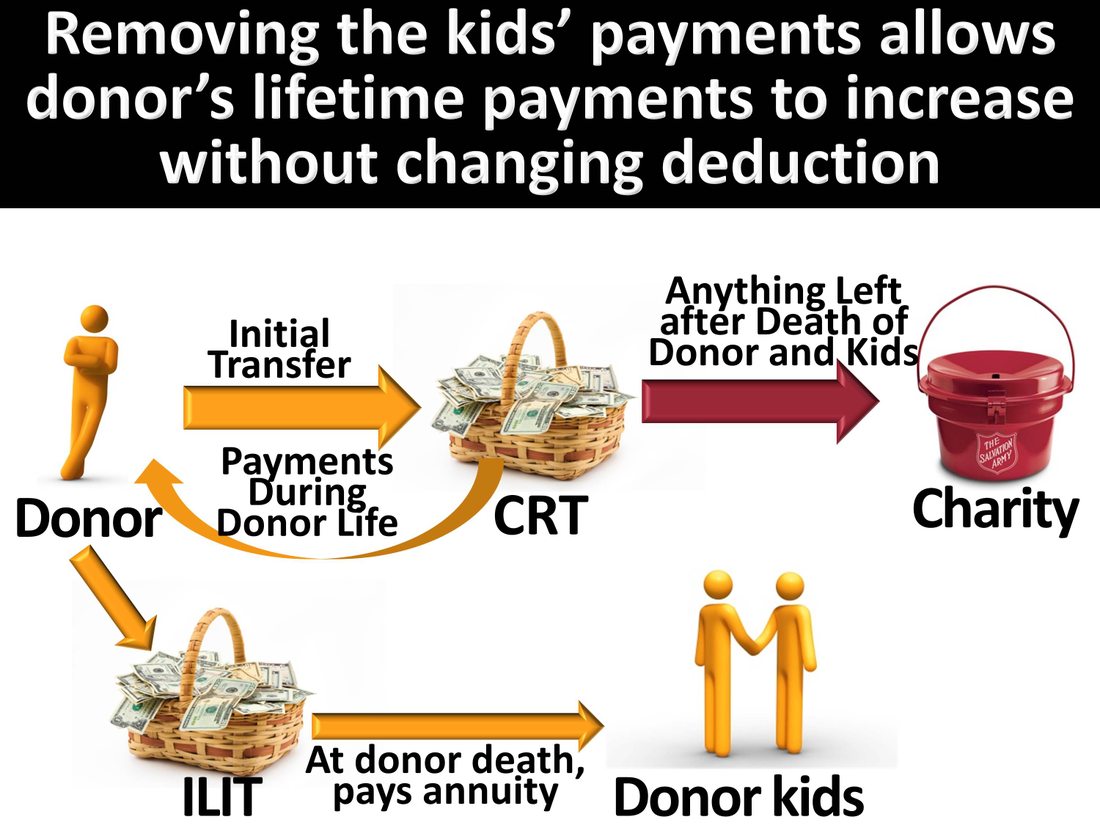
By removing the children as secondary beneficiaries of the Charitable Remainder Trust, the payments to the donor can substantially increase without altering either the tax deduction or the ultimate charitable gift. The amount of this increase in payments can pay premiums on ILIT-owned life insurance throughout the donor's life. The primary motivation for this substitution is to reduce estate taxes. However, if the donor's estate is not subject to estate taxation, then this substitution may be undesirable because the increased income during the donor's life will likely be subject to taxation (depending upon the tax characteristics of the underlying assets in the Charitable Remainder Trust). Donors should weigh the trade-off between income taxation and estate taxation in each case to find the most advantageous approach.

The previous examples presented a simplified process for using an ILIT. However, it can be helpful to understand a bit more about the different steps in creating and operating an ILIT and their potential consequences.
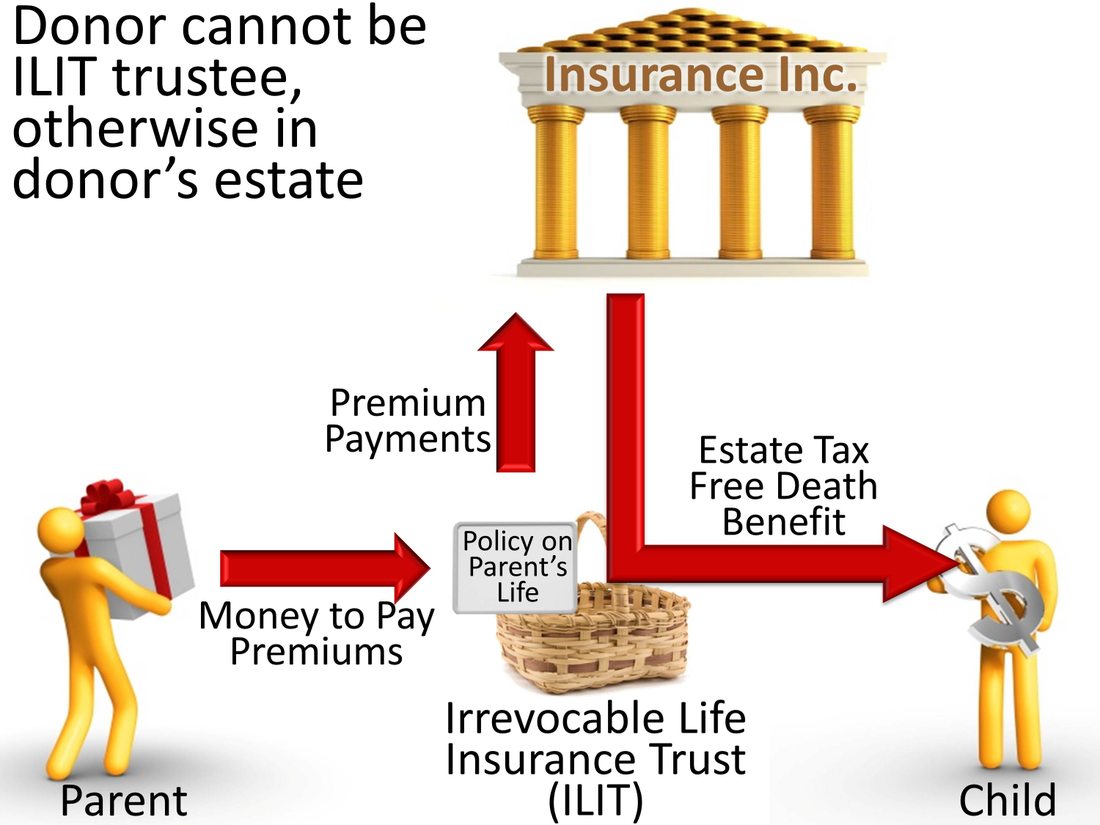
Although the donor can create the rules of the ILIT, even determining the exact wording of the trust document, the donor may not continue to directly control the assets in the ILIT once it is created. Thus, unlike, for example, a Charitable Remainder Trust, the donor may not continue to act as trustee of the ILIT. Doing so gives enough ongoing control to the donor that the ILIT will be included in the donor's estate which would eliminate the estate tax benefits.
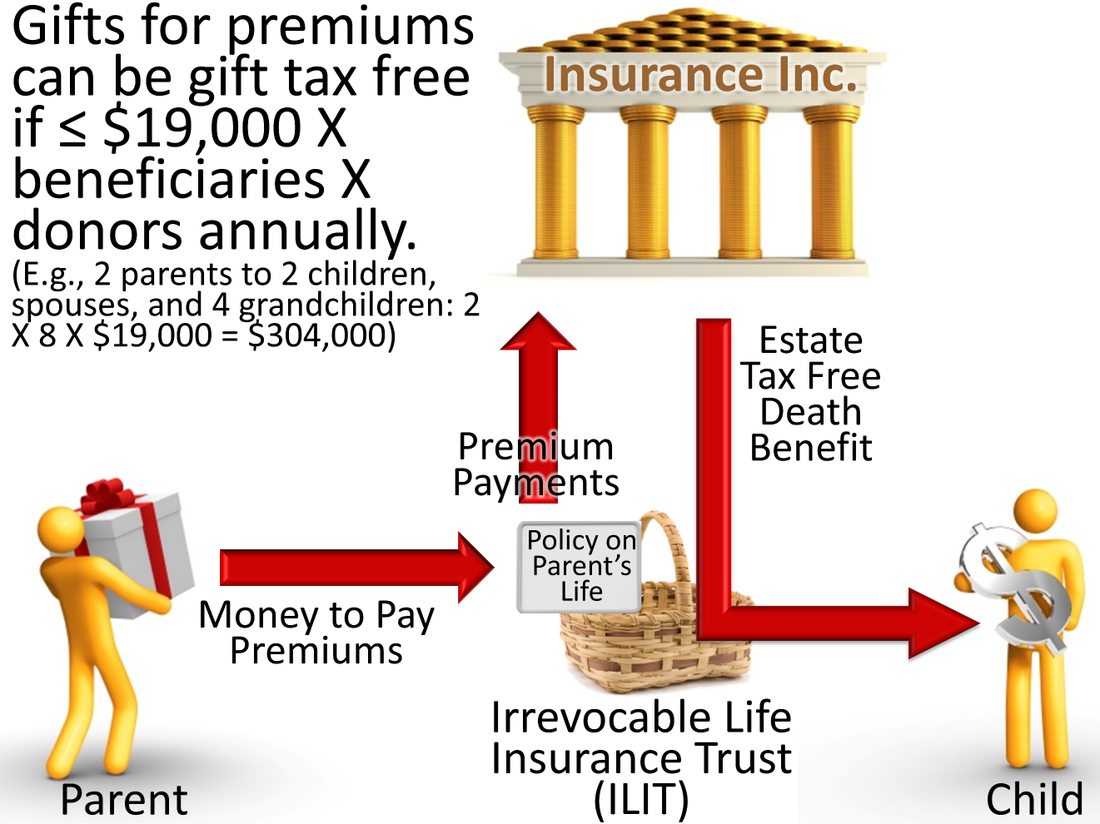
The amount a donor may transfer to another person without gift tax consequences is limited. Each year, a donor can make present interest gifts to other people up to this limit (e.g., $19,000 per donee in 2025) without any gift tax consequences. The amount applies to each donee and each donor. For example, a married couple with two married children each with two children of their own would have eight natural donees. Because both spouses have their own separate annual exclusions, this would allow the transfer of $304,000 (8x2x$19,000) each year without gift tax consequences.
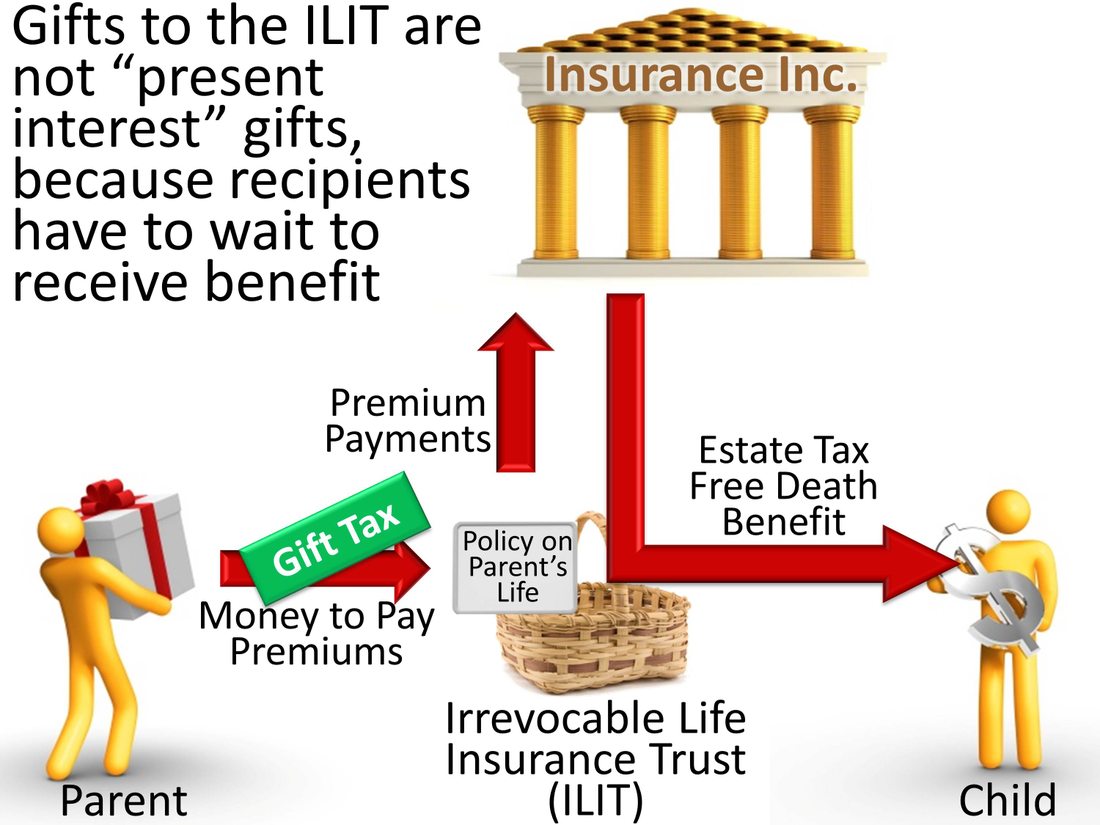
Unfortunately, direct gifts to an ILIT do not qualify for the annual present interest gift exclusion. Thus, direct transfers to the ILIT will have gift tax consequences. Specifically, any direct transfers will reduce the donor's available estate and gift tax exemption. This would eliminate the benefit for the donor who ultimately gifted more dollars to pay premiums than the death benefit paid by the insurance policy. Every dollar of direct gifting to the ILIT will reduce the estate tax credit because gifts to the ILIT are not "present interest" gifts. Direct gifts to an ILIT do not qualify as "present interest" gifts because the beneficiaries of the ILIT do not receive any funds until sometime in the future. One extra step is required to avoid this bad result.
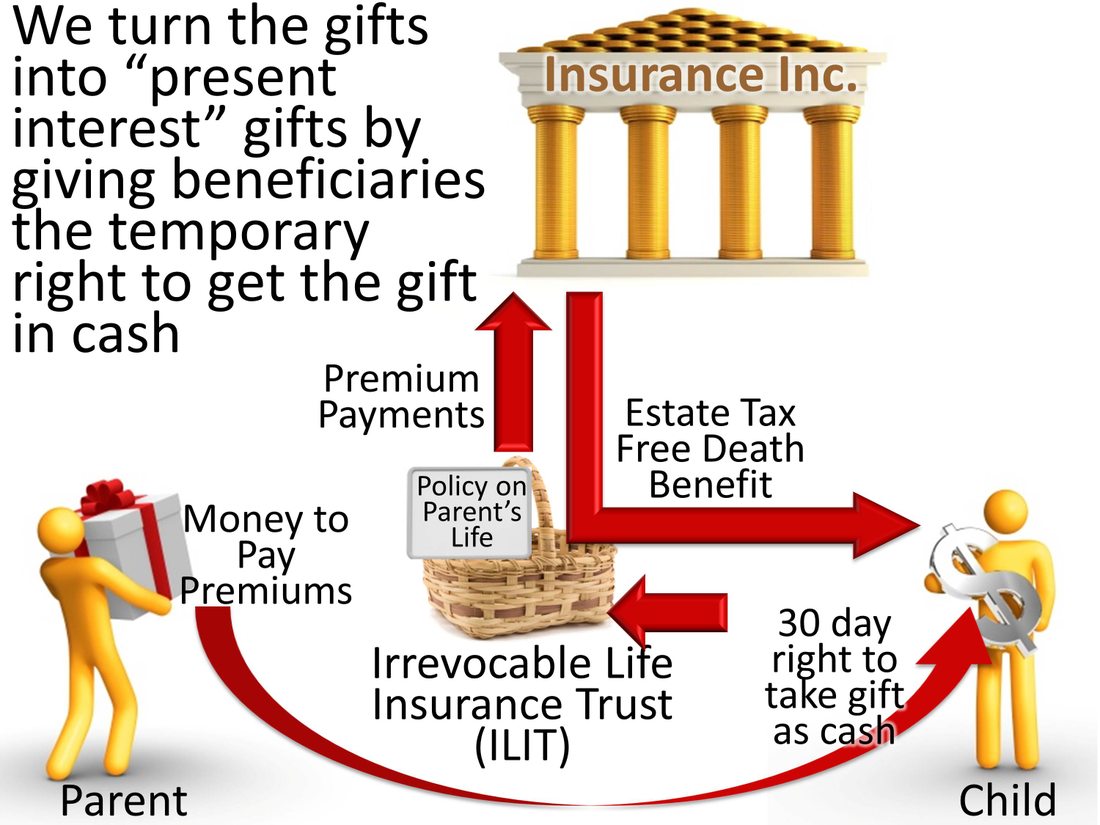
Instead of making transfers directly to the ILIT, the donor makes transfers to the ILIT but with the provision that some beneficiaries of the ILIT (such as the donor's children) have, and are notified in writing of, a 30 day right to take the transfer as an immediate cash gift to them. Because the beneficiaries have a right to take the gift immediately as a cash gift, the gift from the donor becomes a "present interest" gift. This "present interest" gift then qualifies for the gift tax annual exclusion. For example, in 2025, each donee could receive a right to claim up to $19,000 of the transfer from each donor as immediate cash. This $19,000 transfer would generate no gift or estate tax consequences for the donor. The appellate court case that authorized this type of temporary power as a way to claim the present interest gift tax exclusion involved a taxpayer by the name of Crummey. Hence, these are known as "Crummey" powers. These "Crummey" power holders must also be potential beneficiaries of the ILIT. The tax courts have permitted contingent beneficiary power holders, such as grandchildren who will receive a share only if their parent predeceases them before the distribution.

The assumption in this planning is that the recipient of the Crummey powers will choose not to take advantage of their right to an immediate cash withdrawal and will instead allow the money to go to the ILIT. Otherwise, the tax advantages of the planning process would be defeated. This is one reason why such rights are typically given in a family situation where the donor has sufficient informal influence over the recipient to prevent the cash withdrawals. Any overt or formal attempts to influence the powerholder's decision may nullify the tax effects of the Crummey power.
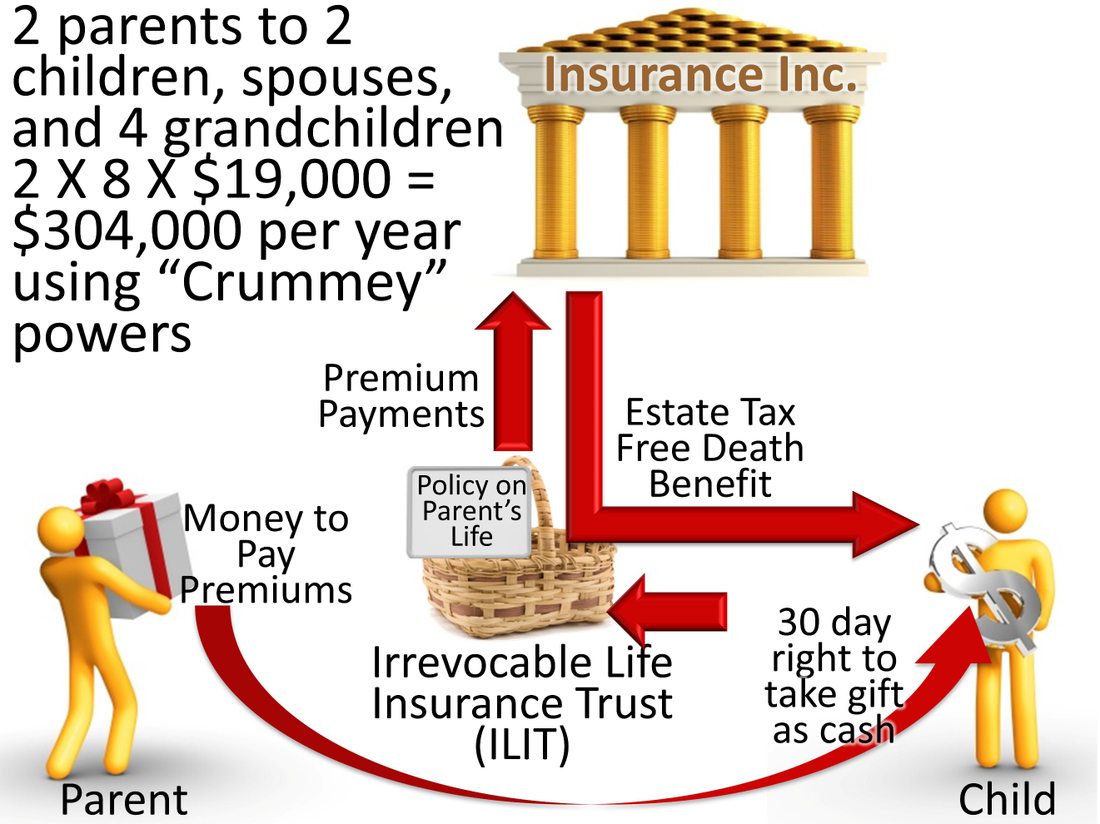
Although the present interest annual gift tax exclusion is relatively small (e.g., $19,000 in 2025), it can be used for every donor and every donee. When combined together for a large number of donees, these add up to substantial annual transfers. For example, if a married couple were making transfers with "Crummey" powers given to their two children, the children's two spouses, and four grandchildren, this would allow for the use of 8 separate annual present interest gift tax exclusions for each donor spouse (e.g., $19,000 X 8 X 2, or $304,000).

When this much money is used for annual premium payments, it can purchase a significant amount of life insurance - especially for younger and healthier donors. The annual present interest gift tax exclusion is also indexed for inflation (although changes occur only in $1,000 increments), allowing for potential funding increases over time.
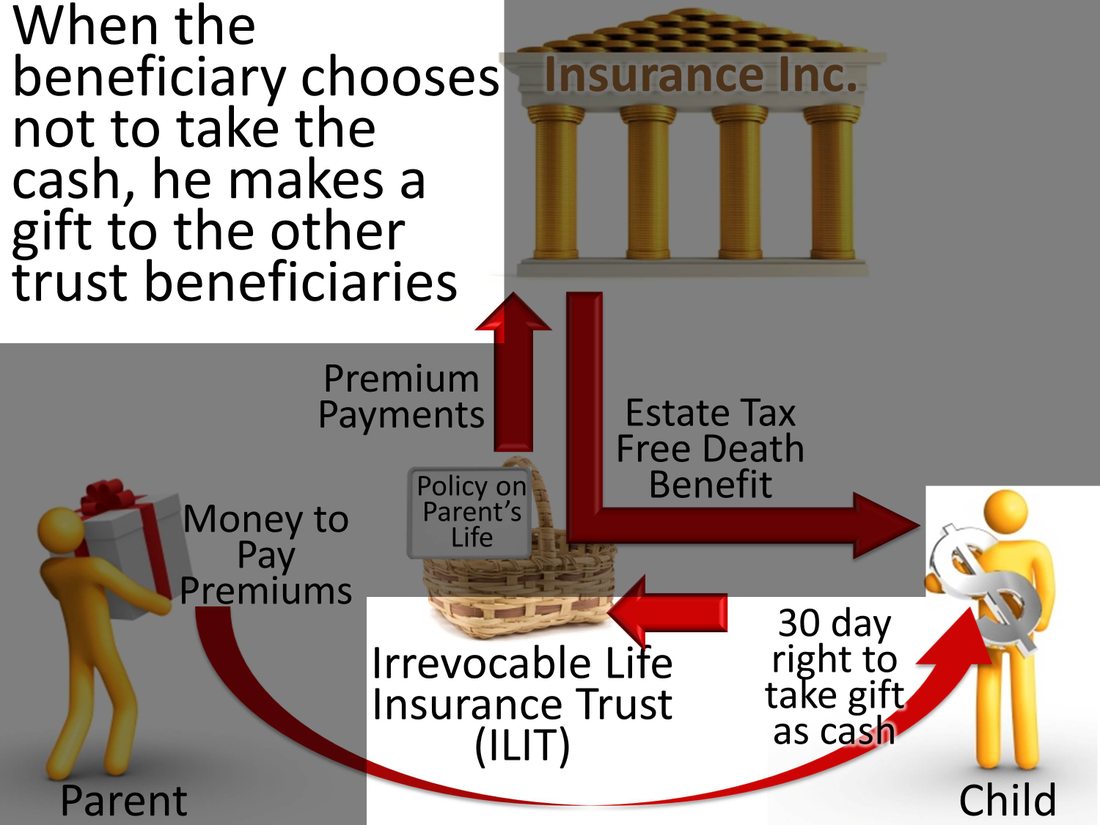
The use of "Crummey" powers solves one problem by converting the transfers into "present interest" gifts for the donors. At the same time, it creates a new problem. The new problem is that when the holder of the "Crummey" power chooses not to use his or her rights, he, in effect, makes a gift to the beneficiaries of the ILIT. If the power holder were the only beneficiary of the ILIT, then this would not be a problem. No gift would have occurred because the ILIT would benefit no one other than the "Crummey" power holder. But, the typical ILIT has more than one beneficiary. This means that failing to exercise the right to immediately withdraw the money results in a gift benefitting others. Once again, the same problem arises here, because the gift to the other ILIT beneficiaries is not a present interest gift. (As before, these beneficiaries must wait until the death of the insured to receive benefits from the expired withdrawal rights.) Because the choice not to use these powers is not a present interest gift, the annual present interest gift tax exclusion will not apply, causing the gift to reduce the "Crummey" power holder's gift and estate tax exemption.
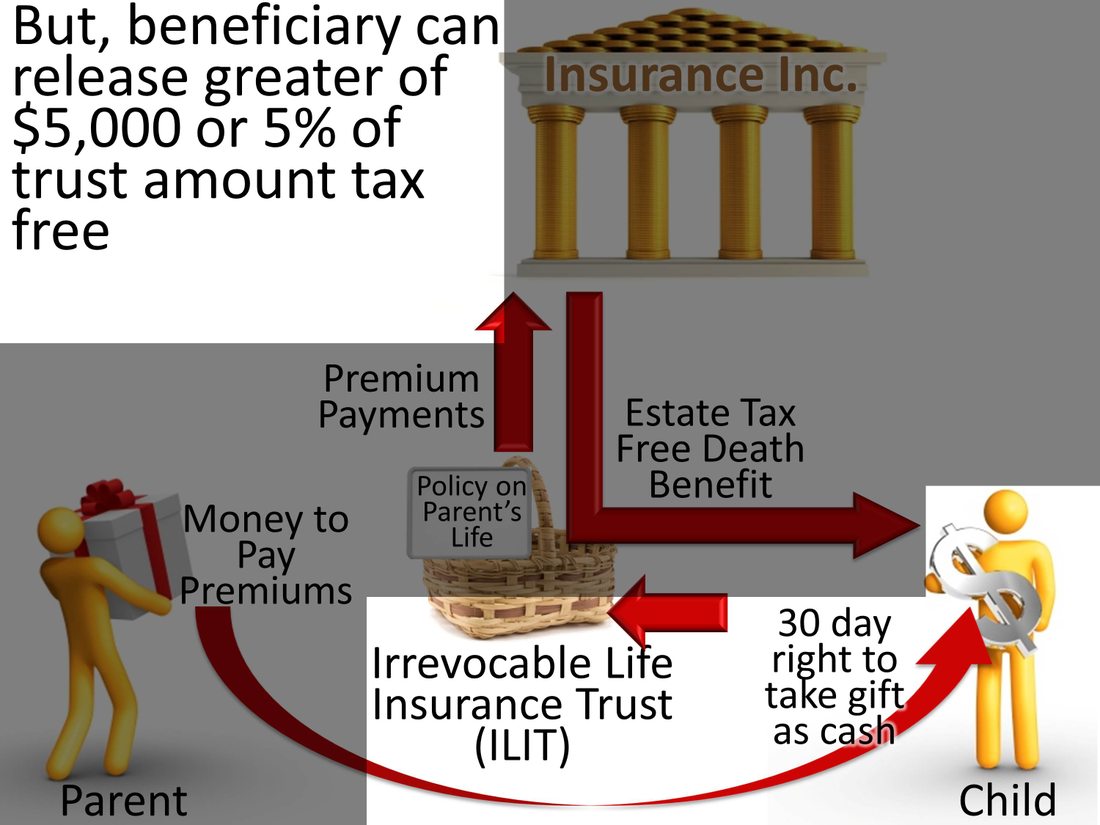
However, the beneficiary may release this type of power up to the greater of 5% of trust assets or $5,000 each year without gift or estate tax consequences. This does not normally allow for the release of the full annual present interest gift tax exclusion ($5,000 is less than $17,000). One approach is to allow the beneficiaries' gift and estate tax exemption to absorb the difference, thus dispersing and postponing the tax effects to the next generation. There is also another alternative.
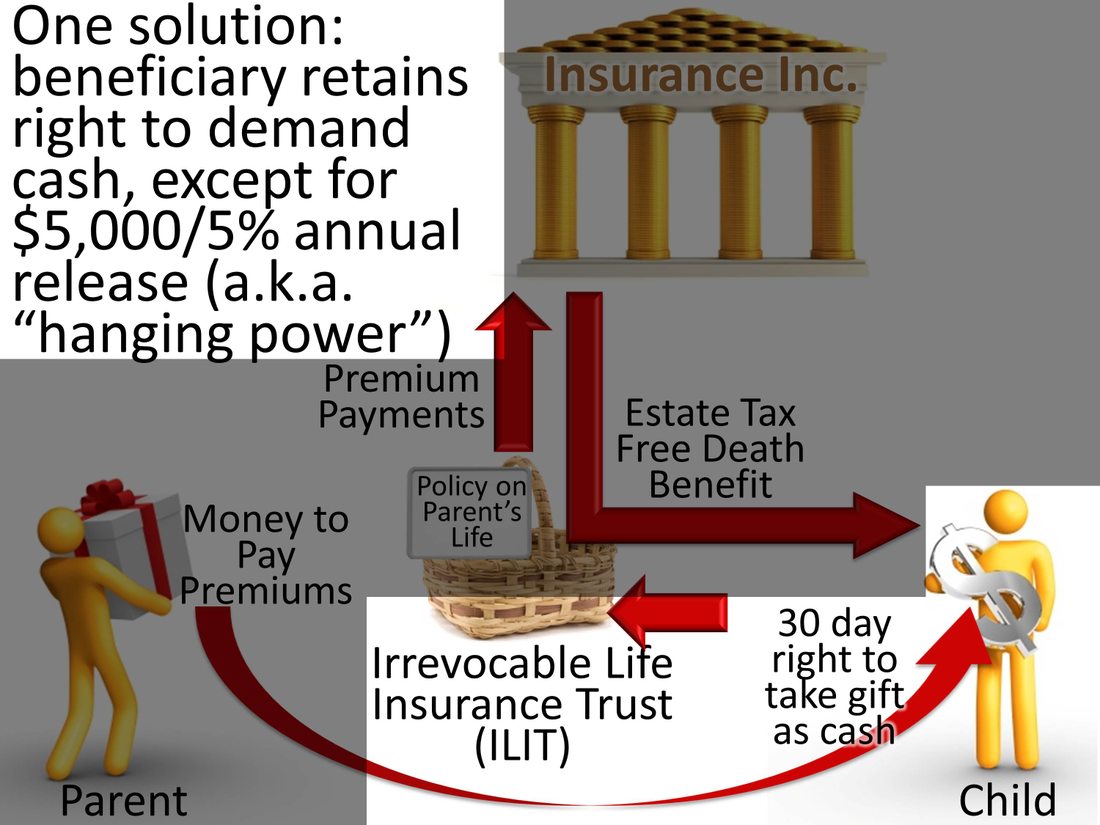
The "Crummey" powers may allow each beneficiary to keep the right to demand his or her share of the cash transferred to the ILIT indefinitely, with this right expiring only at the rate of the greater of $5,000 or 5% of the value of the ILIT per year. This type of provision is called a "hanging power" because the recipient hangs on to the right to demand the cash for a long time. With this drafting, the beneficiary never gives up more than the gift-tax-free amount of his or her right to receive cash (i.e., $5,000 or 5% of trust assets), preventing the beneficiary from making a taxable non-present-interest gift to the ILIT.
The use of hanging powers prevents the beneficiary from using up her own gift and estate tax exclusion amount, but can create problems of its own. The ability of the "5 and 5" powers to eliminate the accumulation of such hanging powers is limited. In fact, each beneficiary can use only one "5 and 5" exemption each year, regardless of how many ILITs or other trusts for which they have such powers. Over time, these hanging powers can continue to accumulate, meaning that the beneficiary has an increasingly large right to receive immediate cash. Creditors could take this right, and the beneficiary's estate will include any unexpired rights for estate tax purposes. Eventually, the "5 and 5" powers can begin to reduce the total hanging powers if, for example, "Crummey" gifts cease to be made. This could occur if the life insurance policy becomes fully-funded at some future point. Additionally, after the death of the insured, the ILIT will hold the entire death benefit. At this point, 5% of the trust assets may be worth far more than $5,000. Because the greater of these two amounts can be lapsed, this would allow for a rapid reduction in the total hanging powers for as long as the ILIT holds such substantial assets prior to distribution.

A generation skipping transfer tax can apply when the donor makes a gift (or estate transfer) to a "skip person," such as a grandchild. A skip person is anyone two or more generations below the donor. However, if the skip person's parent (who is also the donor's descendent) has died, the skip person is treated as being one generation older. Transfers to such skip persons are subject to a generation skipping transfer tax of 40% in addition to the estate tax of 40%. The theory here is that normally, every generation must pay estate taxes on its transfer to the next generation. Giving wealth to a grandchild or great-grandchild "skips" out on taxation that would have been collected at the death of the previous generation. There is an exemption for generation skipping transfers, which is the same size as the estate tax exemption amount. For those transferring more than this exemption amount the potential application of both the 40% estate or gift tax and the 40% generation skipping transfer tax is disturbing. (Because the 40% generation skipping transfer tax is applied to the amount left after payment of estate tax, the net result is a combined tax rate of 64%.)
Crummey powers allow gifts to an ILIT without gift or estate tax consequences up to the annual exclusion limit ($19,000 per donor per donee in 2025). However, a Crummey power does not automatically exclude these gifts from generation skipping transfer taxes. If the ILIT benefits skip persons (e.g., grandchildren with living parents), it is a generation skipping trust and transfers to it will reduce the donor's generation skipping transfer tax credit. The only exception is that if an ILIT is established solely for the benefit of a single skip person (e.g., a single grandchild) and the ILIT assets will be included in the skip person's estate, then gifts up to the annual exclusion limit will also be excluded from generation skipping transfer tax consideration. (Including the ILIT in the skip person's estate is accomplished by giving him or her a general power of appointment to decide who will get the funds if he or she dies before receiving all ILIT assets.) In this way, such transfers to a single-beneficiary ILIT can avoid generation skipping transfer tax. However, benefitting multiple skip persons in this way would require the creation of multiple ILITs, each with a single skip-person beneficiary.

Charitable giving with a life insurance policy can be simple. The owner of a life insurance policy can just name a charity as the beneficiary of the policy. At the death of the insured, the charity will receive a check for the death benefit. Although this transfer generates no estate taxation, it also - like other revocable gifts taking effect at death - generates no charitable income tax deduction. In order to generate a charitable income tax deduction, the donor must make a completed gift during life. Giving a policy to charity may constitute a substantial charitable gift, especially where the life insurance policy combines a death benefit (i.e., simple term insurance) with investment features. These policies can become valuable assets over time. Such policies may be particularly attractive candidates for donation when the original purpose for the life insurance no longer applies. Despite this attractiveness, the rules for tax deductions, the policies themselves, and the proper post-gift management of the policies by the charity can be complicated.
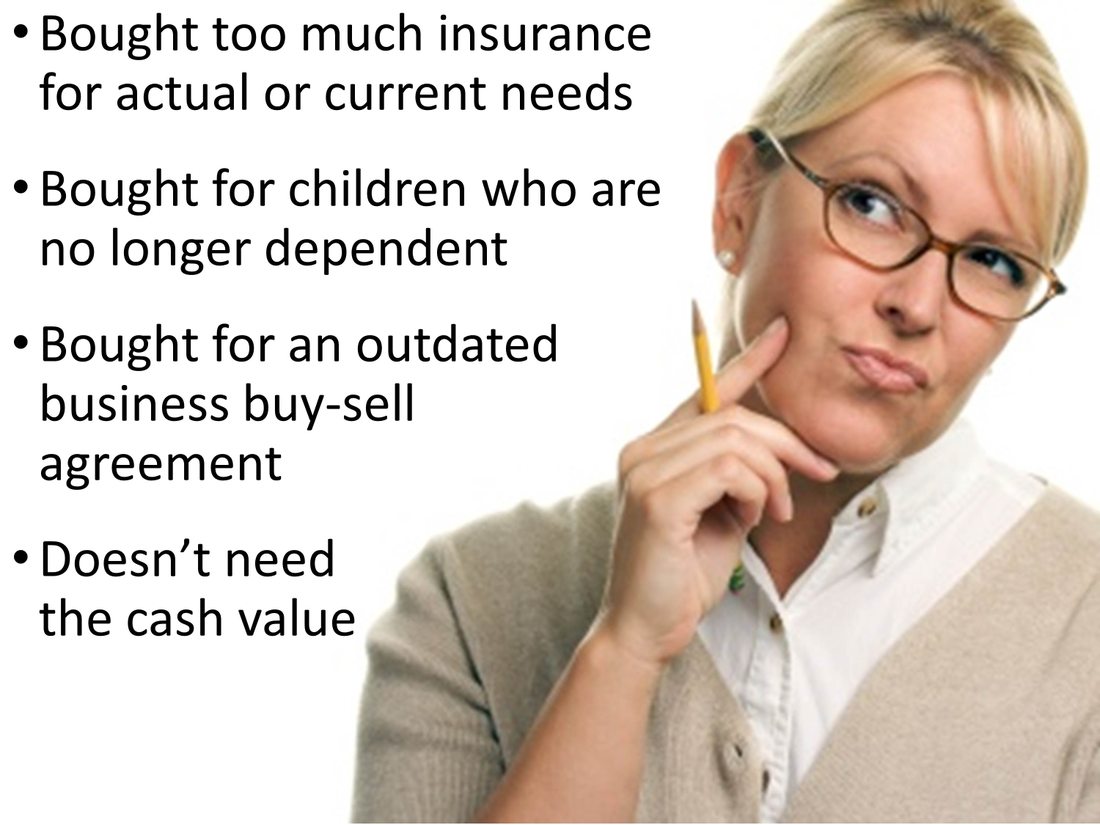
Life insurance can address needs in a variety of circumstances. As circumstances change, the original need for the life insurance may disappear. This lack of need for an existing policy is a common motivation for a donor's decision to donate the policy to charity. A donor may have purchased life insurance to replace his or her income in the event of death as a way to protect his or her minor children. Once the children are grown and independent, the original need for the policy no longer exists. An insurance policy may have been purchased for a business buy-sell agreement. For example, two partners in a business partnership may agree that at the death of one of them, the other will purchase the deceased partner's ownership for an agreed price. Each partner purchases life insurance on the life of the other so that, in the event of one partner's death, the surviving partner will have the cash to purchase the deceased partner's interest. This provides cash for the heirs and prevents the difficulties inherent in sharing forced ownership in an operating business with a group of heirs unfamiliar with the business. However, if the business relationship changes - perhaps due to the business closing or being sold - the need for the life insurance also changes. These are just two examples of the variety of ways in which a policy owner may find that he or she has too much life insurance for current needs. If, in combination with this lack of need for death benefits, the owner also wishes to forego the cash value of the policy in order to benefit charity, a gift of the life insurance policy may make sense.
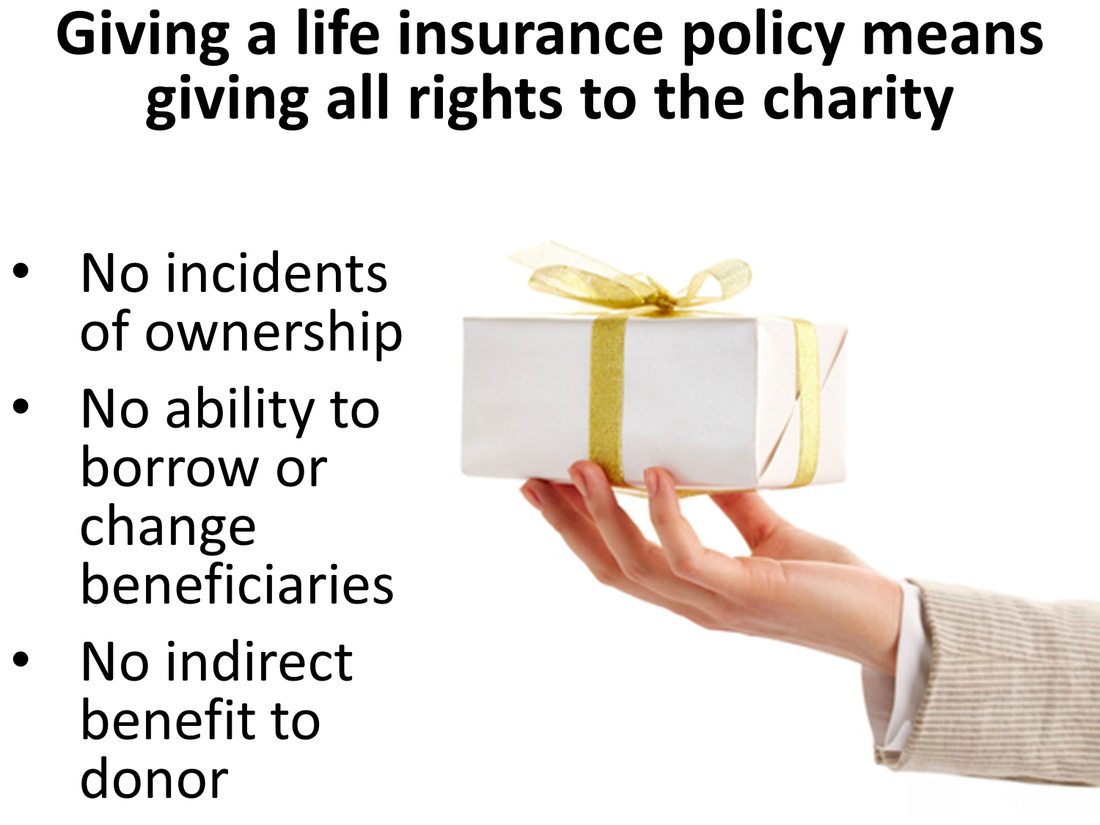
When a donor gives a life insurance policy to charity it is important that the donor give up all rights to and benefits from the policy. This means, for example, that the donor may not keep any rights to change beneficiaries, surrender, assign, or cancel the policy, pledge the policy for a loan, make withdrawals or loans from the cash surrender value, or hold any other reversionary interests. Attempting to retain any rights will result in no completed gift. This also extends to prohibit keeping indirect benefits for the donor, the donor's family, or anyone else designated by the donor. Not only does keeping some rights mean there is no charitable income tax deduction, but it also means that the life insurance policy will still be included in the donor's estate, and thus subject to estate taxation. Further, any additional premiums paid by the donor would not generate deductible gifts.
If the donor were to cash in a life insurance policy, any income generated would be treated as ordinary income, rather than as a capital gain. The donation of an ordinary income property item is valued at the lower of fair market value or the donor's basis. (In contrast, some long-term capital gain property items can be valued at fair market value, even when such value is higher than basis.) However, determining fair market value and even basis in a life insurance policy can be challenging.
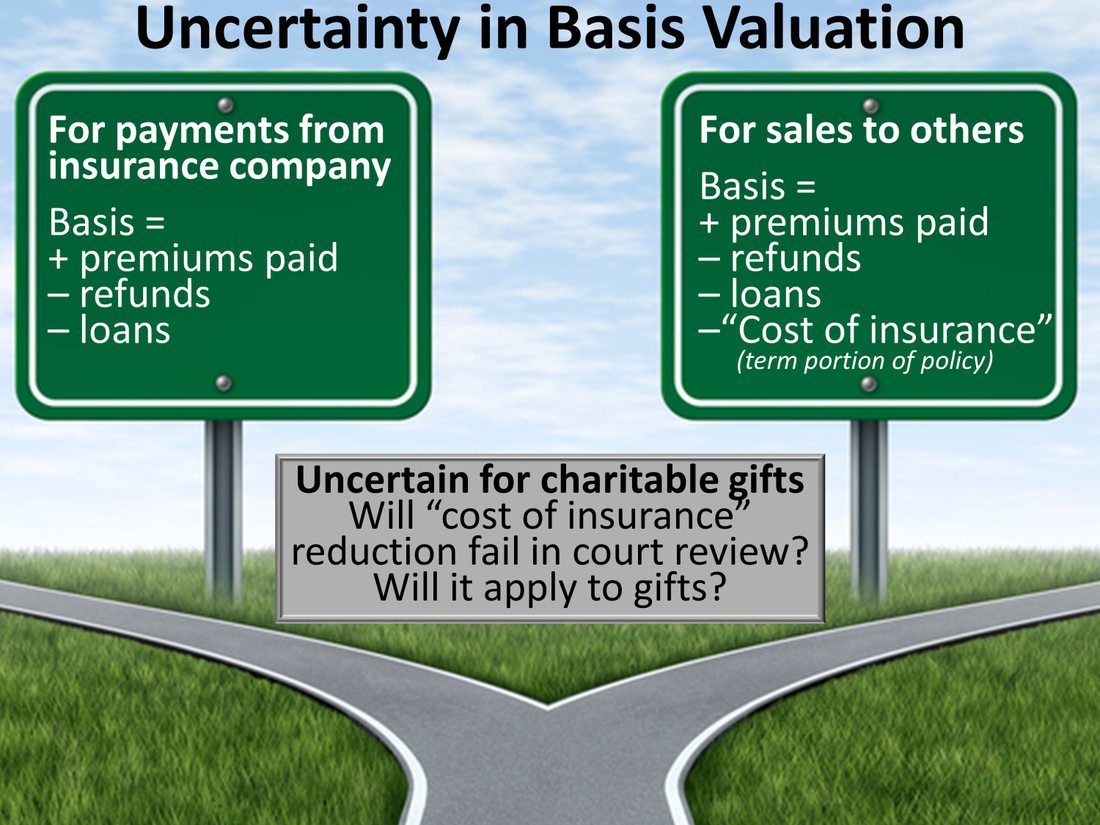
What is the basis in a life insurance policy gifted to charity? This is currently an unsettled question. Basis clearly includes all premiums paid for the policy. Also, any refunds or loans taken from the policy will reduce the basis. The uncertainty surrounds the issue of whether or not the basis should be reduced by the "cost of insurance." The IRS argument for considering "cost of insurance" is that the policy owner has invested premiums, but in return has received the advantage of coverage in the event of death. Thus, because the owner has already received this "peace of mind" benefit, his or her basis should be reduced by the value of this benefit. This value received is what it would have cost the owner to purchase just the death benefit itself (i.e., the term policy) from the company.
At present, it is clear that the basis is not reduced for this "cost of insurance" (a.k.a. "mortality charges") when money is received from the insurance company, e.g., through withdrawals, distributions, or surrendering the policy for cash value. (This is specified by statute in Internal Revenue Code §72.) The IRS has taken the, somewhat controversial, position that basis is reduced by this "cost of insurance" when a policy owner sells the policy to someone else (Rev. Rul. 2009-13 & 2009-14). There are no IRS examples specifically for calculating basis for a charitable deduction from a gift of a life insurance policy. However, charitable gifts to third parties, just like sales to third parties, are not covered by Internal Revenue Code §72, which addresses only payments coming back from the insurance company. It seems unlikely that calculating basis as reduced by the "cost of insurance" would apply to sales of policies, but not gifts of policies. (Such inconsistency would certainly lead to an interesting calculation in the case of a bargain sale to charity.) The most likely IRS position - absent any actual information at this point - appears to be that the basis rule for sales would also be the basis rule for gifts.
There is some question whether or not the courts will support this IRS position. Why? There is no statute directing this approach and this approach is not used in other contexts. For example, if a taxpayer buys a car for $25,000 and sells it a year later for $25,000 she does not report a gain of $5,000 because it would have cost her $5,000 to rent a similar car for a year and she was able to enjoy the benefits of the car while she owned it. The decision regarding whether or not to reduce the basis in a gift by the "cost of insurance" depends upon how aggressive the taxpayer wishes to be in this area of uncertainty.

For a taxpayer who wishes to reduce basis by the "cost of insurance," determining this number may be a challenge. Universal life policies typically report the "cost of insurance" component to policyholders, making this number easily accessible. For term insurance, the "cost of insurance" is simply the premium. However, for traditional whole life policies, the "cost of insurance" may not be reported or easily determined. Death benefit coverage expenses can vary depending upon the age and health of the insured, interest rates, and the quality and rating of the company issuing the policy. Consequently, determining what portion of a whole life policy represents "cost of insurance" can be complex.

Determining the fair market value of a gifted policy can also be a complicated procedure. Of course, all property gifts of $5,000 or more require a qualified appraisal. Consequently, the donor will not be the one to determine this valuation. For a newly issued policy, the valuation can be determined by the premium paid for the policy. For a paid-up policy (i.e., one in which no further premiums need be paid to keep the life insurance in force), the cost of a replacement policy for an insured of that age can be used as a basis for estimating fair market value. Note that very few policies are truly paid up, meaning that no future payments will be due under any circumstances. This is different than a policy that projects no future payments will be due depending upon the investment returns of a policy. Most policies are neither newly issued nor paid-up. For these policies where premium payments are still required, valuation can be quite complex. The approved valuation methods often approximate the cash surrender value of the policy. A donor can use the greater of valuation allowed by the ITR or PERC methods. The ITR method is based on the "Interpolated Terminal Reserve" plus any unearned premiums and a pro rata share of estimated dividends to be paid for the year. There are, in fact, multiple possible methods to calculate the "Interpolated Terminal Reserve," but the life insurance company will typically provide their estimation of this number to the policy holder. However, this number - and, hence, this valuation approach - is not available for universal life or variable life policies. An alternative valuation is the PERC method. PERC comes from Premiums plus Earnings from the policy (such as interest, dividends, and withdrawals) minus Reasonable Charges (such as mortality charges). The PERC number is often roughly equal to the cash value for universal life policies. This PERC number is then multiplied by an "Average Surrender Factor," approximating the charge incurred in surrendering the policy for its cash value.
These traditional valuation approaches do not apply in cases where they are not an appropriate estimation of the value of a life insurance policy. This occurs when the insured has a terminal illness. IRS gift tax regulations specifically prohibit using standard valuation approaches when the insured has a terminal illness. In such cases, the "life settlement" market may provide a more appropriate, and much higher, valuation. This market purchases life insurance policies on the lives of terminally ill individuals. These policies are more valuable because the risk of death, and thus the likelihood of receiving the death benefit in the near future, is dramatically higher than for a typical insured. These valuations, however, can be costly to obtain given the requirement to evaluate the health of a terminally ill individual.
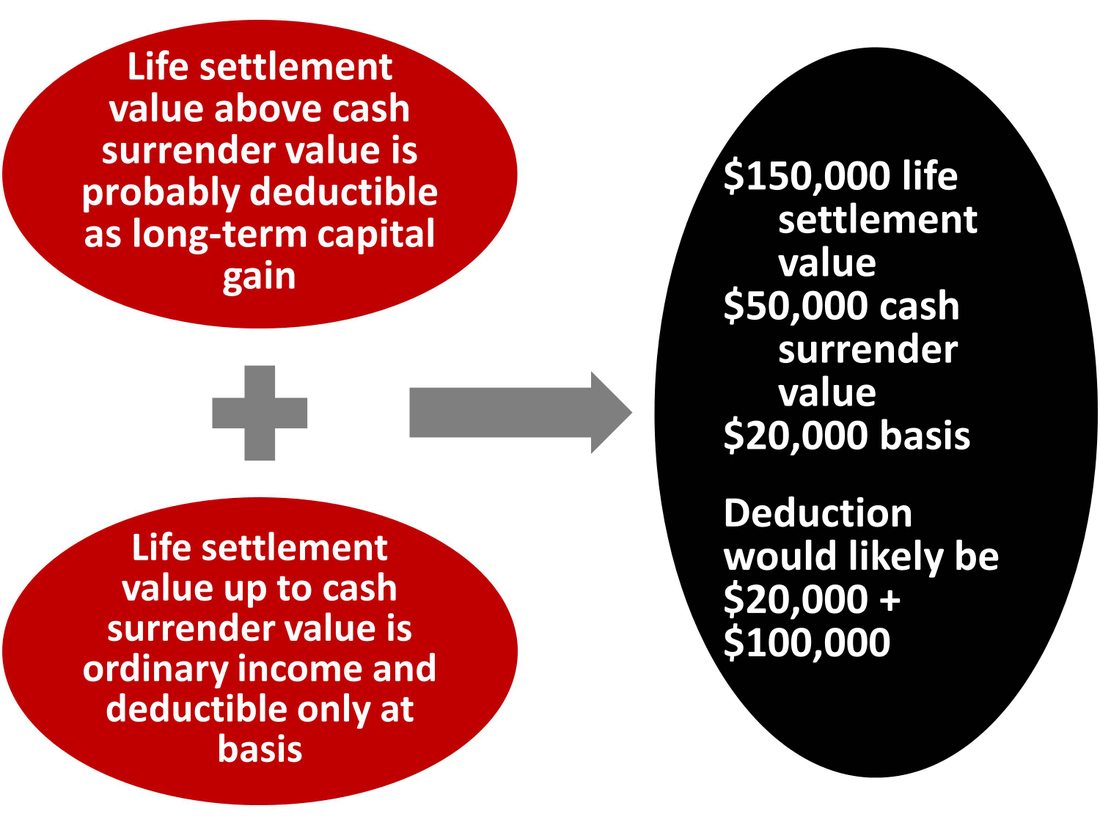
Valuing a donated policy based upon its higher value in the life settlement market creates a more complex calculation for the charitable income tax deduction. As mentioned previously, the typical tax treatment for a donated life insurance policy is to deduct the lesser of basis or fair market value. This is because if the donor were to cash in a life insurance policy, any income generated would be treated as ordinary income rather than capital gain. Ordinary income property is deducted at the lower of basis or fair market value. This picture becomes more complex when selling a policy in the life settlement market. In that case, the value received up to the cash surrender value would generate ordinary income, but the value above cash surrender value would generate capital gain income. (This capital gain treatment is the most likely result although this is not settled law.) This means the life insurance policy is in part ordinary income property and in part long-term capital gain property. The gift of the ordinary income portion of the life insurance policy (i.e., the amount up to the policy's cash surrender value) is valued at the lower of basis or fair market value. However, the gift of any long-term capital gain portion of the life insurance policy (i.e., the amount above the policy's cash surrender value) is valued at the greater of basis or fair market value. This leads to different treatment depending on the relative value of the basis, the cash surrender value, and the life settlement value. Consider the example of a policy with a $150,000 value in the life settlement market, a $50,000 cash surrender value, and a $20,000 basis. Gifting this policy would generate a $20,000 deduction for the ordinary income part (i.e., the part represented by the cash surrender value of the policy), and a $100,000 deduction for the long-term capital gain part (i.e., the part represented by the value over and above the cash surrender value). This, of course, assumes that the donor has not made a special election to value all long-term capital gain gifts during the year at the lower of basis or fair market value. If the life settlement value were not greater than the basis, then the gift would be valued at the lower of its fair market value or basis as with a typical policy. For example, if the basis was $200,000, the cash surrender value was $50,000, and the life settlement value was $150,000, then the deduction would be $150,000 (the lower of basis or fair market value). If the life settlement was lower than the cash value, then the life settlement value would be irrelevant and the policy would be valued as normal.
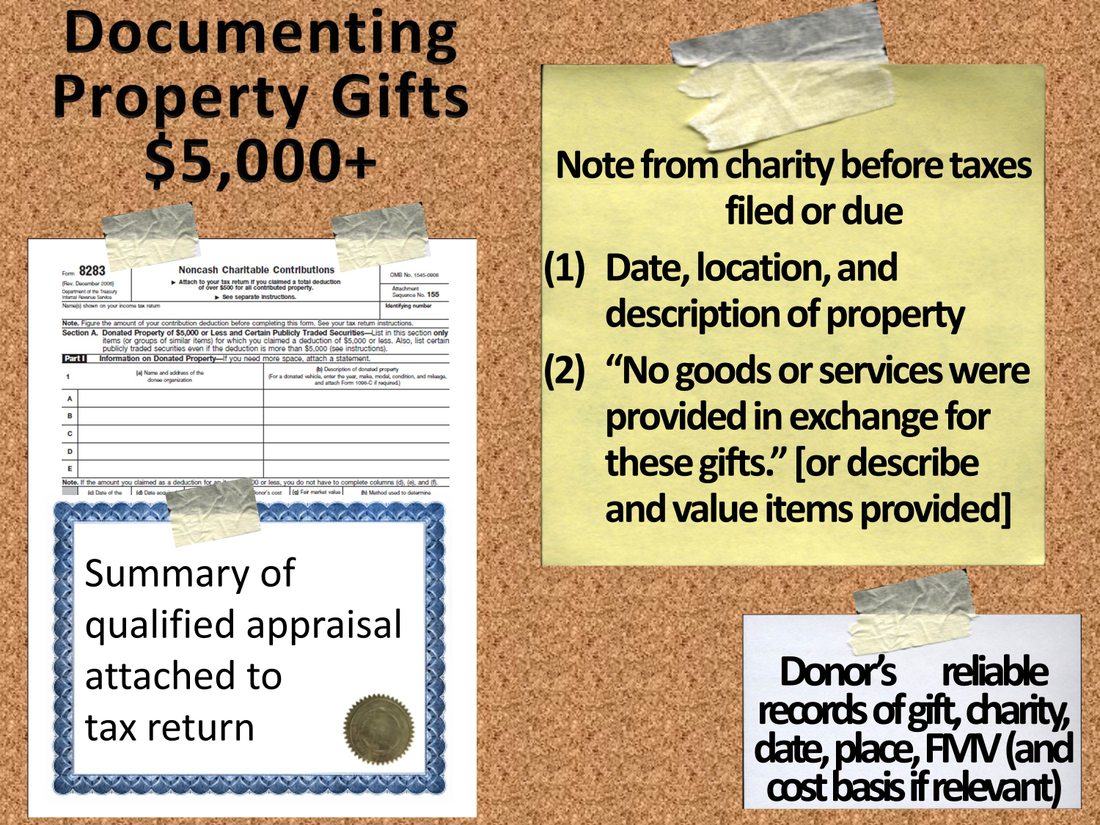
As with all charitable property gifts of $5,000 or more, documenting a life insurance policy gift of this size will require a qualified appraisal. In addition, the donor must complete IRS Form 8283, have reliable records of the gift, date, place, fair market value, and cost basis, and receive a note from the charity indicating the date of the gift with a description of the property and the magic phrase, "No goods or services were provided in exchange for these gifts."

The required appraisal for documenting the charitable gift of a life insurance policy cannot come from the insurance agent or the insurance company. They are parties to the transaction and are therefore disqualified. Consequently, gifting a substantial life insurance policy will require the employment of a qualified outside appraiser. Without such appraisal, the IRS will allow no deduction.
The typical result for donating property with an outstanding loan is that the donor is treated as both receiving income in the amount of the loan and making a charitable gift of the net equity in the property. The first part of this typical result still holds in the case of a gift of life insurance. The donor is treated as having received ordinary income in the amount of the loan, reduced by the applicable basis. The applicable basis is the amount of the loan multiplied by the ratio of the policy's basis to the policy's fair market value. For example, if a donor gifts a policy with a $100,000 fair market value, a $50,000 basis, and $10,000 of existing loans, the transaction will generate $5,000 of ordinary income for the donor [$10,000 loan x ($50,000 basis/$100,000 fair market value)].
However, because of special rules put in place to eliminate charitable split dollar transactions, the presence of a loan eliminates the tax deduction. Thus, as the result of gifting a policy with outstanding loans the donor receives no charitable income tax deduction, but still reports ordinary income.
The bottom line is that gifting policies subject to loans is unwise. It would be better for the donor to pay off the loan first. Then, the donor can gift the policy without loss of the charitable deduction due to the charitable split interest rules. If this is not possible, then the donor may be better off to sell or cash in the policy, pay taxes on the gain, and then make an offsetting deductible charitable gift with the proceeds. At a minimum, it is likely that there will be more tax advantageous assets for the donor to consider gifting instead of a life insurance policy with outstanding loans.
Upon receiving the policy, the charity may do anything with it that any other policy owner could do. This includes surrendering the policy for its cash value, holding the policy until the death of the donor (if the policy is not paid up this will require the payment of premiums either by the charity or, if available, by the original donor), or selling the policy in the life settlement market. Selling the policy in the life settlement market is rare because such markets require extraordinarily high rates of returns for investors. Thus, if the charity is not in a desperate financial position, it is more appropriate for the charity to hold the policy and collect the death benefit. Charities sometimes have an inappropriate tendency to automatically cash out any life insurance policies received, rather than considering the possibility of continuing to hold the policy until the death of the donor. In many cases, the cash surrender value is well below the actuarial value of the policy. By automatically taking the cash surrender value of policies, charities may often be making poor financial choices as compared with continuing to hold the policy, even if holding the policy may require payment of additional premiums. Rather than immediately taking the cash surrender value, it would be more appropriate for charities to work with a life insurance professional to consider the relative financial value of continuing to hold the policy.
A donor may gift an annuity contract to a charity, but such gifts are usually not tax advantageous. Gifting an annuity contract will cause all gain in the contract to be immediately taxed to the donor as ordinary income. In contrast, continuing to hold the annuity would allow the annuity owner to recognize that income over many years, rather than immediately. The donor may offset this immediate recognition of gain by the charitable deduction for the value of the annuity contract (except for annuity contracts issued before April 23, 1987 that have not yet matured where the deduction is limited to the donor's basis in the contract). However, an alternative source for a charitable gift will often be more tax appropriate. For example, gifts of long-term capital gain will generate no recognition of taxable gain. Even gifts from cash may be better if they prevent the immediate recognition of gain resulting from giving an annuity contract. Gifting an annuity at death does not create these same income tax problems, although this requires an annuity that still has value after the death of the donor.

A third use of life insurance in charitable planning is to create a new policy specifically intended to benefit the charity at the death of the donor. In this way, the donor may provide for a large posthumous charitable gift, perhaps funding a significant charitable project. Without the use of life insurance, a donor could fund such a posthumous gift by simply saving up money in a donor advised fund and leaving it at death to the charity. However, this plan would fail if the donor did not live long enough to allow him or her to build up enough savings to fund the gift. The use of life insurance eliminates this risk. Through life insurance, the donor can guarantee that the project will be funded, even if he or she does not live long enough to fund the project through the normal means of savings or regular donations.
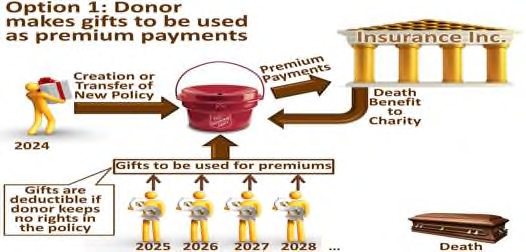
A donor could achieve the transfer of a large charitable gift at death by simply purchasing and owning a life insurance policy and naming the charity as the beneficiary of the policy. However, this approach would generate no charitable income tax deduction. No deduction is allowed in part because the donor could, at any time, change the name of the beneficiary to someone else. In order to generate a tax deduction, the donor must first donate the policy to the charity. Once the charity owns the policy, then the donor could continue to fund the premium payments by making gifts to the charity for that purpose. Although the donor does not retain a legal right to force the charity to use the gifts for premium payments, this is rarely needed as the threat of stopping future giving is usually sufficient to cause the charity to follow the donor's preferences. In order for the transfer of the policy (and any subsequent payments of gifts to be used for premium payments) to generate a charitable gift, the donor must give up all rights to the policy as well as any direct or indirect benefits from the policy.
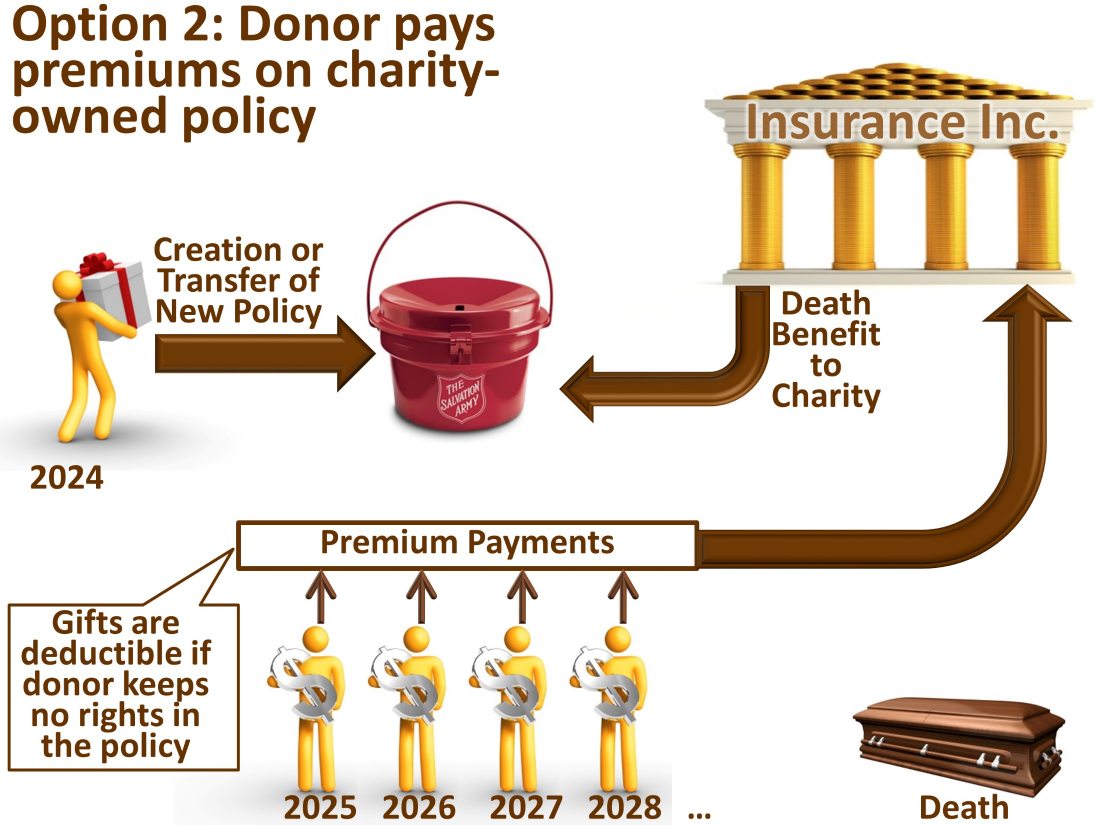
In an alternative arrangement, the donor may gift the policy to the charity (or the charity may create the policy) and then the donor can make premium payments directly to the insurance company. These direct premium payments are deductible gifts, assuming that the charity owns all rights to the policy. Some charities and insurance agents may prefer this arrangement as it could allow the insurance company to send premium notices directly to the donor, rather than burdening the fundraising staff with continued requests. There are, however, some differences in the treatment of premium payments made directly to the life insurance company and those made to charity.
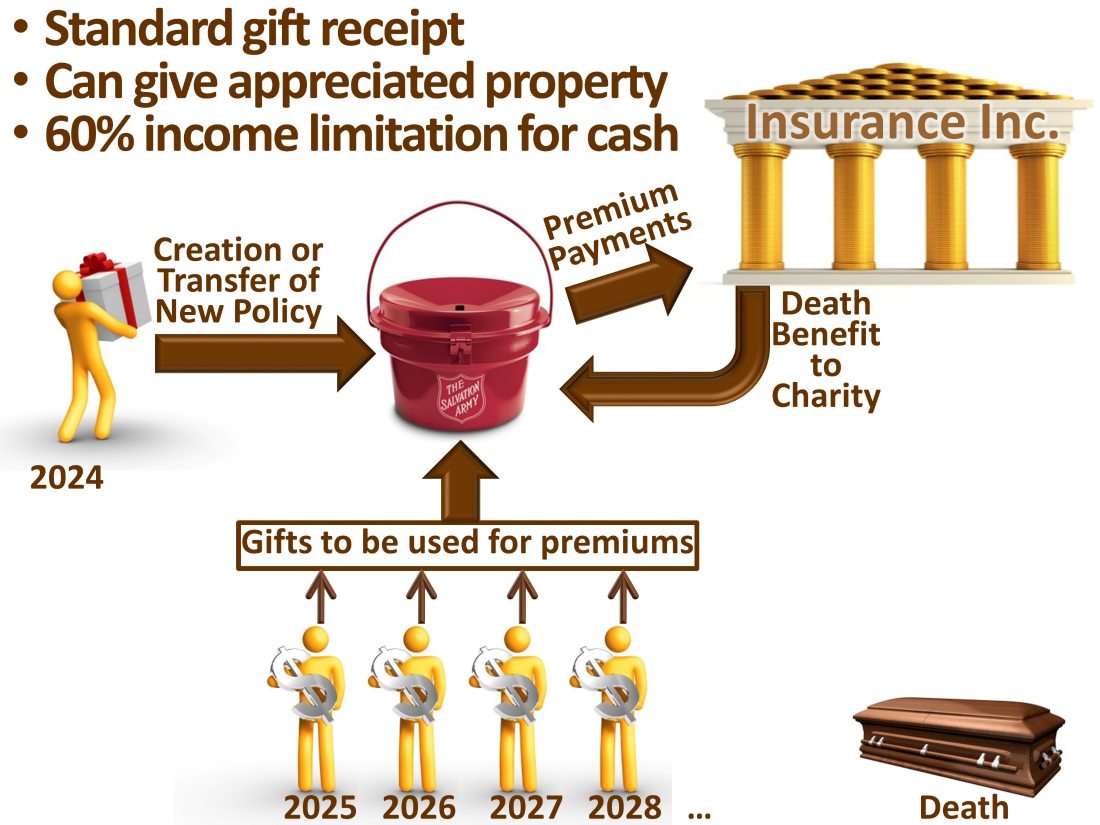
Gifts made directly to the charity for the purpose of funding premium payments are treated as any other gifts made to charity. The charity will issue receipts for the gifts just as with any other gift. Assuming that the donor is making cash gifts to a public charity, these are deductible up to 60% of the donor's adjusted gross income, just as with any other cash gift. The donor could give cash, but could also give appreciated property, which the charity could then sell in order to generate the cash needed to make premium payments. Giving appreciated property may provide the added benefit to the donor of avoiding long-term capital gain taxation.
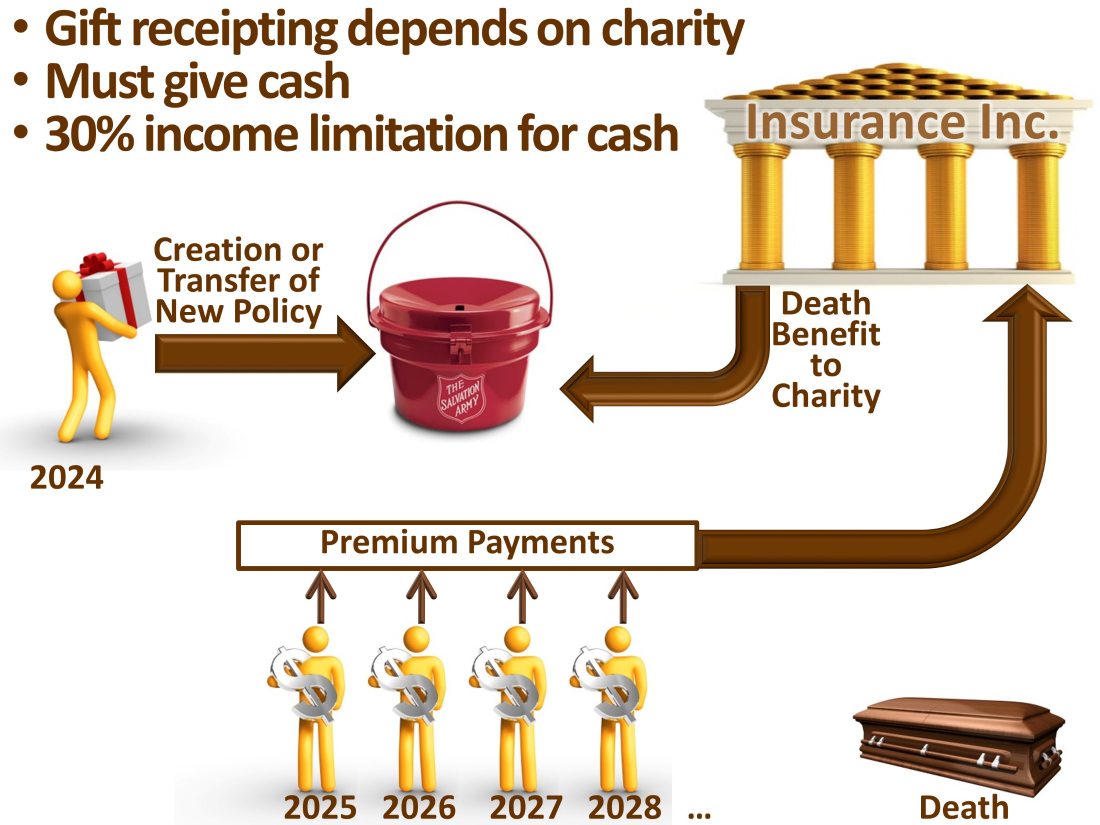
When the donor makes premium payments directly to the life insurance company, the results may differ slightly. Some charities will issue receipts for premium payments made directly to a charity owned life insurance policy, but some may not. Insurance companies will not accept appreciated property for premium payments, so the donor must use cash transfers. Finally, deductions for such transfers to life insurance companies may be limited to 30% of the donor's adjusted gross income, even where the policy owner is a public charity. This is based upon the idea that the cash is not being provide "to" the charity (which results in a 60% income limitation), but instead is being provided "for the use of" the charity (which results in a 30% income limitation). Some cases suggest the possibility of applying a higher limitation to these transactions as well, but that issue is not currently settled.

Encouraging donors to create and pay premiums on charity owned life insurance policies comes with both potential advantages and potential problems for the charity. Thus, it does not make sense for charities to either universally accept or universally reject this approach. Instead, it is useful to consider the specifics of each scenario and the relevant needs of the donor and charity.

One potentially attractive feature of using life insurance is that donors of relatively modest means can fund large posthumous projects. For example, a healthy 40 year old donor might be able to purchase a $1,000,000 life insurance policy for premium payments of only $1,500 per year for the first 30 years of coverage (with premiums rising thereafter). Or, the donor could pay $20,000 for only 20 years, with no additional payments due after that point. Thus, a donor who would never anticipate the ability to make a $1,000,000 gift to the charity could fund that gift by using life insurance.
It is important to note, however, that unless the donor dies earlier than expected, the use of life insurance does not generate a larger gift than would have been possible by simply gifting the premium payment amounts to the charity and allowing them to grow until the death of the donor. The use of life insurance provides protection only against the early death of a donor who had otherwise intended to save or give enough to fund a large project. Further, the apparent ability of life insurance to generate a "big" gift may also rely on the natural misperception of future values. For a typical 40 year old donor, a $1,000,000 gift is a big gift. But, that donor is likely to live for approximately 40 more years. If future inflation is similar to the past, then the future $1,000,000 gift received in 40 years will have the same purchasing power as a $190,000 gift today. Waiting 40 years to receive $190,000 of purchasing power in today's dollars does not feel quite as impressive as the large $1,000,000 figure. Additionally, recent evidence suggests that donors with planned posthumous gifts to charity live longer than others (see James, R. N., III (2013) American Charitable Bequest Demographics), meaning that the charity will have to wait even longer than normal to receive a death benefit from donors.

Some charities like the idea that subsequent gifts occur without ongoing fundraising efforts from the charity. For example, where the donor is making premium payments directly to the insurance company, the bill may come directly from the insurance company, and the donor may pay this as a matter of course along with other bills.

Because the use of life insurance typically involves the employment of insurance agents, these transactions create a natural sales force interested in proposing these planned giving transactions to clients. The proposition of having an agent advocating for the charity without the costs associated with hiring a traditional fundraiser may be attractive to charities. Having such a "free" sales force may be especially interesting to charities with limited resources to hire and train their own fundraising staff. In an ideal situation, both the charity and agent can benefit from these potentially symbiotic relationships.
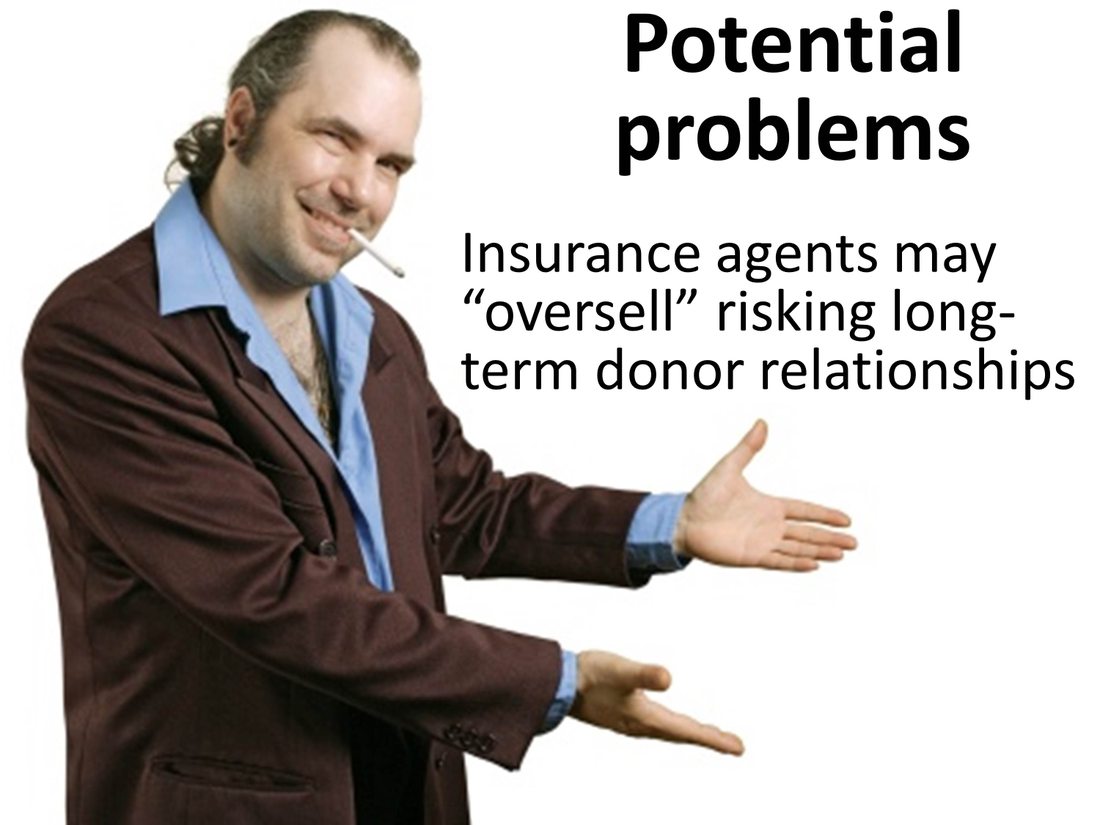
There are, of course, potential downsides to the inability of charities to control or manage those who are proposing charitable transactions. The charity that gives access to its donor base may risk negative reactions from donors, depending upon the characteristics of the selling agent. The agent may focus primarily on making an immediate sale, whereas the charity may be hoping to foster a long-term relationship. Further, the agent may have little downside risk in offending those who are not interested in purchasing the product, whereas the charity may suffer long-term financial effects from damaged relationships with supporting donors.
Another potential problem is the risk that donors will cease providing premiums for the insurance policies. Depending on the type of insurance, keeping the death benefit may require paying premiums for 10, 20, or 30 years or for the rest of the donor's life. It is difficult enough to maintain donor giving from one year to the next - the likelihood that a donor will be consistently committed over many decades or a lifetime is even smaller. For policies that do not reach "paid up" status, there is also a risk of lapse in advancing age. Often health or cognitive problems arise prior to death and these may increase the risk of financial mistakes, such as failing to pay policy premiums. Further, such conditions also increase the likelihood that other family members may take over financial management. These other family members may be less likely to have any commitment to the charity. Taken together, these factors reduce the likelihood that the premium payments will continue indefinitely and, thus, that the charity will ultimately receive any benefit.

Another risk in using life insurance is that the structure of the policy may, ultimately, provide more benefit to the insurance companies and insurance agents than to the charity. This is especially true where the risk for later lapse of the policy is high and such lapse would result in the charity receiving no death benefit. Thus, the donor may be regularly committing funds strictly for charitable purposes, but ultimately providing little or no benefit for charity. This does not mean that such gifting arrangements are inherently disadvantageous to charity, only that careful examination is appropriate.
An additional potential problem relates to the requirement of insurable interest. Taking out a life insurance policy requires that the policy owner have an insurable interest in the insured person. In other words, you cannot take out a life insurance policy on someone just because you think the person will die soon. Allowing such speculation could even create financial incentives for murder. Thus, taking out a life insurance policy on another person normally requires some family or business relationship providing a reason for hedging against the personal or financial loss that would occur in the event of the death of the insured. If a charity takes out a life insurance policy on a major donor, with the goal of protecting against the loss of income that might occur in the event of the death of the donor, then the charity likely has a valid insurable interest. However, if the person had never been a donor, or perhaps had made only a few $20 gifts and the charity then takes out a $10,000,000 policy on the life of the donor - there may be serious questions about the presence of an insurable interest. Fortunately, almost all states have settled this matter by legislation. In these states, charity is granted an explicit insurable interest in any person (or in some cases any donor) who consents to becoming an insured life. To give you a feel for the specific requirements in your state, below are excerpts from different state statutes related to this topic. (Please check for any changes or other issues with local counsel before engaging in a transaction.)
Alabama Code §27-14-3
Any provision of this section and chapter to the contrary notwithstanding, a charitable organization that meets the requirements of Section 501(c)(3) of the Internal Revenue Code of 1986, as amended, may own or purchase life insurance on an individual who consents to the ownership of purchase of that insurance.
Alaska Stat. §21.42.020
Notwithstanding the other provisions of this section, a charitable organization may obtain, by procurement, assignment, or otherwise, life or health insurance on an insured who consents to the issuance of the insurance.
Arizona Rev. Stat. Ann. §20-1104
A charitable organization as provided in section 43-1201, paragraph 4, which has a policy ownership interest has an insurable interest in the life of each proposed insured who joins with the charitable organization in applying for a life insurance policy naming the charitable organization as owner and irrevocable beneficiary.
Arkansas Code Ann. §23-79-103
Notwithstanding any other law or regulation to the contrary, any religious, educational, charitable, or benevolent institution, organization, corporation, association, or trust, including, but not limited to, Charitable Remainder Trusts, may be named beneficiary or owner, or both, of the policy or contract by any applicant for insurance upon his or her own life in any policy of life insurance issued by any life insurance company authorized to do business in this state or in the state of domicile of the applicant for insurance.
CALIFORNIA INS. CODE §10110.1(f)
a charitable organization that meets the requirements of Section 214 or 23701d of the Revenue and Taxation Code may effectuate life or disability insurance on an insured who consents to the issuance of that insurance
Colorado Rev. Stat. §10-7-115
Notwithstanding any other provision of law, any organization that meets the requirements of section 170 (c) of the federal "Internal Revenue Code of 1986", as amended, may own or purchase life insurance on an insured who gives written consent to the ownership or purchase of that insurance.
CONNECTICUT GEN. STAT. §38a-450
Any life insurance company doing business within the state may issue policies of insurance predicated upon the life or lives of any person or persons, payable at maturity to any educational, ecclesiastical, benevolent, charitable or eleemosynary corporation which can legally take and receive testamentary legacies, irrespective of a financial interest on the part of such corporation in the life of the person or persons insured.
DELEWARE CODE ANN. tit. 18, §2705
Life insurance contracts may be entered into in which the person paying the consideration for the insurance has no insurable interest in the life of the individual insured, where charitable, benevolent, educational or religious institutions, or their agencies, are designated irrevocably as the beneficiaries thereof
D.C. Code Ann. §31-4716
A charitable, benevolent, educational, governmental, or religious institution that is described in §501(c)(3) or §170(b)(1)(A) of the Internal Revenue Code or a trust for the benefit of the institution that is qualified as a Charitable Remainder Trust under §664 or a Pooled Income Fund under §642(c)(5) of the Internal Revenue Code may acquire an insurable interest in the life of an individual if: (1) The institution or trust is designated irrevocably as the beneficiary of the insurance proceeds or designated as the owner of the life insurance policy, or both; (2) The application for the insurance contract is procured and signed by the individual whose life is to be insured; and (3) Notwithstanding paragraph (1) of this subsection, the insured pays the premiums for the insurance policy for at least 3 years following the issuance of the policy.
FLORIDA STAT. §627.404(2)b(7)
A charitable organization meeting the requirements of s. 501(c)(3) of the United States Internal Revenue Code, as amended, has an insurable interest in the life of any person who consents in writing to the organization's ownership or purchase of that insurance.
GEORGIA CODE ANN. §33-24-3(j)
A charitable institution as defined under Sections 501(c)(3), 501(c)(6), 501(c)(8), and 501(c)(9) of the Internal Revenue Code of 1986 shall have an insurable interest in the life of any donor.
Hawaii Rev. Stat. §431:10-202(4)
A charitable organization as defined in section 467B-1 has an insurable interest in the life of each proposed insured who joins with said organization in applying for a life insurance policy naming said organization as owner and irrevocable beneficiary.
Idaho Code Ann. §41-1805
Contracts of life insurance may be made and entered into in which the person paying the consideration for such insurance has no insurable interest in the life of the person insured, where charitable, benevolent, educational, or religious institutions are designated irrevocably as the beneficiaries thereof.
215 ILLINOIS COMP. STAT. §5/245.2
Members of not-for-profit organizations that are exempt from taxation as described in paragraph (3), (4), (5), (9), or (10) of subsection (c) of Section 501 of the Internal Revenue Code or either past or present individual or family donors to a not-for-profit organization may obtain life insurance policies naming the not-for-profit organization as the irrevocable sole beneficiary of the policy. The not-for-profit organization, as the sole beneficiary of the policy, may continue to pay the premiums to the issuing insurance company where the donor discontinues the premium payments and continuance of the policy is a prudent investment.
Indiana Code §§27-8-18-4
A charitable entity that purchases or is transferred ownership of a life insurance policy under subsection (a) has an insurable interest in the life of the individual who consents to the charitable entity's purchase or ownership of the policy.
Iowa Code §511.39
A charitable organization described in section 501(c)(3) of the Internal Revenue Code, as defined in section 422.3, has an insurable interest in the life of a person who, when purchasing a life insurance policy, makes a donation to the charitable organization or makes the charitable organization the beneficiary of all or a part of the proceeds of the policy or joins with a charitable organization in applying for an insurance policy which when issued will insure that person's life and name the organization as owner or beneficiary of all or any portion of the benefits of the life insurance policy.
KANSAS STAT. ANN. §40-450(b)
A charitable, benevolent, educational and religious institution qualified under section 501(c) of the internal revenue code shall be deemed to have an insurable interest in the life of an individual insured who has executed a written consent to the assignment of the insurance contract to such institution if such institutional assignee is named as the irrevocable beneficiary thereof.
Kentucky Rev. Stat. Ann. §304.14-050
(1)Life insurance contracts may be entered into in which the person paying the consideration for the insurance has no insurable interest in the life of the individual insured, where charitable, benevolent, educational, or religious institutions, or their agencies, are designated irrevocably as the beneficiaries thereof.
(2) In making such contracts the person paying the premium shall make and sign the application therefor as owner, and shall designate a charitable, benevolent, educational or religious institution, or an agency thereof, irrevocably as the beneficiary or beneficiaries of such contract. The application shall be signed also by the individual whose life is to be insured
Lousiana Rev. Stat. Ann. §22.902
Notwithstanding any other law or regulation to the contrary, any religious, educational, eleemosynary, charitable, or benevolent institution or undertaking may be named beneficiary in or owner of any policy of life insurance issued by any life insurance company upon the life of any individual. The beneficiaries or owners named shall have an insurable interest for the full face of the policy and shall be entitled to collect same.
MAINE REV. STAT. ANN. tit. 24-A, §2405
1. Life insurance contracts may be entered into in which the person, trust or trustee paying the consideration for the insurance has no insurable interest in the life of the individual insured, where charitable, benevolent, educational or religious institutions, or their agencies, are designated irrevocably as the beneficiaries thereof.
2. In making such contracts, the person paying the premium shall make and sign the application therefor as owner or as settlor of a trust, and shall designate a charitable, benevolent, educational or religious institution, or any agency thereof, irrevocably as the beneficiary or beneficiaries of such contract. The application must be signed also by the individual whose life is to be insured.
MARYLAND CODE ANN., INS. §12-201(c)
(1) This subsection applies only to a charitable, benevolent, educational, governmental, or religious institution that is described in §170(b)(1)(A) or §501(c)(3) of the Internal Revenue Code, or a trust for the benefit of that institution that is qualified as a Pooled Income Fund under §642(c)(5) or a Charitable Remainder Trust under §664 of the Internal Revenue Code.
(2) An institution or trust described in paragraph (1) of this subsection may procure or cause to be procured an insurance policy on the life of an individual if: (i) the institution or trust is designated irrevocably as the beneficiary of the insurance policy; and (ii) the application for the insurance policy is signed by the individual whose life is to be insured or the individual's legal guardian.
MASSACHUSETTS GEN. LAWS ch. 175, §123A(2)
A charitable institution as defined under section 501 (c)(3), (c)(6), (c)(8), and (c)(9) of the Internal Revenue Code shall be deemed to have an insurable interest, without limitation, in the life of any donor.
Michigan Comp. Laws §500.2212
Notwithstanding any other section of this act, an organization described in and qualified under section 501(c)(3) of the internal revenue code of 1986, 26 U.S.C. 501, has an insurable interest in the life of an individual who gives written consent to the ownership or purchase of a policy on his or her life.
MINNESOTA STAT. §60A.0783(2)f
An organization in section 170(c) of the United States Internal Revenue Code of 1986, as amended through December 31, 2008, has an insurable interest in the life of any person who consents in writing to the organization's ownership or purchase of that insurance.
Mississippi Code Ann. §83-5-251
Any religious, educational, eleemosynary, charitable or benevolent institution or its agency may be named beneficiary in any policy of life insurance issued by any insurance company upon the life of any individual. A religious, educational, eleemosynary, charitable or benevolent institution or its agency designated as a beneficiary has an insurable interest for the full face of the policy and is entitled to collect the full face of the policy.
Missouri Rev. Stat. §377.080
A charitable, benevolent, educational or religious institution qualified pursuant to section 501(c)(3) of the federal Internal Revenue Code, as amended, shall be deemed to have an insurable interest in the life of an insured individual if, in the absence of any fraud or coercion: (1) The individual has designated the institution as a beneficiary; (2) The individual has made a gift or an assignment of an interest in life insurance on the life of such insured individual; or (3) The life insurance is owned by such charitable, benevolent, educational or religious institution and such institution has obtained the consent of the person whose life is being insured, as required by section 376.531.
Montana Code Ann. §33-15-201(5)
A charitable institution has an insurable interest in an individual if: (a) the individual authorizes the charitable institution to purchase insurance naming the charitable institution as an irrevocable beneficiary; and (b) the insurance is purchased with contributions made by the individual.
Nebraska Rev. Stat. §44-704(4)
Nothing in Chapter 44 shall prohibit an organization or entity described in section 501(c)(3) of the Internal Revenue Code or to whom a charitable contribution could be made under section 170(c) of the code or a trust all of whose beneficiaries are organizations or entities described in section 501(c)(3) of the code or to whom a charitable contribution could be made under section 170(c) of the code from procuring, effectuating, or causing to be procured or effectuated the ownership of any life insurance policy or annuity contract upon the life of an individual if such individual gives written consent to the issuance of such policy or contract when such organization, entity, or trust is the owner of such policy or contract. Nothing in Chapter 44 shall require such organization, entity, or trust to have an insurable interest as defined in section 44-103 in the life of such individual in order for a policy or contract to be procured or effectuated pursuant to this subsection.
Nevada Rev. Stat. §687B.050
1. Life insurance contracts may be entered into in which the person paying the consideration for the insurance has no insurable interest in the life of the individual insured, where charitable, benevolent, educational or religious institutions or their agencies are designated irrevocably as the beneficiaries thereof.
2. In making such contracts the person paying the premium shall make and sign the application therefor as owner, and shall designate irrevocably a charitable, benevolent, educational or religious institution or an agency thereof as the beneficiary or beneficiaries of such contract. The application shall be signed also by the individual whose life is to be insured.
NEW HAMPSHIRE REV. STAT. ANN. §408:2-a
I. A life insurance policy may be issued with the person paying the premiums for such insurance having no insurable interest in the life of the insured, providing a charitable, benevolent, educational, or religious institution or any other organization which qualifies for a charitable deduction under the Internal Revenue Code is designated irrevocably as the owner and beneficiary of the policy. II. A life insurance policy may be issued with the person paying the premiums designated in the application as owner and insuring the premium payer's own life and designating a charitable, benevolent, educational, or religious institution or any other organization which qualifies for a charitable deduction under the Internal Revenue Code as the irrevocable beneficiary of the policy. III. Nothing in this section shall affect the right of any person to effectuate life insurance on such person's own life, or by a person or any business entity on another life if there exists any reasonable expectation of pecuniary benefit or advantage, direct or indirect, in the continued life of the other person. IV. No life insurance policy may be issued under this section unless the insured has consented in writing to the issuance of such policy.
New Jersey Stat. Ann. §17B:24-1.1(5)
A nonprofit or charitable entity qualified pursuant to section 501 (c) (3) of the Internal Revenue Code of 1986 (26 U.S.C. s.501(c)(3)), or a government entity has an insurable interest in the life or physical or mental ability of its directors, officers, employees, supporters or their designees or others to whom it may look for counsel, guidance, fundraising or assistance in the execution of its legally established purpose, who either: (a) join with the entity in signing the application for insurance, which application names the entity as the owner and irrevocable beneficiary of the policy; or (b) after having been listed as owner, subsequently transfer ownership of the insurance to the entity and name the entity as the irrevocable beneficiary of the policy.
New Mexico Stat. Ann. §59A-18-5
A. Life insurance contracts may be entered into in which the person paying the consideration for the insurance has no insurable interest in the life of the individual insured, where charitable, benevolent, educational or religious institutions or their agencies are designated irrevocably as the beneficiaries thereof.
B. In making such contracts the person paying the premium shall make and sign the application therefor as owner, and shall designate irrevocably a charitable, benevolent, educational or religious institution or an agency thereof as the beneficiary or beneficiaries of such contract. The application shall be signed also by the individual whose life is to be insured.
New York Ins. Law §3205
(3) Notwithstanding the provisions of paragraphs one and two of this subsection, a Type B charitable, educational or religious corporation formed pursuant to paragraph (b) of section two hundred one of the not-for-profit corporation law, or its agent, may procure or cause to be procured, directly or by assignment or otherwise, a contract of life insurance upon the person of another and may designate itself or cause to have itself designated as the beneficiary of such contract.
North Carolina Gen. Stat. §§58-58-86
If an organization described in section 501(c)(3) of the Internal Revenue Code purchases or receives by assignment, before, on, or after the effective date of this section, life insurance on an insured who consents to the purchase or assignment, the organization is deemed to have an insurable interest in the insured person's life.
NORTH DAKOTA CENT. CODE §26.1-29-09.1(3)d
In the case of religious, educational, eleemosynary, charitable, or benevolent organizations, a lawful interest in the life of the individual insured if that individual has executed a written consent to the insurance contract.
Ohio Rev. Code Ann §3911.09
Any religious, charitable, scientific, literary, educational, or other institution or entity that is described in section 170, 501(c)(3), 2055, or 2522 of the "Internal Revenue Code of 1986," 100 Stat. 2085, 26 U.S.C.A. 170 , 501 , 2055 , 2522 , as amended, may be the owner of, or may be designated beneficiary in, any policy of life insurance issued upon the life or lives of one or more individuals. Any such institution or entity has an insurable interest in the life of each insured and is entitled to enforce all rights and collect all benefits to which it is entitled pursuant to the policy.
OKLA.HOMA STAT. tit. 36, §3604
Life insurance contracts may be entered into in which the person paying the consideration for the insurance has no insurable interest in the life of the individual insured, where charitable, benevolent, educational or religious institutions, or their agencies, are designated as the beneficiaries thereof. In no event shall an individual be named as a beneficiary. In making these contracts, the person paying the premium shall make and sign the application therefor as owner and shall designate a charitable, benevolent, educational, or religious institution, or an agency thereof, as the beneficiary or beneficiaries of the contract. The application or any subsequent change of beneficiary designation shall be signed by the individual whose life is to be insured. These contracts shall be valid and binding among the parties, notwithstanding the absence otherwise of an insurable interest in the life of the individual insured.
Oregon Rev. Stat. §743.030
Life insurance policies may be effected although the person paying the consideration has no insurable interest in the life of the person insured if a charitable, benevolent, educational or religious institution is designated irrevocably as the beneficiary.
(2) In making such policies the person paying the premium shall make and sign the application therefor as owner. The application also must be signed by the person whose life is to be insured. Such a policy shall be valid and binding between and among all of the parties thereto.
Pennsylvania 40 P.S. §512
A charitable organization that meets the requirements of section 501(c)(3) of the Internal Revenue Code of 1986 (Public Law 99-514, 26 U.S.C. §501 (c)(3)), as amended, may own or purchase life insurance on an insured who consents to the ownership or purchase of that insurance
Rhode Island - None
South Carolina Code Ann. §38-63-100
Notwithstanding any other provision of law, a bona fide charity or nonprofit corporation which is in compliance with the "Solicitation of Charitable Funds Act" (Chapter 55 of Title 33) has an insurable interest in the life of an insured under a policy in which the charity or corporation is irrevocably named as a beneficiary provided that the application for insurance is signed by the insured.
South Dakota Codified Laws §§58-10-4
Insurable interest in personal insurance defined. Insurable interest with reference to personal insurance includes only interests as follows:...(4) A charitable organization that meets the requirements of section 501(c)3 of the Internal Revenue Code of 1986, as amended to January 1, 1992, and owns or purchases life insurance on an insured who consents to the ownership or purchase of the insurance has an insurable interest in the life of the insured;
Tennessee Code Ann. 56-7-314;
If an organization described in either §170(c) or §501(c)(3) of the Internal Revenue Code of 1986, codified in 26 U.S.C. §§170(c) and 501(c)(3), respectively, purchases or receives by assignment, before or after April 23, 1992, life insurance on an insured who consents in writing to the purchase or assignment, the organization is deemed to have or to have had an insurable interest in the insured person's life on the date of purchase or assignment.
Texas Ins. Code Ann. §1103.005
A religious, educational, eleemosynary, charitable, or benevolent institution or undertaking may be designated as a beneficiary in a policy that insures the life of an individual.
Utah Code Ann. §31A-21-104(7)
This section does not prevent an organization described under Section 501(c)(3), (e), or (f), Internal Revenue Code, as amended, and the regulations made under this section, and which is regulated under Title 13, Chapter 22, Charitable Solicitations Act, from soliciting and procuring, by assignment or designation as beneficiary, a gift or assignment of an interest in life insurance on the life of the donor or assignor or from enforcing payment of proceeds from that interest.
Vermont - None
Virgina Code Ann. §38.2-301(4)
In the case of an organization described in §501 (c) of the Internal Revenue Code, the lawful and substantial economic interest required in subdivision 2 of this subsection shall be deemed to exist where (i) the insured or proposed insured has either assigned all or part of his ownership rights in a policy or contract to such an organization or has executed a written consent to the issuance of a policy or contract to such organization and (ii) such organization is named in the policy or contract as owner or as beneficiary.
Washington Rev. Code Ann. §48.18.030
(d) Subject to rules adopted under subsection (4) of this section, upon joint application with a nonprofit organization for, or transfer to a nonprofit organization of, an insurance policy on the life of a person naming the organization as owner and beneficiary, a nonprofit organization's interest in the life of a person if:
(i) The nonprofit organization was established exclusively for religious, charitable, scientific, literary, or educational purposes, or to promote amateur athletic competition, to conduct testing for public safety, or to prevent cruelty to children or animals; and
(ii) The nonprofit organization: (A) Has existed for a minimum of five years; or (B) Has been issued a certificate of exemption to conduct a Charitable Gift Annuity business under RCW 48.38.010, or is authorized to conduct a Charitable Gift Annuity business under RCW 28B.10.485; or (C) Has been organized, and at all times has been operated, exclusively for benefit of, to perform the functions of, or to carry out the purposes of one or more nonprofit organizations described in (d)(ii)(A) or (B) of this subsection and is operated, supervised, or controlled by or in connection with one or more of those nonprofit organizations; and
(iii) For a joint application, the person is not an employee, officer, or director of the organization who receives significant compensation from the organization and who became affiliated with the organization in that capacity less than one year before the joint application.
(4) The commissioner may adopt rules governing joint applications for, and transfers of, life insurance under subsection (3)(d) of this section. The rules may include: (a) Standards for full and fair disclosure that set forth the manner, content, and required disclosure for the sale of life insurance issued under subsection (3)(d) of this section; and (b) For joint applications, a grace period of thirty days during which the insured person may direct the nonprofit organization to return the policy and the insurer to refund any premium paid to the party that, directly or indirectly, paid the premium; and (c) Standards for granting an exemption from the five-year existence requirement of subsection (3)(d)(ii)(A) of this section to a private foundation that files with the insurance commissioner documents, stipulations, and information as the insurance commissioner may require to carry out the purpose of subsection (3)(d) of this section.
WEST VIRGINA CODE §33-6-2(c)4
(c) "Insurable interest" with reference to personal insurance includes only interests as follows:...(4) A charitable institution as defined under Sections 501(c)(3), 501(c)(6), 501(c)(8) and 501(c)(9) of the Internal Revenue Code of 1986, as amended.
Wisconsin Admin. Code Ins. §2.45
A charitable organization may be the applicant, owner or beneficiary of a life insurance policy issued on the life of any individual. A charitable organization is deemed to have an insurable interest in the individual.
Wyoming Stat. Ann. §26-15-103
(a) Contracts of life insurance may be made and entered into in which the person paying the consideration for the insurance has no insurable interest in the life of the person insured, if charitable, benevolent, educational or religious institutions are designated irrevocably as a beneficiary but not necessarily the primary beneficiary thereof.
(b) In making a contract as specified in subsection (a) of this section, the person paying the premium shall make and sign the application therefor as owner and shall designate a charitable, benevolent, educational or religious institution irrevocably as the beneficiary or one (1) of the beneficiaries of the policy. The application also shall be signed by the person whose life is to be insured.

Even when it works, encouraging donors to make premium payments on life insurance will typically benefit the charity only after many years. During the intervening time, donors are making cash gifts year after year, but the charity has no resulting gift income to spend. Depending upon the needs and desires of the charity, this may be a highly undesirable result even if, ultimately, the charity receives substantial gifts.
Another potential downside for the donor is that because the gift occurs only after the donor's death, the donor will never actually get to see the impact of his or her gift during life. Ultimately, the charity may be able to build a building, create a scholarship, or achieve any number of important charitable tasks, but the donor will never witness this. In contrast, if the donor were to take the premium payments and simply give them to the charity as a traditional donation, the impact would occur immediately. This is an important downside given that life insurance does not make the total gift bigger unless the donor dies earlier than expected. (If the donor lives to his or her life expectancy, a life insurance policy will not return more than simply investing the premium payment amounts.)
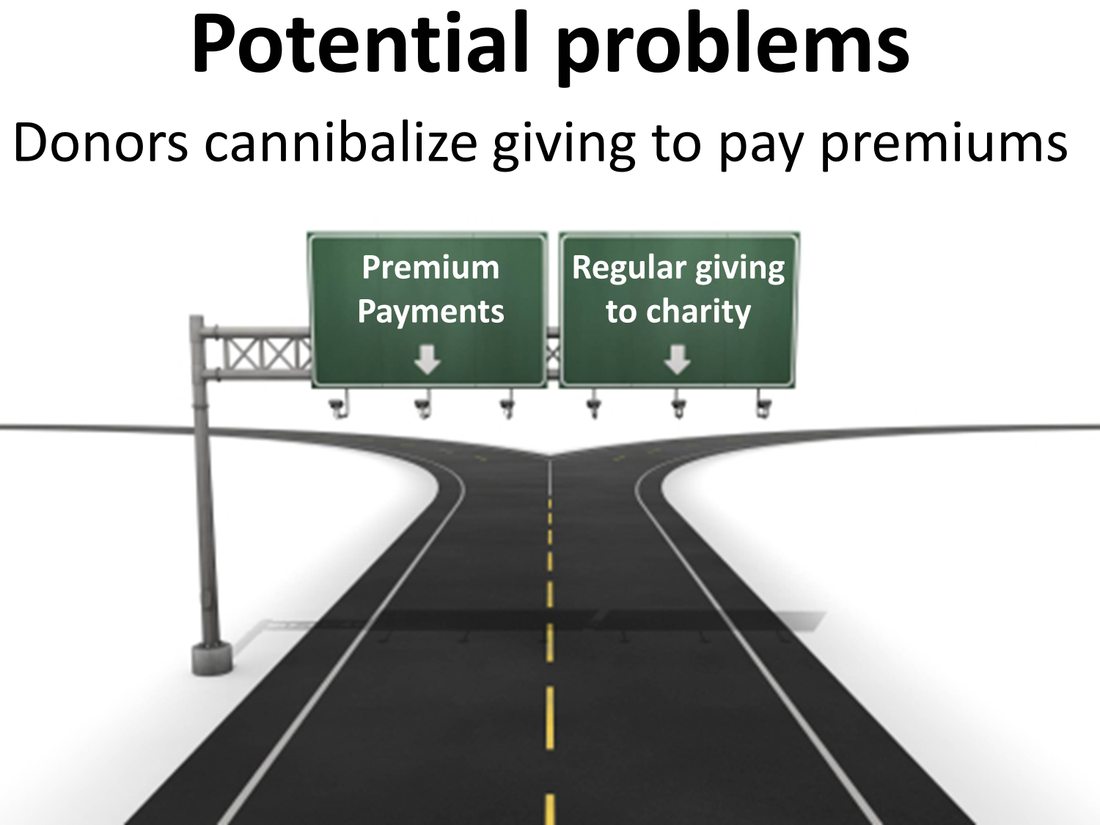
Some charities may take the approach that "something is better than nothing," meaning that any money raised by life insurance agents through the sale of charity owned life insurance is simply a bonus. This approach, however, ignores the possibility that the donor may be directing funds to premium payments that otherwise might have gone to the charity as simple donations. If the premium payments result in cannibalizing the donations that the donor would otherwise have made, then it is important for the charity to carefully weigh the value of using life insurance policies as a means to raise funds. Although these premium payments may indeed generate something for the charity, it is possible that the charity will also be losing something greater in the process.
How can a charity influence a donor's decision to use life insurance to benefit the charity? Ultimately, the charity can refuse to accept the donation of a life insurance policy. If the charity does not accept ownership of the policy, then the donor cannot deduct premium payments as gifts to the charity. Given the potential for premium payments to cannibalize regular giving, it may be wise for a charity to establish guidelines for the types of newly-created insurance policies that it will accept. (Of course, transfers of long-term life insurance policies that have built up substantial cash surrender value are a different matter as discussed in the previous section.) These requirements can include accepting only policies that will reach paid-up status in a relatively short time. Paid-up status is the point at which no additional premium payments are necessary in order to keep the death benefit in force for the remainder of the insured's life (or up to, e.g., age 100). This paid-up status may depend upon the projected returns of underlying assets and the stability of the issuing company. Thus, these companies should be highly rated and the return projections should be reasonable to make sure that once a policy reaches paid up status the charity will, ultimately, receive the death benefit. Reaching paid-up status in a relatively short time (e.g., 10 years) is important for two reasons. First, it reduces the likelihood that the policy will lapse due to non-payment of premiums by the donor, resulting in no gift to the charity. Second, it provides a planned break in the premium obligation to allow for shifting the donor into an alternative campaign or gifting approach at that time.
It may be counter-intuitive and even uncomfortable for a nonprofit organization to refuse a gift, especially one desired by the donor and the donor's insurance agent. But, the potential for the charity to receive nothing despite the donor's many contributions may suggest this unusual approach in cases where the policy does not meet the charity's guidelines. If the donor's regular gifting will be less because of the premium payments he or she is making on the charity owned life insurance policy, the charity should consider making a special effort to understand the value of the proposed insurance policy prior to accepting the gift.

Financial advisors and fundraisers can often help donors accomplish their charitable goals using life insurance in a variety of different ways. Life insurance can serve as tax-free wealth replacement for charitable estate gifts transferred to charity. Older life insurance policies may have built up significant value over time, making them potentially attractive as charitable gifts. New life insurance policies owned by a charity, with proper planning, can also be a beneficial strategy. Although the rules can be complex and the techniques may be appropriate only for certain circumstances, when life insurance is needed, it is important for advisors and fundraisers to be ready to suggest these potentially attractive solutions.