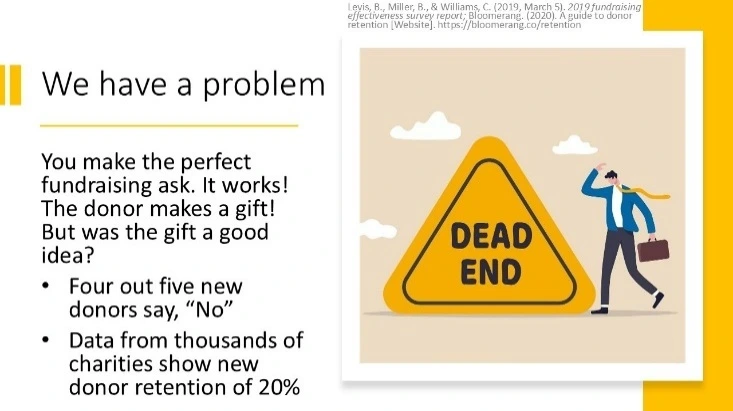
We have a problem
You make the perfect fundraising ask. It works! The donor makes a gift to your charity. Congratulations!
But was the gift a good idea? Four out five new donors say, “No.” Data from thousands of charities show new donor retention of 20%.339 They make a gift. But they don’t repeat their mistake. Even a year later, they haven’t done it again. The story “worked” to get a gift. But something was missing. It didn’t work again.
This causes money problems. A study of more than 10,000 charities found a seriously “leaky bucket.”340 Increased giving from active donors and new gifts from others created gains of $5 billion. Hooray! But wait. Other donors stopped or reduced their giving creating losses of more than $4.6 billion. The researchers explained,
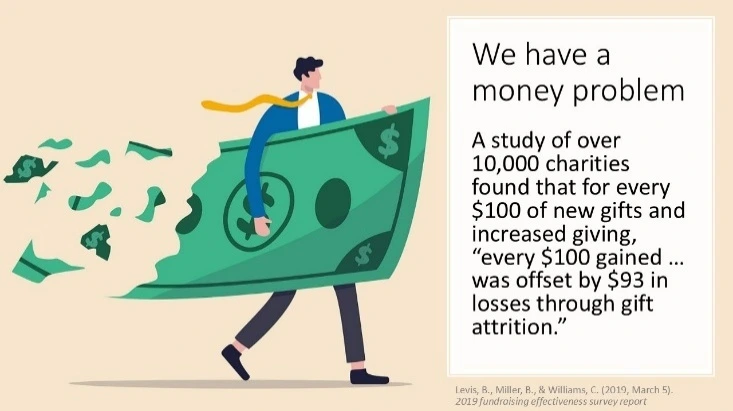
“every $100 gained … was offset by $93 in losses through gift attrition.” 341
Why is this happening? One study explored this question. It interviewed lapsed donors. Why had they stopped giving? The top reasons related to the charity were about impact and gratitude.342
It wasn’t just that these were weak. It’s that they often didn’t exist at all. Ex-donors commonly explained, the charity,
“Did not inform me how my money had been used.”
Many said the charity,
“Did not acknowledge my support.”
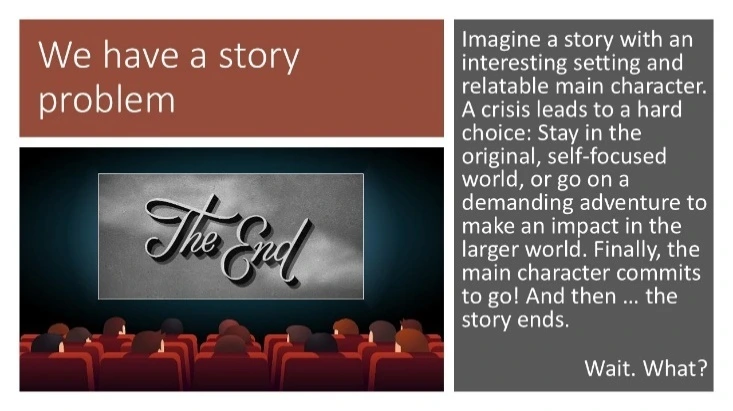
We have a story problem
Imagine a story in an interesting setting. The main character has a relatable backstory. A crisis or opportunity builds the tension. Finally, he faces a stark choice: Stay in his original, self-focused world, or go on a demanding adventure to make an impact in the larger world. After some delay, he finally commits. He looks, steely-eyed, at his wise guiding sage and says, “Let’s do this!” And then … the credits roll. Or the novel ends.
Wait. What? No, no, no! That’s not right. That story is awful! I mean, is it even a story? Where’s the journey? Where’s the climax and victory? Where’s the resolution? That was terrible! Would you buy another book from that author? Would you watch another movie by that director? Probably not.
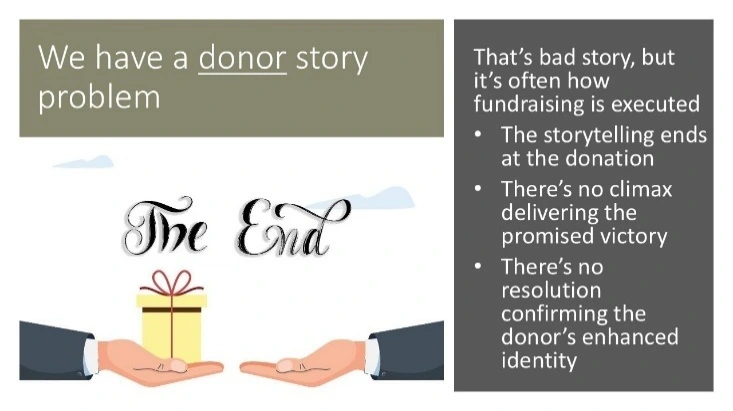
Of course, that’s a terrible way to tell a story. Yet, this is often how actual fundraising is executed. The storytelling ends at the donation decision. There’s no climax delivering the promised victory. There’s no resolution confirming the donor’s enhanced identity.
The wrong story
Charities aren’t finishing the story. Why not? Often, it’s because they weren’t trying to tell a donor story in the first place. Instead, they were telling the story that they wanted to hear. It’s a story about them. It’s not a donation story. It’s not a donor story. It’s a charity insider story.

In that story, the charity insiders are the main characters. They’re the heroes. The donor is just a bit player. He makes a quick cameo appearance. He is there to honor the heroic administrators. He lays money at their feet (because they’re so heroic). Then he disappears.
That story isn’t about the donor. It’s not about the donor’s gift. It’s not about the donor’s impact. It’s about the charity insiders. It’s about the administrators. It’s about their heroic journey.
This story easily ignores donor retention. Donors are supposed to come back automatically. In this story, donors are there to honor the charity insiders’ heroism. So long as charity insiders keep being their heroic selves – and keep reminding donors of this – giving should continue.
Retention, this story suggests, should be easy. It should be automatic. Fundraisers should instead focus elsewhere. They should focus on spreading the charity insiders’ fame. They should focus on telling the charity insiders’ story to new people. They should focus on new donors.
The wrong story in metrics
This story bias affects real-world management. One study looked at fundraising accounting metrics. It reviewed their use at hundreds of charities.343 Out of eleven metrics, which one was most frequently reported to top management? The number of new donors recruited.
Some charities tracked costs for both new-donor acquisition and current-donor retention. Even for these charities, internal reporting was different. New-donor acquisition cost was twice as likely to be reported to top management.344
What about improving donor commitment and satisfaction? Most fundraisers felt these weren’t even “slightly important” to top management.345
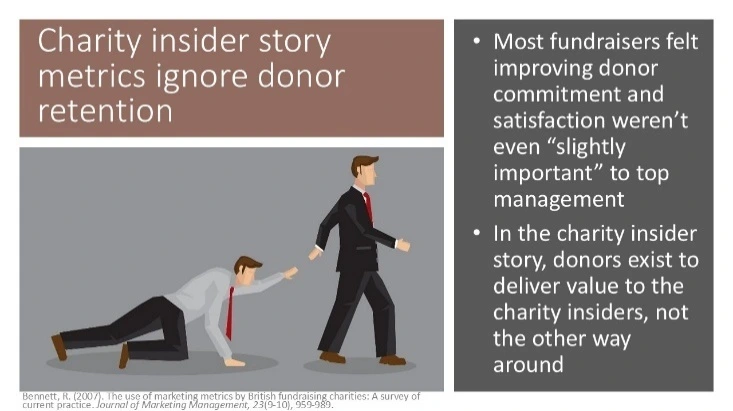
In math, a dollar is a dollar, whether from new or old donors. But in story, things are different. Top management lives the charity insider hero story. But that story doesn’t match with donor retention efforts. In that story, delivering a donor experience worth the gift doesn’t even make sense. Donors exist to deliver value to the charity insiders, not the other way around.
The right story
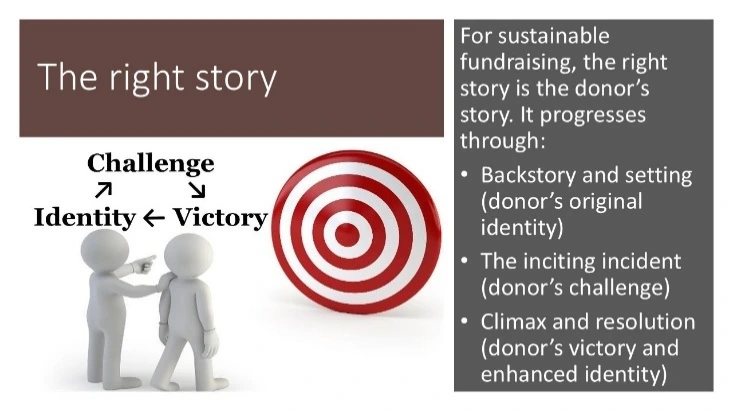
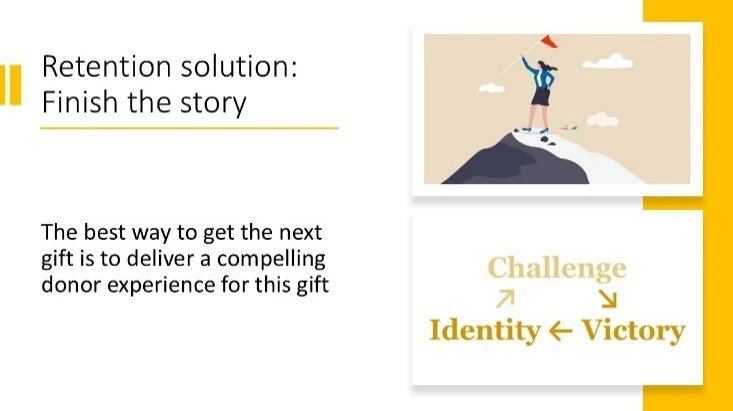
For sustainable fundraising, the right story is different. It’s the donor’s story. The donor’s story progresses through
- Backstory and setting (donor’s original identity)
- The inciting incident (donor’s challenge)
- Climax and resolution (donor’s victory and enhanced identity).
It connects the following:

In the donor’s story, the challenge step is the ask. But the effective ask incorporates the full story cycle.
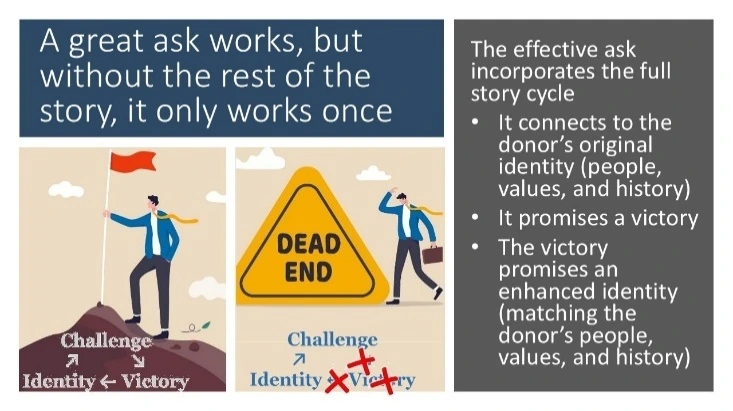
- The ask connects to the donor’s original identity (people, values, and history).
- The ask promises a victory.
- The victory promises an enhanced identity. It’s personally meaningful. It matches the donor’s people, values, and history.
This makes for a great ask. It works. The ask promises a victory. It promises an enhanced identity. But it doesn’t deliver them. It doesn’t finish the story. A great ask works. But without the rest of the story, it only works once.
Plot means change
A story with no plot fails. A popular guide to screenwriting explains it this way. Films where a character’s life at the end is the same as the beginning, “do not tell story.”346
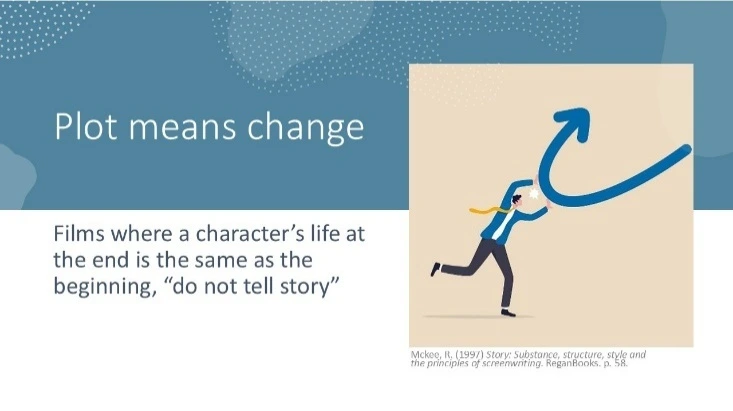
Such films are called “non-plot.” They’re “non-plot” because they have no change. Instead, “story dissolves into portraiture.”347 There is no story because story requires change.
For a donor, the question is simple:
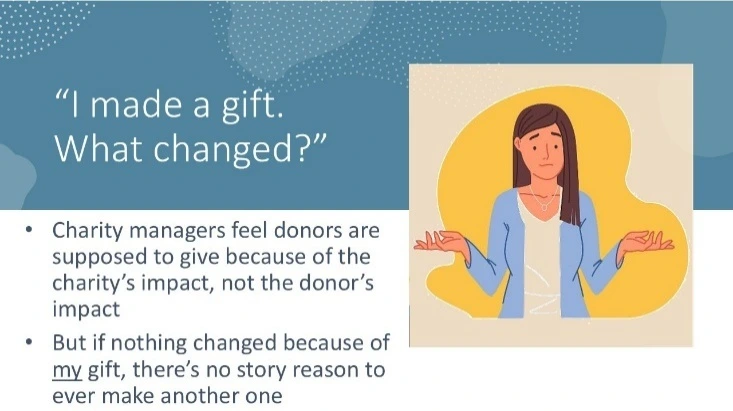
“I made a gift. What changed?”
In the donor’s story, the victory is the donor’s impact. It’s the impact of the donor’s gift.
Charity managers often misunderstand this. To them, a specific donor’s impact is vague. It’s uncertain. It’s also beside the point. Donors are supposed to give because of the charity’s impact.
But here’s the problem. If nothing changed because of the donor’s gift, there’s no donation story. There’s no donor story. There’s no story reason to ever make another gift.
The secret to donor retention: Finish the story
Delivering a powerful ask is great. But it’s not the same as delivering value to the donor. Delivering value is about what happens after the donor says, “Yes.”
Why don’t new donors give again? It’s simple. The donor’s experience wasn’t worth the gift. It failed to deliver value.
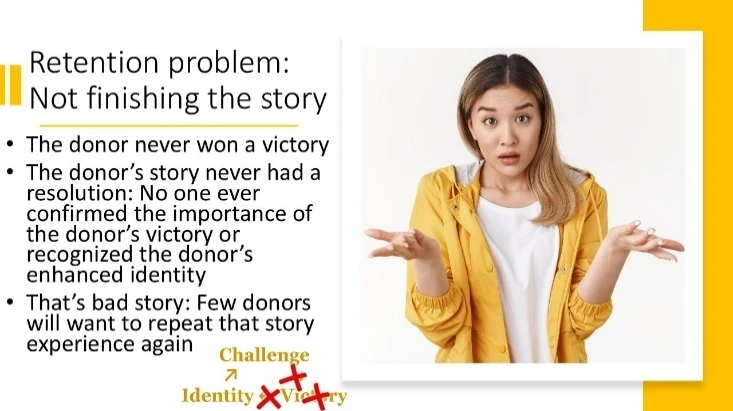
The charity didn’t finish the donor’s story. The donor’s story never had a climax. The donor never won a victory. The donor’s story never had a resolution. No one ever confirmed the importance of the donor’s victory. No one ever recognized the donor’s enhanced identity. That’s bad story. Few donors will want to repeat that story experience again.
Retention means getting the next gift. What’s the best way to start that process? Deliver a compelling donor experience for this gift. That means finishing the story. It means delivering victory. It means showing the impact from the donor’s gift.
Penelope Burk defines the word “Oversolicitation” as
“v. (Verb) Being asked to give again before they knew their first gift had an impact.”348
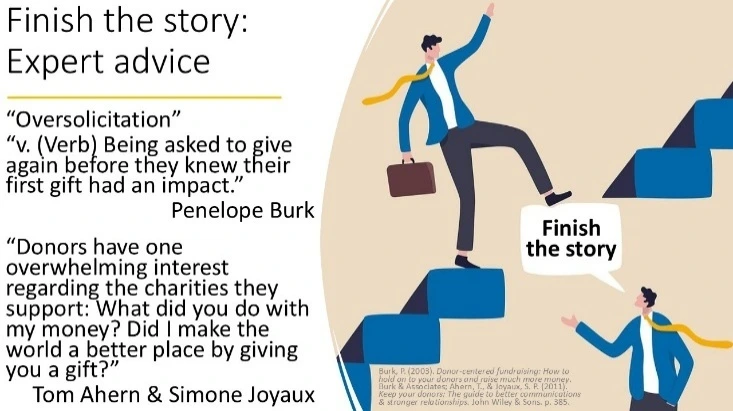
Tom Ahern and Simone Joyaux write,
“Donors have one overwhelming interest regarding the charities they support: What did you do with my money? Did I make the world a better place by giving you a gift?”349
Finish the story: Experimental evidence
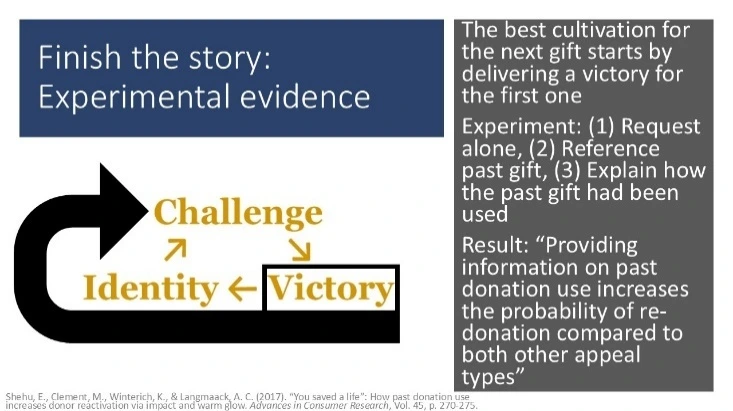
The best cultivation for the next gift starts with this one. It starts by delivering a victory. One experiment decided to test this.350 It tested three appeals to previous donors. One appeal just explained what the requested gift would be used for. A second one also mentioned their past donation. The third instead mentioned how the past donation had been used. The results? The researchers explained,
“Providing information on past donation use increases the probability of re-donation compared to both other appeal types.”
Why? They explained,
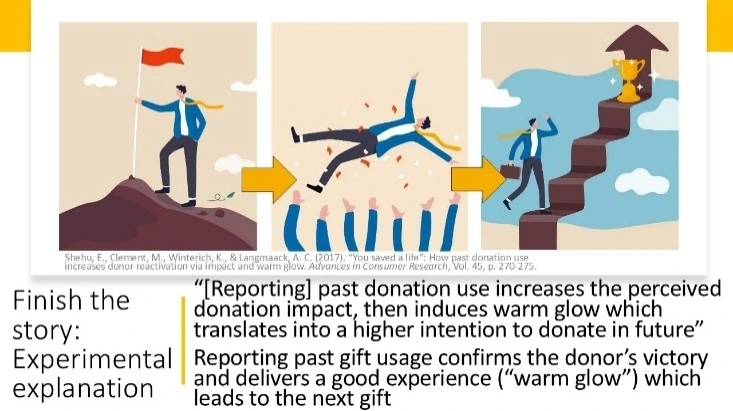
“[Reporting] past donation use increases the perceived donation impact, then induces warm glow which translates into a higher intention to donate in future.”
Reporting past gift usage works. It confirms the donor’s victory. It shows a finished story. This induces a “warm glow.” It delivers a good experience. Delivering a good experience leads to the next gift. Getting the next gift starts by finishing the last story.
The secret to major gift success: Finish the story
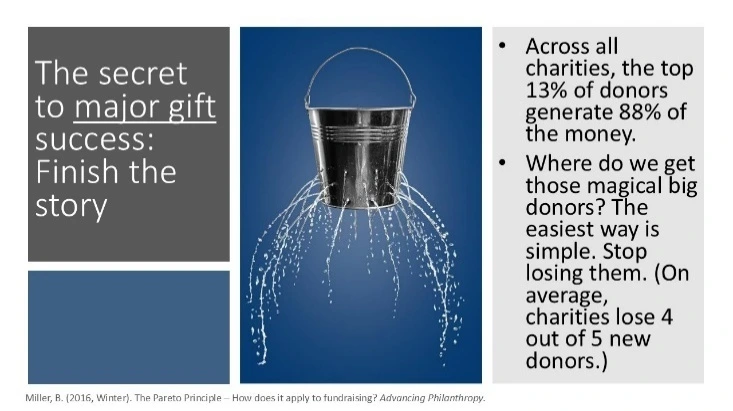
Major donors are, of course, critical to fundraising success. Across all charities, the top 13% of donors generate 88% of the money.351 So, where do we get those magical big donors? The easiest way is simple. Stop losing them.
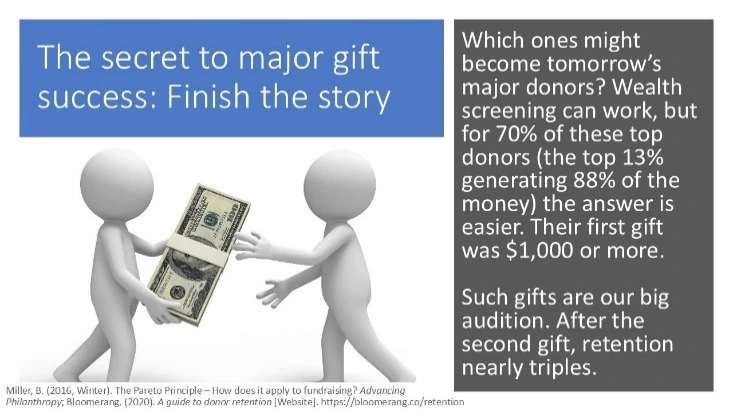
On average, charities lose 4 out of 5 new donors.352 Improving that only slightly could easily double retention. But how do we know which of these new donors to focus on? How can we tell which ones might be tomorrow’s major donors? Sophisticated wealth screening can be great. But for 70% of these top donors (the top 13% generating 88% of the money), the answer is easier. Their first gift was $1,000 or more.353
Such gifts are our big audition. Can we deliver a donor experience worth that initial gift? This first gift is the critical one. After the second gift, retention nearly triples.354 Passing this initial audition can massively increase our major donors.
It’s not about cold calls or wealth lists. It’s about delivering value. Delivering value leads to retention. But it does more. Retention leads to referrals. One secret to new major donors is happy current major donors.
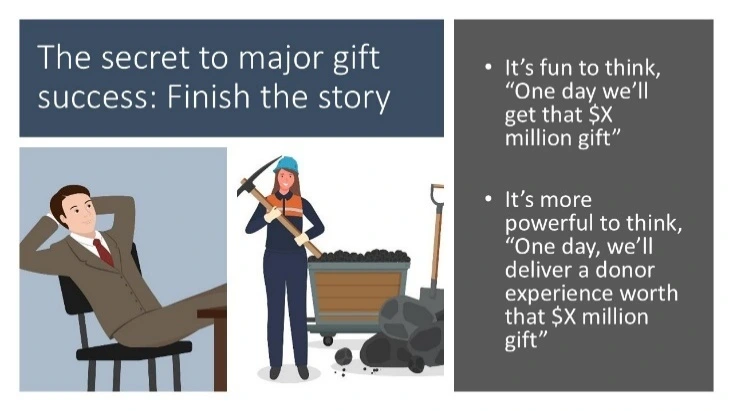
Charity managers love to dream about the magical new big donor. They think, “One day we’ll get that $X million gift.” That’s fun. But they rarely think, “One day, we’ll deliver a donor experience worth that $X million gift.” That’s not as much fun. That’s hard work.
Conclusion
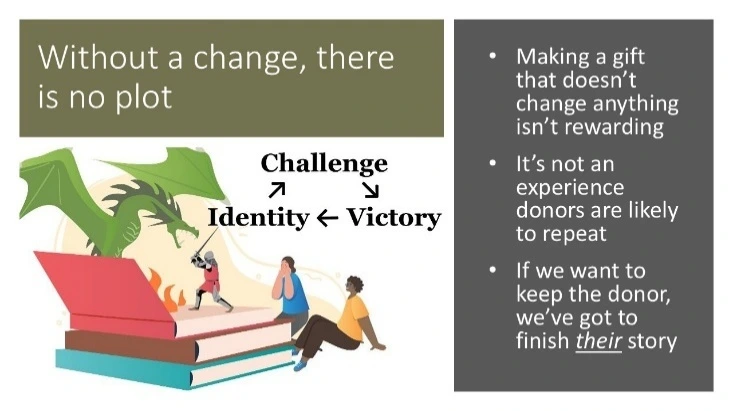
Without a change, there is no plot. Making a gift that doesn’t change anything isn’t rewarding. It’s not an experience donors are likely to repeat. Of course, once we’ve got the donor’s money, we don’t have to finish their story. We don’t have to deliver their victory. But then we shouldn’t expect the donor to return. If we want to keep the donor, we’ve got to finish their story.
Next up,
Notes and references
Bloomerang. (2020). A guide to donor retention [Website]. https://bloomerang.co/retention
↩Levis, B., Miller, B., & Williams, C. (2019, March 5). 2019 fundraising effectiveness survey report.
↩Id at p. 1.
↩The top three reasons related to the charity were:
• “I feel that other causes are more deserving.” [i.e., impact]
• The charity “did not acknowledge my support.” [i.e., gratitude]
• The charity “did not inform me how my money had been used.” [i.e., impact]
This omits non-charity causes such as donor finances, death, or relocation. One final reason, inability to remember making the initial gift, likely also relates to the charity’s lack of impact reporting or gratitude expression. Sargeant, A. (2001). Managing donor defection: Why should donors stop giving? New Directions for Philanthropic Fundraising, 2001(32), 59-74. p. 64, Table 4.1.
↩Bennett, R. (2007). The use of marketing metrics by British fundraising charities: A survey of current practice. Journal of Marketing Management, 23(9-10), 959-989.
↩Id at Table 1.
89% used donor acquisition costs with 44% reporting it to top management (44%/89%=49.4%). 70% used donor retention costs with 19% reporting it to top management (19%/70%=27.1%).
↩When choosing what would motivate top management to invest in fundraising with budget increases, the least popular option was, “Predicted improvements in donors’ feelings of satisfaction with or commitment to the organization” with 52% of fundraising managers indicating this was “not important” and 32% indicating “slightly important.” Bennett, R. (2007). The use of marketing metrics by British fundraising charities: a survey of current practice. Journal of Marketing Management, 23(9-10), 959-989. p. 966, Table 2.
↩Mckee, R. (1997) Story: Substance, structure, style and the principles of screenwriting. ReganBooks. p. 58.
↩Id.
↩Burk, P. (2003). Donor-centered fundraising: How to hold on to your donors and raise much more money. Burk & Associates.
↩Ahern, T., & Joyaux, S. P. (2011). Keep your donors: The guide to better communications & stronger relationships. John Wiley & Sons. p. 385.
↩Shehu, E., Clement, M., Winterich, K., & Langmaack, A. C. (2017). “You saved a life”: How past donation use increases donor reactivation via impact and warm glow. Advances in Consumer Research, Vol. 45, (Eds.
A. Gneezy, V. Griskevicius, & P. Williams). Duluth, MN: Association for Consumer Research. p. 270-275. https://www.acrwebsite.org/volumes/v45/acr_vol45_1024372.pdf
↩Miller, B. (2016, Winter). The Pareto Principle – How does it apply to fundraising? Advancing Philanthropy.
↩Bloomerang. (2020). A guide to donor retention [Website]. https://bloomerang.co/retention
↩Miller, B. (2016, Winter). The Pareto Principle – How does it apply to fundraising? Advancing Philanthropy.
↩“However, if you can get a second donation (or golden donation), your retention rates increase dramatically because repeat donor retention is much higher. Nonprofits who focus on receiving that golden donation naturally increase their average donor retention rate (about threefold!) because of this higher repeat retention rate.” (citing to 20.3% new donor retention and 61.3% repeat donor retention). Bloomerang. (2020). A guide to donor retention [Website]. https://bloomerang.co/retention
↩