Selling “nothing”?
Fundraisers work in “sales.” OK. But then what, exactly, do fundraisers sell? One shared this,
“My then-boyfriend, who worked in sales, told his colleagues (admiringly, I think) that ‘Beth makes a living out of selling nothing!’”355
Although misguided, this comment points to an important question. What exactly do fundraisers sell?
This can be a tricky question even in simple product sales. Suppose we sell drills. People buy a drill because they want a drill, right? Not really. The saying goes, “No one wants a drill. What they want is the hole.”356
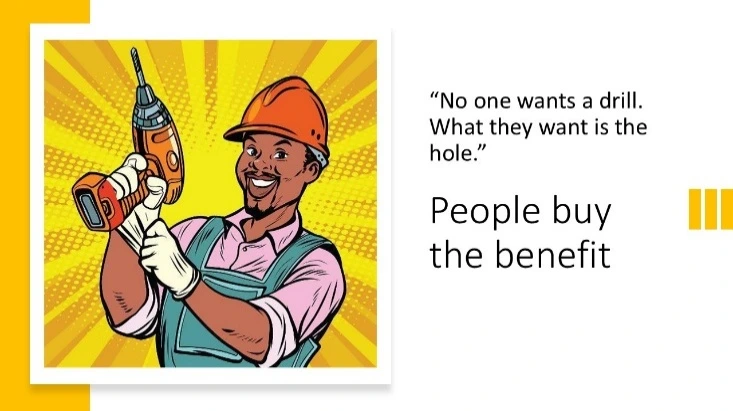
The question goes further. People don’t actually want holes.357 Holes aren’t the benefit. They want shelves hung in the garage. They want a deck on their house. Shelves and decks require holes. Making holes requires a drill.
What drives a sale is the benefit, not the product. Understanding what we’re selling means understanding the benefit.
What about fundraising? What benefit do donors get?
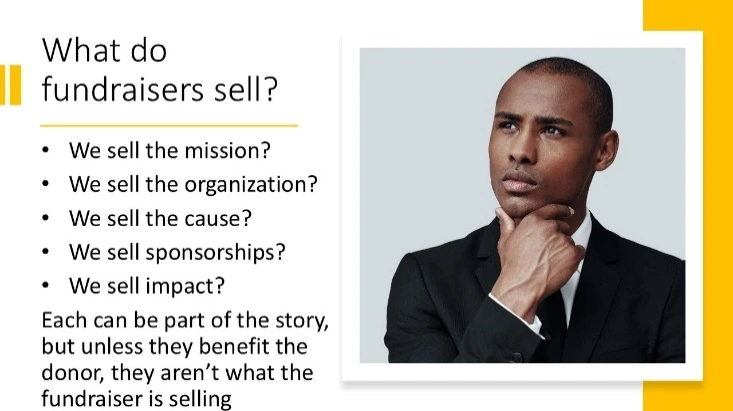
What do fundraisers sell?
If fundraisers are selling something, what is it? There are many popular answers:
- We sell the mission.
- We sell the organization.
- We sell the cause.
- We sell sponsorships.
- We sell impact.
Each of these can be important. Each can be part of the story. But unless they benefit the donor, they aren’t what the fundraiser is selling.
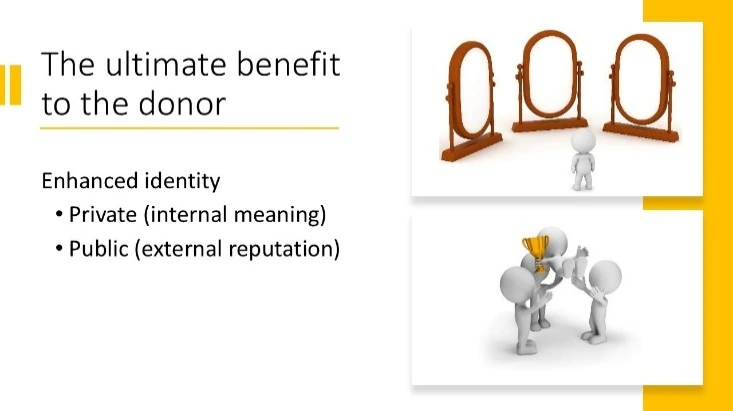
What does the donor walk away with in the end? What is the ultimate benefit to the donor from the gift?358 What benefit is the fundraiser selling?
It is one thing. It is an enhanced identity.359
- It can be private. This delivers internal meaning.
- It can be public. This delivers external reputation.
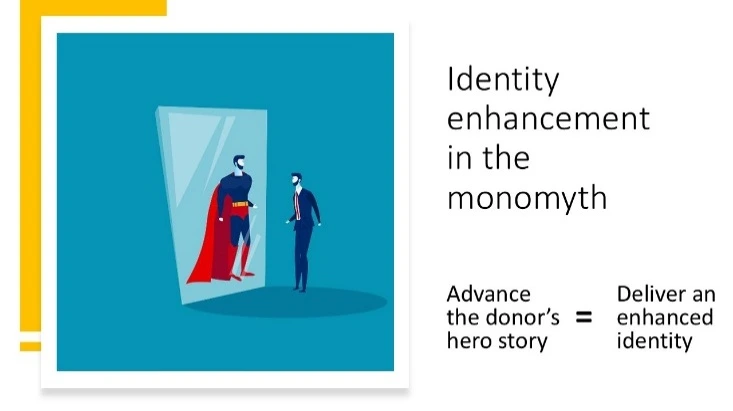
Identity enhancement in the monomyth
One sentence sums up the fundraising advice in this book:
Advance the donor’s hero story.
Doing this delivers an enhanced identity. This works because the hero’s journey is an identity enhancement process.360
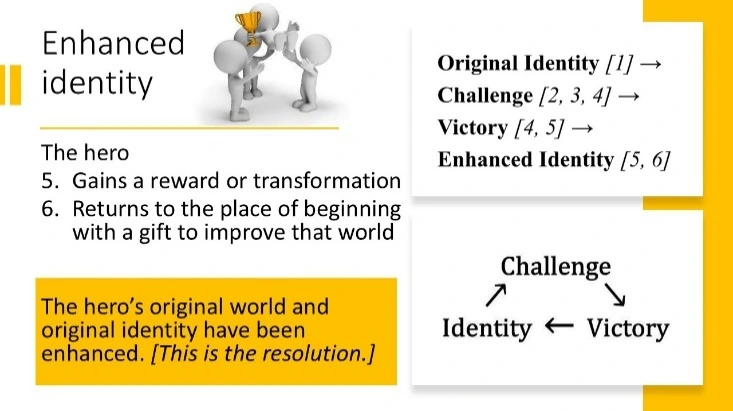
The universal hero story is called the monomyth.361 It includes specific steps. The hero
- Begins in the ordinary world
- Is faced with a challenge (the call to adventure)
- Rejects then accepts the call and enters the new world
- Undergoes ordeals and overcomes an enemy
- Gains a reward or transformation, and
- Returns to the place of beginning with a gift to improve that world.
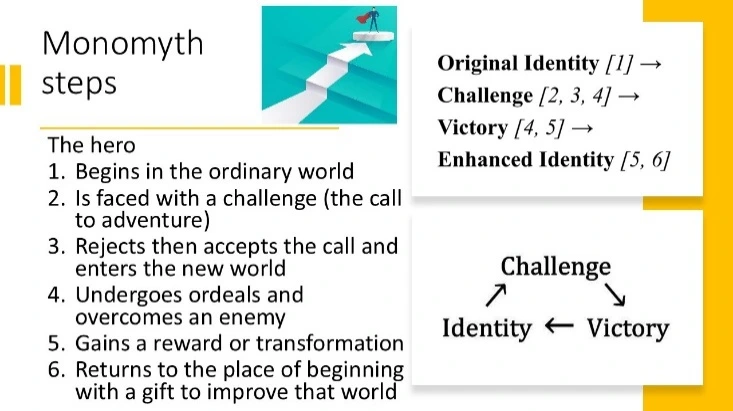
Through these steps, the hero’s story progresses through

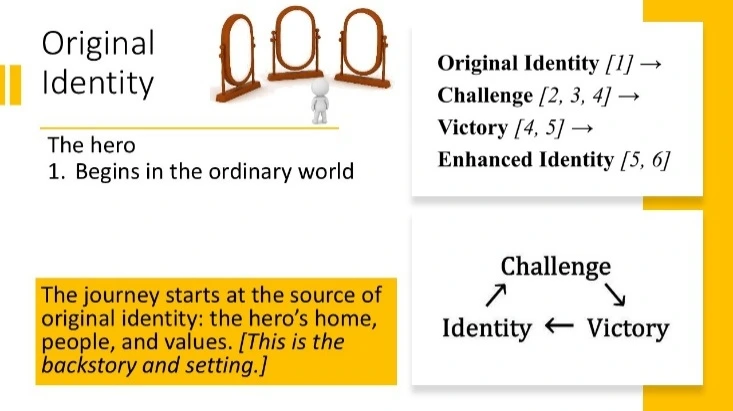
Original identity
- The journey starts at the source of original identity. This is the hero’s home, people, and values. (In the narrative arc, this is backstory and setting.)
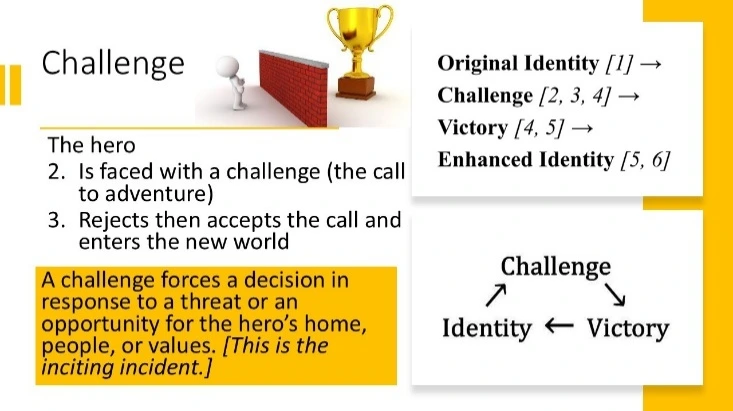
- Challenge
- A challenge forces a decision in response to a threat or an opportunity. The threat or opportunity affects the hero’s home, people, or values. The challenge motivates action with the hope of victory. It launches the hero’s journey. (In the narrative arc, this is the inciting incident.)
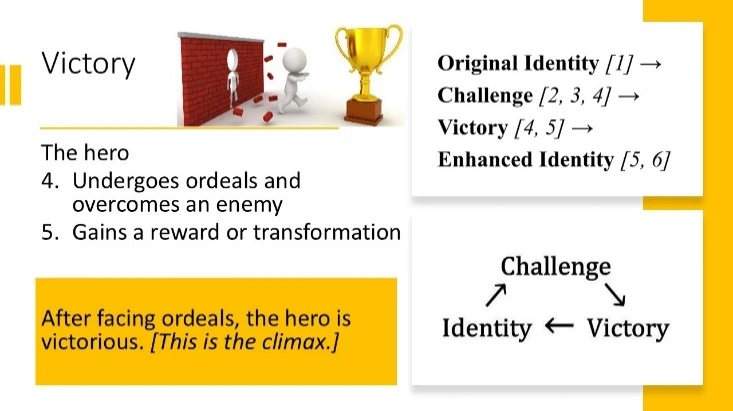
- Victory
- After facing ordeals, the hero is victorious. The hero gains a reward or transformation. (In the narrative arc, this is the climax.)
- Enhanced identity
The journey results in a new identity. The main character becomes a victorious hero. This identity can be internal (private) and/or external (public). The hero returns with a gift to benefit the original world. The journey ends where it started. But now the original world and the original identity have been improved. (In the narrative arc, this is the resolution.)
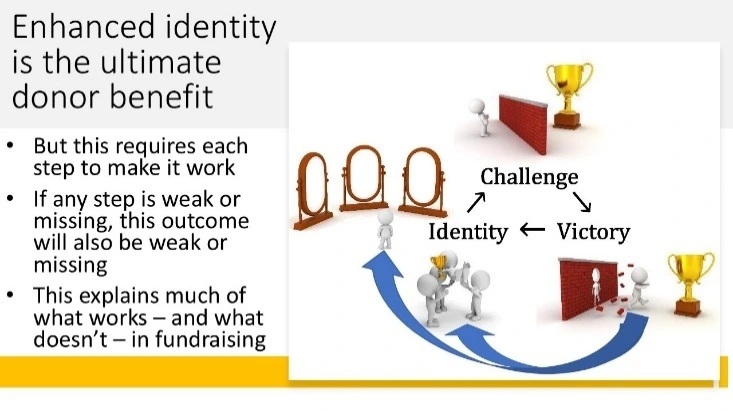
In three words, the monomyth cycle is362

Identity enhancement in fundraising
These are not just steps in the hero’s journey. These are elements for the ideal donor experience. A heroic donation matches the monomyth cycle. It is
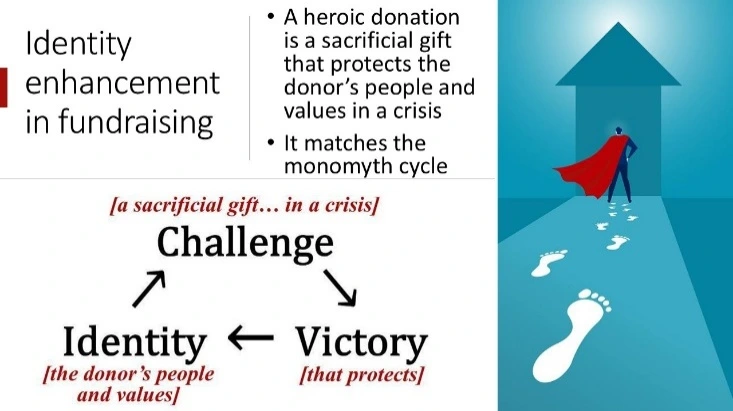
A sacrificial gift that protects the donor’s people and values in a crisis.
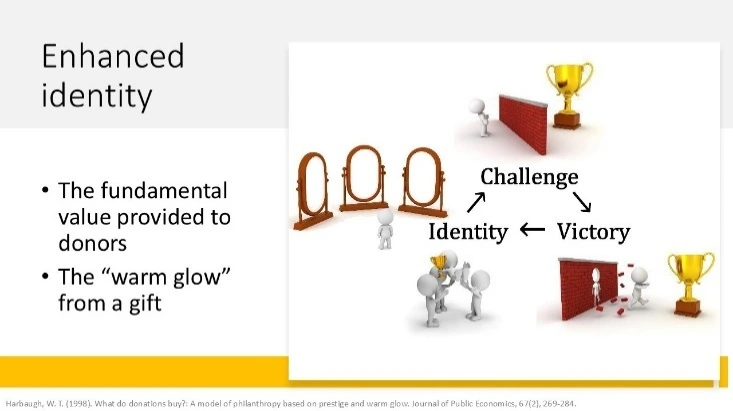
This links challenge, identity, and victory.

Each step comes from the previous one. Each results in the next.
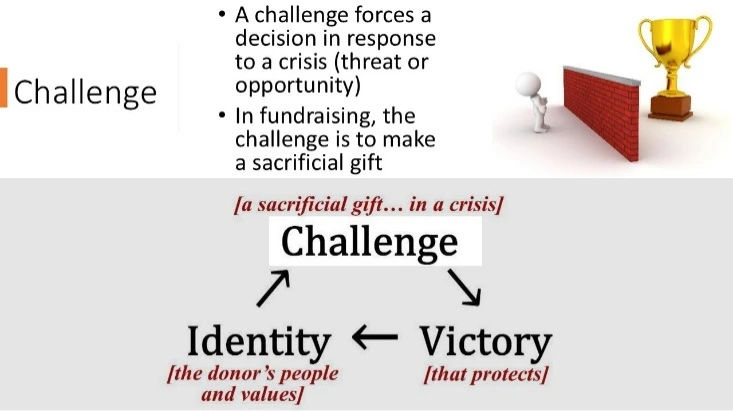
A challenge forces a decision in response to a crisis (threat or opportunity). In fundraising, the challenge is to make a sacrificial gift.363
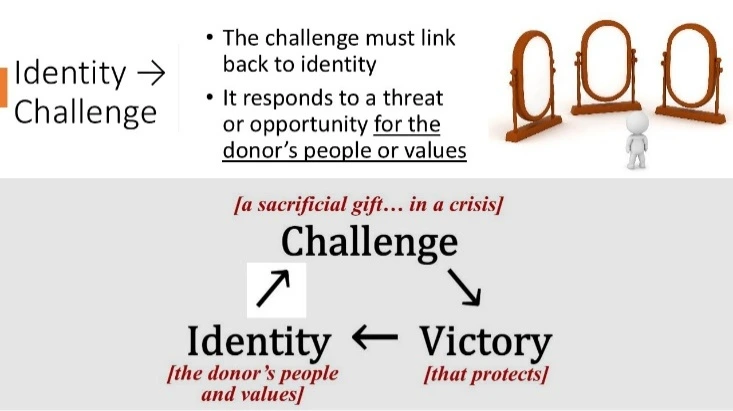
This challenge must link back to the donor’s identity. Identity comes from one’s people, values, and life story. The challenge responds to a threat or opportunity. But it should be a threat or opportunity for the donor’s people or values. The challenge should originate in the donor’s identity.
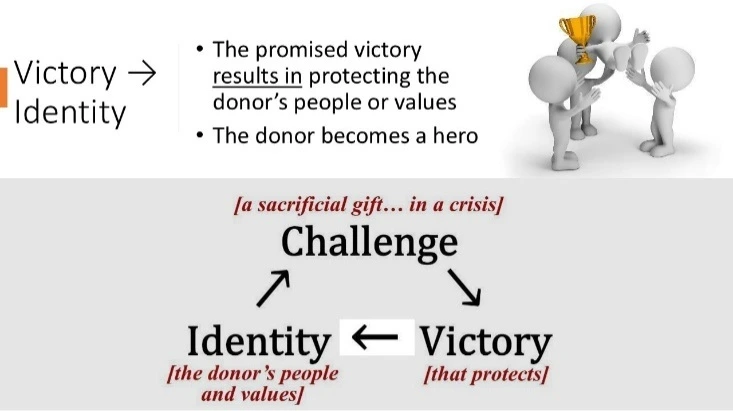
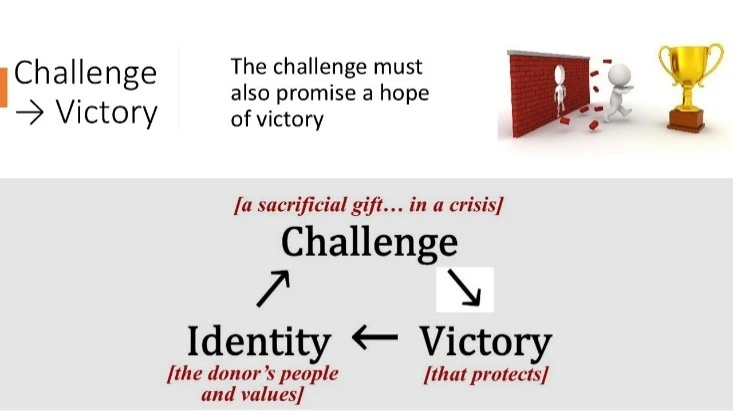
The challenge must also promise the hope of a victory. The promised victory results in protecting the donor’s people or values. It enhances the donor’s identity. The donor becomes a hero. The donor becomes a sacrificial protector of his people and values. This new status might be private, delivering personal meaning. It might be public, enhancing reputation. It might be both.
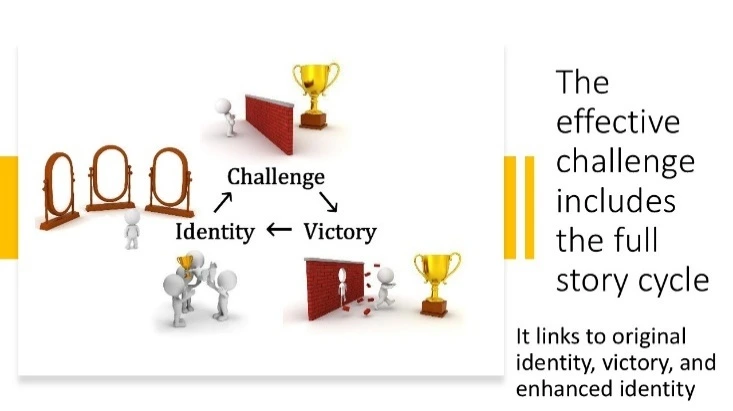
The effective challenge promises this full story cycle. It links to the donor’s original identity, victory, and enhanced identity. The ideal donor experience completes this story cycle. It results in an enhanced identity for the donor.
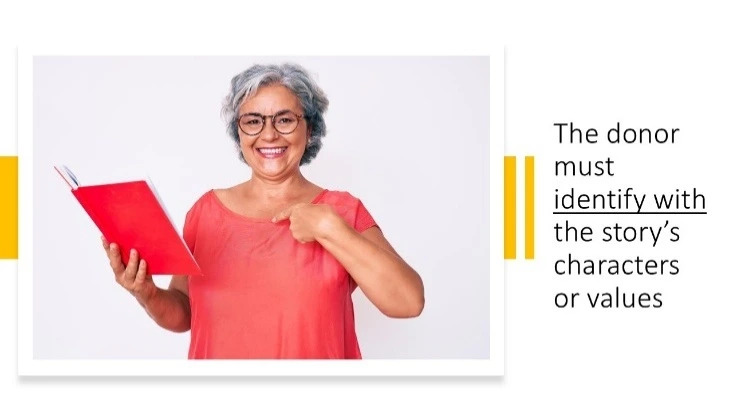
This story requires connecting with the donor’s identity. Does this mean the story’s main character must be the donor? No, although that strategy works. It means the donor must identify with the story’s characters or values. The story’s characters must be, in some important way, like the donor. The story’s values must be like the donor’s values. This turns a story into the donor’s story.
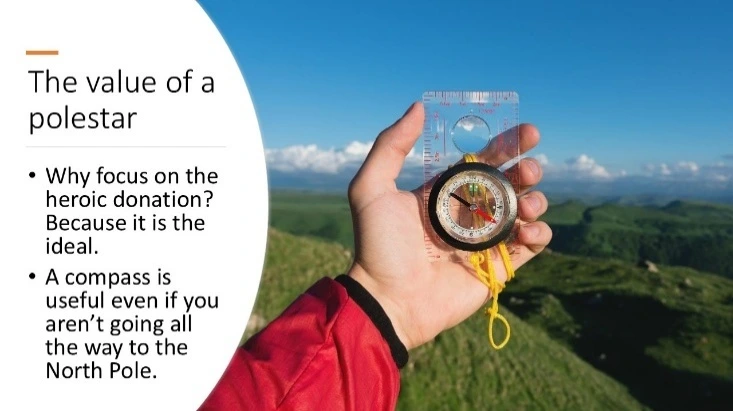
The value of a polestar
Isn’t calling a donation heroic a bit much? Does writing a $20 check have to be an epic event? Of course not.
So why focus on the heroic donation? Because it is the ideal.364 Understanding the ideal is important. It’s like having a compass. A compass is useful even if we aren’t going all the way to the North Pole.
Understanding the heroic donation is like knowing which way is north. As a giving opportunity moves closer to this heroic ideal, it becomes more compelling. No, the $20 donation request doesn’t have to be epic. But the closer it moves to being heroic, the more compelling it is. The heroic donation gives “true north” for fundraising.
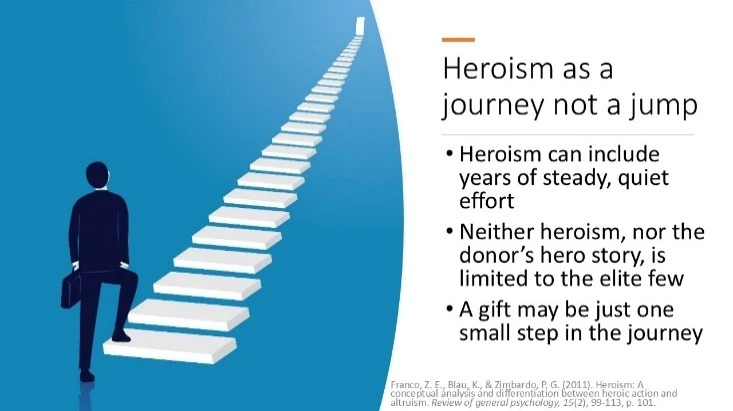
Heroism as a journey not a jump
Not all heroism occurs in a single instant. Heroism can include years of steady, quiet effort.365 The accumulation of small acts can build a compelling hero story.366
Thus, neither heroism nor the donor’s hero story is limited to the elite few.367 The goal is to advance the donor’s hero story. A gift may be just one small step in that journey. But if we know the destination, each step will lead in the right direction.
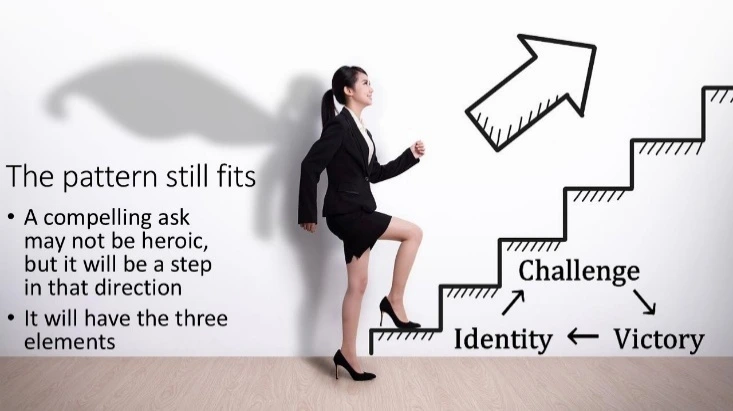
Experimental research in fundraising
Not every donation must rise to the heroic level. But the pattern still fits. A compelling ask may not be heroic. But it will be a step in that direction. It will fit the pattern. It will have the elements of
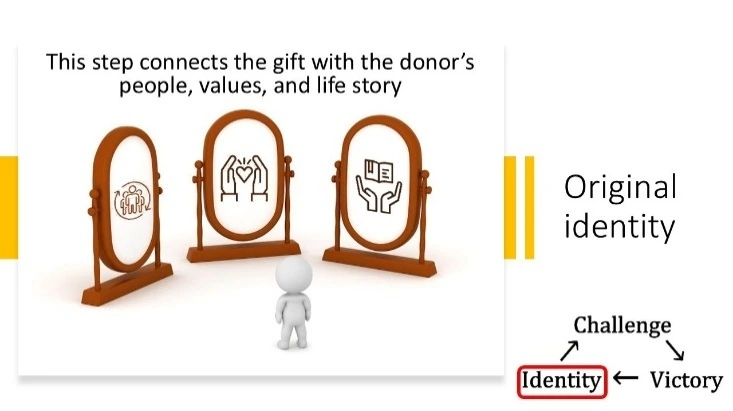
- Original identity
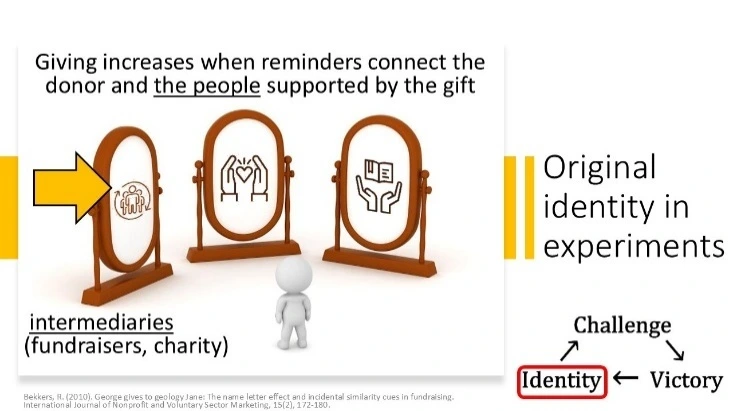
This step connects the gift with the donor’s people, values, and life story. These form the donor’s “original world.” They are the donor’s sources of identity.
This isn’t just a matter of literary speculation. It’s what happens in experimental research. Giving increases when reminders highlight connections between
- The donor’s life story and the gift 368
- The donor and the values supported by the gift, or 369
- The donor and the people supported by the gift including
- The beneficiaries (those the charity helps)370
- The intermediaries (the charity, its fundraisers, or administrators), or 371
- Other supporters (other donors or advocates).372
- Challenge
- A compelling challenge forces a decision in response to a threat or opportunity. The threat or opportunity affects the donor’s people or values. (In other words, the challenge links back to identity.)
- The challenge promises protection for those people or values. (In other words, the challenge links forward to a victory that links to identity.) These links appear in experimental results.
- A challenge forces a decision. In fundraising, the ask is the challenge. The ask forces a decision. In experiments, asking increases donations.373 Asking works. In other words, giving increases when there is a challenge.
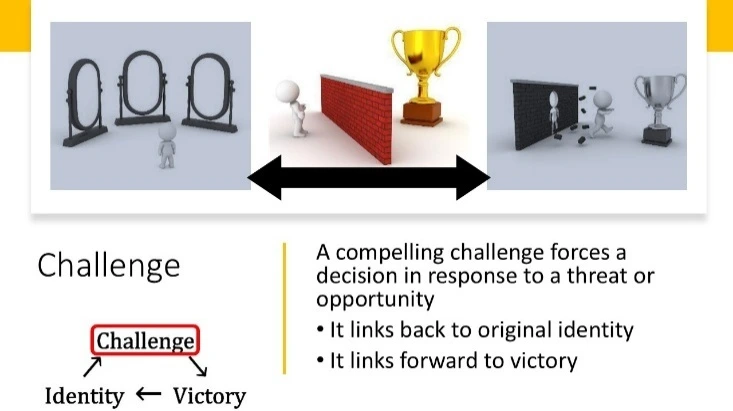
Giving also increases when the challenge addresses a threat or opportunity for the donor’s people or values. This happens with
- An external threat attacking the donor’s people or values, or 374
- An internal threat of personally violating norms of the donor’s people or values.375
- Victory
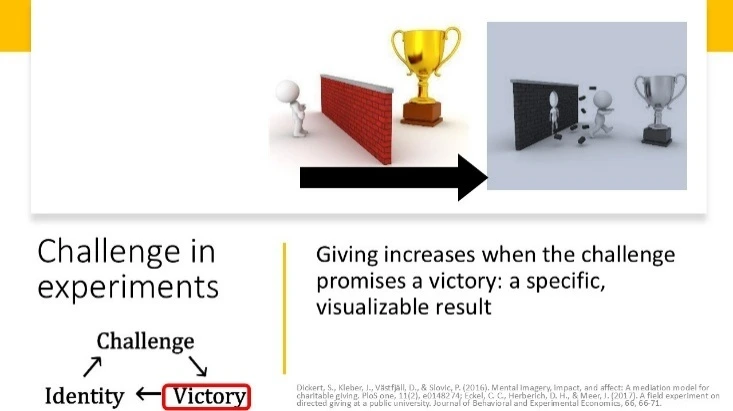
Giving increases when the challenge promises a victory. This works when the gift promises a specific, visualizable result.376 This fails when the impact is vague, or the problem is overwhelming.377
- Enhanced identity
Identity enhancement is the ultimate goal. It’s the fundamental value provided to donors. It’s the “warm glow” from a gift.378 It’s the source of donor happiness.379 In experiments, it increases donations. This works with external identity – delivering public reputation.380 It also works with internal identity – delivering personal meaning.381
Conclusion
Clever fundraising tricks can work. But mostly they work once.382 After all the tricks and traps, either the donor experience was worth the gift, or it wasn’t. Sustained success requires delivering real value. Fundraisers can do this. They can deliver real value to the donor.
The ultimate value to the donor from fundraising is enhanced identity. But this benefit comes at the end of the journey. It requires each step to make it work. If any step is weak or missing, the outcome will also be weak or missing. Understanding this explains much of what works – and what doesn’t – in fundraising.
Notes and references
Breeze, B. (2017). The new fundraisers: Who organizes charitable giving in contemporary society? Policy Press. p. xi
↩Quote Investigator. (2019, March 23). No one wants a drill. What they want is the hole [Website]. https://quoteinvestigator.com/2019/03/23/drill/
↩McKelvey, S. (2012, August 8). Why that whole “people don’t want a drill, they want a hole” thing doesn’t go far enough [Website]. https://www.websearchsocial.com/why-that-whole-people-dont-want-a-drill-they-want-a-hole-thing-doesnt-go-far-enough/
↩In a general sales context, this key issue can be addressed by answering the central question, “How will this customer be different as a result of doing business with us?” McLeod, L. E. (2012). Selling with noble purpose: How to drive revenue and do work that makes you proud. John Wiley & Sons. p. 50.
↩This discussion focuses on identity enhancement in its most basic form. This can be as simple as, e.g., “I feel better about myself after I give.” However, this touches on the substantially more complex journey of individuation. Individuation “denotes the process by which a person becomes a psychological ‘in-dividual,’ that is, a separate, indivisible unity or ‘whole.’ Jung, C. G. (1990). The archetypes and the collective unconscious. In H. Read, M. Fordham & G. Adler (Eds.), R.F.C. Hull (Trans.). The collected works of C. G. Jung. Vol 9 (2nd ed.). Princeton University Press. p. 275.
↩For elaborations of this concept, see e.g., Elenbaas, J. D. (2016). Excavating the mythic mind: Origins, collapse, and reconstruction of personal myth on the journey toward individuation. [Ph.D. dissertation]. Pacifica Graduate Institute; Gerhold, C. (2011). The hero's journey through adolescence: A Jungian archetypal analysis of “Harry Potter”. [Ph.D. dissertation]. The Chicago School of Professional Psychology.
↩Campbell, J. (1949/2004). The hero with a thousand faces (commemorative ed.). Princeton University Press. p. 1.
↩Campbell uses a three-step circular illustration with this description:
“A hero ventures forth from the world of common day into a region of supernatural wonder: fabulous forces are there encountered and a decisive victory is won: the hero comes back from this mysterious adventure with the power to bestow boons on his fellow man.”
Campbell, J. (1949/2004). The hero with a thousand faces (commemorative ed.). Princeton University Press. p. 28.
I label these steps as follows:
The beginning point of “the world of common day” is “original identity.”
“Venturing forth into a region of supernatural wonder” is “challenge.”
“Fabulous forces are there encountered and a decisive victory is won” is “victory.”
“The hero comes back from this mysterious adventure with the power to bestow boons on his fellow man” is “enhanced identity.”
I apply this both to a scenario where the charitable gift serves as part of the final step in the heroic life story and where the gift request itself constitutes the challenge that promises a victory delivering enhanced identity.
↩Philip Zimbardo, Professor Emeritus at Stanford and Founder/President of the Heroic Imagination Project, explains that heroes can be ordinary people “who engage in extraordinary actions to help others in need or in defending a moral cause, doing so aware of personal risk and loss, and without expectation of material gain for their action.” Zimbardo, P. (2017). Foreword. In S. T. Allison, G. R. Goethals, & R. M. Kramer (Eds.), Handbook of heroism and heroic leadership. Routledge. p. xxi.
Similarly, Franco, Blau, & Zimbardo define heroism as, “Heroism is the willingness to sacrifice or take risks on behalf of others or in defense of a moral cause.” Franco, Z. E., Blau, K., & Zimbardo, P. G. (2011). Heroism: A conceptual analysis and differentiation between heroic action and altruism. Review of General Psychology, 15(2), 99-113. p. 113.
↩The role of heroism is to establish an ideal. In the introduction to the largest collection of academic work on heroism, the editors begin by explaining, “Heroism represents the pinnacle of human behavior. The most noble act that a human being can perform is a heroic act, and the most distinguished life that a human being can lead is a heroic life.” As a pinnacle, heroism is necessarily an extreme example. In its extremity it serves as a polestar by which to measure our acts and our lives. But the attraction to heroism is not just for the few. Instead, it is “central to our humanity.” Its pursuit opens the path to personal transformation and deep meaning.
Allison, S.T., Goethals, G. R, & Kramers, R. M. (2017). Setting the scene: The rise of heroism science. In S. T. Allison, G. R. Goethals, & R. M. Kramer (Eds.), Handbook of heroism and heroic leadership (pp. 1-16). Routledge. p. 1
↩“Social heroism is typically less dramatic, unfolds over a much longer time period, and is frequently undertaken in private rather than public settings.” Franco, Z. E., Blau, K., & Zimbardo, P. G. (2011). Heroism: A conceptual analysis and differentiation between heroic action and altruism. Review of General Psychology, 15(2), 99-113. p. 101.
↩The idea of heroism as a range of behaviors is reflected in Franco, Blau and Zimbardo’s description of heroic imagination: it “can be seen as mind-set, a collection of attitudes about helping others in need, beginning with caring for others in compassionate ways, but also moving toward a willingness to sacrifice or take risks on behalf of others or in defense of a moral cause”. Franco, Z. E., Blau, K., & Zimbardo, P. G. (2011). Heroism: A conceptual analysis and differentiation between heroic action and altruism. Review of General Psychology, 15(2), 99-113. p. 111.
↩“Modern treatments of heroism emphasize that heroes serve fundamental human needs (Allison & Goethals, 2014; Kinsella, Ritchie, & Igou, 2015a), and that all of humanity—not just a select group of moral elite—is capable of heroism (Franco, Blau, & Zimbardo, 2011).” Allison, S.T., Goethals, G. R, & Kramers, R. M. (2017). Setting the scene: The rise of heroism science. In S. T. Allison, G. R. Goethals, & R. M. Kramer (Eds.), Handbook of heroism and heroic leadership (pp. 1-16). Routledge. p. 3.
Citing to:
Allison, S. T., & Goethals, G. R. (2014). “Now he belongs to the ages”: The heroic leadership dynamic and deep narratives of greatness. In G. R. Goethals et al. (Eds.), Conceptions of leadership: Enduring ideas and emerging insights. Palgrave Macmillan
Franco, Z. E., Blau, K., & Zimbardo, P. G. (2011). Heroism: A conceptual analysis and differentiation between heroic action and altruism. Review of General Psychology, 15(2), 99-113.
Kinsella, E. L., Ritchie, T. D., & Igou, E. R. (2015). Lay perspectives on the social and psychological functions of heroes. Frontiers in Psychology, 6(130), 1-12. doi: 10.3389/fpsyg.2015.00130.
↩James, R. N., III. (2015). The family tribute in charitable bequest giving: An experimental test of the effect of reminders on giving intentions. Nonprofit Management and Leadership, 26(1), 73-89.; James, R. N., III. (2016). Phrasing the charitable bequest inquiry. VOLUNTAS: International Journal of Voluntary and Nonprofit Organizations, 27(2), 998-1011. James, R. N., III. (March 7, 2016). Using biasing questions in charitable bequest surveys. Available at SSRN: https://ssrn.com/abstract=2744006; James, R. N., III., & O’Boyle, M. W. (2014). Charitable estate planning as visualized autobiography: An fMRI study of its neural correlates. Nonprofit and Voluntary Sector Quarterly, 43(2), 355-373; Routley, C. J. (2011). Leaving a charitable legacy: Social influence, the self and symbolic immortality (Unpublished doctoral dissertation). University of the West of England, Bristol, UK, p. 220 (“Indeed, when discussing which charities they had chosen to remember, there was a clear link with the life narratives of many respondents.”)
↩Guéguen, N. & Lamy, L. (2011). The effect of the word “love” on compliance to a request for humanitarian aid: An evaluation in a field setting. Social Influence, 6(4), 249-258; James, R. N., III. (2018). Increasing charitable donation intentions with preliminary importance ratings. International Review on Public and Nonprofit Marketing, 15(3), 393-411; Shariff, A. F. & Norenzayan, A. (2007). God is watching you: Priming god concepts increases prosocial behavior in an anonymous economic game. Psychological Science, 18(9), 803-809.
↩Ben-Ner, A., McCall, B. P., Stephane, M., & Wang, H. (2009). Identity and in-group/out-group differentiation in work and giving behaviors: Experimental evidence. Journal of Economic Behavior & Organization, 72(1), 153-170. James, R. N., III. (2019). Using donor images in marketing complex charitable financial planning instruments: An experimental test with charitable gift annuities. Journal of Personal Finance. 18(1), 65-74.
↩Bekkers, R. (2010). George gives to Geology Jane: The name letter effect and incidental similarity cues in fundraising. International Journal of Nonprofit and Voluntary Sector Marketing, 15(2), 172-180.
↩Tian, Y., & Konrath, S. (2021). The effects of similarity on charitable giving in donor–donor dyads: A systematic literature review. VOLUNTAS: International Journal of Voluntary and Nonprofit Organizations, 1-24, https://doi.org/10.1007/s11266-019-00165-w
↩Meer, J., & Rosen, H. S. (2011). The ABCs of charitable solicitation. Journal of Public Economics, 95(5-6), 363-371; Yörük, B. K. (2009). How responsive are charitable donors to requests to give? Journal of Public Economics, 93(9-10), 1111-1117; Sanders, M., & Smith, S. (2016). Can simple prompts increase bequest giving? Field evidence from a legal call centre. Journal of Economic Behavior & Organization, 125, 179-191. Castillo, M., Petrie, R., & Wardell, C. (2014). Fundraising through online social networks: A field experiment on peer-to-peer solicitation. Journal of Public Economics, 114, 29-35.
↩Consider the following reactions to perceived threats:
Online donations to the ACLU grew from the typical $5 million to more than $120 million in the year after President Trump took office.
See Reints, R. (July 5, 2018) The ACLU’s membership has surged and it’s putting its new resources to use. Fortune. http://fortune.com/2018/07/05/aclu-membership-growth/
In the first two months after 9/11, donors gave over $1.5 billion in related donations.
See, Barstow, D. & Henriques, D. B. (2001, November 17). A nation challenged the charities: I.R.S. makes an exception on terror aid. New York Times. p. B1.; See also, U.S. General Accounting Office (2002, December). September 11: More effective collaboration could enhance charitable organizations' contributions in disasters. GAO-03-259 at 7-8, https://www.gao.gov/assets/240/236312.pdf (Reporting the September 11th Fund raised more than half a billion dollars with the American Red Cross Liberty Fund raising over $1 billion); Steinberg, K. S., & Rooney, P. M. (2005). America gives: A survey of Americans’ generosity after September 11. Nonprofit and Voluntary Sector Quarterly, 34(1), 110-135.
Dramatic increases in charitable donations also followed other terrorist attacks such as the Oklahoma City federal building bombing.
See, Katz, R. A. (2003). A pig in a python: How the charitable response to September 11 overwhelmed the law of disaster relief. Indiana Law Review, 36, 251-333. p. 252. fn. 2.
Similarly, Israelis living closer to terror attacks in Israel increased their charitable donations more than those living further away.
See, Berrebi, C., & Yonah, H. (2016). Terrorism and philanthropy: the effect of terror attacks on the scope of giving by individuals and households. Public Choice, 169(3-4), 171-194.
Emphasizing the threatened status of a species increases donations for related conservation projects.
See, Curtin, P., & Papworth, S. (2018). Increased information and marketing to specific individuals could shift conservation support to less popular species. Marine Policy, 88, 101-107; Lundberg, P., Veríssimo, D., Vainio, A., & Arponen, A. (2020). Preferences for different flagship types in fundraising for nature conservation. Biological Conservation, 250, 108738. Veríssimo, D., Vaughan, G., Ridout, M., Waterman, C., MacMillan, D., & Smith, R. J. (2017). Increased conservation marketing effort has major fundraising benefits for even the least popular species. Biological Conservation, 211, 95-101.
↩Croson, R., Handy, F., & Shang, J. (2009). Keeping up with the Joneses: The relationship of perceived descriptive social norms, social information, and charitable giving. Nonprofit Management and Leadership, 19(4), 467-489. Darlington, R. B. & Macker, C. E. (1966). Displacement of guilt-produced altruistic behavior. Journal of Personality and Social Psychology, 4(4), 442-443; Ohtsubo, Y. & Watanabe, E. (2013). Unintentional unfair behavior promotes charitable donation. Letters on Evolutionary Behavioral Science, 4(1), 1-4; Sachdeva, S., Iliev, R. & Medin, D. L. (2009) Sinning saints and saintly sinners the paradox of moral self-regulation. Psychological Science, 20(4), 523-528.
↩Dickert, S., Kleber, J., Västfjäll, D., & Slovic, P. (2016). Mental imagery, impact, and affect: A mediation model for charitable giving. PloS One, 11(2), e0148274; Eckel, C. C., Herberich, D. H., & Meer, J. (2017). A field experiment on directed giving at a public university. Journal of Behavioral and Experimental Economics, 66, 66-71.
↩Erlandsson, A., Björklund, F., & Bäckström, M. (2014). Perceived utility (not sympathy) mediates the proportion dominance effect in helping decisions. Journal of Behavioral Decision Making, 27(1), 37-47; Small, D. A., Loewenstein, G., & Slovic, P. (2007). Sympathy and callousness: The impact of deliberative thought on donations to identifiable and statistical victims. Organizational Behavior and Human Decision Processes, 102(2), 143-153.
↩This matches the concept that economics literature identifies as “warm glow.” Warm glow is not the result of the good social outcome; it is the result of the good social outcome being caused by the donor’s actions. For example, warm glow is not the benefit I receive from some social problem being corrected, even though that does improve my world. Instead, it is the additional utility I get when I am the one who corrected that problem. This first benefit says nothing about my role or my identity other than that I am a consumer who benefits from some socially desirable outcome. The second instead shows that I am a producer of a socially desirable outcome. It is the utility from this role as a producer, not just a consumer, of social benefit that the “warm glow” idea captures. When this role as a producer of social benefit is observed by others, it can also generate donor benefits from prestige. The concept of “warm glow” was established in economic analysis by Andreoni, J. (1989). Giving with impure altruism: Applications to charity and Ricardian equivalence. Journal of Political Economy, 97(6), 1447-1458, and Andreoni, J. (1990). Impure altruism and donations to public goods: A theory of warm-glow giving. The Economic Journal, 100(401), 464-477.
An example of otherwise inexplicable behavior is when most experimental participants donate from their funds even when the overall total contribution to the charity is preset and donations are anonymous as shown in Crumpler, H., & Grossman, P. J. (2008). An experimental test of warm glow giving. Journal of Public Economics, 92(5-6), 1011-1021. Separately, evidence of a prestige effects is widespread, such as that shown in Harbaugh, W. T. (1998). The prestige motive for making charitable transfers. The American Economic Review, 88(2), 277-282.
↩This may be particularly important for high-net-worth philanthropy. One qualitative study of giving by the very wealthy found, “happiness appears to be a more or less explicit driving force for rich people’s philanthropy.”
Sellen, C. (2019). Is philanthropy a way for the wealthy to convert wealth into happiness? Preliminary exploration in France. In Gaël Brulé & Christian Suter (Eds.), Wealth and subjective well-being (pp. 247-278). Springer. p. 247.
↩Harbaugh, W. T. (1998). What do donations buy?: A model of philanthropy based on prestige and warm glow. Journal of Public Economics, 67(2), 269-284; Harbaugh, W. T. (1998). The prestige motive for making charitable transfers. The American Economic Review, 88(2), 277-282; Peasley, M. C., Coleman, J. T., & Royne, M. B. (2018). Charitable motivations: the role of prestige and identification. The Service Industries Journal, 38(5-6), 265-281.
↩Shang, J., Reed, A., Sargeant, A., & Carpenter, K. (2020). Marketplace donations: The role of moral identity discrepancy and gender. Journal of Marketing Research, 57(2), 375-393.
↩Bracht, J., & Feltovich, N. (2009). Whatever you say, your reputation precedes you: Observation and cheap talk in the trust game. Journal of Public Economics, 93(9-10), 1036-1044; Wilson, R. K., & Sell, J. (1997). “Liar, liar ...” Cheap talk and reputation in repeated public goods settings. Journal of Conflict Resolution, 41(5), 695-717.
In another example, setting a charitable pledge as a default significantly increased pledges. But it also significantly increased reneging on the pledge. Ultimately, giving was not significantly greater when the pledge was set as a default. In other words, the default “trick” worked, but not for long. Gaudeul, A., & Kaczmarek, M. C. (2020, in press). Going along with the default does not mean going on with it: attrition in a charitable giving experiment. Behavioural Public Policy, 1-32. DOI: https://doi.org/10.1017/bpp.2019.3
↩