
BARGAIN SALE GIFTS ARE AT ONCE A RELATIVELY RARE AND QUITE COMMON FORM OF CHARITABLE PLANNING. WHAT DOES THIS MEAN? A TRADITIONAL BARGAIN SALE GIFT, SUCH AS WHERE A DONOR SELLS LAND WORTH $1 MILLION TO A CHARITY FOR $500,000 IS NOT A COMMON OCCURRENCE FOR MOST CHARITIES. HOWEVER, OTHER FORMS OF COMPLEX CHARITABLE PLANNING INVOLVE THE DONOR MAKING A TRANSFER AND, IN EXCHANGE, RECEIVING BACK SOME BENEFIT FROM THE CHARITY (SUCH AS A LIFETIME INCOME STREAM RESULTING FROM A CHARITABLE GIFT ANNUITY). ALTHOUGH NOT REFERENCED BY THIS NAME, SUCH TRANSACTIONS ARE, IN FACT, ALSO BARGAIN SALES. THUS, IT MAKES SENSE TO FIRST UNDERSTAND THE RULES FOR THE SIMPLEST FORM OF BARGAIN SALE TRANSACTIONS, BECAUSE THESE SAME RULES WILL APPLY LATER WHEN EXAMINING MORE COMPLEX CHARITABLE TRANSACTIONS.
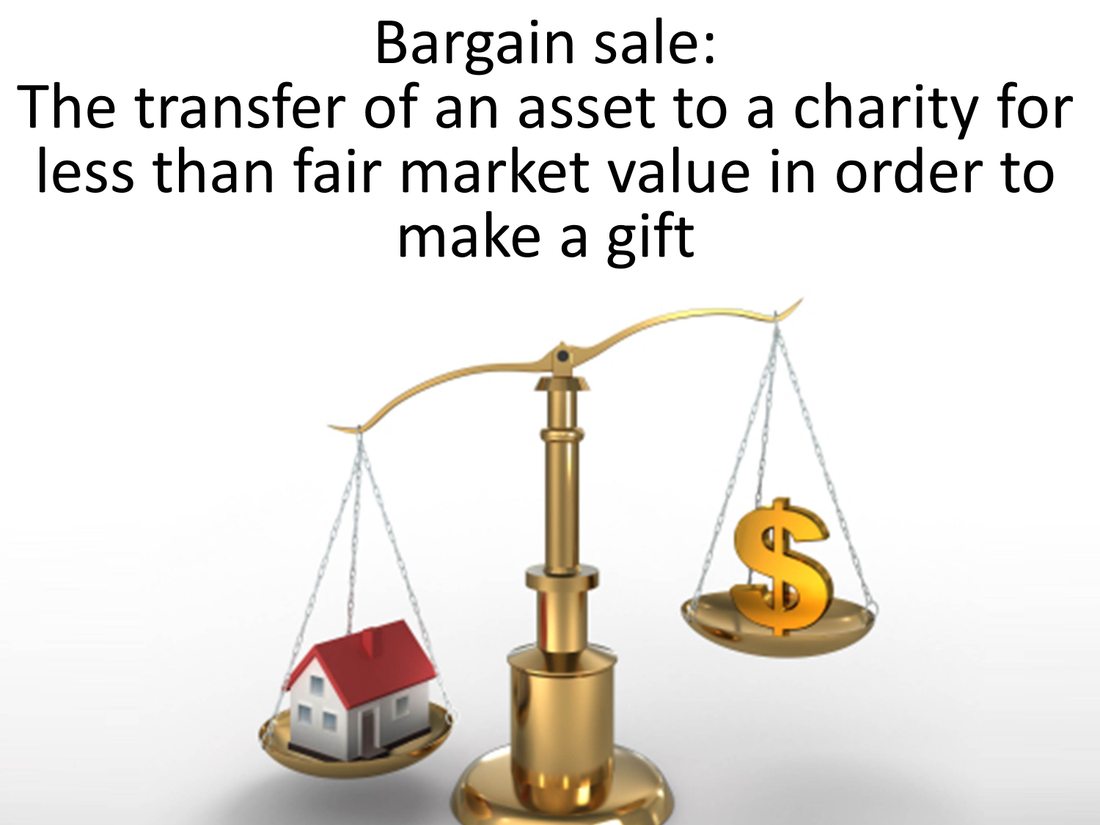
A bargain sale is the sale of an asset to a charity at less than fair market value in order to make a gift. A bargain sale is the same as a standard sale except that the sale price is intentionally lowered below fair market value for the purpose of making a gift to the purchasing charity. Alternatively, one may think of a bargain sale as a special form of charitable gift where the donor makes a gift, but also receives money or other valuable property back from the charity in exchange for the gift.

Calculating the charitable deduction for a typical bargain sale transaction can be relatively simple. The donor deducts the value of what she gave less the value of what she received from the charity in exchange for the gift. In this way, the rules for deducting bargain sale gifts are like "quid pro quo" gifts. A donor who makes a $500 contribution and, in exchange, receives tickets to a charity dinner worth $100 may deduct $400 ($500 gift - $100 benefit). In both cases, the deduction is the value given less the value received.
This assumes that the donor is giving property which can be valued at fair market value for charitable income tax deduction purposes. If the donor gives property that can be valued only at the lower of basis or fair market value, then the charitable deduction rules are a bit more complex and will be reviewed later in this chapter. This also excludes a situation in which a donor makes a gift in exchange for rights to purchase tickets at college athletic events as such gifts generate no deduction.
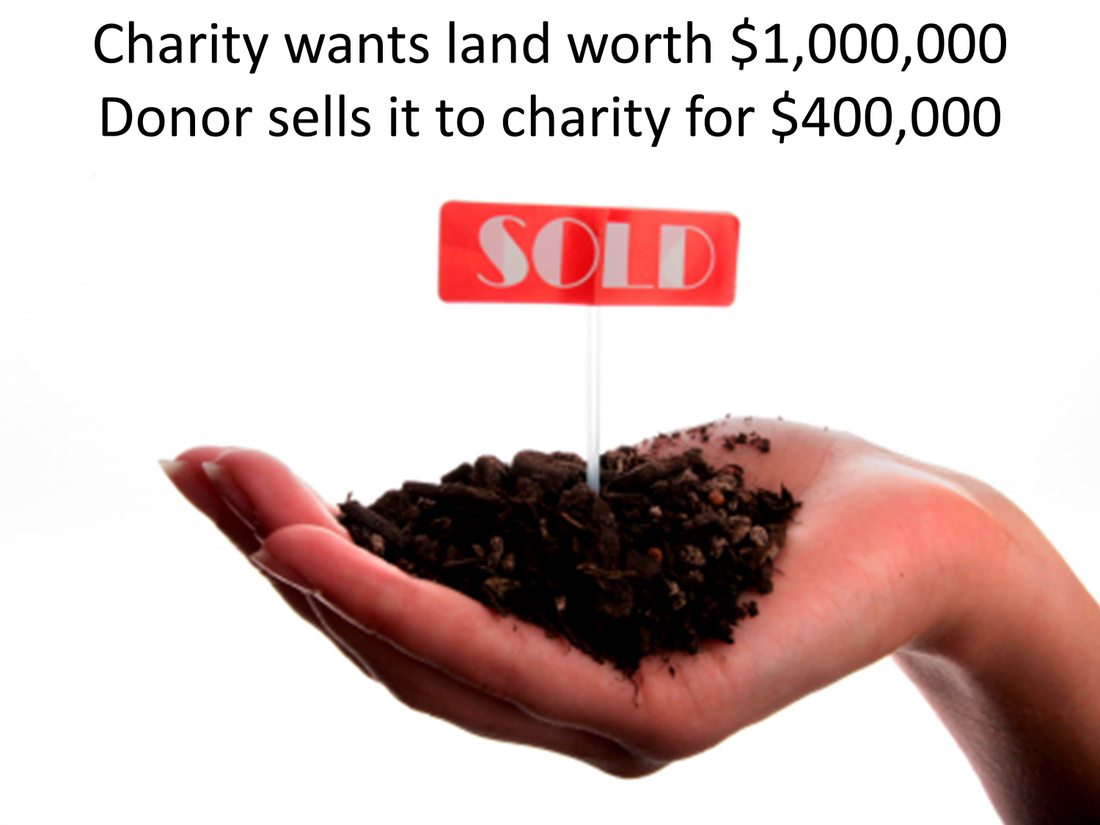
Following the same idea, suppose a charity wants land owned for more than a year by the donor that is worth $1 million. The donor offers a lower price in order to benefit the charity and subsequently sells the land to the charity for $400,000. In this case, the donor has made a $600,000 charitable gift ($1,000,000 land given to charity - $400,000 payment received from charity).
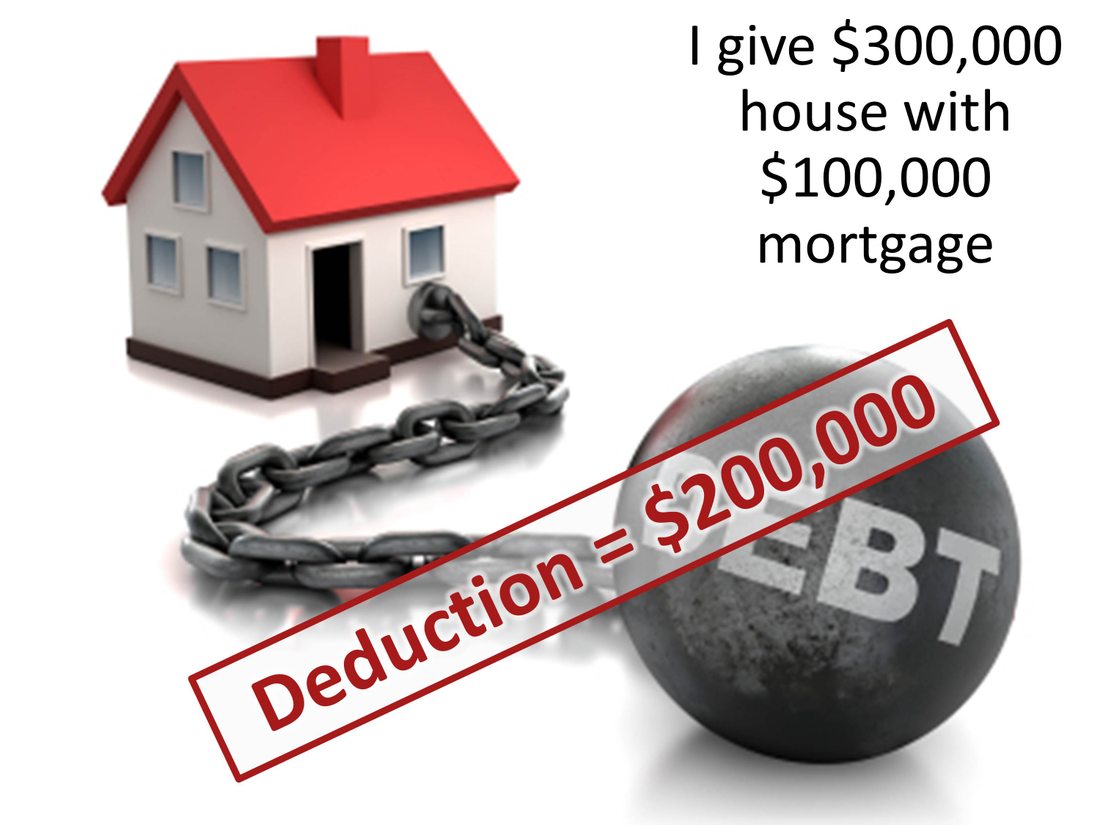
A bargain sale can occur even where the charity does not directly transfer money to the donor. For example, a donor could make the gift of a $300,000 house to a charity where the house was subject to a $100,000 mortgage. The donor has exchanged property worth $300,000 for debt relief of $100,000, thus making a gift of $200,000. Such transactions may not be ideal, because the $100,000 of debt relief will count as income to the donor. This treatment of secured debt occurs regardless of the actual agreement for which party will ultimately make the debt payments. For example, if the donor donates a house with a mortgage, but agrees to make all subsequent mortgage payments, the transaction is still treated as if the donor received $100,000 of debt relief. Future mortgage payments made on the property owned by the charity will constitute charitable gifts at the time each is made, but the agreement to make future mortgage payments does not change the tax results of the initial transaction. The initial transaction is still treated as if the donor received a $100,000 benefit in exchange for transferring the property. Similarly, the donor is treated as receiving $100,000 of debt relief even if the donor is still legally liable to pay the remaining debt. For this reason, it is often disadvantageous to gift debt-encumbered property to charity.
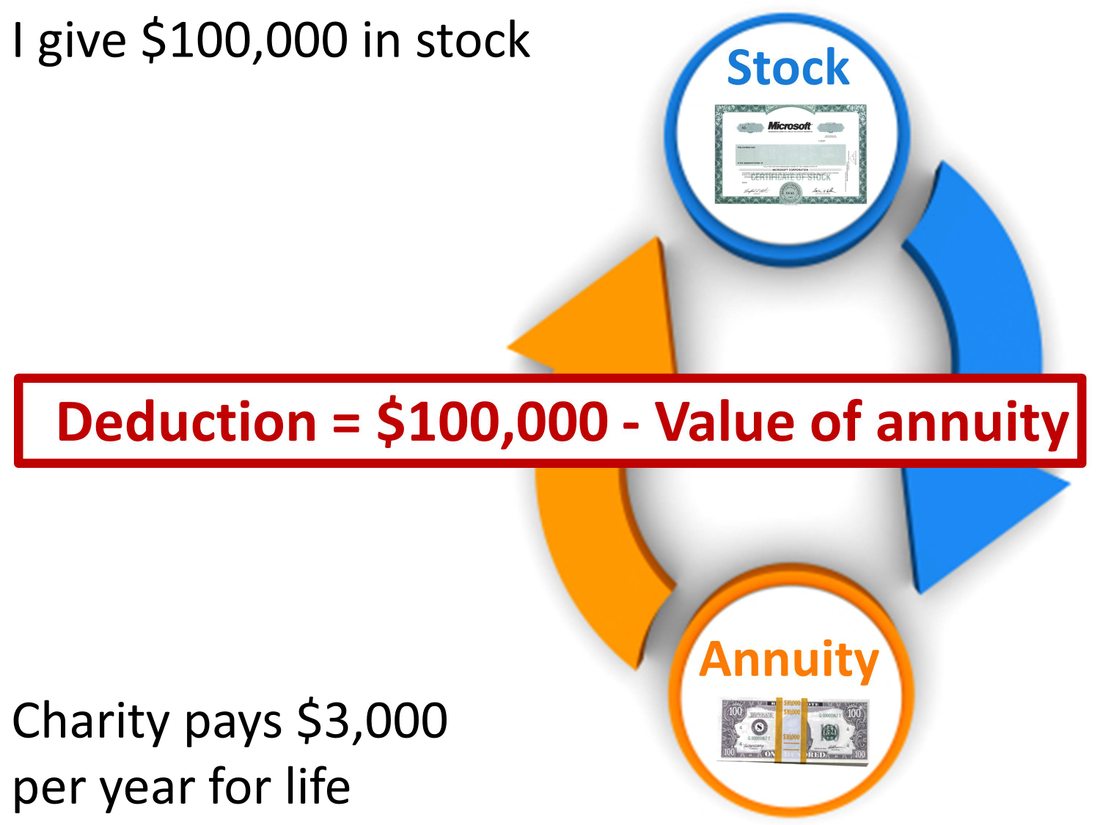
A Charitable Gift Annuity is another example of a bargain sale. Suppose, for example, a donor gives $100,000 of publicly-traded securities (held for more than a year) to a charity in exchange for lifetime payments of $3,000 per year for life from the charity. In this case, the donor has made a charitable gift of $100,000 less the value of the annuity. (Calculation of the value of such annuities will be reviewed in the chapter on the taxation of Charitable Gift Annuities.) Although the ultimate calculations for such a charitable deduction are more complex, the fundamental principle of bargain sale transactions is the same. The donor deducts the value of what he gave less the value of what he received back in exchange from the charity.

The tax consequences resulting from bargain sales become more complex when considering the results of bargain sales in recognizing capital gains. These calculations differ from the relatively simple capital gain calculations that result from a normal, non-charitable, sales transaction.
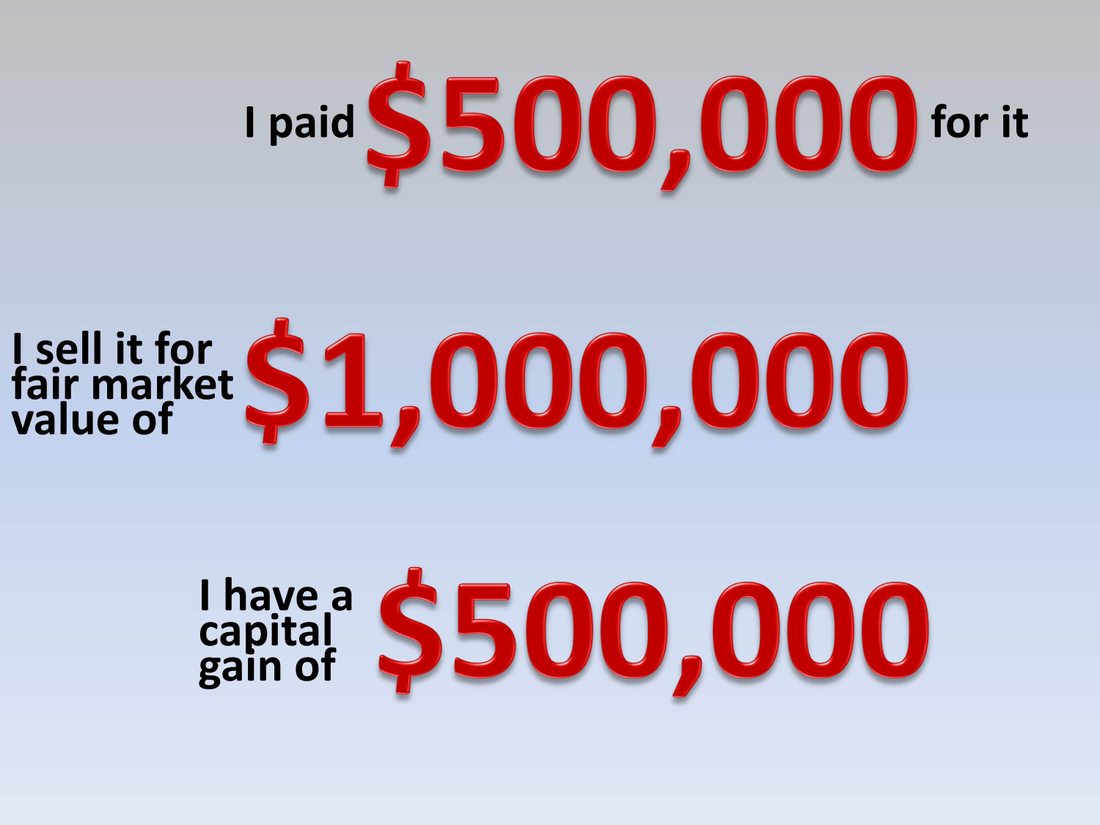
If an investor pays $500,000 for an item of property (such as shares of stock) and then later sells that property for $1 million, the investor has a capital gain of $500,000. The $500,000 paid for the property is referred to as "basis." The capital gain is simply the amount the investor received for the property less the amount the investor paid for the property or, in this case, $1,000,000 - $500,000. (This passes over for the moment other potentially complicating factors that can alter the basis such as additional investments in improving the property or depreciation deductions previously taken, in order to focus on the basic concept of capital gain as the difference between the money received at sale and the money paid at purchase.)
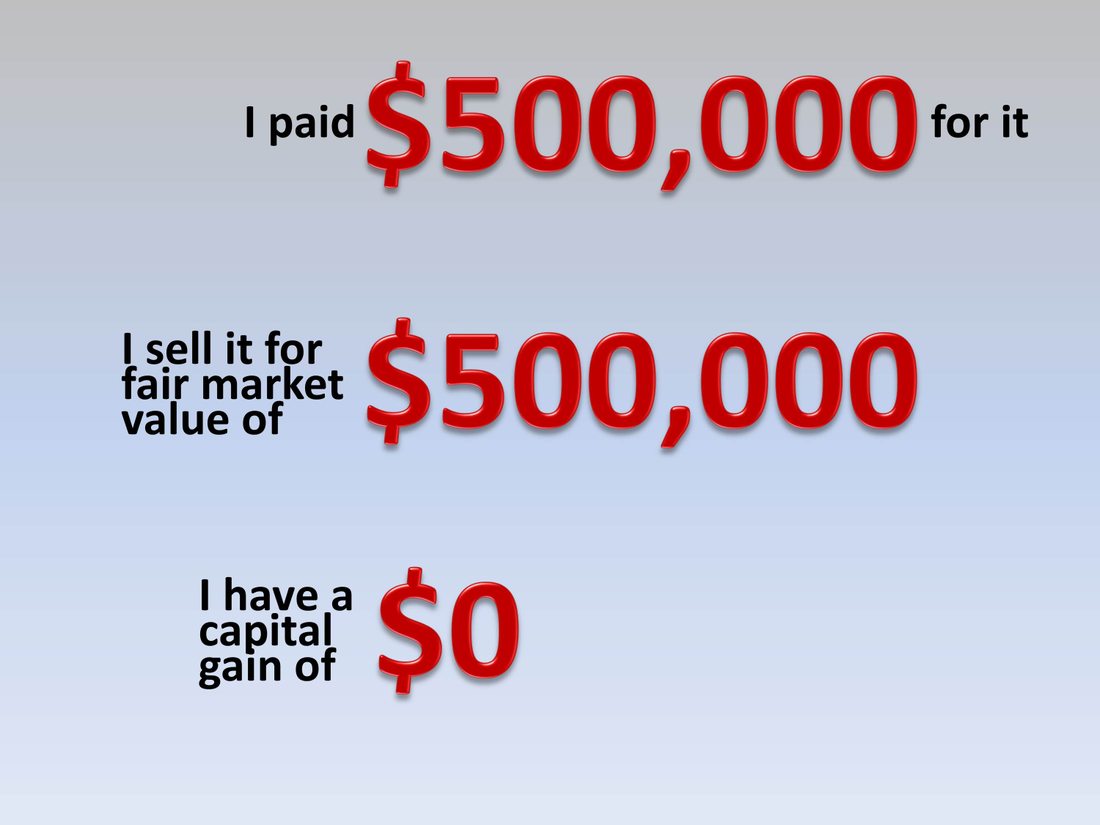
In another example, if the investor pays $500,000 for an item of property and then later sells the same item of property for $500,000, the investor has no capital gain. There is no profit to be taxed. These examples show the relative simplicity of calculating capital gain in a typical transaction. However, this simplicity changes dramatically with a bargain sale.
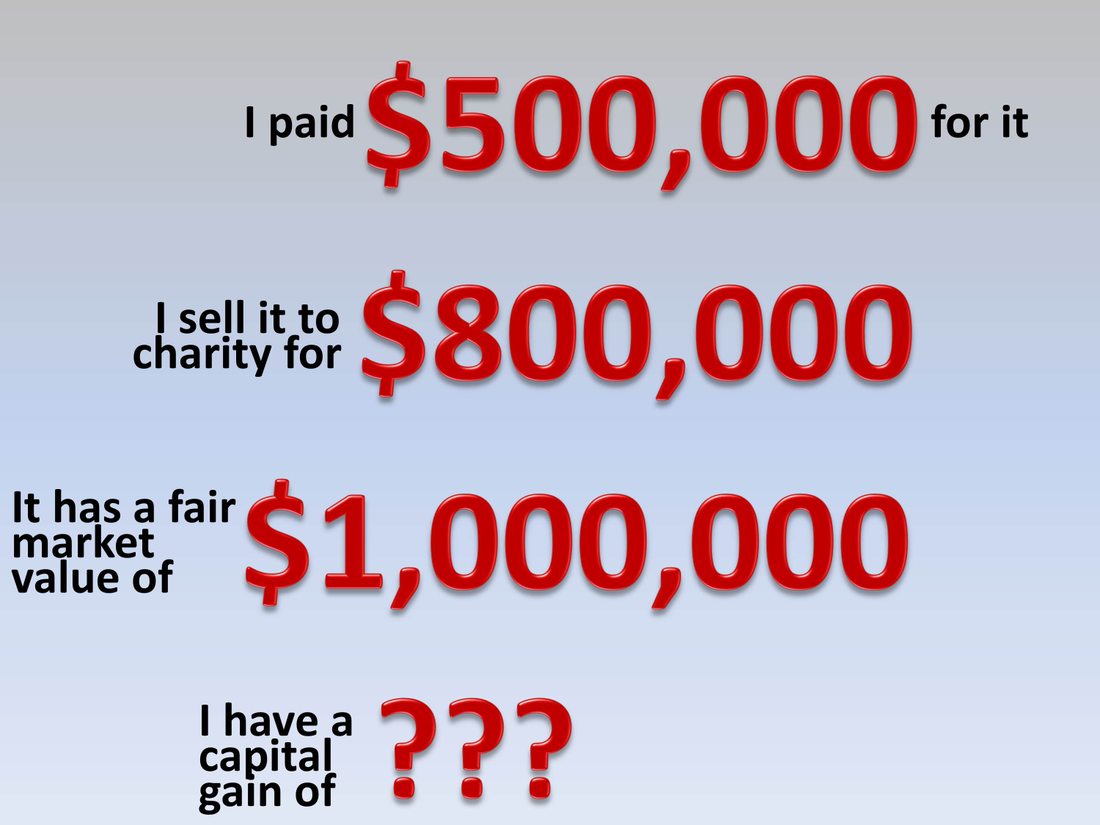
Suppose the donor pays $500,000 for property and the property grows in value to $1 million. However, instead of selling the property for $1 million, the donor wishes to benefit a charity, and so he sells the property to the charity for a bargain price of $800,000. What is the donor's capital gain on this type of transaction? The tempting, but wrong answer is to simply subtract the $500,000 purchase price from the $800,000 received from the charity. This is not the correct answer. The donor does indeed receive $800,000. However, because part of the value of the property was donated, part of the $500,000 basis in the property will apply to the "gift" portion of the transaction. Only the remaining share of the basis will be applied to the "sale" part of the transaction, and only this "sale" portion of the basis may be subtracted from the $800,000 received from the charity when calculating the capital gain. The next section walks through this calculation process step by step.
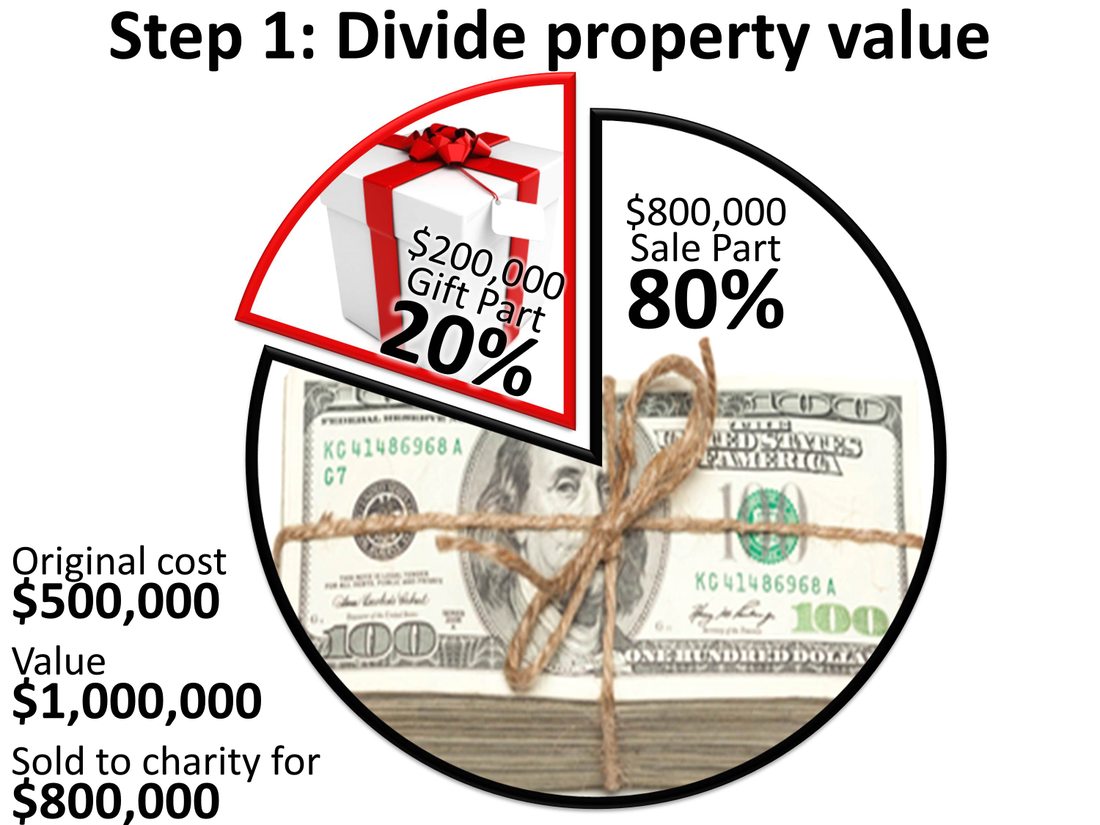
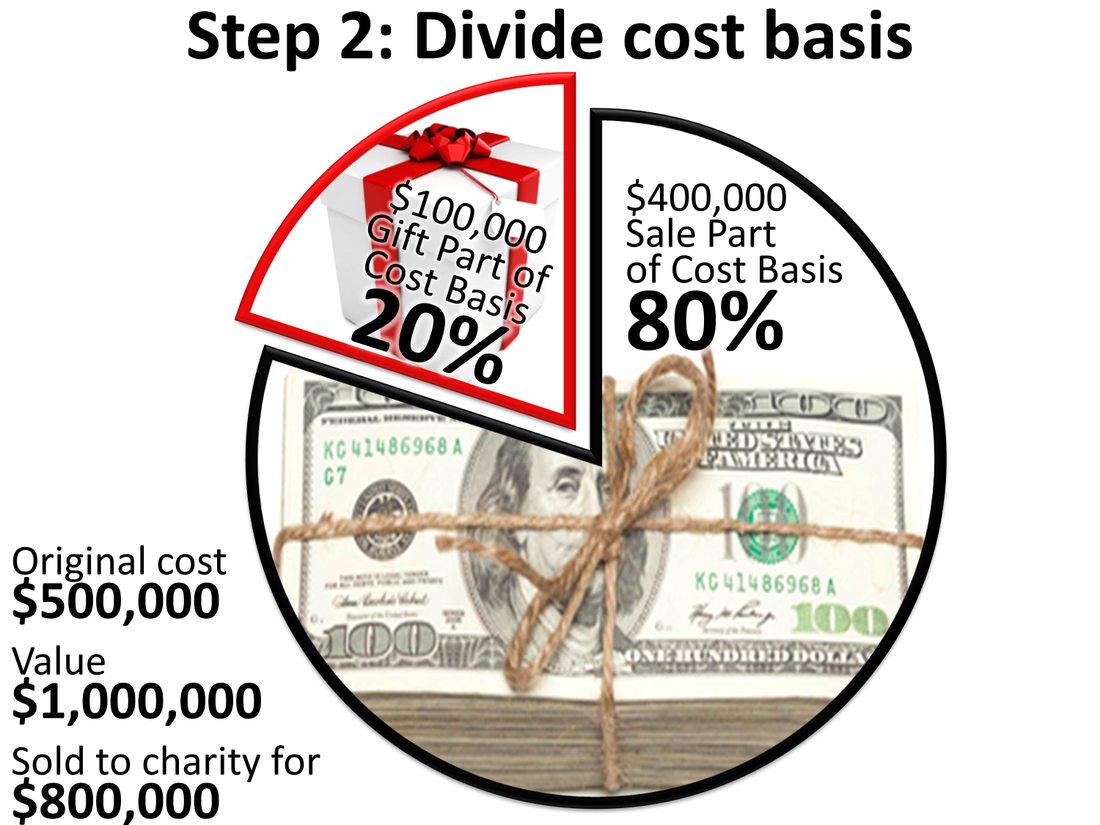
The first step in calculating the capital gain resulting from a bargain sale transaction is to divide the property value into the gift part and the sale part. In this case, the donor gave property worth $1 million to the charity in exchange for $800,000. Thus, $800,000 of the transaction was a sale (because the donor received full compensation for that share of the property). The remaining $200,000 of the transaction was a gift. Another way of thinking of this is that the donor sold 80% of the property and gifted 20% of the property.
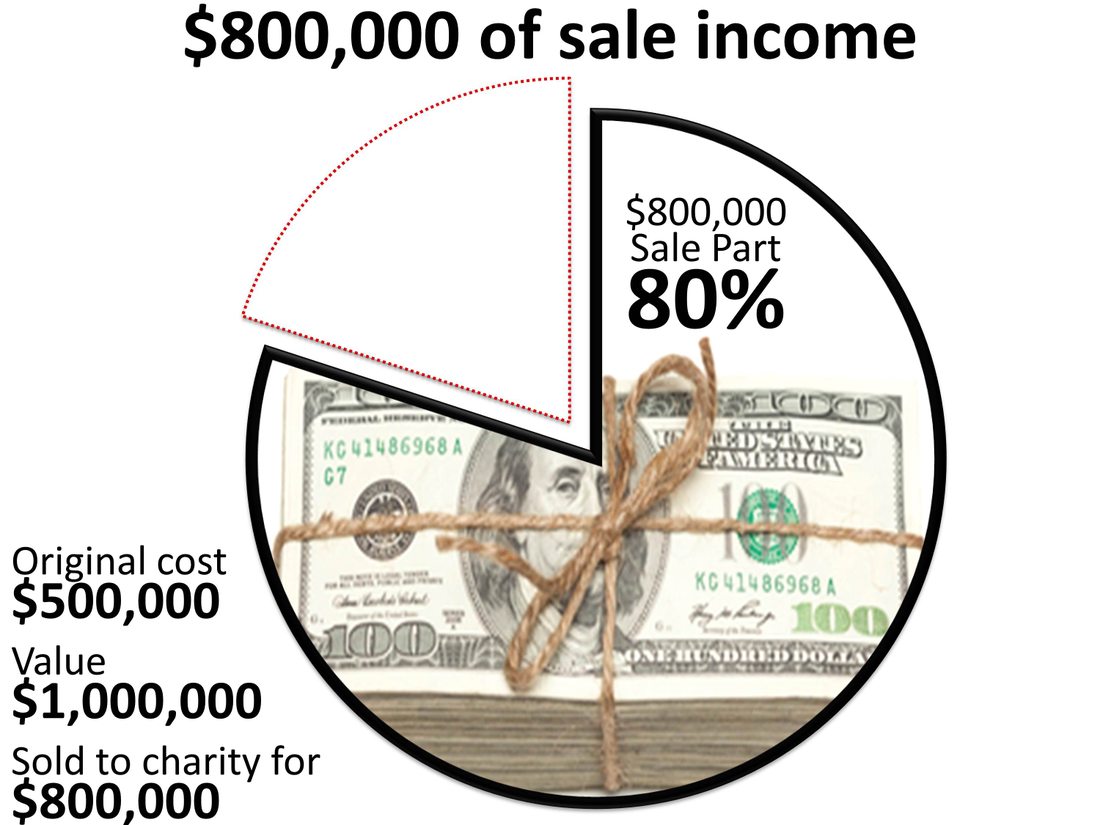
The donor received $800,000 from the "sale" part of the transaction. Thus, the donor will have $800,000 of capital gain income less the "sale" part of the donor's basis in the gifted property. Determining the "sale" part of the donor's basis requires dividing that basis between the "sale" part and the "gift" part.
Because the donor is treated as having sold 80% of the property and gifted 20% of the property, 80% of the basis will apply to the "sale" part of the transaction and 20% of the basis will apply to the "gift" part of the transaction. Thus, the $500,000 original cost basis is divided between the "sale" part and the "gift" part of the transaction. Because 20% of the value of the property was gifted to the charity, 20% of the $500,000 original cost basis (i.e., $100,000) is applied to the "gift" part of the transaction. The remaining 80% of the value of the property was sold, i.e., the donor received full compensation for 80% of the value of the property. Thus, 80% of the $500,000 original cost basis (i.e., $400,000) is applied to the "sale" part of the transaction.
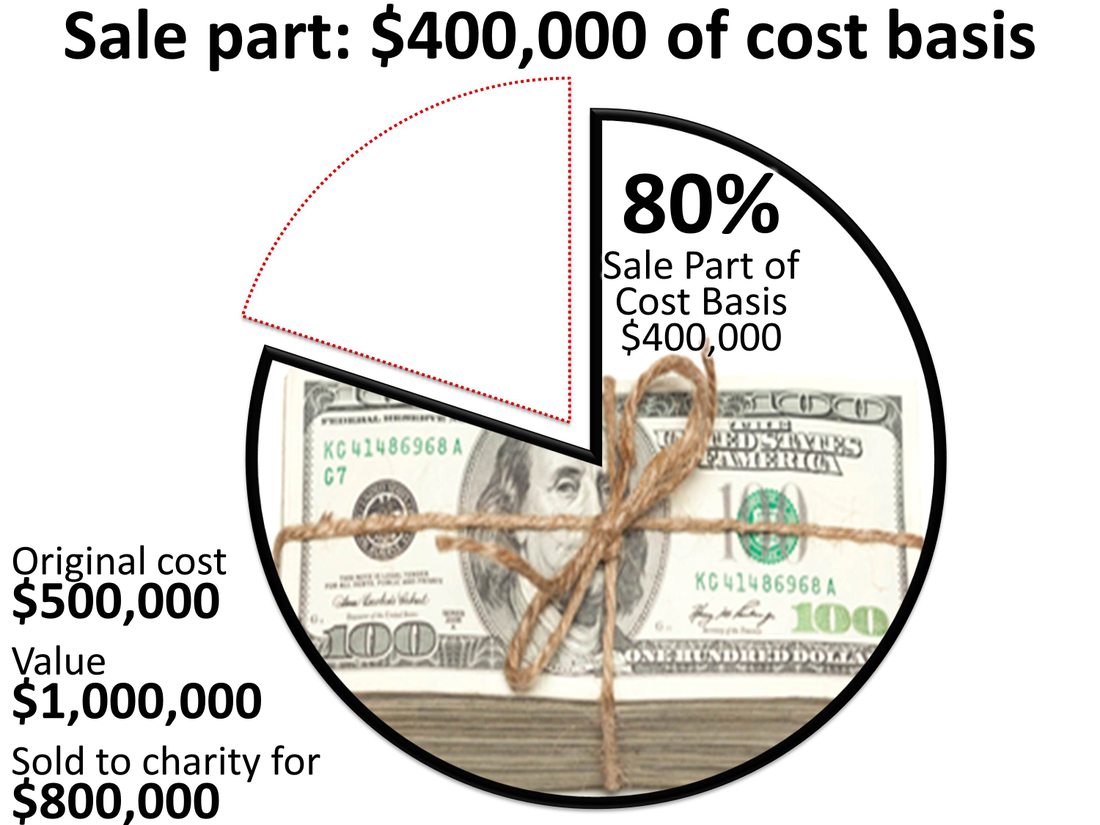
Because, the donor received 80% of the value of the property, the donor can use 80% of the value of the cost basis when calculating capital gain. In this case, 80% of the cost basis is $400,000. This is the portion of the cost basis applied to the "sale" part of the transaction.
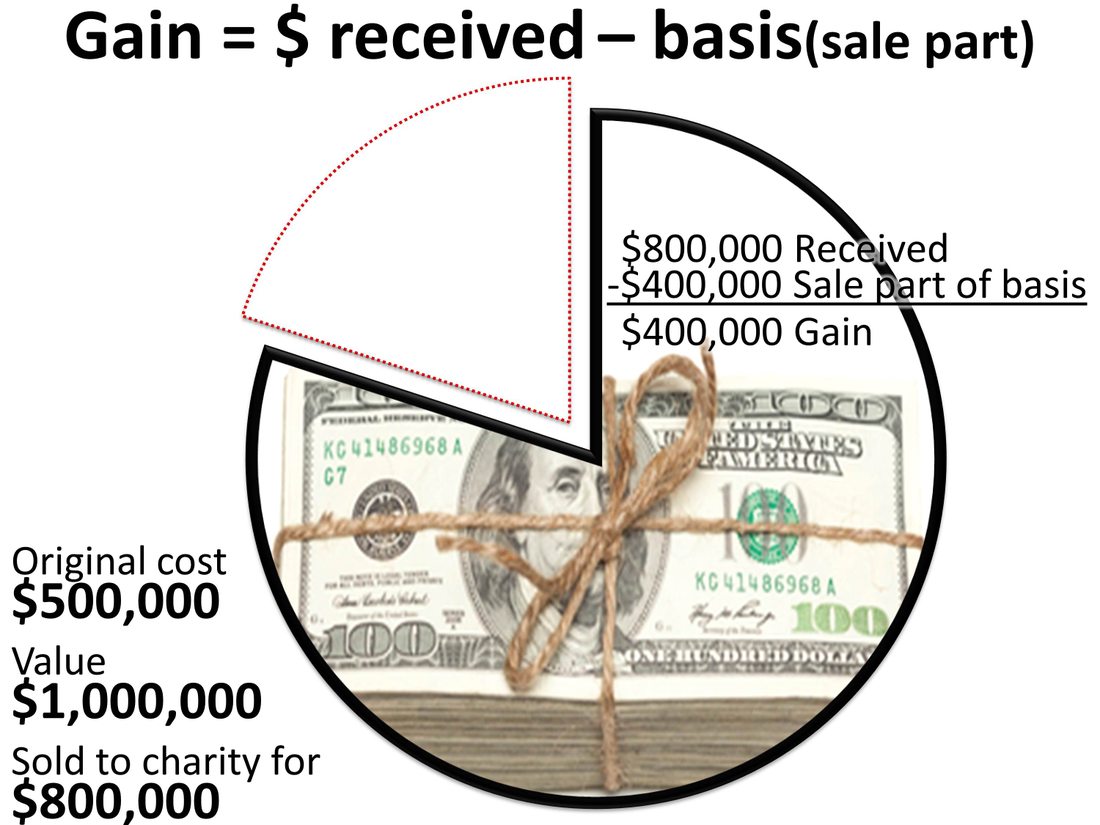
The donor's capital gain is the $800,000 he received from the bargain sale transaction less the $400,000 of basis that applies to the "sale" part of the transaction. Thus, the donor's capital gain is, in this case, $800,000-$400,000, or $400,000. It may seem disadvantageous to lose the ability to subtract the full $500,000 basis. Consider, however, the alternate transaction where the donor sold the property at a fair market value of $1,000,000 and then gifted $200,000 of the proceeds to the charity. The charity would receive the same $200,000 benefit in either transaction. However, if the donor sold the property he would pay tax on $500,000 of capital gain ($1,000,000 sale price - $500,000 basis). By using a bargain sale transaction, the donor has reduced his capital gain from $500,000 to $400,000. Considering that combined federal and state long-term capital gains tax rates (including Affordable Care Act taxes) can be in excess of 37%, structuring this transaction as a bargain sale (rather than a sale then gift) can result in substantial tax savings for the donor.
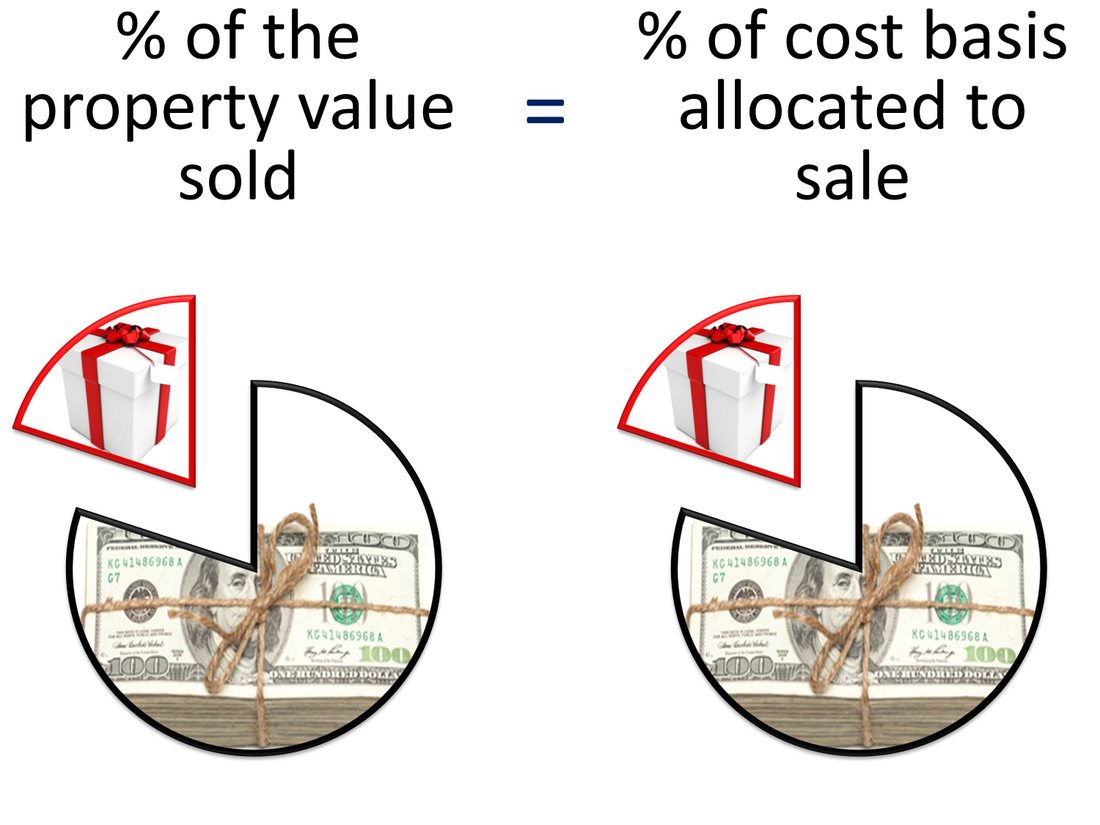
The basic principle of calculating capital gain in a bargain sale transaction is simply that the percentage of the property value that is sold (i.e., the percentage of the fair market value the donor receives in exchange for the property) is the percentage of the cost basis that can be used for calculating capital gain. The most important idea is to avoid the temptation of simply subtracting the amount paid for the property (basis) from the amount received for the property. Although this works for other types of capital gain calculations, it is not appropriate here because part of the basis is applied to the "gift" part of the transaction.

The last section reviewed how the "sale" part of the basis is used to calculate the donor's capital gain. But, what happens to the "gift" part of the basis? When would a donor use this in a tax calculation?

The basis in gifted property is not normally relevant when the property can be deducted at its fair market value. In such cases, if an item of property were worth $100,000, the charitable deduction for gifting such property would be $100,000 regardless of the basis in the property. However, some types of property gifts to charity may be deducted only at the lower of basis or fair market value. For example, gifts of "unrelated use" tangible personal property are deducted at the lower of basis or fair market value. ("Unrelated use" here means that the charity will not be physically using the tangible personal property item in furtherance of its charitable mission, but most likely will instead be selling the item and using the proceeds.) In the case of a bargain sale involving such property, the deduction would be limited to the "gift" portion of the property's basis. Similarly, a gift of short-term capital gain property (i.e., appreciated property held for 12 months or less) is also valued at basis and the deduction for a bargain sale of such property is limited to the "gift" portion of the property's basis.
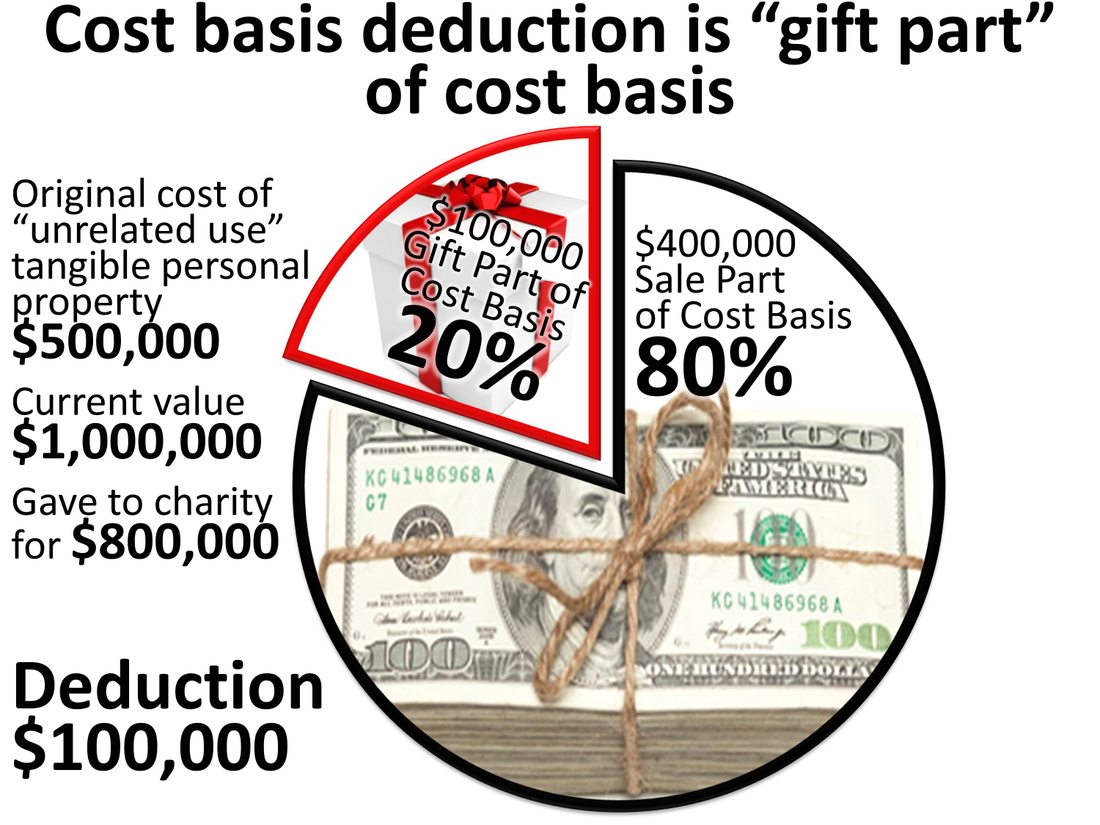
Consider the previous example, but now suppose that the gifted property was "unrelated use" tangible personal property. Because gifts of "unrelated use" tangible personal property can be deducted only at the lower of basis or fair market value, the donor in this case may deduct only the basis. However, the donor may not deduct the entire basis, because part of the basis was applied to the "sale" part of the transaction (and used in the donor's capital gain calculation). Instead, the donor may deduct only the "gift" portion of the basis, which, in this transaction, was $100,000 (i.e., 20% of the original $500,000 basis).

As mentioned previously, there are tax benefits to using bargain sales, especially when compared to the alternative transaction of selling an item of property for its fair market value and then donating a portion of the proceeds to charity.
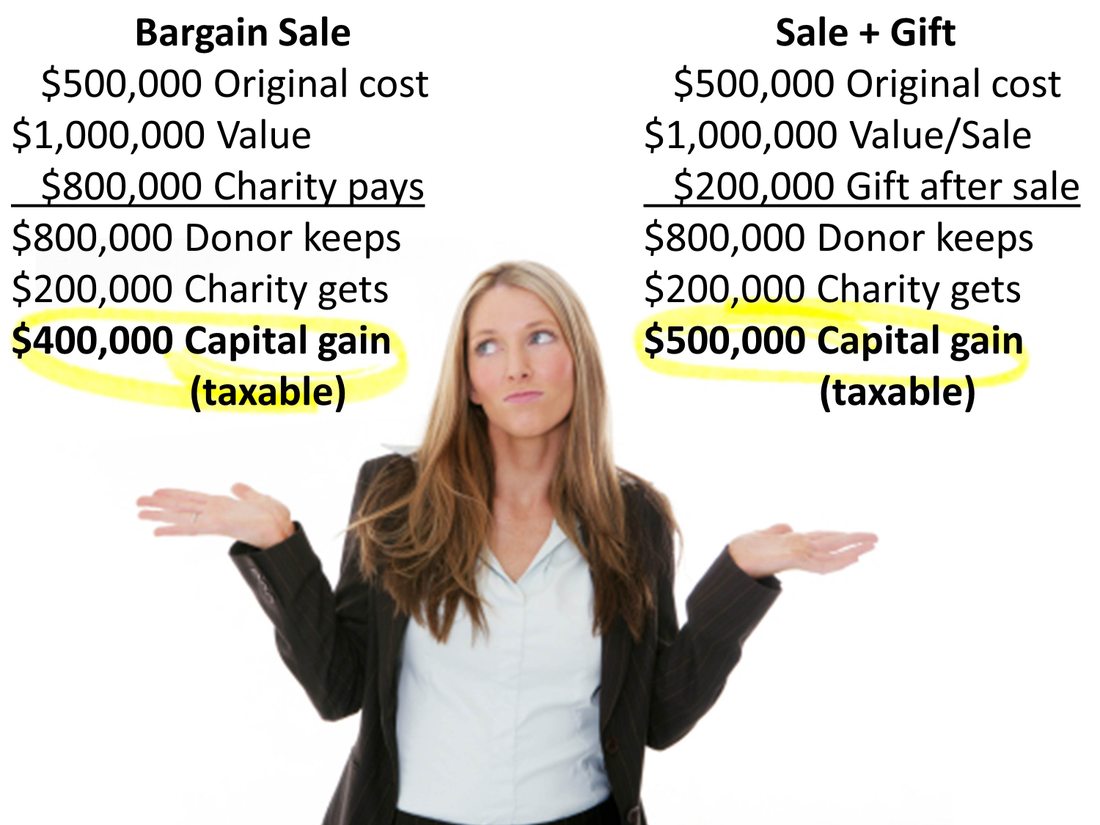
The primary benefit of a bargain sale transaction as compared with selling the property at fair market value and then making a gift to charity out of the proceeds is the partial avoidance of capital gain tax. Using our original example (and assuming that the gifted property can be deducted at fair market value), the donor sells the $1,000,000 property to the charity for $800,000 and receives a $200,000 charitable income tax deduction. If instead, the donor sold the property for $1,000,000 and then gave the charity $200,000 out of the proceeds of the sale, the donor would also generate the same $200,000 charitable income tax deduction. However, the capital gain tax consequences of the two transactions differ. As calculated previously, the bargain sale results in a $400,000 capital gain (i.e., the $800,000 received from the charity less 80% of the $500,000 basis). If instead the donor were to sell the property at its fair market value and then make a gift to charity out of the proceeds, the donor would recognize a $500,000 gain (i.e., $1,000,000 received from the sale less the $500,000 basis). Both transactions result in the transfer of $200,000 of benefit to the charity. Both transactions result in the donor keeping $800,000 (pre-tax) from the sale. However, the bargain sale generates $400,000 of capital gain where the sale followed by a gift generates $500,000 of capital gain.
This benefit results from the same principle discussed in previous chapters; it is better to donate appreciated assets (when such assets can be deducted at fair market value) instead of cash. A gift of cash generates a single tax benefit: a charitable income tax deduction. A gift of appreciated property generates two tax benefits: a charitable income tax deduction and avoidance of capital gains tax. The bargain sale, when used with appreciated property, results in the same double tax benefit for the "gift" portion of the transaction.

A donor should not give depreciated property. Instead, the donor should sell the depreciated property, claim a loss for tax purposes, and then donate the proceeds of the sale to charity. The same principle applies to bargain sales. A donor should not make a bargain sale with depreciated property, but should instead sell the depreciated property for its fair market value, claim a loss for tax purposes, and then donate some portion of the proceeds of the sale to charity. A tax loss is valuable. It can be used to offset other gains and thereby reduce the taxes owed. Giving depreciated property needlessly destroys this tax benefit.

It is usually undesirable to give debt-encumbered property to charity because the donor will be treated as having received income from the charity in the amount of the debt attached to the gifted property. In some cases, it may be possible to shift the debt to other assets so that the property gifted to charity will have no debt encumbrances. This produces a much more attractive tax result.
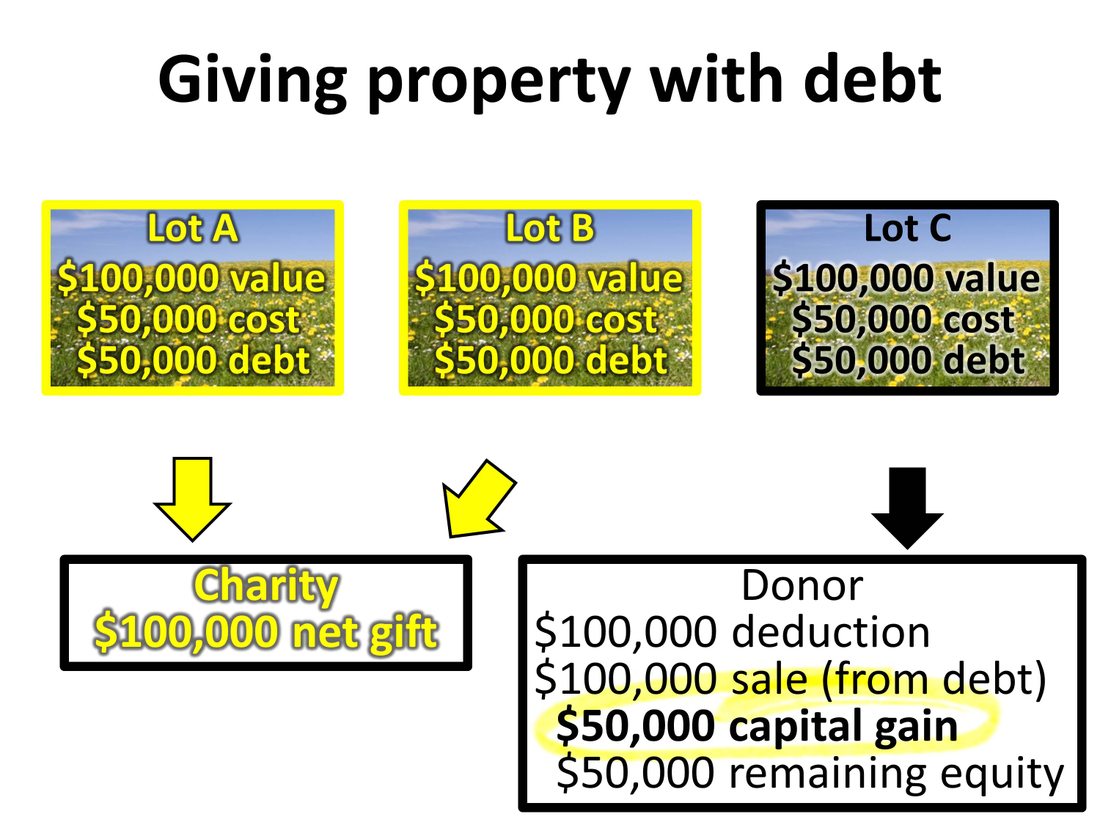
Suppose that a donor owned three pieces of land. Each property was worth $100,000, had been originally purchased for $50,000 more than a year ago, and had a $50,000 mortgage. The donor could choose to give debt-encumbered property to the charity. However, giving debt-encumbered property to a charity is treated as a bargain sale where the donor receives debt relief in exchange for the gift. (This is true regardless of whether or not the donor actually remains liable for the debt.) Consequently, each gifted property would generate a $50,000 charitable income tax deduction ($100,000 property value - $50,000 "debt relief") and a $25,000 capital gain ($50,000 "debt relief" received - 50% of the $50,000 cost basis). In order to generate a $100,000 gift to charity, the donor would need to give two such properties, generating a $100,000 charitable income tax deduction and $50,000 of capital gain. There is, however, a much more advantageous way to make such a charitable gift if the debt attached to the properties could be shifted.
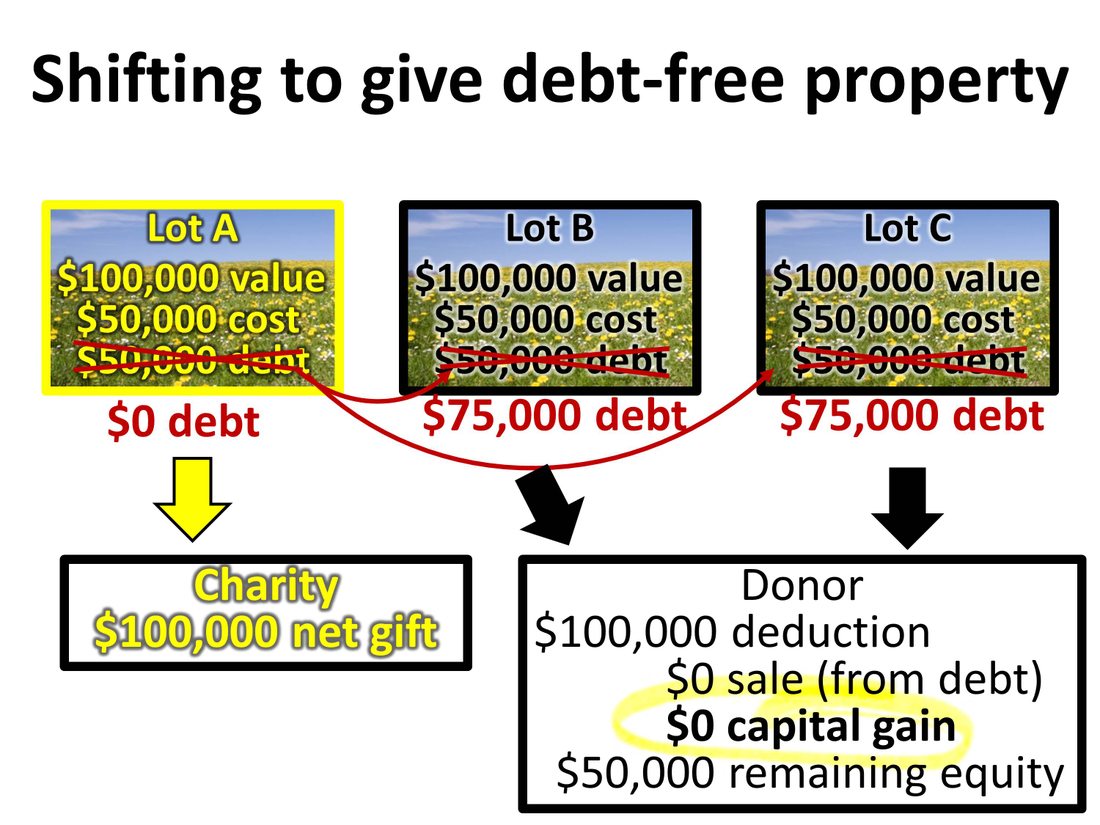
If the donor were able to transfer the debt from one property over to the remaining two properties, and then donate the single debt-free property to charity, the tax consequences are much better. (The likely process of such debt transference would be to refinance the remaining two properties to increase their debt from $50,000 to $75,000, using the proceeds from this refinancing to pay off the debt on the property to be gifted.) Gifting this debt-free property to charity results in the same $100,000 charitable income tax deduction as in the previous transaction involving the gifting of two debt-encumbered properties. It also leaves the donor with the identical $50,000 of remaining equity as in the previous transaction. The only difference is that instead of recognizing $50,000 of capital gain as in the previous transaction, the donor recognizes no capital gain from this alternative transaction. By simply altering the process for making the gift, the donor has received a substantially improved tax result.

Let's now examine a few interesting cases involving the bargain sale rules.
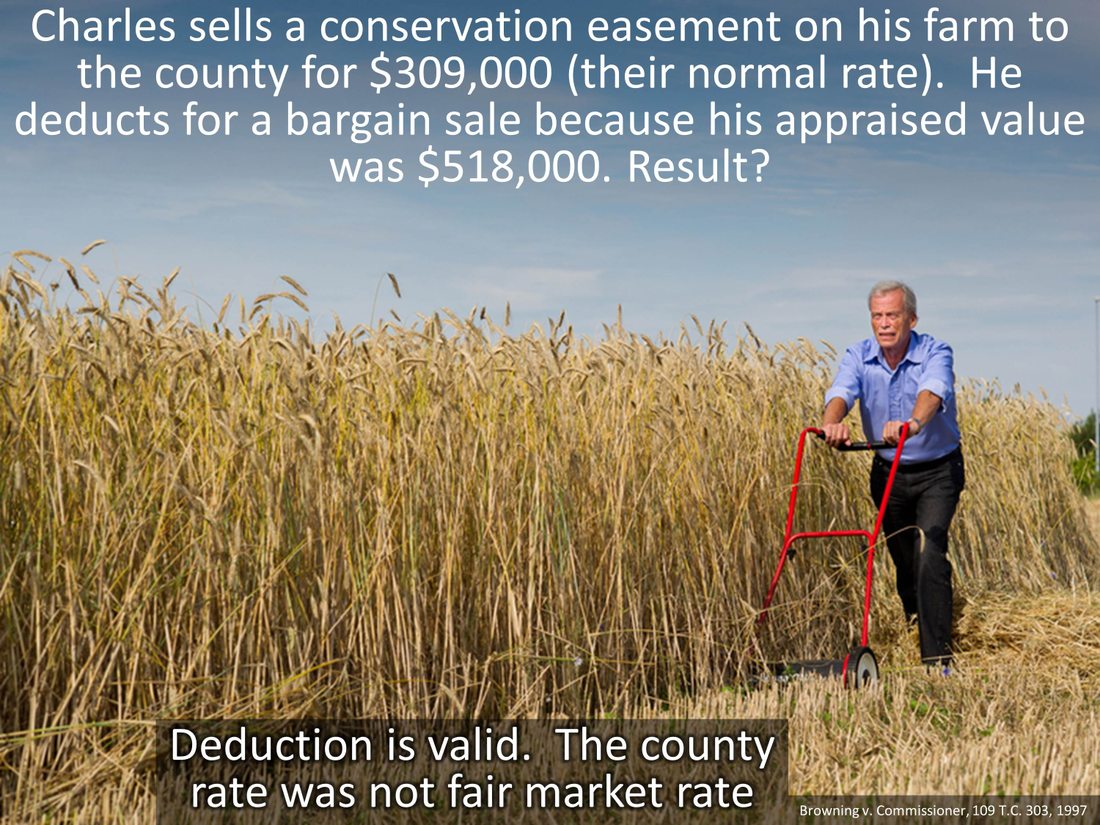
In the case of Browning v. Commissioner (109, T.C. 303, 1997), the taxpayer sold a conservation easement on his farm to the county for $309,000. A conservation easement prevents the land from being developed to its highest potential in order to maintain the natural or agricultural state of the land. Such conservation easements reduce the value of the land, and are, consequently, valuable property rights. The taxpayer indicated a desire to benefit the county and the county's conservation easement program in his decision to sell the conservation easement to the county for $309,000. The $309,000 sale price was based upon the standard rate at which the county agreed to pay for such conservation easements. The taxpayer obtained a qualified appraisal for his conservation easement rights of $518,000. The taxpayer claimed a charitable income tax deduction of $209,000 (i.e., $518,000 fair market value less the $309,000 sale price). The tax court ruled that this was an appropriate deduction because the donor sold a property right to the county for less than its fair market value with the intent of benefiting the county's program. (Charitable gifts can include gifts to government entities as well as charitable organizations.) Note that this result happened even though the recipient organization did not necessarily believe that it was engaging in a bargain sale. The only requirements were that the donor sold the item for less than fair market value to the charity/government with the intent of benefitting the charity/government.
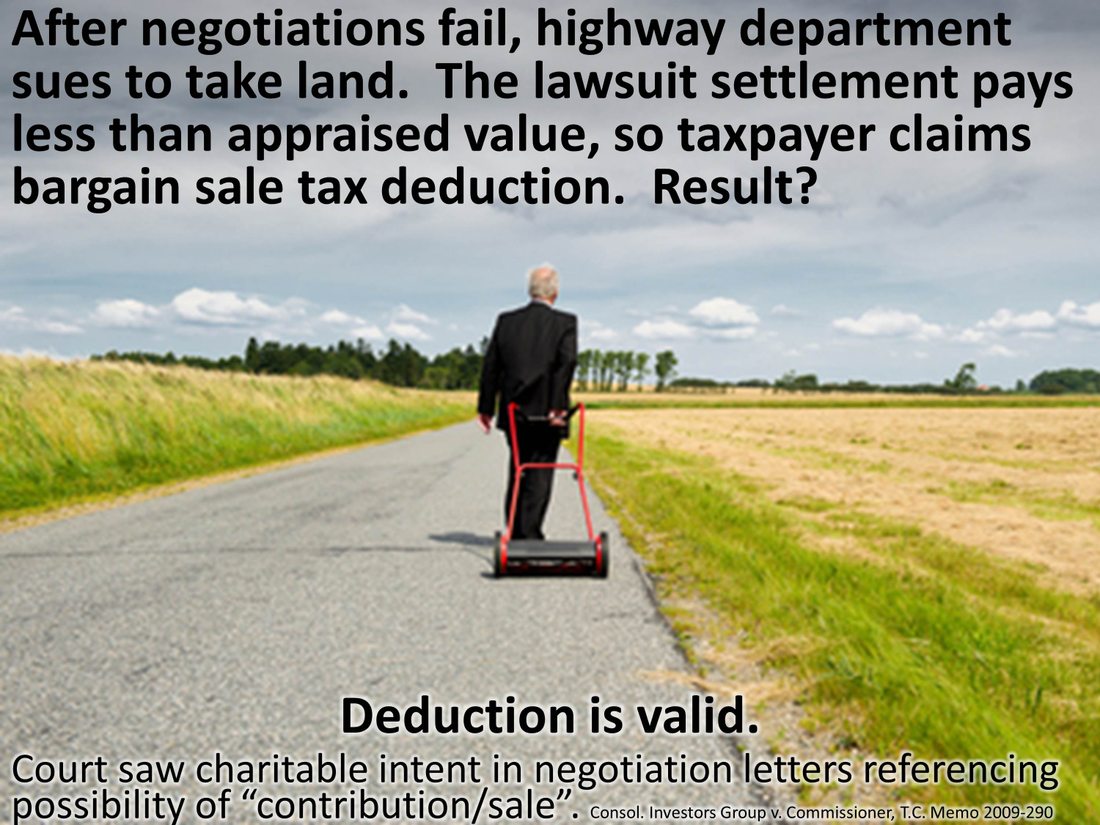
In a more extreme case (Consol. Investors Group v. Commissioner, T.C. Memo, 2009-290) a taxpayer was engaged in extended negotiations with the highway department over the sale of land to be used in the construction of a new road. These negotiations did not go well. The landowner believed the land to be worth far more than the highway department was willing to pay, and this belief was supported by an appraisal. As a result of the failure to reach an agreement, the highway department sued to take the land by force through eminent domain. In settlement of the contentious lawsuit, the taxpayer agreed to take an amount that was greater than the highway department's earlier offers but less than appraised amount. Throughout the process, the highway department strongly disagreed with the high appraisal valuation obtained by the taxpayer. Nevertheless, after settling the lawsuit, the taxpayer claimed a charitable income tax deduction for the difference between the appraised value and the amount ultimately received from the highway department. The tax court found that the taxpayer's appraisal was appropriate, meaning that the taxpayer received less than the fair market value in exchange for the land. Importantly, in the early negotiation period of this case the taxpayer had sent communication to the highway department referencing an interest in a sale or "contribution/sale." The court indicated that this communication established the donor's charitable intent in benefitting the highway department. Thus, despite the recipient's vociferous contention that they had paid fair market value and that there was no bargain sale, the taxpayer/donor was allowed to deduct the difference between the appraised value and the amount received from the government entity. This is an extreme case showing that it is not the charitable recipient's intent or belief that matters, but only that the donor sold property to the charity for less than fair market value with the intent of making a partial gift to the charitable entity.

As mentioned previously, understanding the tax consequences of bargain sale gifts serves two purposes. First, traditional bargain sales can be a useful charitable planning device. As contrasted with selling at fair market value and then making a gift out of the proceeds of the sale, a bargain sale gift can result in lower capital gain taxes. Second, other types of more complex charitable planning, such as Charitable Gift Annuities, are themselves forms of bargain sales. Thus, understanding the tax rules for bargain sales is helpful in understanding the tax consequences for these more complex transactions, because the same principles will continue to apply.