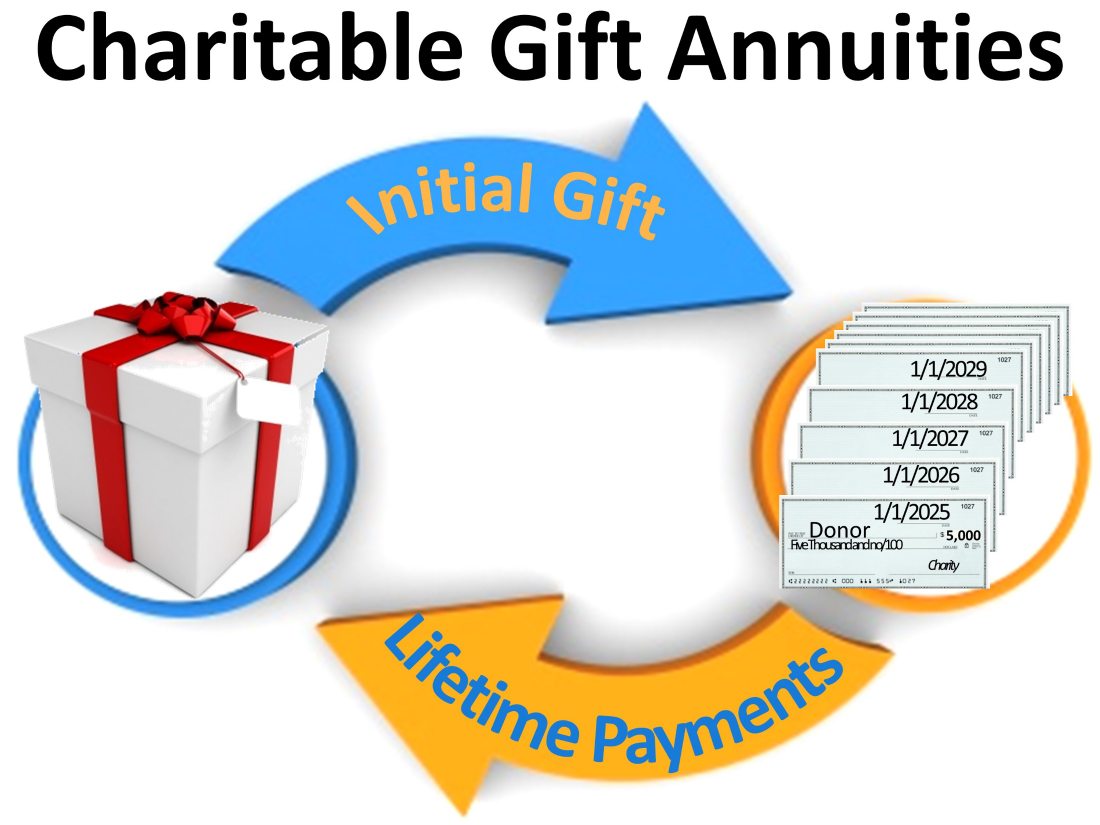
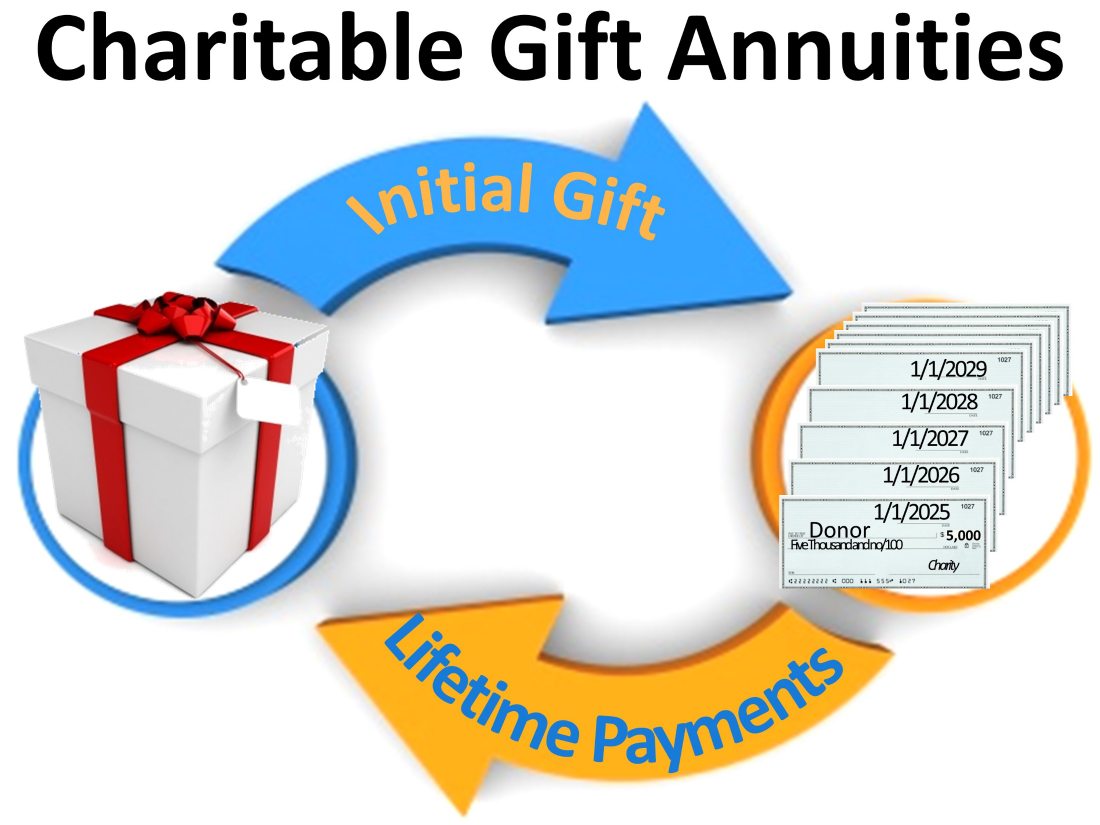
THE ESSENCE OF A CHARITABLE GIFT ANNUITY IS THAT A DONOR MAKES A GIFT TO A CHARITY, AND IN RETURN, THE CHARITY MAKES PAYMENTS TO THE DONOR FOR LIFE. DESPITE THE SIMPLICITY OF THIS CONCEPT, CHARITABLE GIFT ANNUITIES ARE A POWERFUL CHARITABLE PLANNING VEHICLE THAT CAN BE USED IN A VARIETY OF SITUATIONS WITH DONORS FROM A WIDE RANGE OF ECONOMIC CIRCUMSTANCES. LIKE THE MORE COMPLEX AND EXPENSIVE CHARITABLE REMAINDER TRUSTS, CHARITABLE GIFT ANNUITIES PROVIDE A SOURCE OF REGULAR PAYMENTS TO THE DONOR. ALSO, CHARITABLE GIFT ANNUITIES CREATE AN IMMEDIATE TAX DEDUCTION. FINALLY, WHEN PURCHASED WITH APPRECIATED SECURITIES (OR OTHER APPRECIATED ASSETS), CHARITABLE GIFT ANNUITIES PROVIDE THE OPPORTUNITY TO DEFER CAPITAL GAINS TAXES. THIS COMBINATION OF TAX ADVANTAGES AND INCOME CREATION MAKE CHARITABLE GIFT ANNUITIES ATTRACTIVE FOR BOTH DONORS AND CHARITIES IN A NUMBER OF SITUATIONS.
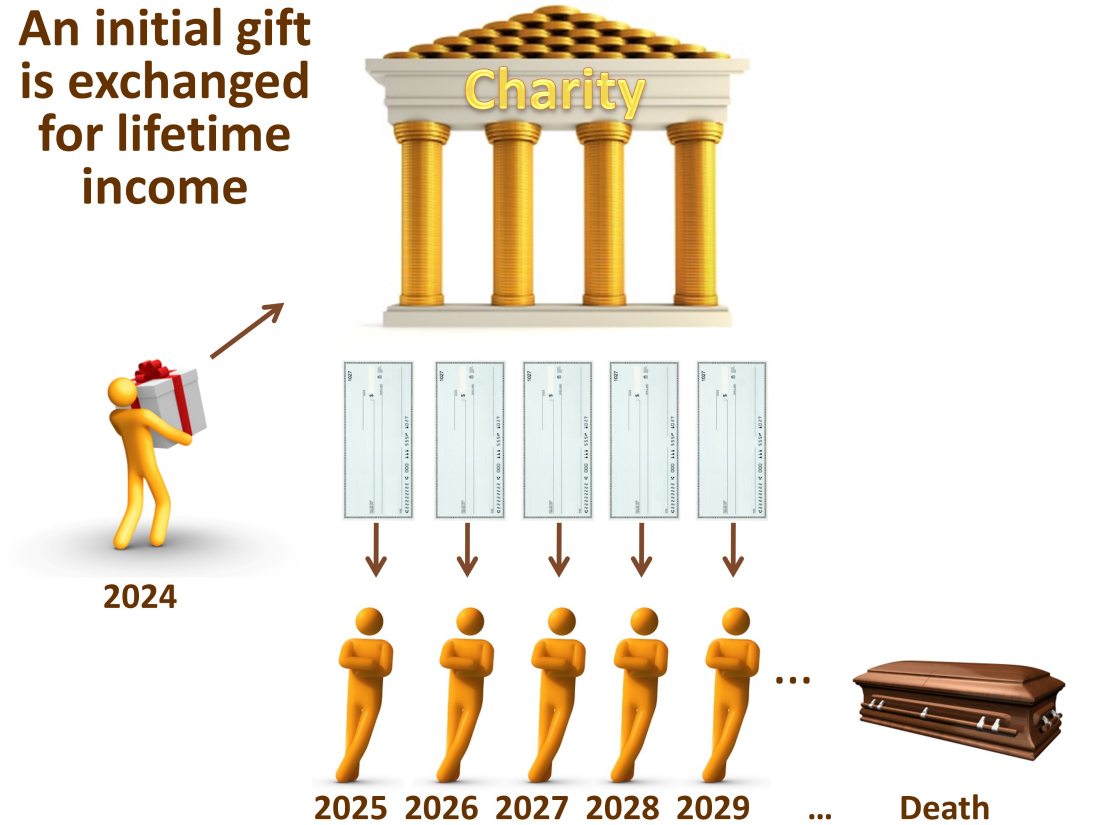
The most common form of a Charitable Gift Annuity transaction is where a donor makes a gift to a charity, and in exchange, the charity makes payments back to the donor for the donor's life. The payments can be annual, semi-annual, quarterly, monthly, or even weekly. A Charitable Gift Annuity is an example of a bargain sale. A bargain sale occurs when the donor transfers a gift to a charity, and in return receives something worth less than the fair market value of the gift. In this case, the donor receives an annuity (i.e., a stream of payments for life) in exchange for a gift. The value of the annuity (as calculated by the IRS tables) must be less than 90 percent of the value of the gift. Thus, the donor makes a bargain sale, gifting money or property and in return receiving something worth less than the gift.
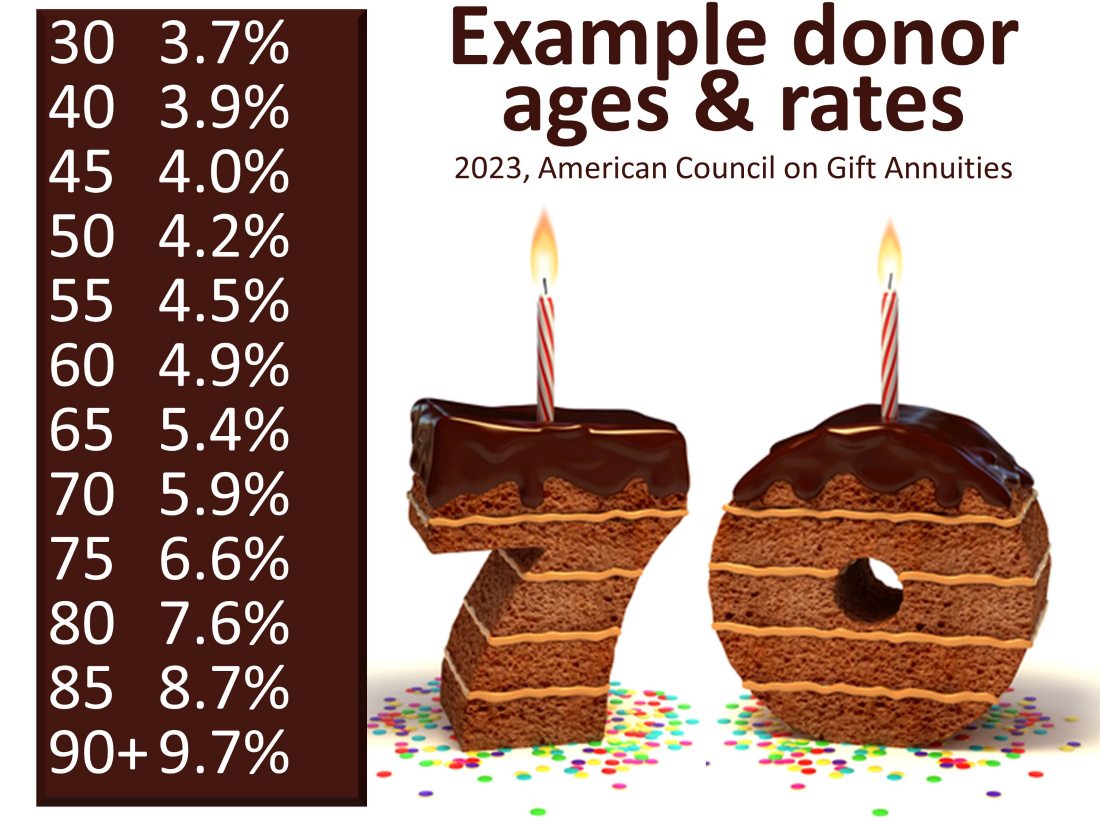
The lifetime payments resulting from a gift annuity are based upon the size of the gift and the age of the annuitant. (The "annuitant" is the person who receives payments for life. The annuitant is typically the donor. However, the donor could choose to purchase an annuity that pays to another person for the other person's life.) As seen in the table, an older annuitant will receive larger annual payments than a younger annuitant for the same gift. This difference exists because, on average, younger annuitants live longer and the charity will consequently have to make payments to younger annuitants for more years. The annuity payment is typically fixed for the life of the annuitant. For example, if a 55 year old purchased a $10,000 annuity she would receive $400 per year for life (assuming the charity was following the guidelines of the accompanying table). This $400 payment never changes. Thus, when the donor who had purchased the annuity at age 55 turned 85, she would still be receiving a $400 annual payment. (However, if she were to purchase a new gift annuity at age 85, it would pay a higher rate, because of her older age.) The higher payout rates at older ages help explain why these gift annuities are most popular with older donors.
This table shows the suggested rates from the American Council on Gift Annuities in 2023. No charities are required to use these rates. However, most do. The intended goal of the American Council on Gift Annuities rates is to identify the payment level at which, on average, 50% of the face value of the initial transfer will remain with the charity at the annuitant's death. These suggested payout rates are based upon current interest rates and expected mortality. The rates can be changed every six months to reflect underlying interest rates.
Why do gift annuities seemingly pay so much more than bank certificates of deposit? This is because in a gift annuity, the donor loses the principal. A certificate of deposit generates income, but the principal is still owned by the depositor and can be withdrawn at any time. A gift annuity generates only lifetime payments. At death the payments end and there is no remaining asset in the donor's estate. Consequently, it is not appropriate to directly compare interest rates from a certificate of deposit with payout rates from a gift annuity. (Indeed, such comparisons are explicitly prohibited when marketing Charitable Gift Annuities.)
It is often wise for a charity to present more than one rate in a proposal to an individual donor. The suggested rate from the American Council on Gift Annuities could be termed the high rate (e.g., 4.0%) along with alternatives for a medium rate (e.g., 3.0%) and a low rate (e.g., 2.5%). Why would a donor voluntarily choose the medium or low rates? This is because, fundamentally, the donor desires to benefit the charity and advance its cause. If the lower rate can meet the donor's income target it will generate a greater benefit for the charity (and a greater tax deduction for the donor). Many charities leave substantial gifts "on the table," by simply assuming that the donor will always want the highest rate from the charity, rather than presenting proposals that include three different rate options.
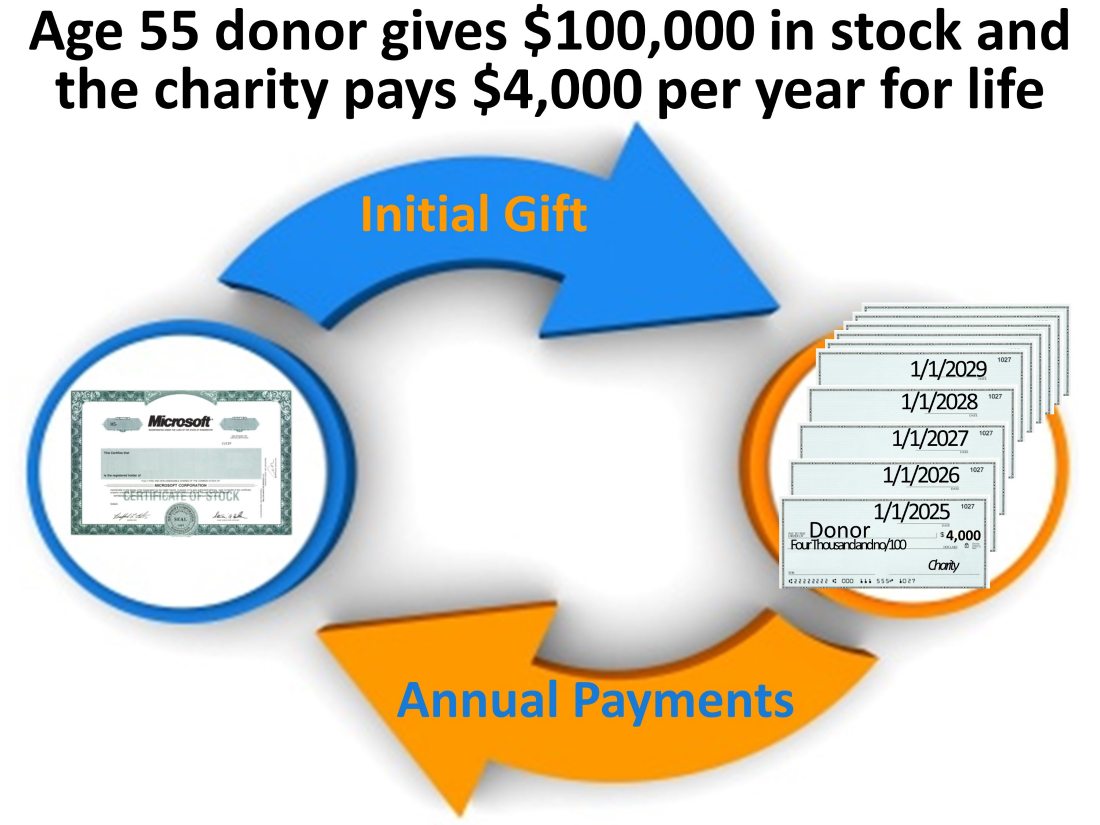
Using the previous rate table, if a donor aged 55 gave $100,000 in publicly traded securities to a charity in exchange for a Charitable Gift Annuity, the charity would make $4,000 annual payments back to the donor for the donor's life.
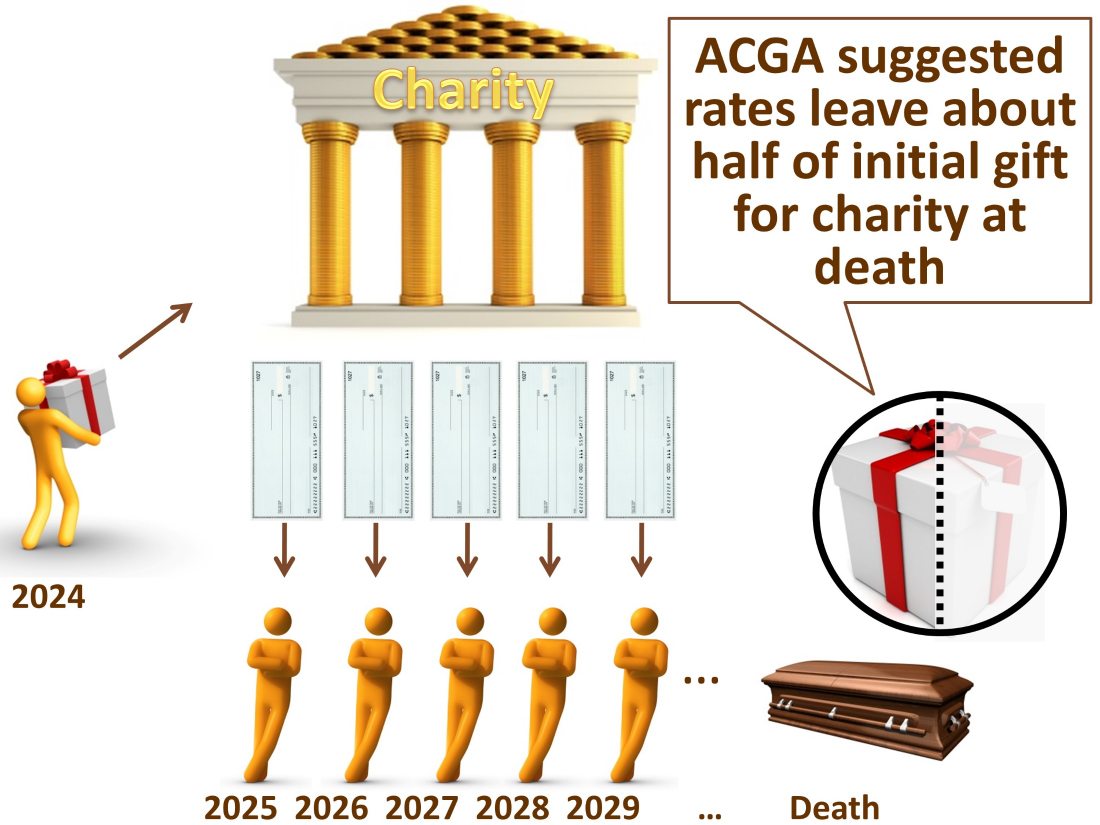
As mentioned previously, the American Council on Gift Annuities suggested rates are intended to leave half of the face value of the initial transfer available for the charity at the death of the annuitant (assuming that the charity makes the lifetime payments using interest and principle from the initial gift). This does not mean that the value of a Charitable Gift Annuity to a charity is half of the amount transferred by the donor. Although the charity is projected to receive half of the face value of the initial transfer, the charity must typically wait many years for this to occur. For example, a $10,000 gift annuity by a 30-year-old donor may be projected to ultimately result in a $5,000 residual going to the charity (after the lifetime of annuity payments are made to the donor); the charity must still wait an average of approximately 50 years to receive this $5,000 residual. The right to receive $5,000 in 50 years is worth far less than $5,000 today.
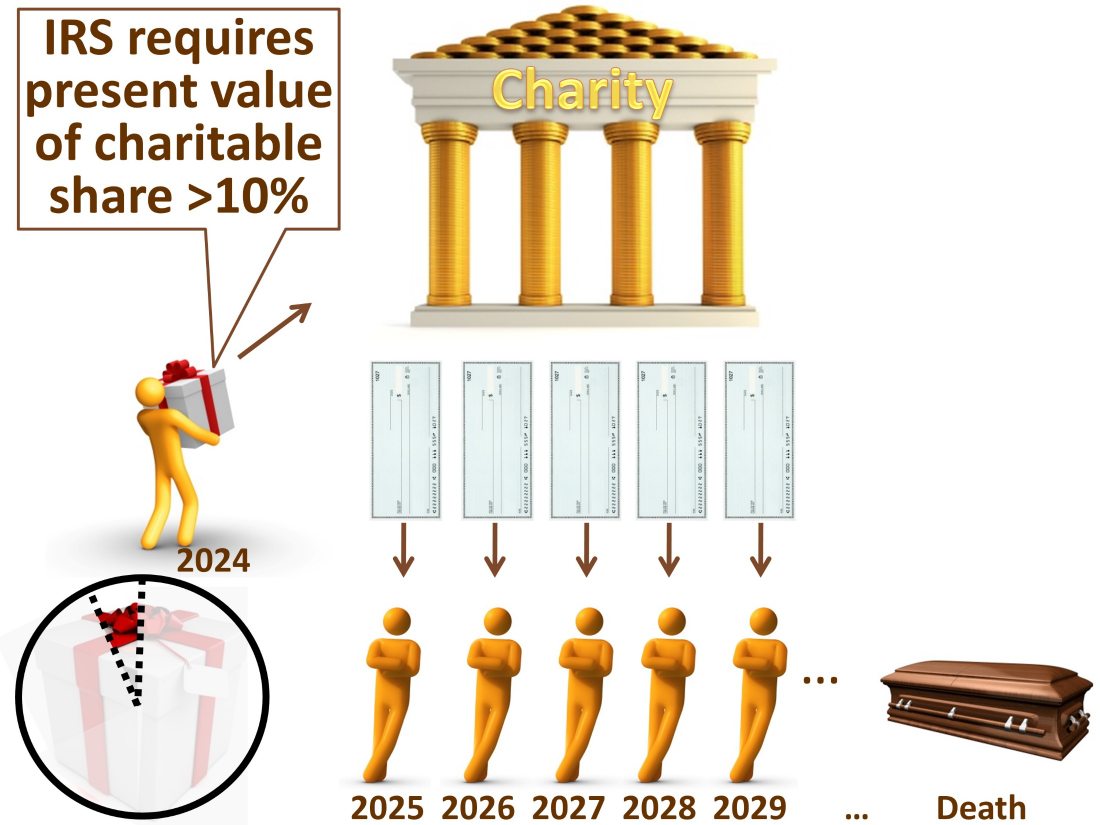
In order for a Charitable Gift Annuity to be considered a charitable arrangement for tax purposes, the annuity must be worth less than 90% of the value of the gift. This does not mean that the charity need only be projected to have a residual of more than 10% after making a lifetime of annuity payments. The projected residual amount comes to the charity only after years of waiting, so at the time the Charitable Gift Annuity is purchased the residual is worth much less than its future projected value. For example, the present value of an expectation of receiving $5,000 in 50 years is worth far less than $5,000 today.
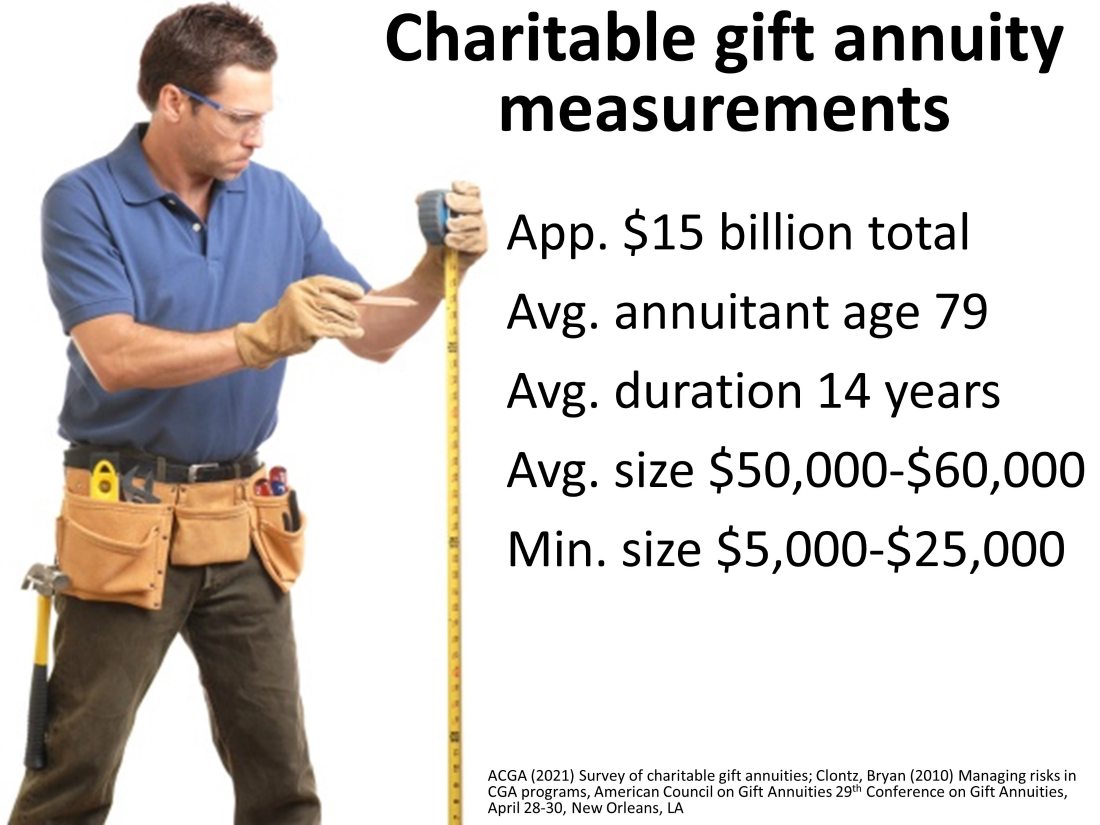
Although many Charitable Gift Annuities are relatively small, their usage is so common that, when combined, they constitute a $15 billion segment of charitable planning. The relatively small minimum size of Charitable Gift Annuities is part of the reason why they are so popular. Because gift annuities are issued by each individual charity, the minimum amounts depend upon the policies of each charity. However, it is not uncommon to find Charitable Gift Annuities available at the $5,000 or $10,000 level. This low entry level also allows hesitant donors to "experiment" with planned giving. It is not uncommon to see donors purchase a series of small Charitable Gift Annuities before increasing the size of gift annuity purchases. By giving donors experience with gifts that pay income, Charitable Gift Annuities can also serve as a gateway to more expensive and complex vehicles such as Charitable Remainder Trusts.
Data from the 2021 American Council on Gift Annuities survey of Charitable Gift Annuities shows that the average age of an annuitant at the time of making the gift was 79 years old. According to that survey, 72% of all Charitable Gift Annuities were purchased by donors aged 76 to 85. This attraction for older donors makes sense, both because of their post-retirement interest in secure lifetime payments and because of the sharp divergence between interest rates and lifetime payout rates available at older ages. In 2013, BNY Mellon Wealth Management reported that the majority of their more than 3,000 Charitable Remainder Trusts were established by donors aged 70 to 74 (See James, R. N. III & Franey, J., 2013, Trending forward: Emerging demographics driving planned giving. National Conference on Philanthropic Planning, Minneapolis, MN). This suggests that the peak age for Charitable Remainder Trust establishment is about five years younger than the peak age for Charitable Gift Annuity purchase. Other research suggests that the peak age for producing matured charitable bequest gift dollars is about 88 years of age (See James, R. N. III, 2013, American Charitable Bequest Demographics, 1992-2012). With upcoming increases in the population of older age groups, a demographic effect would be felt first in Charitable Remainder Trust establishments, second in Charitable Gift Annuity purchases, and last in matured charitable bequests.
The previous statistics establish that Charitable Gift Annuities are quite popular in charitable planning. Why? The reason for their popularity is that they are a simple way to fill a need for donors in a variety of circumstances. Let's examine some of those situations.

It can often be the case that older donors have substantial assets and would like to make major charitable contributions, but they worry that a major gift could leave them without enough assets for their lifetime needs. The worry is that he or she may outlive his or her assets. This concern can prevent the donor from making the substantial charitable gifts that he or she would like to make.
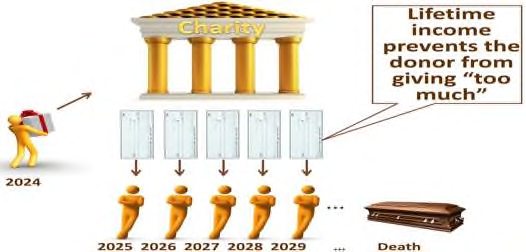
A Charitable Gift Annuity is designed to overcome this worry about outliving one's assets by providing a lifetime source of income. Where a donor might regret having made a major gift of assets if she later lived "too long" and needed those assets for regular lifetime spending, such concerns are alleviated by giving through a Charitable Gift Annuity.

The Charitable Gift Annuity may also be preferable to a simple charitable bequest because it generates an immediate income tax deduction. Although understanding that annuity payment rates are not interest rates (because the donor loses the principal), if the donor is already planning to transfer the principal at death to the charity, then the Charitable Gift Annuity becomes exceptionally attractive. For example, if a donor owns a $10,000 certificate of deposit, which he has already designated a charity to receive at death, then his payments from a Charitable Gift Annuity would be more directly comparable with his interest earned on the certificate of deposit, because in either case, the charity will receive the principal at death. (Naturally, there are still differences that make this comparison inexact. For example, the donor can later choose to immediately spend the entire certificate of deposit, but with a gift annuity the donor has only a lifetime income stream.)
The Charitable Gift Annuity is also attractive for the charity because, unlike a charitable bequest, a Charitable Gift Annuity is an irrevocable gift. The charity need not worry about last minute changes to the donor's plan by the donor or nefarious heirs, because the transfer is already complete. Recent research shows that charitable plans become highly unstable in the years immediately prior to death (see James, R.N., 2013, American Charitable Bequest Demographics: 1992-2012). Thus, it is particularly beneficial to a charity to be able to convert revocable bequest intentions into irrevocable planned gifts, such as Charitable Gift Annuities.
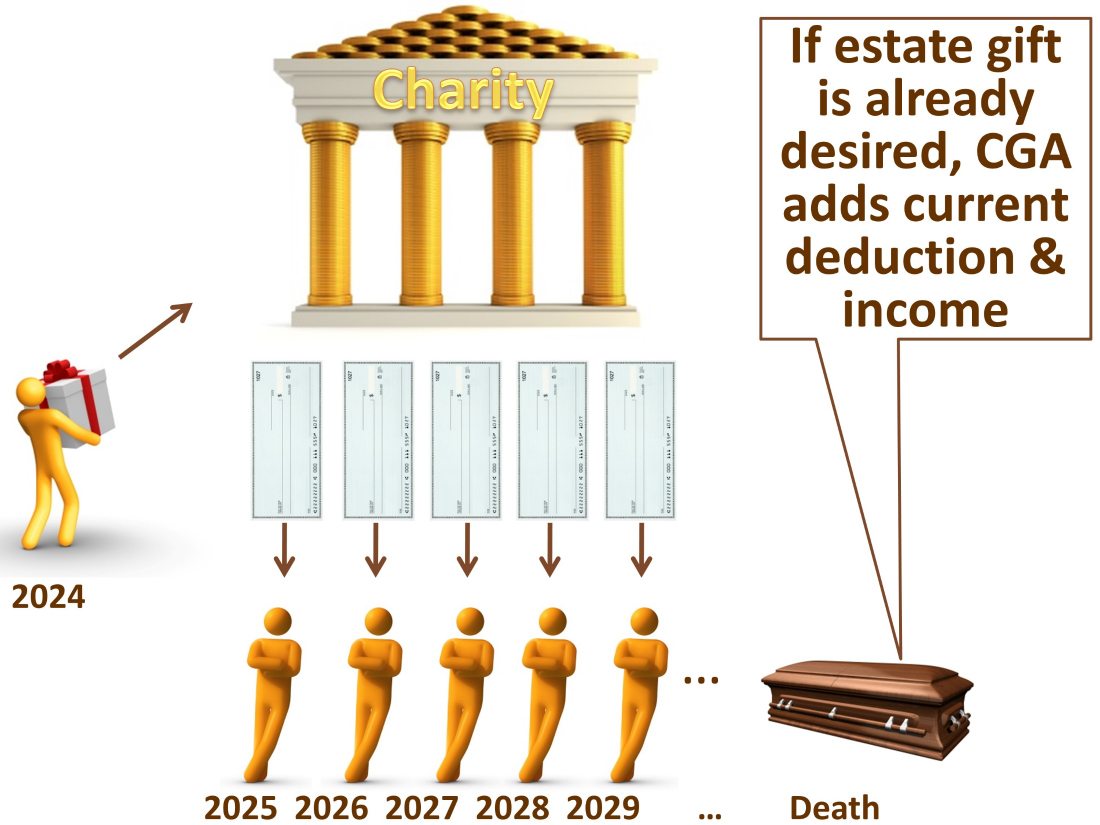
From a donor's perspective, a Charitable Gift Annuity can be preferable to leaving the same amount as a bequest gift because a bequest gift generates no income tax deduction and no lifetime payments. For a donor with the twin goals of generating lifetime income and making a post-mortem gift to a charity, the gift annuity works far better than alternative strategies such as investing and leaving a gift to the charity by will. Simply purchasing an immediate annuity from a life insurance company provides lifetime payments, but doesn't accomplish the donor's charitable goals. Similarly, writing a charity into one's will generates no income tax deductions. But, by converting that revocable bequest decision into an irrevocable Charitable Gift Annuity, the donor benefits the charity and generates immediate income tax benefits and lifetime income, making the gift annuity an attractive option.

Charitable Gift Annuities can also have advantages over more complex and expensive planned giving vehicles. If a donor is specifically concerned about having lifetime income that won't change or run out, the Charitable Gift Annuity can be an ideal charitable planning option. A Charitable Remainder Unitrust can make payments for life, but the amount of each payment depends upon the return of the underlying investments. This risk could be diversified using a Pooled Income Fund, but the payments will still vary with market fluctuations. A Charitable Remainder Annuity Trust makes fixed payments for life. However, if the investments in the Charitable Remainder Annuity Trust perform poorly, the trust can run out of money, causing the annual payments to stop.
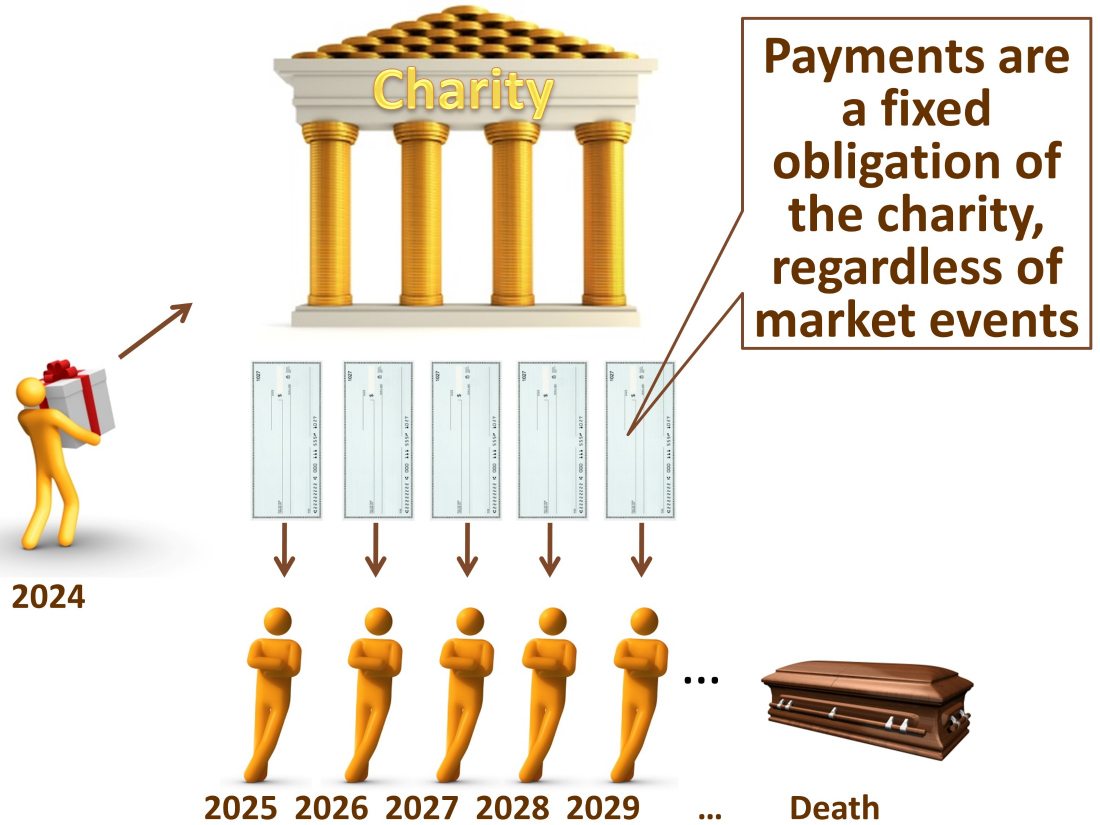
In contrast, the Charitable Gift Annuity payments are a fixed obligation of the charity, which must be paid regardless of investment returns or market events. So long as the charity continues to exist, the gift annuity payments must be made.
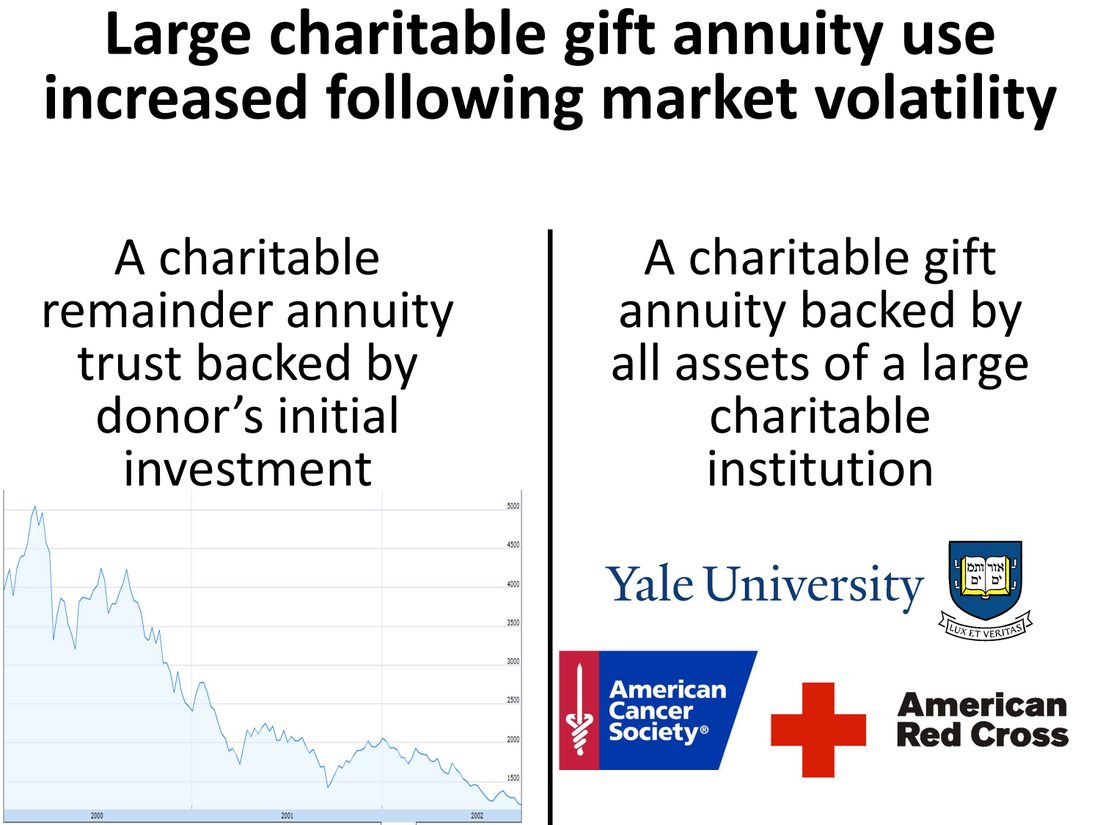
The security provided by Charitable Gift Annuities can be more attractive in times of market volatility. Traditionally, Charitable Gift Annuities have been considered primarily "small dollar" vehicles. However, following substantial market drops during the most recent financial crisis, the number of multimillion dollar Charitable Gift Annuities increased notably. The attraction of the Charitable Gift Annuity issued by a financially stable nonprofit is its ultimate security. Considering that, historically, major universities and churches have outlived successive generations of businesses and governments, some gift annuities may provide an exceptional level of security. Although other charitable planning vehicles, such as the Charitable Remainder Trust, provide opportunities for influencing investment choices, they are also exposed to investment risk. When attention to investment risk is high (such as following a market crash) the attraction of the guaranteed gift annuity payments increases as compared with the risk of a Charitable Remainder Trust.

Another reason Charitable Gift Annuities are so popular is that they are the simplest and easiest way to participate in charitable planning that produces both a tax deduction and income for the donor. Charitable Gift Annuities are the simplest way for fundraisers to respond to the common statement from donors that "I wish I could do more, but..." Charitable Gift Annuities offer a way for donors to make a gift and provide a payment stream for other needs, such as college tuition or retirement income. And yet the transaction can be as simple as writing a check and signing a one-page standard agreement from the charity.
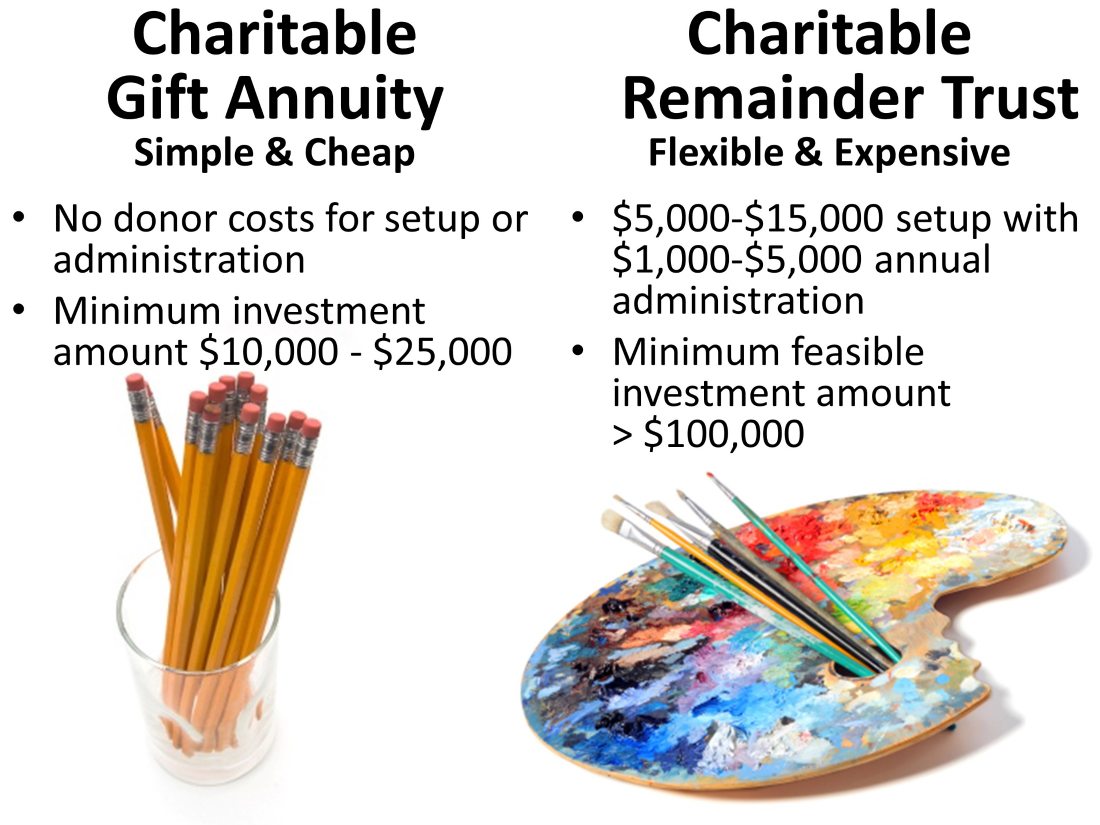
If the enormous flexibility available with Charitable Remainder Trusts can be thought of as the paint palette of an artist, then the Charitable Gift Annuity is like the reliable number 2 pencil. Charitable Gift Annuities are simple and cheap for donors. There are no donor costs for setup or administration and the minimum investment amount is commonly only $10,000 or $25,000. Each Charitable Gift Annuity agreement with a particular charity is typically identical except for the donor's age, the payment rate, and the transfer amount. In contrast, Charitable Remainder Trusts are usually hand-crafted documents specifically designed for the individual donor and his or her particular desires. This enormous flexibility comes at a cost, both for the initial creation of the Charitable Remainder Trust and for annual administration. Because of these costs, the minimum feasible amount for a Charitable Remainder Trust is normally 10 times that of a Charitable Gift Annuity. Of course, there are significant potential advantages to using a Charitable Remainder Trust that are not available with Charitable Gift Annuities that can, in many cases, warrant the added expense for the donor. One solution is not universally better than the other; both can fit the specific needs in different circumstances.

To this point we have been comparing Charitable Gift Annuities with leaving a charitable bequest. This anticipates a scenario in which the charity holds the initial gift amount, makes payments to the donor for life, and then only after the death of the donor takes the remaining amount of the gift to use for charitable purposes. However, the charity is not required to take this conservative approach (except in the State of New Hampshire). A charity could instead calculate the share of the gift that would normally be needed to make the lifetime payments and immediately spend the remaining amount. For a charity that chose to do this, the donor would be able to see the impact of his or her gift immediately. For some donors, this could be an attractive feature, especially when compared to a bequest gift where the donor would not be alive to see its impact.
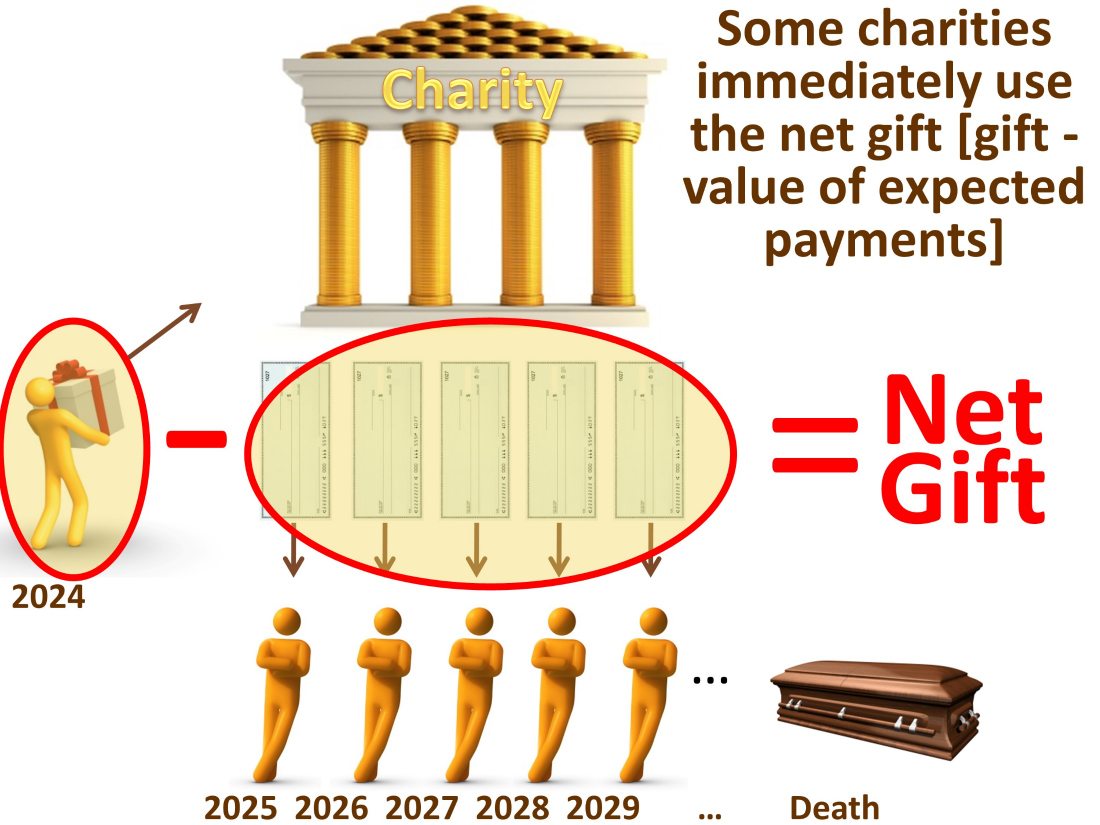
To make an immediate use of Charitable Gift Annuity funds, the charity spends the projected gift portion of the transaction. Calculating this projected gift portion involves estimating the donor's longevity and the charity's investment returns. Consequently, there is some risk involved if the projections are in error. This risk explains why not all charities engage in this practice of immediately using the projected gift portion of Charitable Gift Annuity funds. Nevertheless, it is an available option to charities in most states.
Note that in Florida, Tennessee, Washington, Hawaii, and New Jersey, the charity must hold the amount projected for the donor's payments plus a 10% cushion. In New York the cushion amount is at least 10%, and may be higher. Even in these jurisdictions, however, making immediate use of part of the Charitable Gift Annuity is permitted. In other jurisdictions, the charity could choose to immediately use even more than the projected "gift portion," although this creates a future net liability for the organization.
To this point we have been reviewing some of the features and benefits of the Charitable Gift Annuity. However, there are also some risks involved with the Charitable Gift Annuity. First, let's examine the risks for the donor.
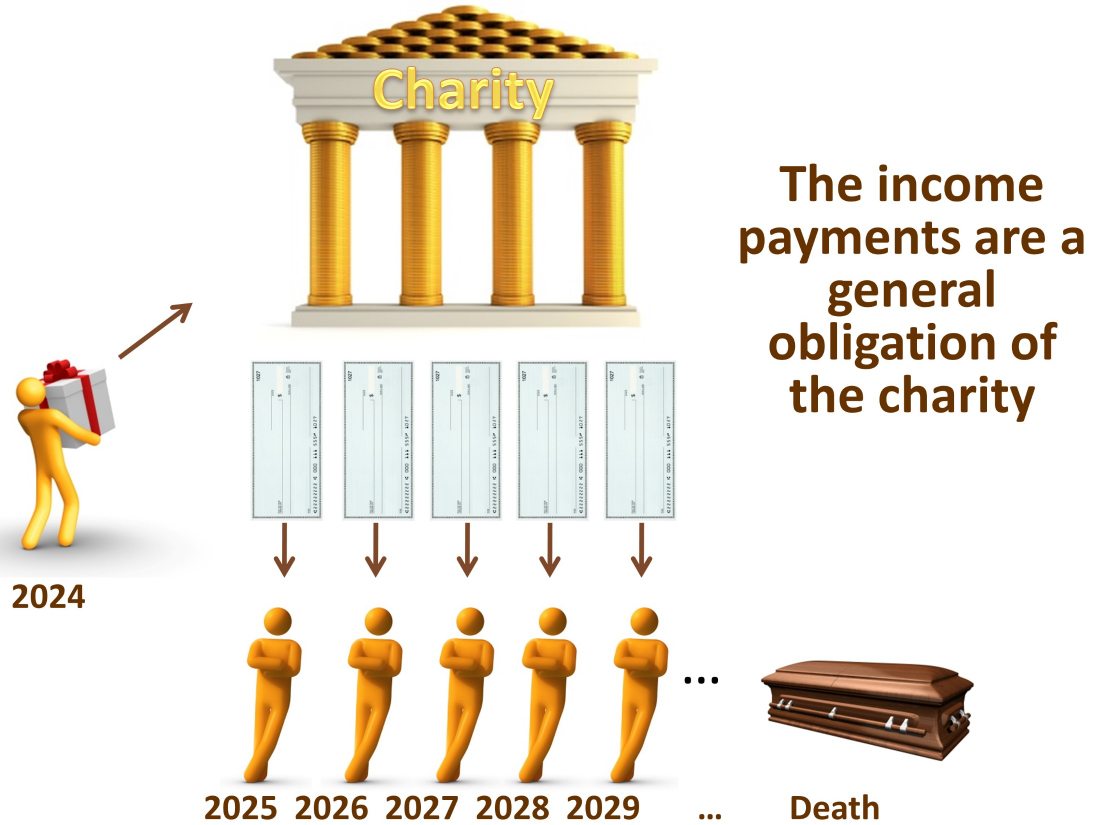
The annuity payments come from the charity. The charity is required to make these payments and they are a general obligation of the charity. So long as the charity survives, the donor need not be concerned with market crashes and other investment worries.
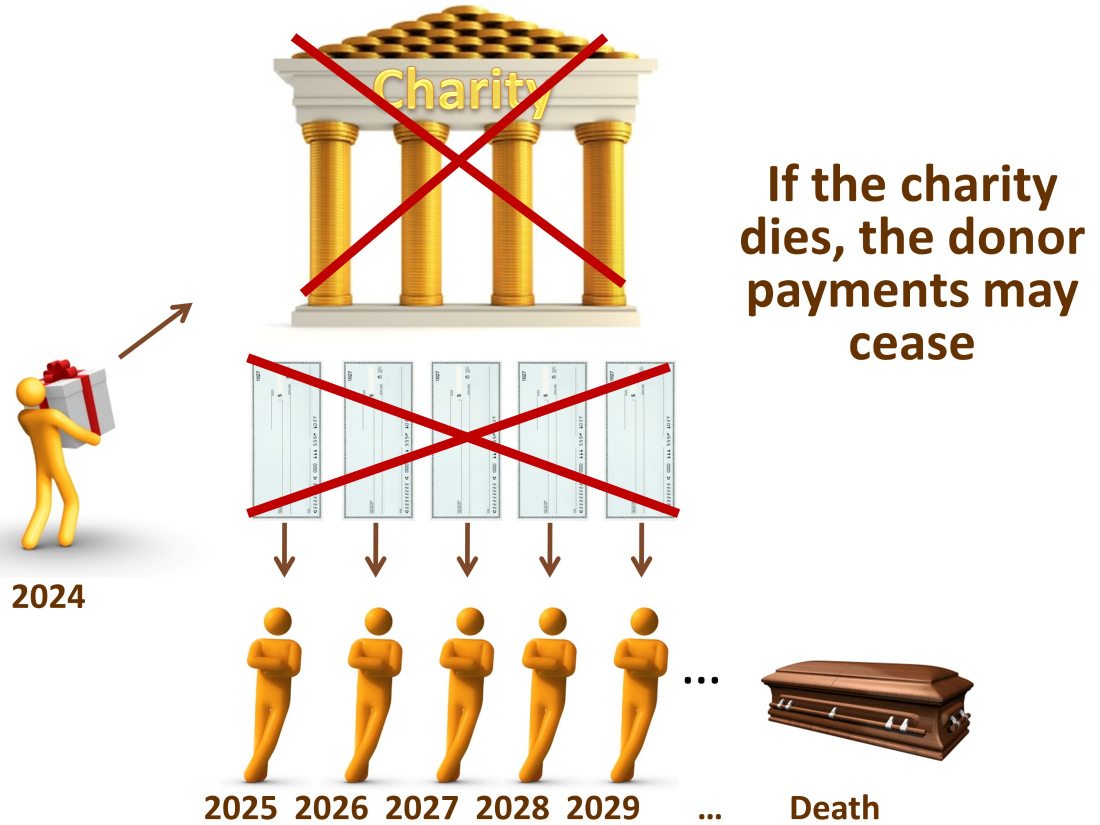
However, if the charity goes bankrupt, the donor payments may cease or be reduced. Thus, the primary risk for the donor is that the charity would be unable to make its payments in the future. As a general obligation of the charity there may be no specific assets that can be attached in the event of a bankruptcy. Although some charities have, and a few states require, segregated reserve funds, this segregation may not be sufficient to prevent other creditors from having a claim on the funds. Additionally, such segregated funds may also deplete due to poor investment decisions.
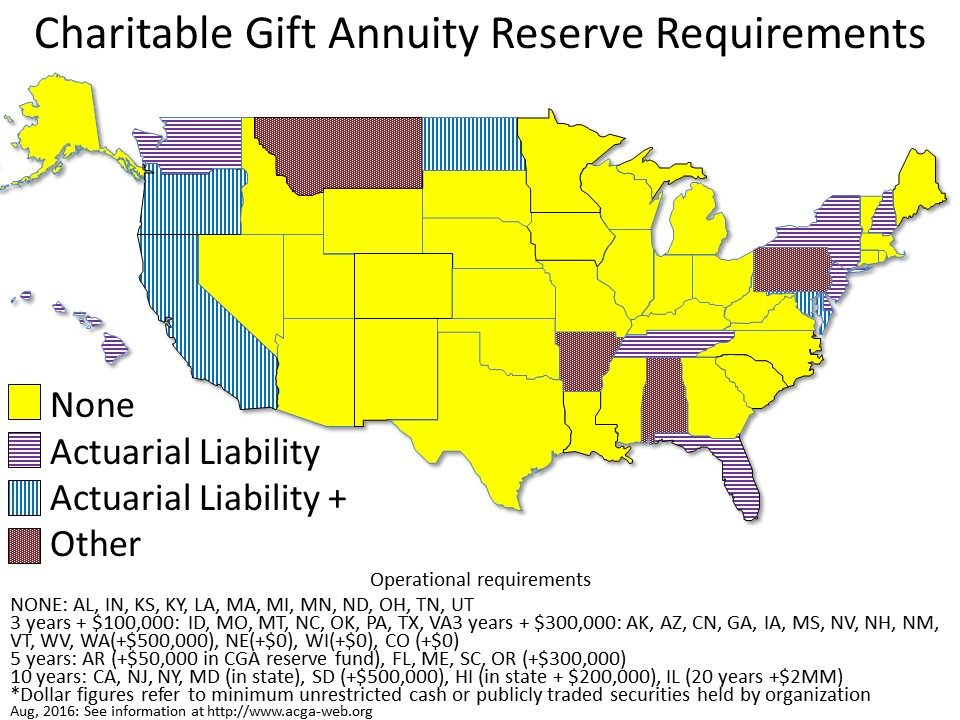
Compared with the field of commercial annuities issued by insurance companies, Charitable Gift Annuities are remarkably unregulated. As shown by this map, the majority of states have no reserve requirements for nonprofits issuing Charitable Gift Annuities. This means that a charity operating in one of the states working with a donor in one of these states could choose to immediately spend 100% of the amount given for the Charitable Gift Annuity and simply leave the payments as an unfunded obligation for the future. Several states have operating requirements such that a charity issuing Charitable Gift Annuities must have been in operation for a minimum number of years and have a minimum amount of unrestricted cash (or cash equivalents such as publicly-traded securities). Unrestricted cash, however, does not mean that there are no creditor obligations on the cash. Unrestricted cash means only that it is money that has not been temporarily or permanently restricted by a donor. Further, these requirements for unrestricted cash are fixed dollar amounts that do not vary, regardless of the number or amount of Charitable Gift Annuities being issued by the nonprofit. In essence, these operational requirements simply limit gift annuity issuance to charities that are not brand new and have at least a little money in the bank. Note that in states like Indiana, Kansas, Kentucky, Louisiana, Massachusetts, Michigan, and Minnesota, there are neither operational requirements nor reserve requirements. This means that a nonprofit could be created one day, start issuing Charitable Gift Annuities the next day, and then immediately spend 100% of the amount given for all Charitable Gift Annuities. Obviously, such a scenario entails substantial risk for the donor. At the same time, Charitable Gift Annuities issued by large stable nonprofits may be among the most secure lifetime payment streams available. However, the lack of regulation in some areas creates a "Wild West" scenario in which the donor must do some investigation to understand the risks involved.
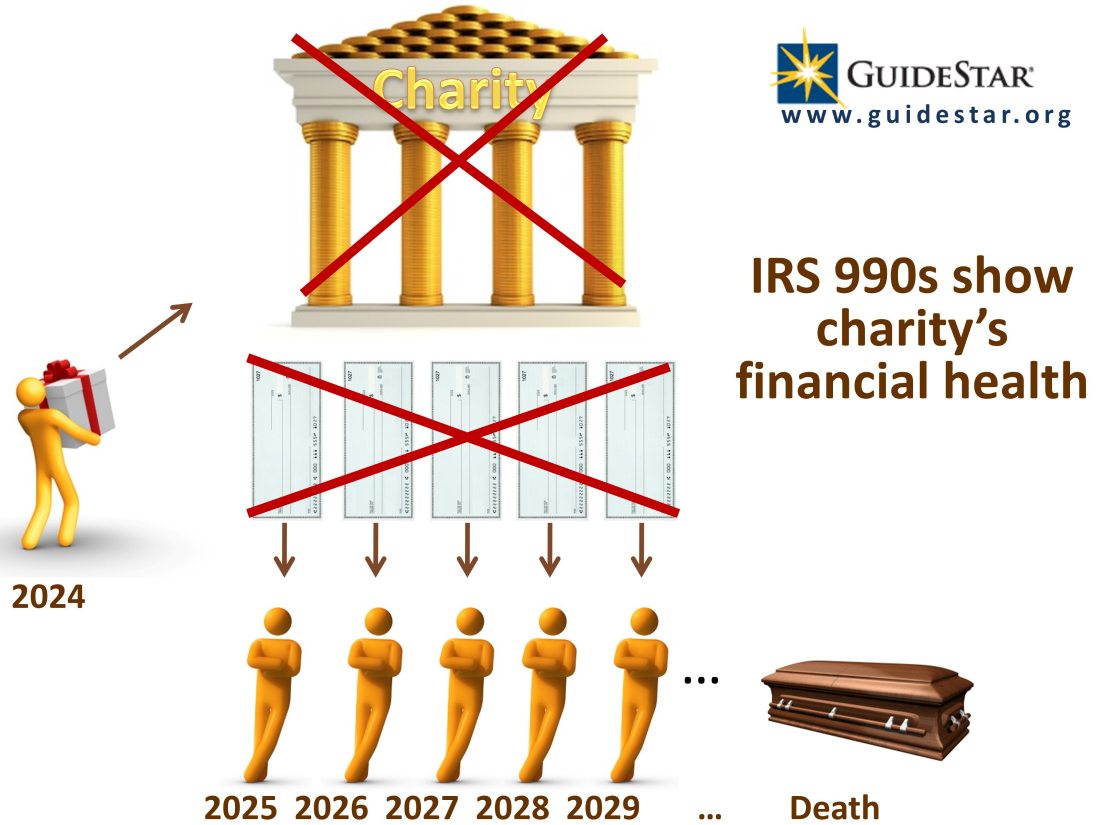
One way to investigate the financial condition of a charity is to examine the IRS form 990 for the charity. The IRS form 990 contains financial information about the charity, including assets, liabilities, income, and expenditures. Charities are required to provide these forms to anyone who requests them. Additionally, these forms are available from a number of websites for no charge. Some of the websites that currently post IRS form 990s are
. www.guidestar.org
. projects.propublica.org/nonprofits/
Given the complexity of reading and understanding financial statements, this is an area where a financial advisor could be particularly helpful to a donor.
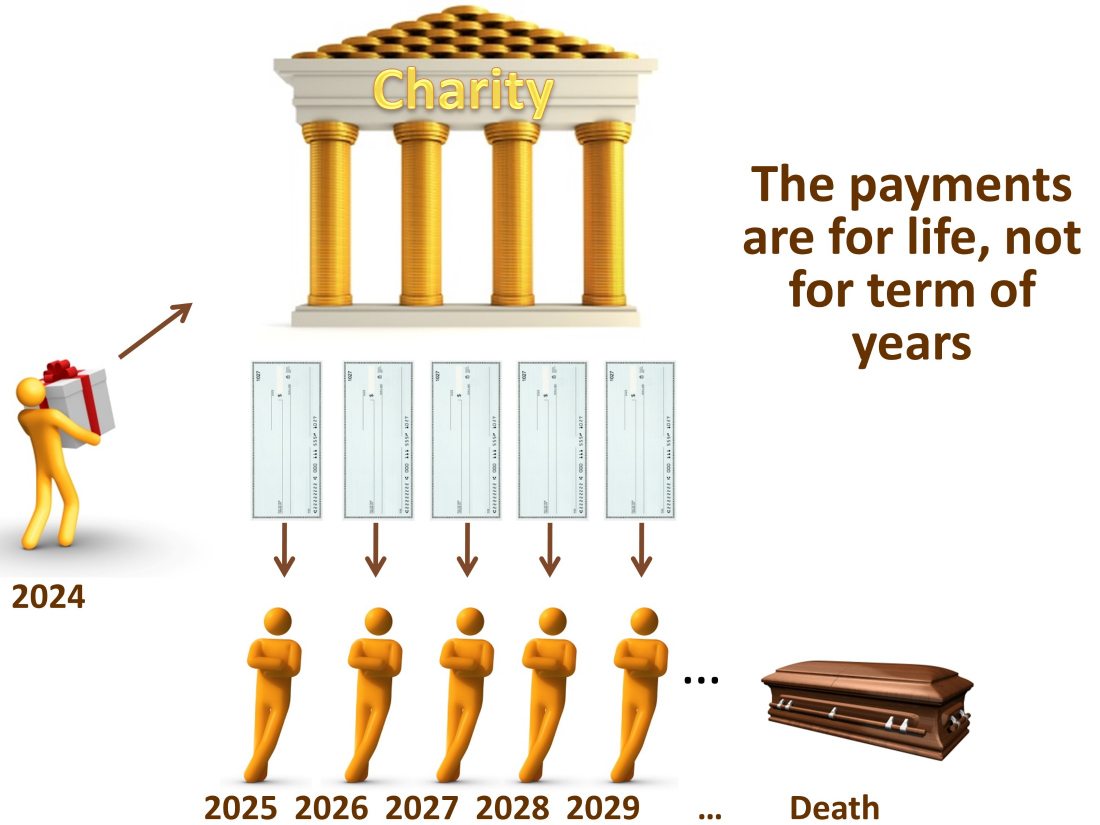
Unlike some commercial annuity products, Charitable Gift Annuities do not offer payments for a fixed term of years or a minimum guaranteed number of years. Instead, Charitable Gift Annuity payments are for life only. This is not due to the lack of willingness of charities. Rather, the IRS tax code penalizes charities for offering other varieties of gift annuities, even though these may be available from commercial annuity providers.
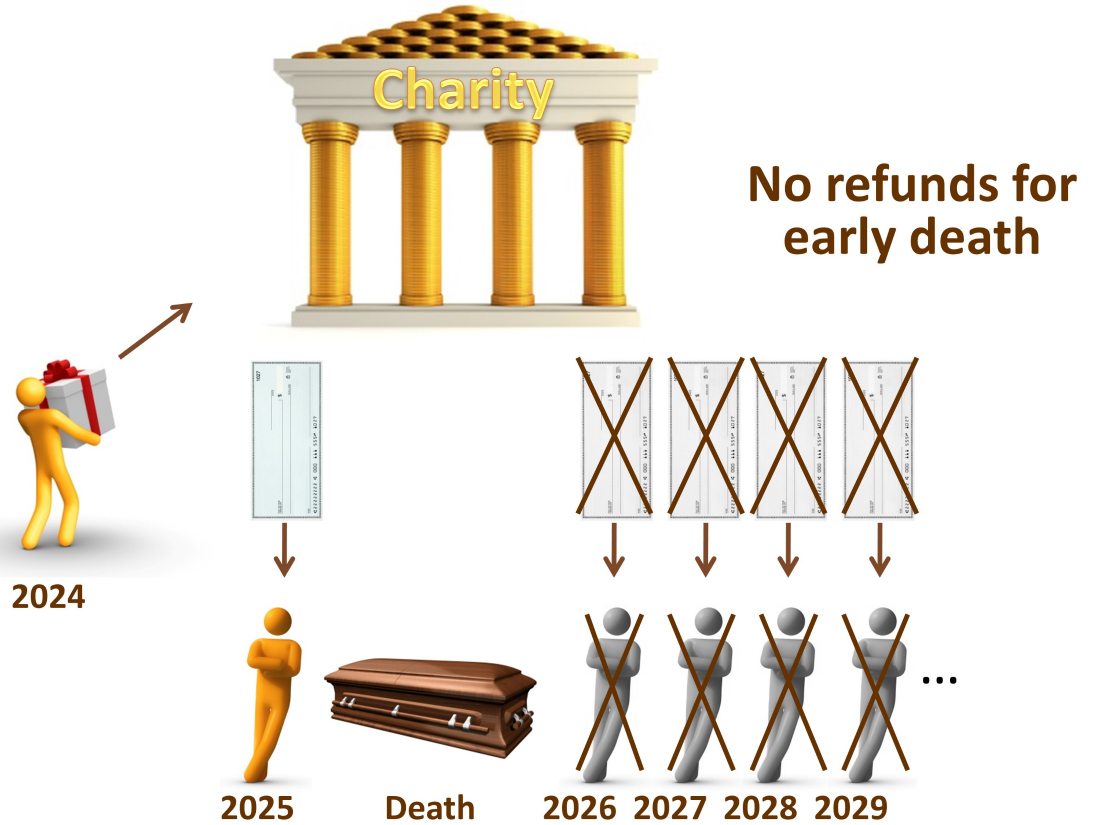
One risk in purchasing a gift annuity that makes payments for life is that the annuitant could die immediately after purchasing the annuity. Unfortunately for the annuitant, there are no refunds for early death, nor are charities allowed to offer gift annuities with guaranteed minimum payment amounts or with a fixed number of payment years. From a financial perspective, there is a clear risk in that the donor may receive very few benefits prior to death. However, if the donor's goal was to make a large gift to charity (but not risk outliving his or her assets), then the risk of receiving few payments is of less concern as the donor's goal will still be achieved.

To this point we have been considering the simplest and most common form of a gift annuity where the donor makes a gift and in return receives lifetime payments from the charity. Although a charity is not allowed to offer annuities with a guaranteed return in the event of premature death or annuities paying for a set number of years, the tax code does permit a few other gift annuities variations. (Note that if a charity were to offer gift annuities with terms outside of approved variations, the charity would be required to pay taxes on income earned from the gift annuities as unrelated business income tax and their sale would be subject to federal securities and/or state insurance regulation, thus making them highly undesirable charitable giving vehicles.)
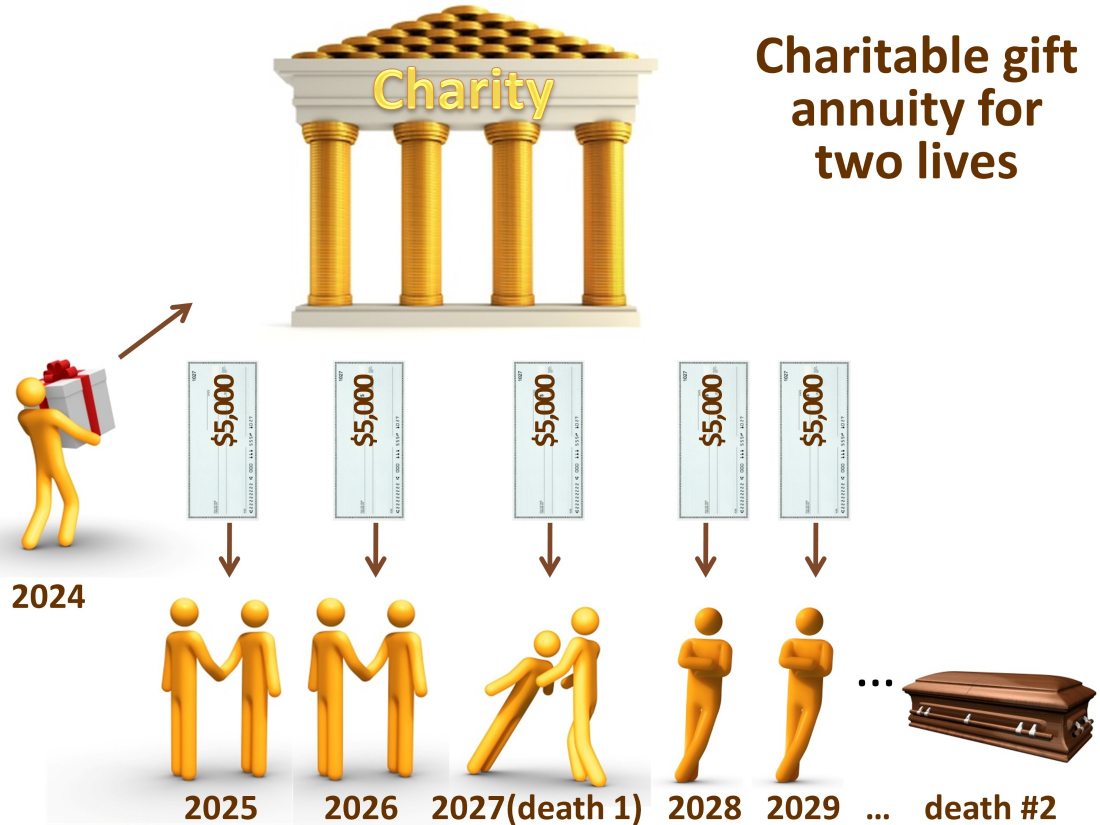
The most common variation on the traditional gift annuity is the gift annuity that pays for two lives. This means that the annuity payments will continue to be made until the death of the last of the two individuals to die. (The payment is not reduced at the death of the first to die of the two annuitants.) Most commonly, these gift annuities pay for the lives of the donor and the donor's spouse. However, there are no requirements that either annuitant be related to the donor. A gift annuity cannot, however, pay for more than two lives. Nor, can it pay for the life of someone who is not yet born (e.g., "pay for my life and the life of my first child if he or she is born before my death").
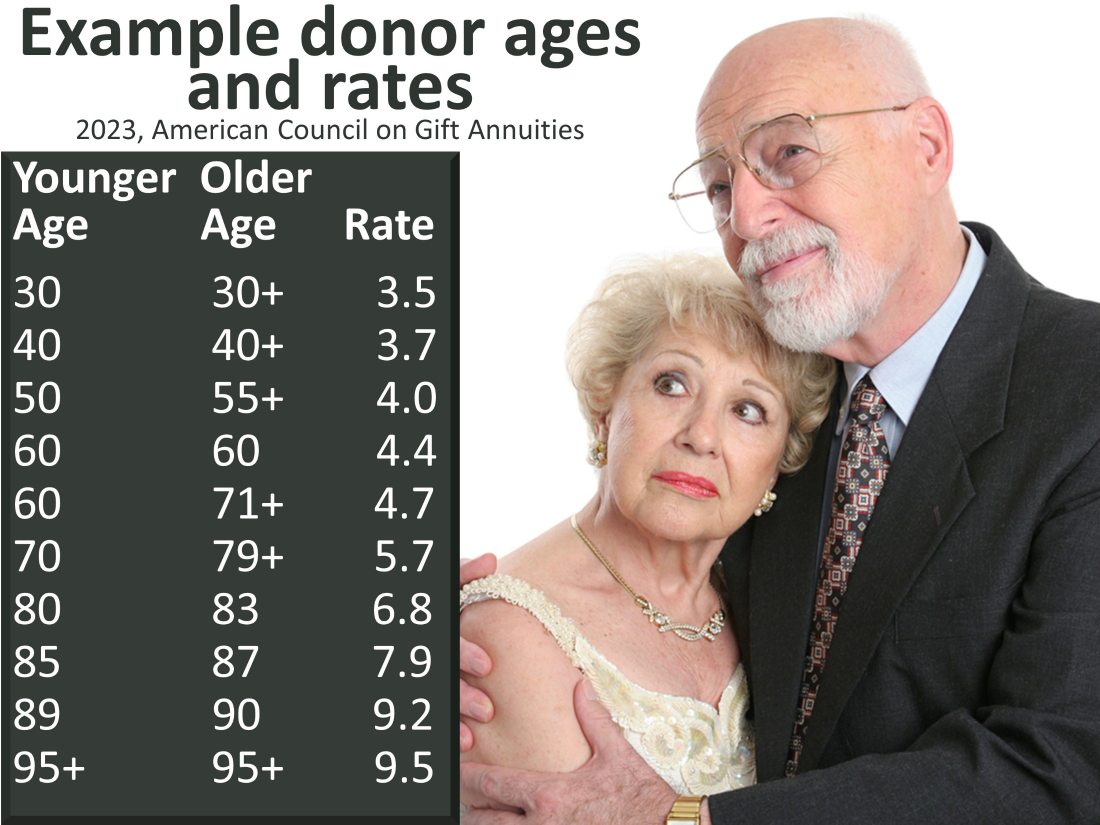
The American Council on Gift Annuities also issues suggested rates for these two-life annuities. As before, these rates vary depending upon prevailing interest rates and the ages of the two annuitants. The full table is much larger than for single life annuities, given the wider range of age combinations possible. This excerpt provides a few examples from that table.
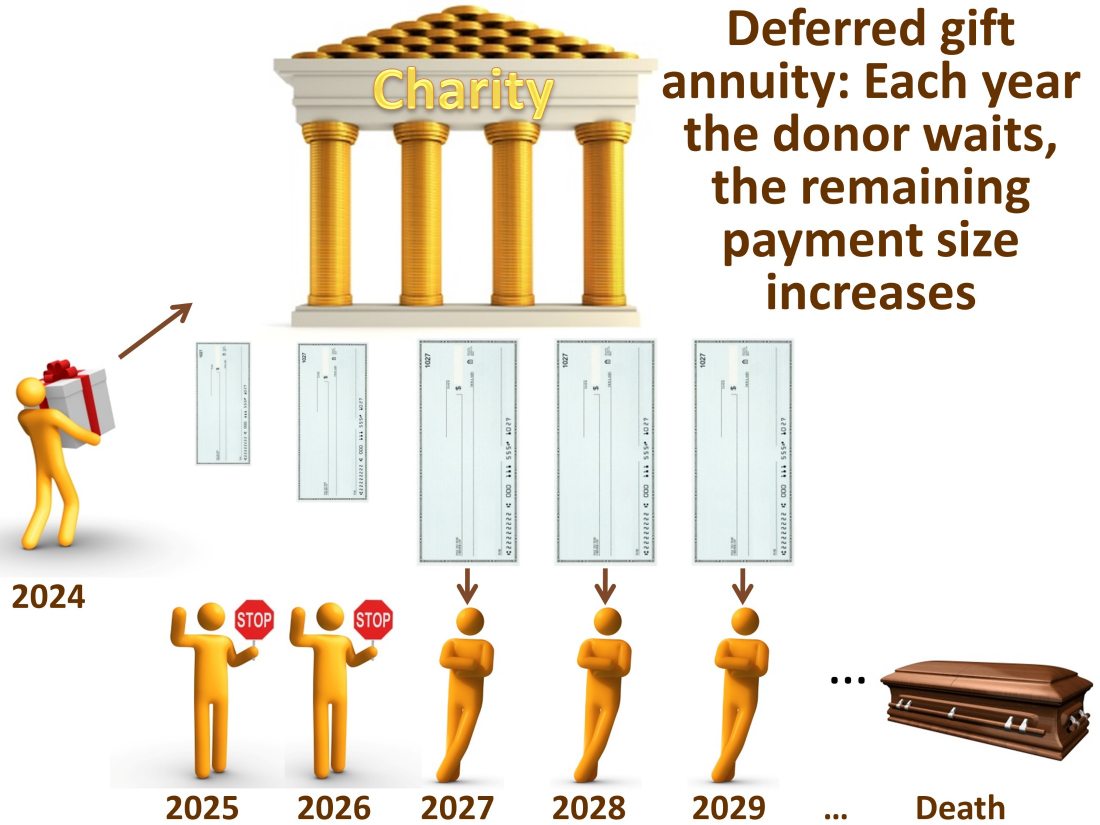
One particularly attractive variation of the standard gift annuity is the deferred gift annuity. If the donor does not need the income payments to begin immediately, the donor may choose to postpone the start of the annuity payments. Each year that the donor postpones the start of the annuity payments will increase the size of the remaining payments. This may be helpful for donors who wish to make an immediate transfer, receive an immediate tax deduction, but postpone income until some future year, such as the start of retirement. The donor can either establish in advance when the annuity will begin or can decide each year whether or not to begin the annuity in that particular year (this is sometimes called a "flexible annuity", see PLR 9743054).
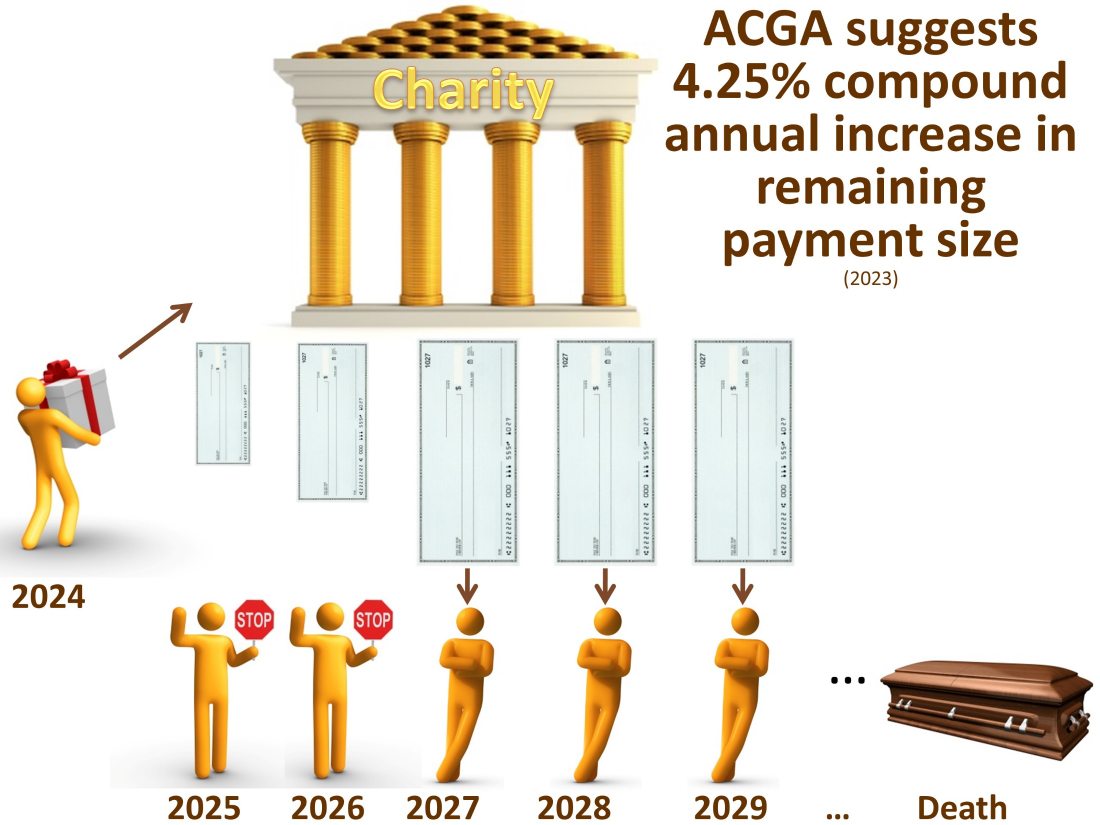
The essence of a deferred Charitable Gift Annuity is that if the donor postpones the start of the annuity payments, each remaining payment will become larger. The American Council on Gift Annuities suggests a compounding rate which incorporates current interest rates and the reduced longevity of the annuitant. If a compounding rate is so high that it increases the overall value of the annuity beyond the simple immediate annuity, it will reduce the available tax deduction. For example, in 2023 the payout rate would be the current rate in effect at the age the payout begins multiplied by 1.0425n where n is the number of years the payout was delayed after the initial gift (i.e., a 4.25% compound annual increase in the remaining payment size).
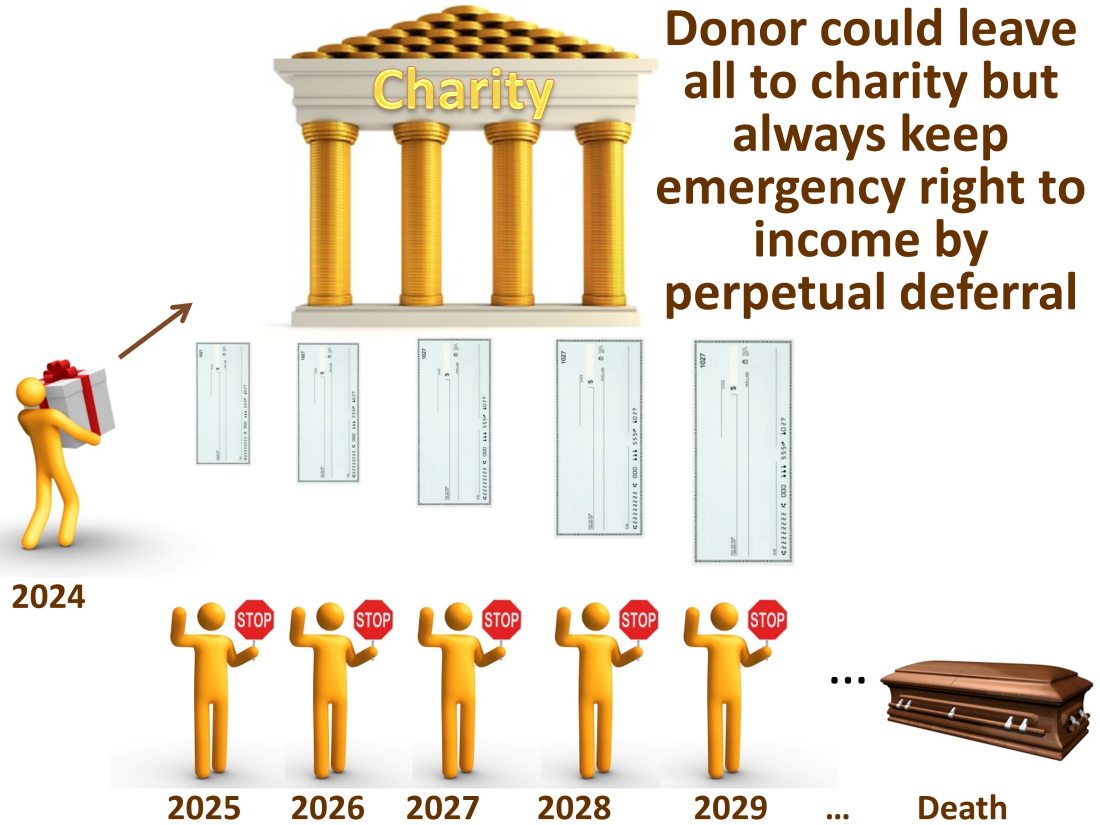
The deferred or flexible gift annuity also creates the opportunity for a donor to make a gift, but retain an "emergency" right to receive payments. This can be helpful with a donor who does not anticipate ever needing the payments, but who nevertheless feels insecure about making the gift because of unknown possibilities. The donor can choose to postpone the payments indefinitely and, at death, the charity would receive the entirety of the initial gift. Although the amount transferred to the charity is the same as could have been transferred through a bequest, this transaction allows for an immediate income tax deduction and also allows the charity to make immediate use of a portion of the initial gift.
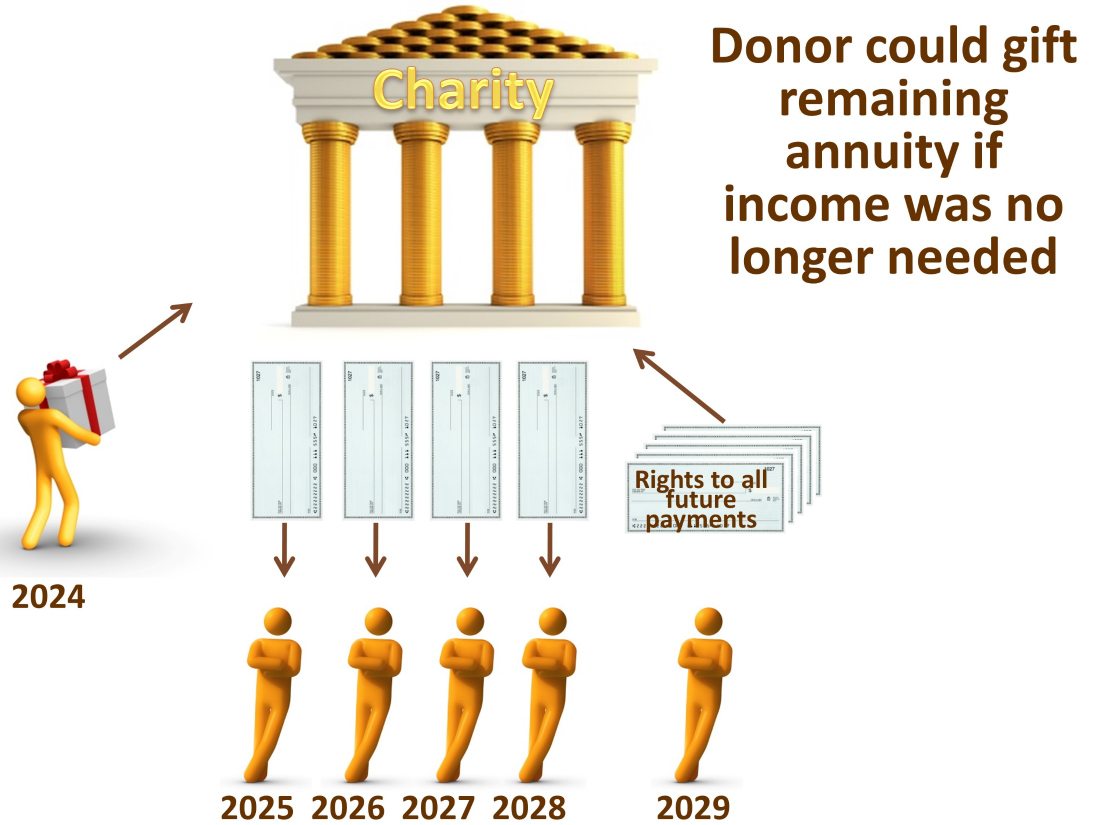
If a donor purchased a gift annuity and then later found that he or she no longer needed the annuity payments, the donor could gift the rights to all future payments to the charity and potentially receive an income tax deduction for that gift. This could be more tax efficient than receiving each check (which counts, at least in part, as income) and then gifting it back to the charity (which creates a deduction that may or may not completely offset the income, depending upon a variety of factors such as the amount of other itemized deductions, adjusted gross income level, and so forth).
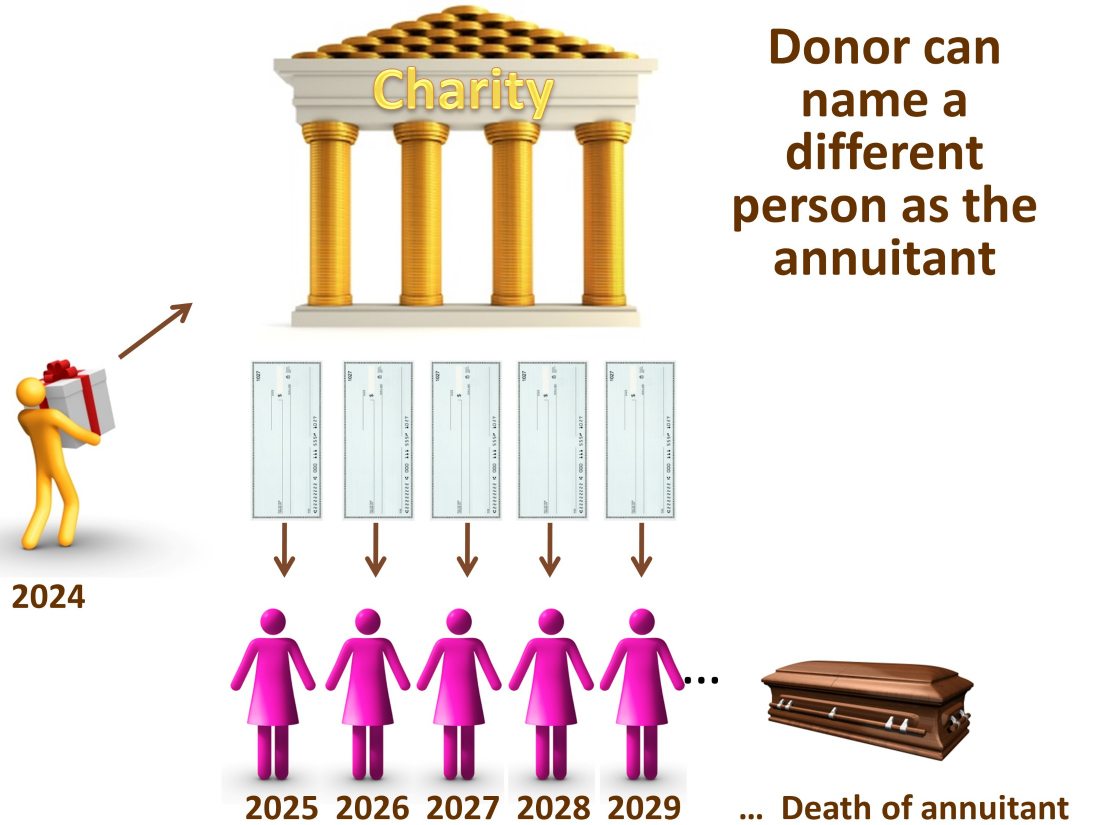
The typical Charitable Gift Annuity makes lifetime payments to the donor. However, the donor may instead select someone else to receive payments as the annuitant. This is a potentially taxable gift if given to a non-spouse, so for a donor whose estate is large enough to be concerned with estate taxes, such gift tax considerations must be considered. (Although, as discussed later, such gift taxes can be reduced by the annual present interest exclusion because gifts of immediate annuities are considered to be gifts of present interests.)
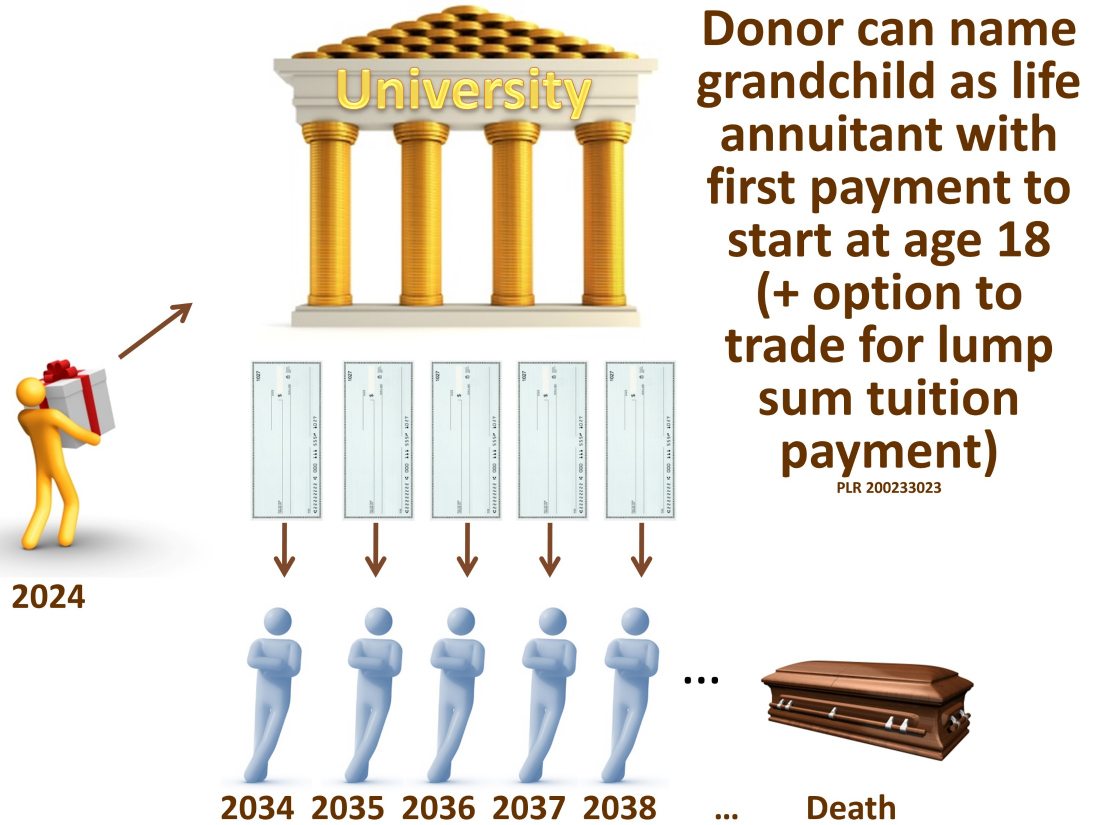
One creative variation on a Charitable Gift Annuity allowed a donor to name his grandchild as the life annuitant with the lifetime payments to begin at age 18. This particular annuity had an additional provision that allowed the grandchild to trade the lifetime income for an equivalent lump-sum tuition payment at the donor's alma mater. Because the annuity was issued by the donor's alma mater, this created an attractive incentive for the grandchild and a potential double benefit for the university.
We have discussed the risks for the donor in purchasing a Charitable Gift Annuity (consisting largely of the risk that the charity would go bankrupt or the annuitant would die too quickly). However, given the nature of the obligation to make lifetime payments, there are also substantial risks for charities that issue Charitable Gift Annuities.

A primary risk for the charity is that the annuitant may live much longer than projected. The charity is obligated to continue making payments for the life of the annuitant, regardless of how long the annuitant lives. A Charitable Gift Annuity that would have provided a substantial gift if the annuitant had lived to his life expectancy may instead generate a net loss for the charity if the annuitant lives far longer.
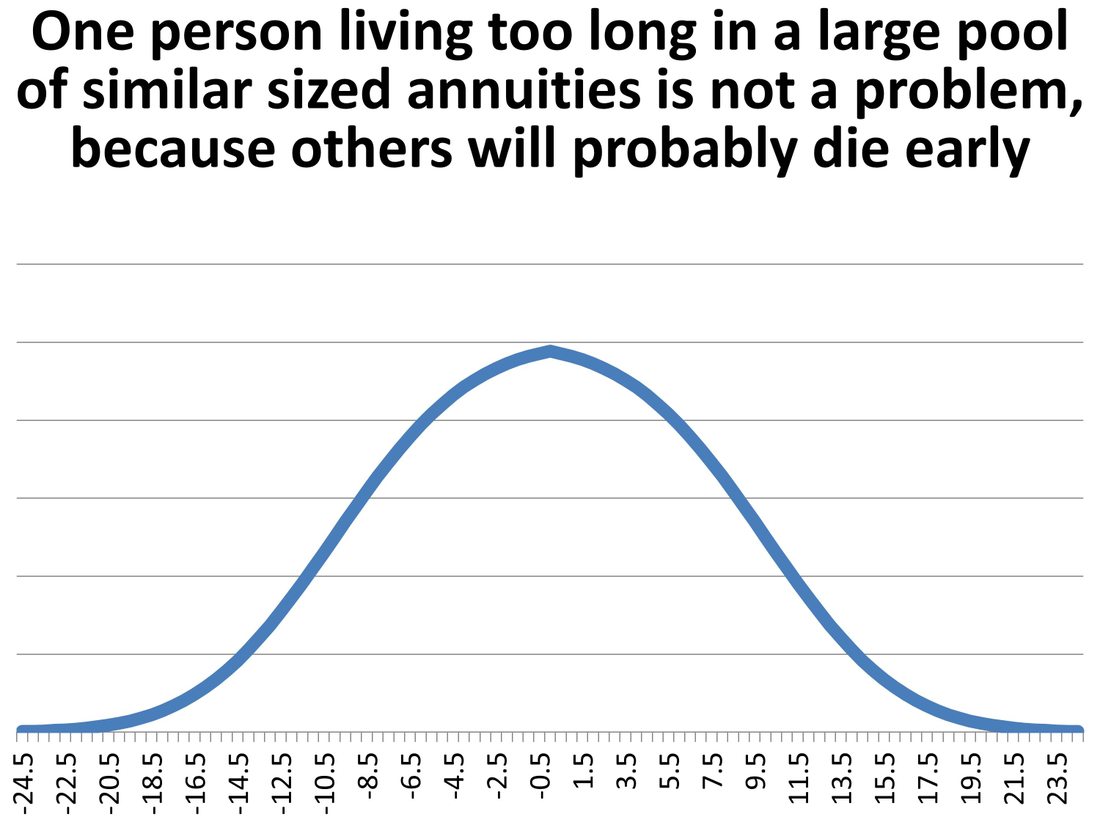
The primary protection for this type of risk is to have a large pool of annuitants with similar sized annuities. Although some will live many years beyond their life expectancy, others will die sooner than their life expectancy and, on average, the lifetime payments should approximate life expectancies. The risk that one annuitant will outlive his life expectancy by 10 years is significant, but the risk that a pool of 10,000 annuitants will outlive their life expectancies by, on average, 10 years is very low.
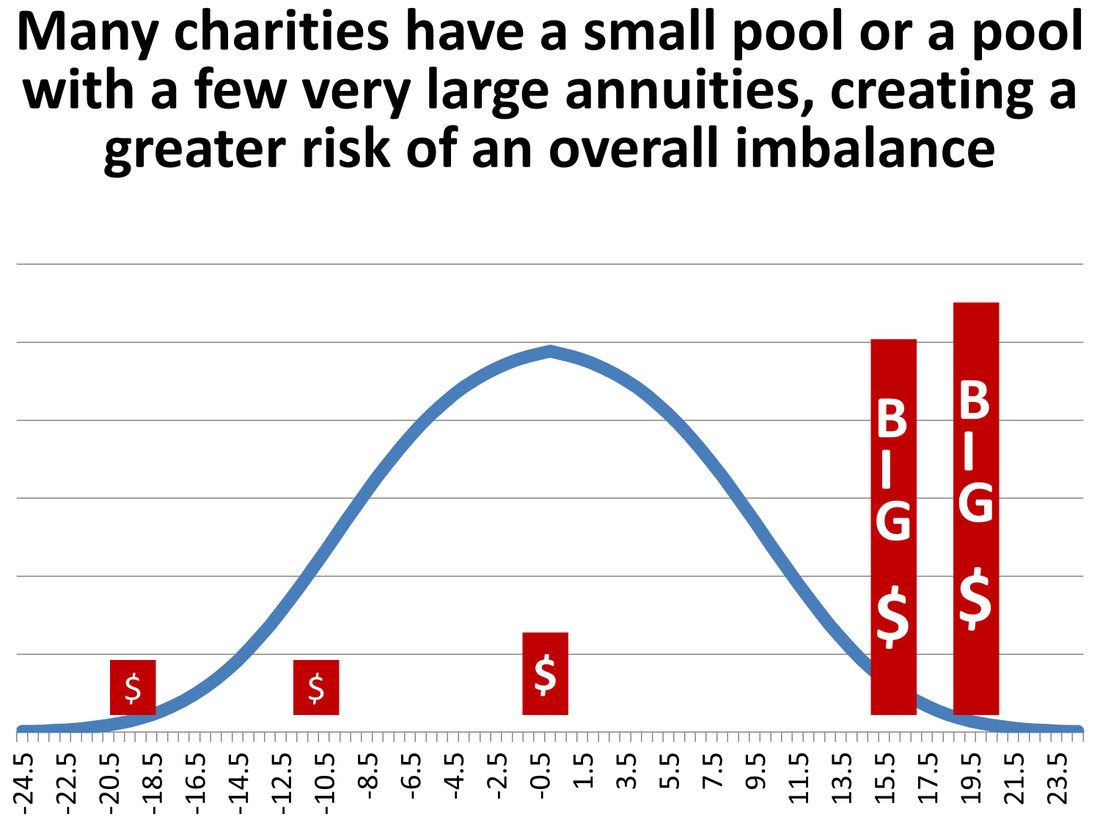
Many charities do not have the protection against longevity risk that comes from having a large pool of annuitants with similar sized annuities. This can occur either because the charity has a small pool of annuitants, or because the charity's pool contains a few very large annuities. A large pool of small annuities will not offset the risk of a few very large annuities. Suppose, for example, a charity has 1,000 annuities paying $1,000 per year and one annuity paying $1 million per year. The risk that the annuitant receiving $1 million per year will live longer than anticipated will not be offset by the early deaths of other annuitants because of the differential in the annuity sizes.
Longevity risk can also be influenced by the age of the donors when purchasing gift annuities. This is an area where the relative risk may be counterintuitive. Using standard payout rates, starting an annuity for an 80-year-old donor is actually riskier than starting one for a 40-year-old donor. This may seem odd, because of the expectation that the 80-year-old person will certainly not, on average, live as long as the 40-year-old. However, the annual payments to the 80-year-old are much larger than those for the 40-year-old. Keeping this in mind, why would the annuity for the older annuitant be riskier?
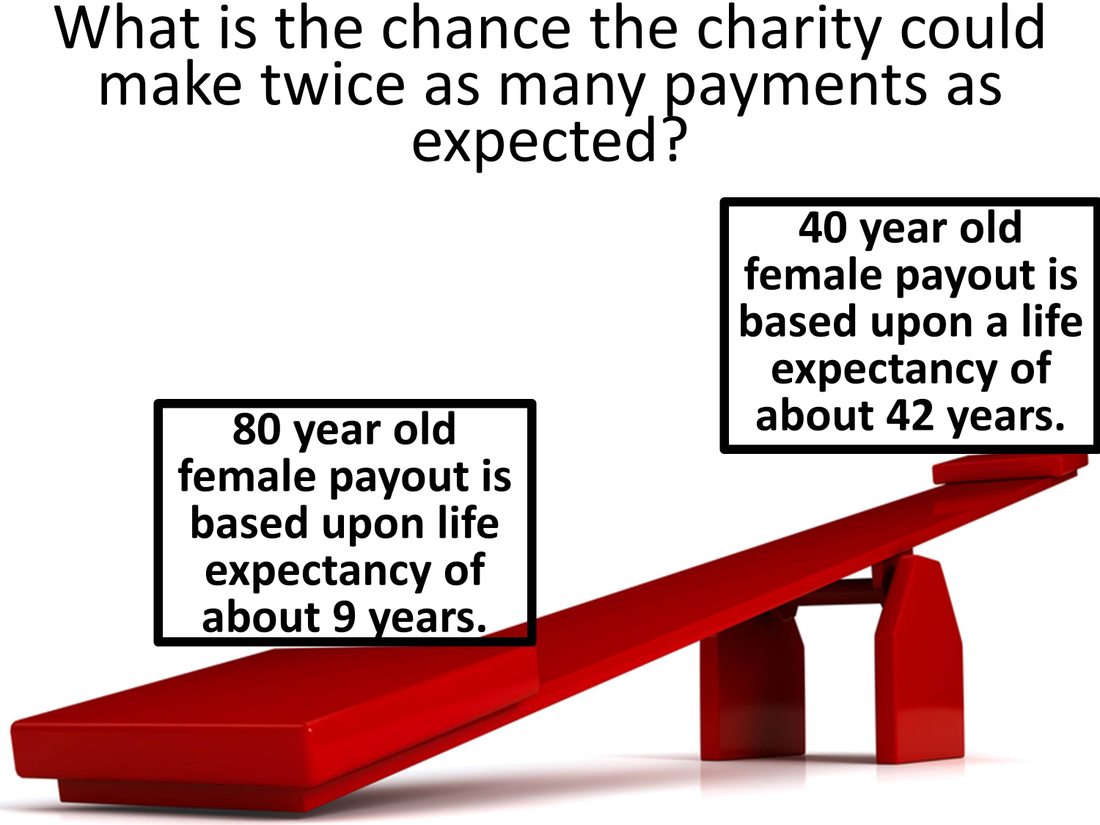
To understand why starting an annuity for the older annuitant is riskier (i.e., subject to greater variation), it helps to ask the question, "What is the chance the charity could make twice as many payments as initially projected?" The payout for an 80-year-old female is based upon a life expectancy of about nine years. If the 80-year-old female lived to the age of 98, the charity would make twice as many payments as projected. The potential for an 80-year-old to live to the age of 98 is quite significant. The payout for a 40-year-old female is based upon a life expectancy of 42 years. In order for the charity to make twice as many payments as projected, this annuitant would have to live to be 124 years old, which is essentially impossible. Thus, in comparison, the charity is far more likely to make twice as many payments as projected to the older annuitant, reflecting the greater risk (variance) with this annuity.
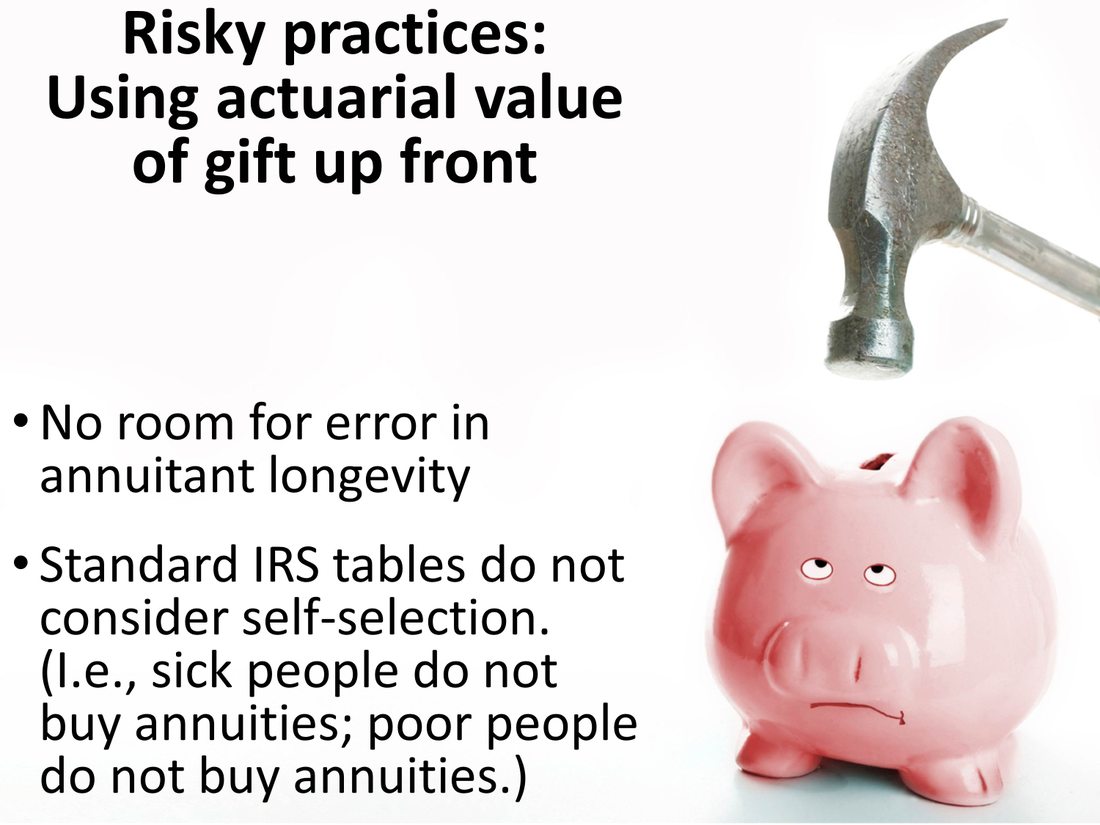
A charity can increase the risk that gift annuity obligations will ultimately siphon money from regular operating income by immediately using the projected gift portion of the Charitable Gift Annuity. This is inherently risky because the annuitants in the charity's pool will live longer than expected approximately half of the time, meaning that the charity has a 50% chance of having to make annuity payments from operating income in the future. This 50-50 chance is increased dramatically if the longevity tables used by the charity to calculate its payment obligations are inappropriate. For tax calculation purposes, the IRS requires the use of its tables based upon standard longevity expectations. However, these tables do not reflect the longevity expectations of people who buy annuities. First, people who are sick or know that they are approaching death do not buy annuities. By eliminating these people who are near death, the pool of individuals who purchase annuities will, on average, live longer than others of the same age. Second, people who are poor do not purchase annuities. Those who are poor do not, on average, live as long as those who are wealthy. Once again, this eliminates a group of individuals with relatively shorter life expectancies from the pool of individuals who purchase annuities. Finally, individuals who make charitable gifts tend to live longer than individuals who do not. Once again, the life expectancy of the pool of those who purchase Charitable Gift Annuities is much longer than the life expectancy of the population in general. Thus, a charity that removed the "gift portion" of a Charitable Gift Annuity as calculated by the IRS, should not expect to be able to cover the annuity payments from the remaining amount. (For a discussion of appropriate estimations of Charitable Gift Annuity life expectancies see Clontz, B. The Methuselah effect: Longevity's impact on planned giving. The National Conference on Philanthropic Planning, 2010.)
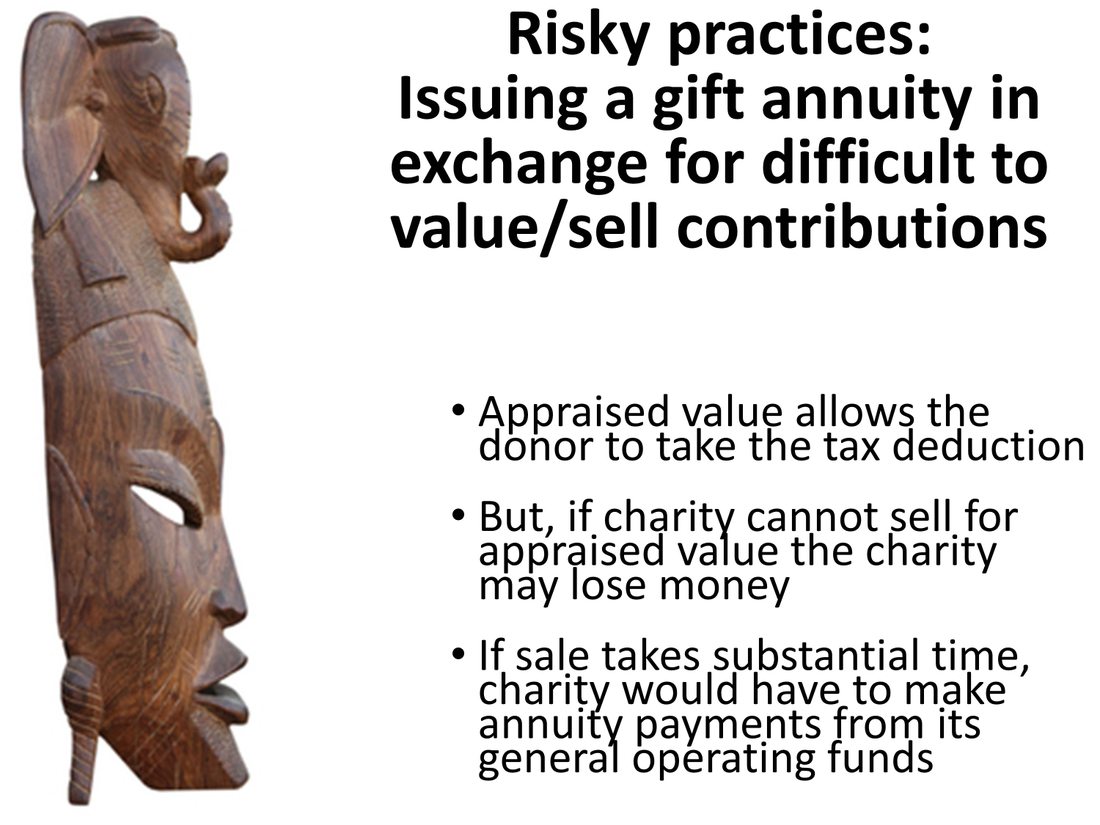
A charity can choose to issue a gift annuity in exchange for any type of valuable property. However, the gift annuity is a risky proposition for the charity if the charity accepts difficult-to-value or difficult-to-sell property in exchange for the annuity. In the case of a simple gift of such property, the charity may get more or less than the appraised value, but the charity still gets some value. However, if the charity exchanges the property for a gift annuity, and later sells the property for less that its originally appraised value, then the charity may have given an annuity worth more than the gift. In other words, the charity can easily lose money on such transactions. Even if the charity is ultimately able to sell the property for its appraised value, if this sale takes some time, the charity will have to make annuity payments from its general operating income in the interim. For these reasons, few charities will accept difficult-to-value or difficult-to-sell property in exchange for a gift annuity.
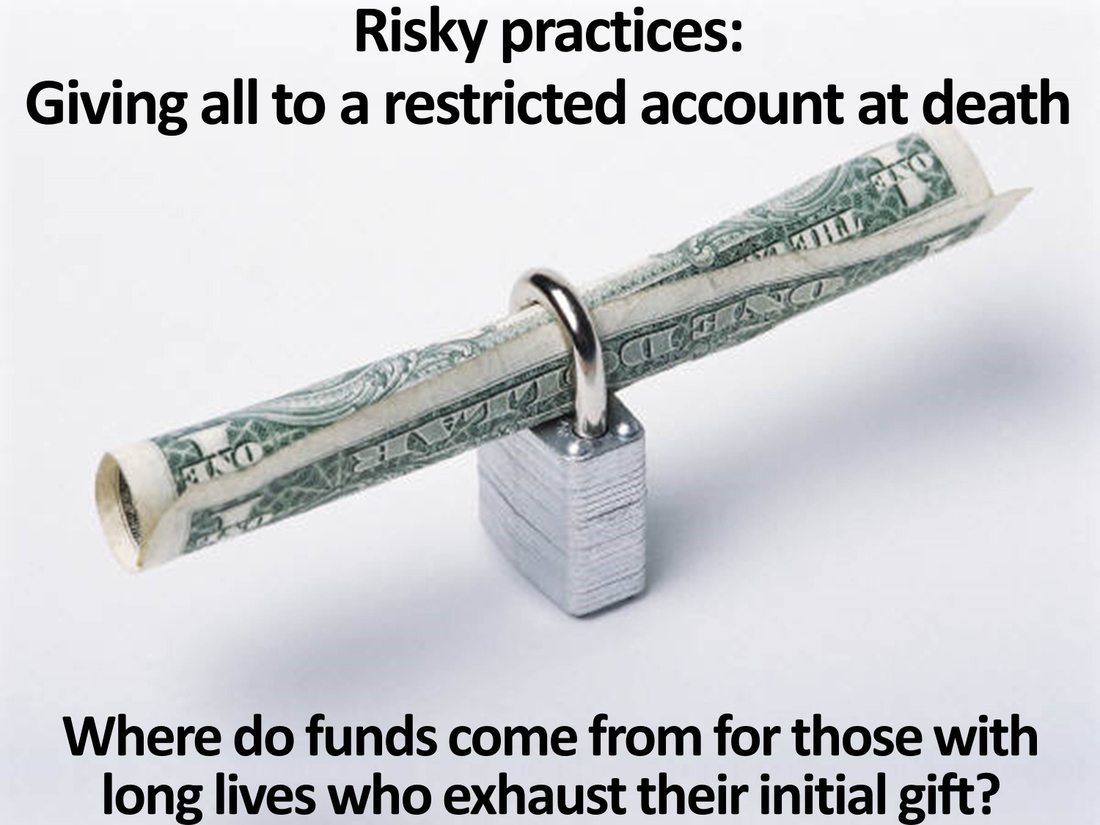
Another practice that increases the likelihood that a charity will ultimately have to make annuity payments from current income is allowing Charitable Gift Annuities to benefit a specific department or project within the charity. There is usually no problem with this practice if the charity holds the initial funds in the restricted account until the annuitant dies, but there can be. The question this raises is "Where do the funds come from for those annuities where the annuitant lives so long that the entire initial contribution is exhausted?" Will the targeted department or project have to make these payments from its operating income? If the payments come from the general annuity pool, then the general pool receives only the penalty from longer lives (which are not paid for by the funds from the restricted purpose), but none of the advantage from shorter lives (which benefits the specific restricted purpose as required by accepting the donor's restrictions). Ultimately, this creates a net transfer from general unrestricted funds to the specific department or project funds over and above the donor's restriction. Although accepting such restricted purpose Charitable Gift Annuities may still be a wise fundraising strategy, the charity must recognize the potential for this secondary drain on funds available for unrestricted, general purposes.
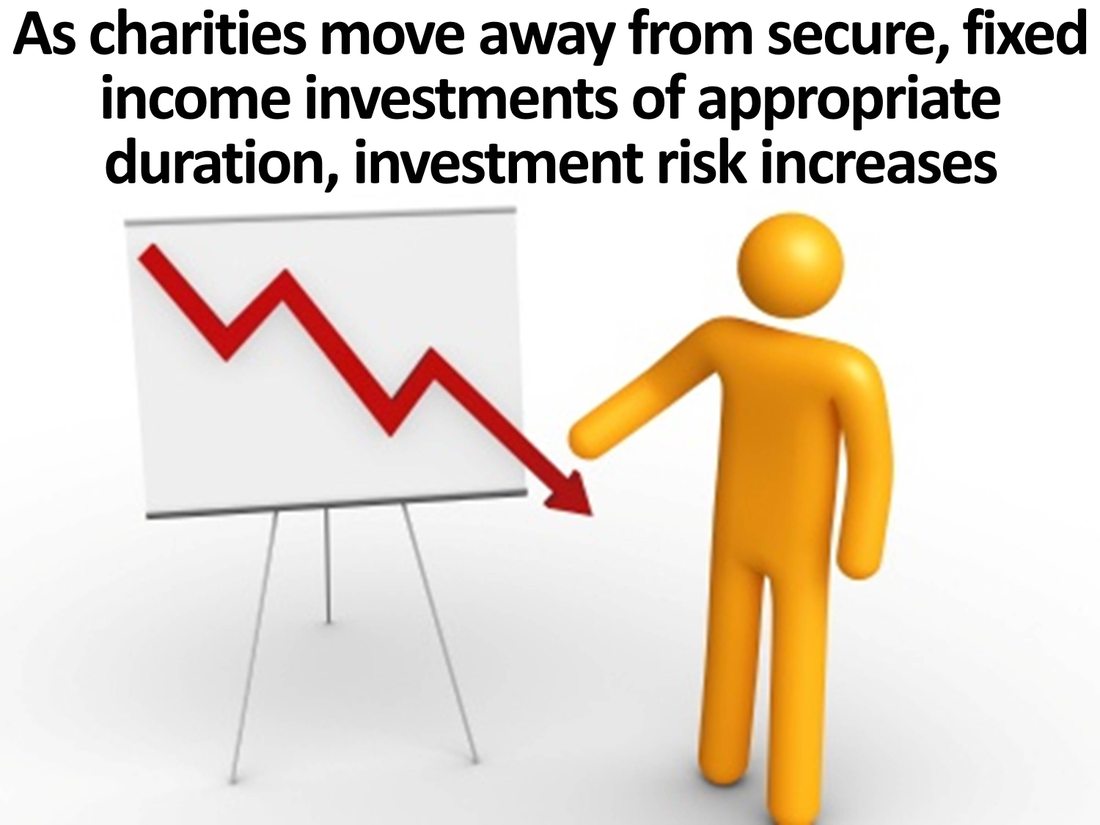
To this point we have been discussing primarily the risk that a donor will live longer than expected. However, the charity may also have investment risk. When issuing a Charitable Gift Annuity, the charity takes a large sum of money upfront, and uses it to pay annual payments for a long period of time. This involves investing the upfront sum of money.
As the charity increases the risk for its investments, it increases the risk that those investments will perform poorly, ultimately requiring the charity to make annuity payments out of current operating income. To reduce investment risk to a minimum, a charity could invest in only secure fixed income investments of appropriate duration to closely match the payment obligations. Of course, as risk diminishes so too does the expected return and consequently the expected amount remaining at the death of the annuitant. Some charities invested their gift annuity pools heavily or entirely in equities during good times, and subsequently pulled out of equities following a market crash, resulting in gift annuity pools with net liabilities to the organization.
It is important to note that investment duration also plays a role in investment risk for annuity payments. For example, charities that issued gift annuities during a high interest rate environment, and then "conservatively" invested in secure short-term fixed income investments, were later faced with making these high annuity payments when interest rates for short-term fixed income investments had fallen dramatically. If instead the charity had invested in secure fixed income investments that matched the duration of the expected annuity payments, then subsequent changes in interest rates would not have caused problems. Essentially, the charity would have locked in the high interest rate investments at the same time the charity made the high interest rate commitment.
These sources of risk do not suggest that charities should avoid issuing gift annuities, because these risks are all manageable. An investment portfolio can be constructed to match the annuity payment obligations subject to the charity's risk/reward preferences.
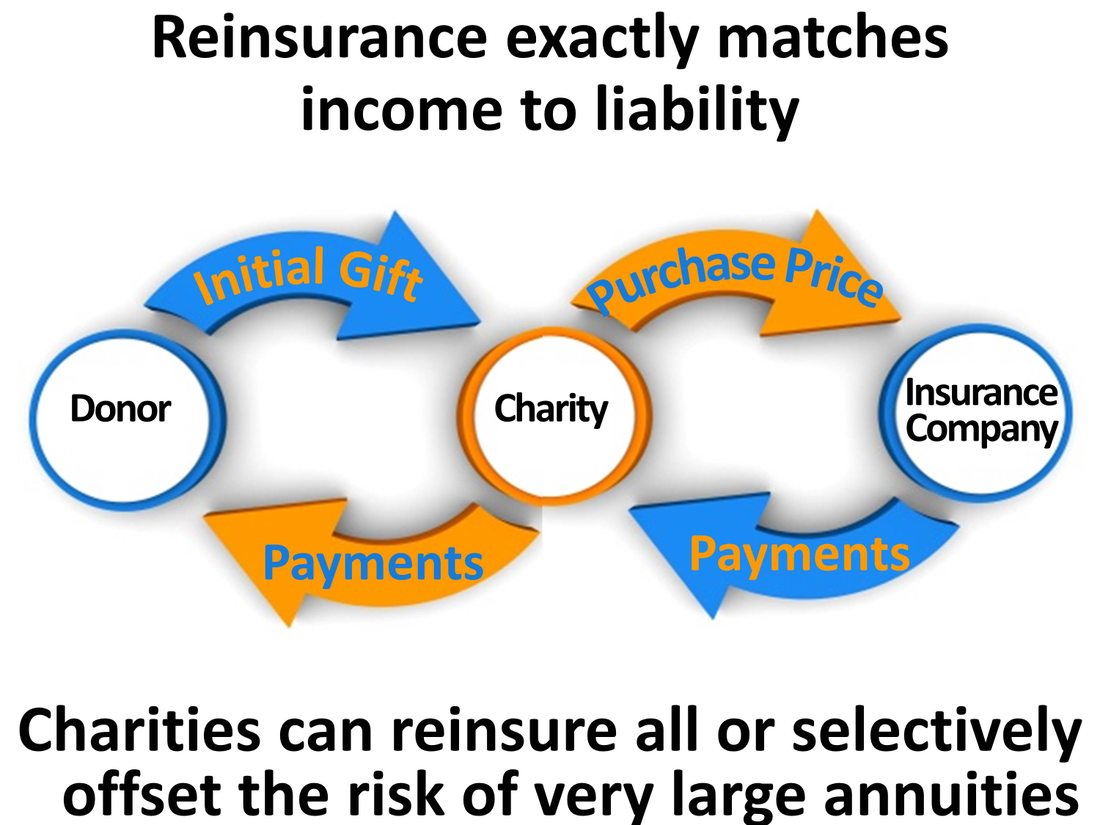
Of course, the "perfect match" for the annuity payment obligation is a commercial annuity. In this case, the charity simply purchases an annuity on the annuitant's life from an insurance company. Assuming the stability of the insurance company, the charity transfers all market risk, interest rate risk, and annuitant longevity risk. The charity simply becomes a conduit through which the insurance company annuity payments are made. Because the Charitable Gift Annuity includes a gift portion, there is enough money to purchase the commercial annuity and have funds remaining for charitable purposes. Additionally, by purchasing these commercial annuities the charity may immediately use the remaining funds. (This is true in all jurisdictions. Even those States with gift annuity reserve requirements recognize that there are no reserves needed where a commercial annuity substitute has been purchased.) The downside to this transaction is that the price of a commercial annuity includes not only the cost of making the payments, but also a profit for the issuing company. Thus, in theory, the charity could retain this profit margin by managing its own gift annuity pool. However, in practice, this may be difficult because managing a pool appropriately requires both expertise and a sufficiently large number of annuitants to reduce unexpected longevity risk. Even a charity that does not reinsure all of its gift annuities may appropriately consider reinsuring only its very large annuities. This is because a large pool of small annuities will not be sufficient to offset the longevity risk for a small number of very large annuities. In this case, the only way for a charity to manage the risk that an annuitant with a very large annuity will live much longer than expected is to purchase a commercial annuity for that obligation, because there are simply not enough other large annuities in the charity's pool to offset the risk.
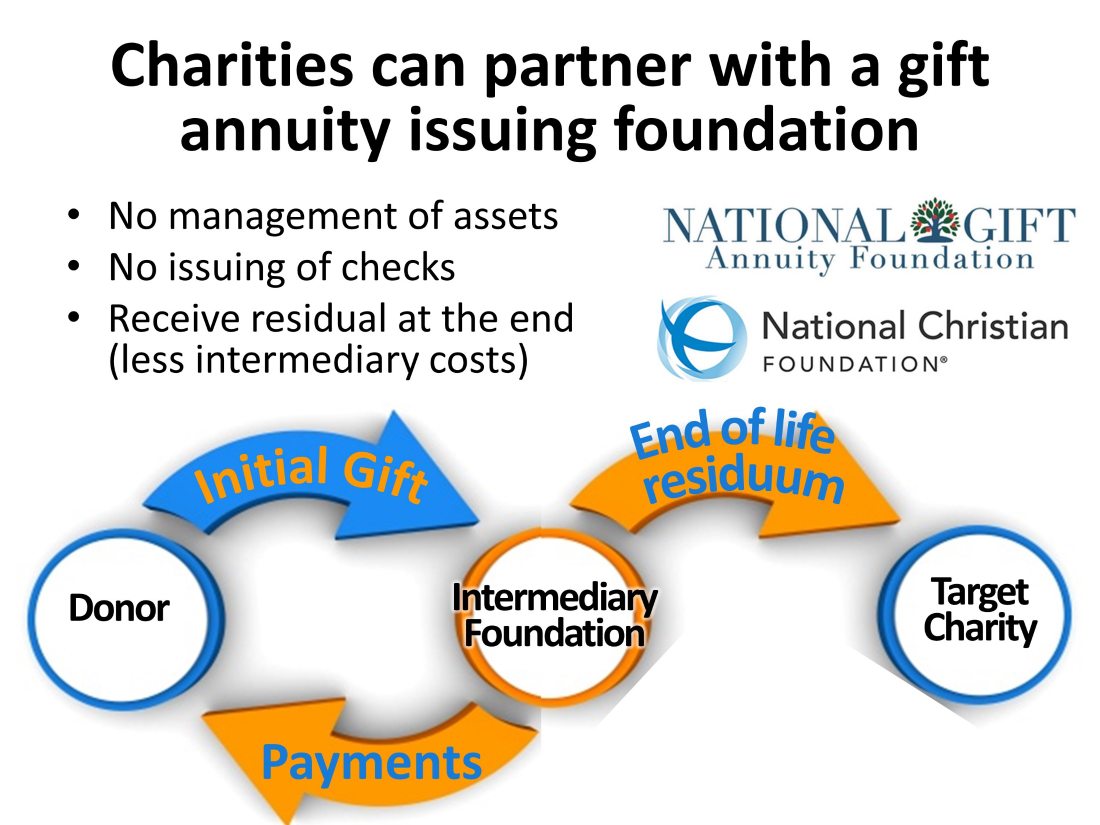
Additionally, charities can avoid all management issues by directing donors to buy a charitable gift annuity from an intermediary gift annuity foundation. The foundation invests the assets, issues annuity payments to donors, and at transfers a residuum to the target charity. Although using such an intermediary does include management fees for such services, this relief of administrative duties, investment risk, and longevity risk can be enormously beneficial for the charity. See, e.g.,
. nationalgiftannuity.org
. www.ncfgiving.com/solutions/charitable-gift-annuity/

Financial advisors can become involved with Charitable Gift Annuities in a number of ways. As mentioned above, managing a gift annuity pool requires expertise to match the obligations with the investments and the charity's risk/reward preferences. This is precisely the kind of expertise that financial advisors may bring to a charity. Additionally, financial advisors can be helpful to a charity in managing its risk not only through appropriate investments, but also through the purchase of matching commercial annuities, either selectively for very large gift annuities, or universally for all gift annuities. Financial advisors can also be helpful to their clients who are considering gift annuities by examining the financial stability of the issuing nonprofit organization. Financial advisors may also be able to benefit the nonprofit organization (while simultaneously building a client base) by providing information to a nonprofit's donors about planned giving products such as Charitable Gift Annuities in cooperation with the charity.
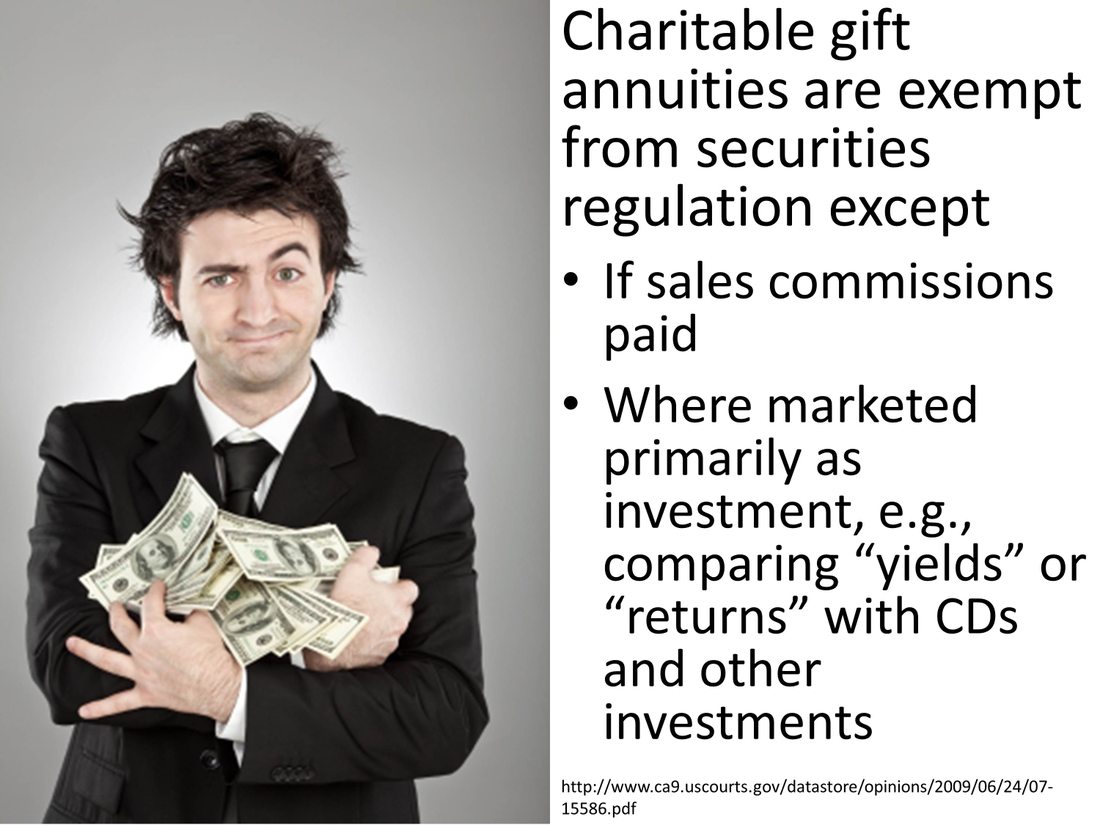
A major benefit of Charitable Gift Annuities is that they are generally exempt from securities regulations. This is what permits nonprofit organizations to sell gift annuities in a largely unregulated environment. However, there are cases where the sale of a Charitable Gift Annuity will lose its exemption from securities regulation. This is a major issue because if the exemption is lost then the sale of these securities can result in criminal penalties (and, in fact, has resulted in jail time in previous cases). The sale of Charitable Gift Annuities will not be exempt from securities regulation where the annuities are marketed primarily as investments, rather than as a means to benefit the charity. An example of marketing a Charitable Gift Annuity as an investment is to compare the "yields" or "returns" with bank certificates of deposit, or other traditional investments. (As discussed previously an annuity payment rate is not a yield or a return, and thus, such comparisons are, prima facie, inappropriate.) The sale of Charitable Gift Annuities will also lose exempt from securities regulations if sales commissions are paid. Additionally, Charitable Gift Annuities may not vary payments based upon the future income generated from investments (including the originally donated property). This variability feature, available in commercial variable annuities, also results in the loss of exemption from securities regulations.
Charitable Gift Annuities are a handy and frequently used gift planning vehicle. Although simple in form and easy to complete, gift annuities do offer some flexibility in their structure. The simplicity in creating these agreements conceals a substantial complexity in understanding and managing the underlying risks. This complexity expands substantially when considering the full tax implications of Charitable Gift Annuities. As such, these tax implications are discussed in their own separate chapter.