
A DONOR MAKES A GIFT AND IN RETURN RECEIVES ANNUAL PAYMENTS FOR LIFE FROM THE CHARITY. THIS IS THE BASIC CONCEPT OF A CHARITABLE GIFT ANNUITY. DESPITE THIS UNDERLYING SIMPLICITY, UNDERSTANDING THE TAX IMPLICATIONS OF A CHARITABLE GIFT ANNUITY CAN BE QUITE COMPLEX - SO COMPLEX, IN FACT, AS TO WARRANT THIS SEPARATE CHAPTER. WHAT CAUSES THIS COMPLEXITY IN TAX CONSEQUENCES FOR CHARITABLE GIFT ANNUITIES?
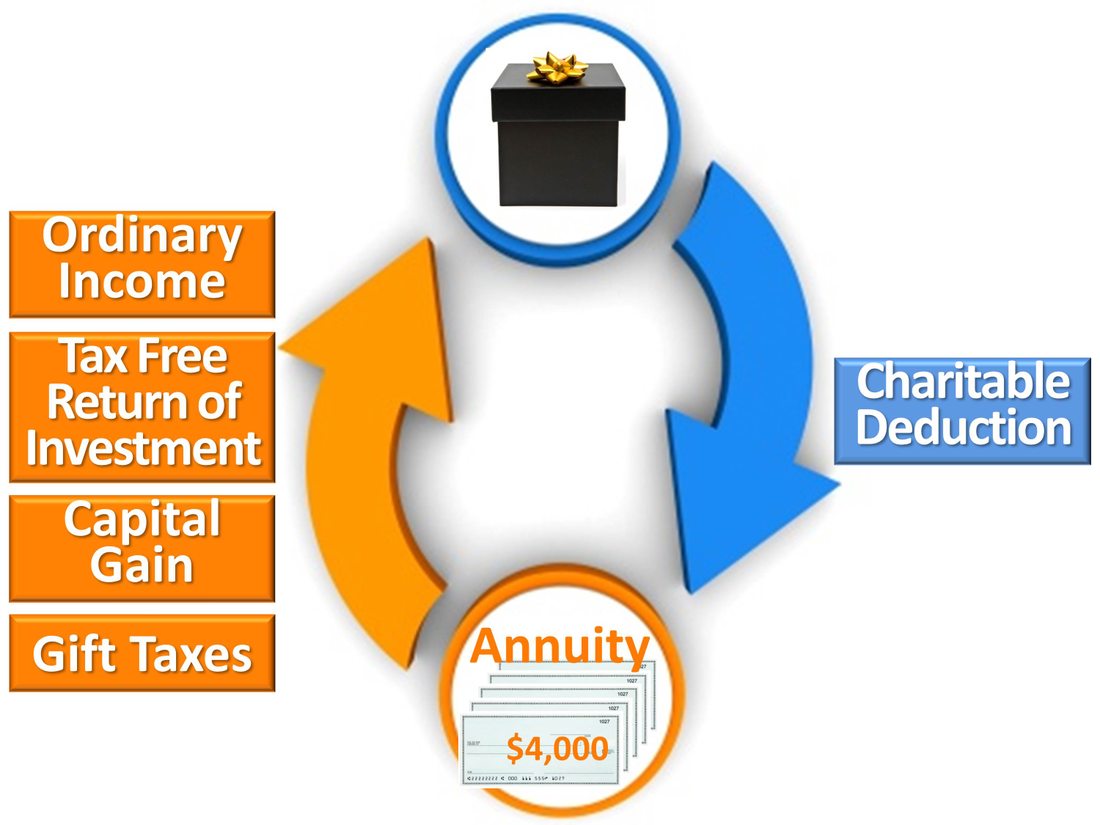
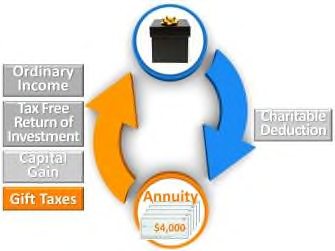
The complexity begins with the reality that Charitable Gift Annuities generate potential tax consequences in five different ways. The Charitable Gift Annuity is, at least in part, a charitable gift. Because it is a charitable gift, it generates a charitable income tax deduction for the donor. However, unlike other forms of charitable gifts, the Charitable Gift Annuity also generates a stream of payments to the annuitant. This lifetime stream of payments produces its own set of tax results. Some part of each payment will count as ordinary income to the recipient. Some part of some payments may also count as tax-free return of investment. If the gift given to the charity in exchange for the annuity was appreciated property, then some part of some payments may also be taxed as capital gain. Finally, if the donor decides not to take the payments for himself, but instead provides a lifetime income for someone else (other than the donor's spouse), then the donor has made a potentially taxable gift to the recipient. Thus, this single gift vehicle can result in capital gain income, ordinary income, an income tax deduction, tax-free return of capital, and a taxable gift. Let's begin with the calculation of the income tax deduction generated by the purchase of a Charitable Gift Annuity.

A Charitable Gift Annuity is a form of a bargain sale. As with other bargain sales, the charitable tax deduction is based on the value of what the donor contributed less the value of what the donor received. Determining the value of what the donor contributed is relatively easy. If the donor gave $10,000 in cash, then the value of the donor contribution is $10,000. Determining the value of what the donor receives in exchange for the gift (i.e., the value of the annuity) can be a bit more challenging.
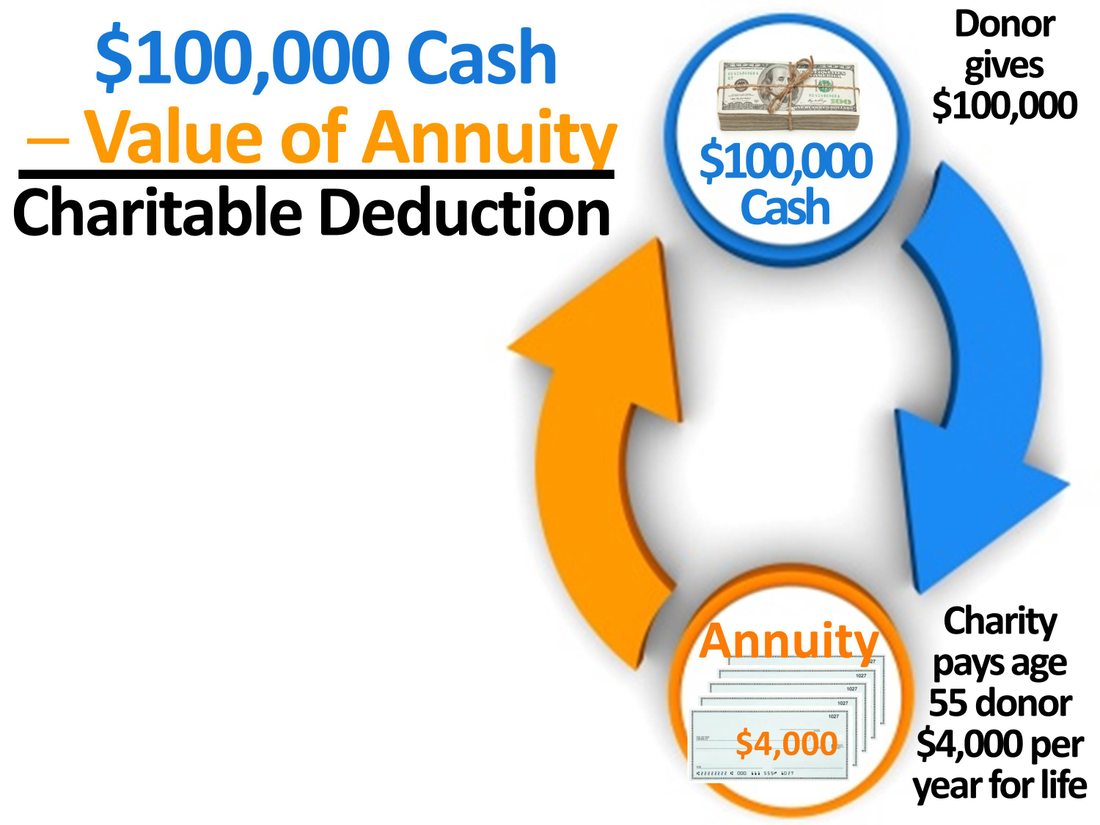
Let's look at an example that we will return to throughout this section. Suppose that a donor, age 55, gives $100,000 in cash to a charity, and in exchange, the charity agrees to pay the donor $4,000 per year for his life. The charitable deduction will be the value of what the donor gave to the charity less the value of what the donor received from the charity. Determining the value of what the donor gave to the charity is simple. He gave $100,000.

But, how do we determine the value of the annuity that the donor received in return for his gift? If the donor died immediately after making the contribution, then he would not have received any payments from the charity. On the other hand, if the donor lived for 50 more years, then the donor would receive 50 X $4,000 (i.e., $200,000) from the charity in exchange for his gift. Because it is impractical to wait 50 years to determine the donor's charitable deduction, we must instead estimate the projected value of the annuity at the time that the gift annuity was purchased. Thus, the value of the annuity will be based upon the idea that the annuitant will live to his projected life expectancy. The reality of the annuitant's actual life span will not affect either the initial valuation of the annuity or the charitable deduction. In our example, the value of the annuity is the value of receiving $4,000 each year for the life expectancy of a 55-year-old. The value of this payment stream will depend upon the prevailing interest rates. Why? Consider this. Generating $4,000 each year when interest rates paid 4% would require a $100,000 investment. If interest rates paid 1%, this would require a $400,000 investment. And if interest rates paid 16%, this would require only a $25,000 investment. Thus, the value of a $4,000 per year payment depends heavily on the prevailing interest rates. Fortunately, the IRS has a prescribed process for determining the appropriate interest rate and calculating the value of annuities. Let's now walk through that process step-by-step.
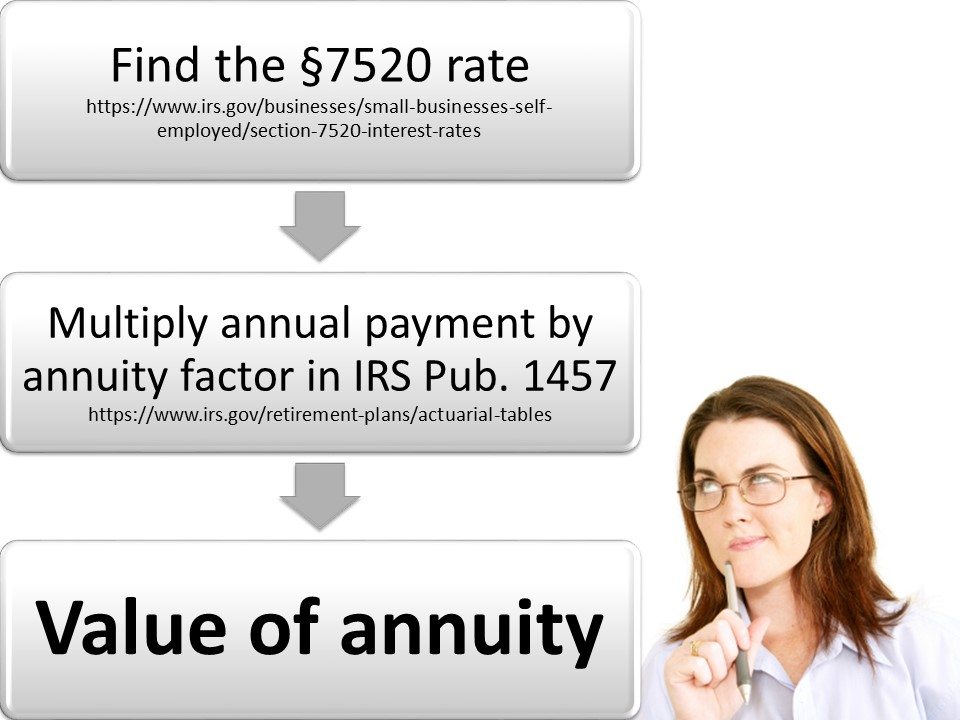
The first step in valuing an annuity is to determine the appropriate interest rate. For purposes of calculating the deduction for a Charitable Gift Annuity, the relevant interest rate is referred to as the §7520 rate. This rate is published on the IRS website at:
https://www.irs.gov/businesses/small-businesses-self-employed/section-7520-interest-rates (It is also published on a variety of other planned giving websites.) Once we know the appropriate interest rate, we can find the appropriate annuity factor in the actuarial tables posted at
https://www.irs.gov/retirement-plans/actuarial-tables Multiplying this annuity factor by the annual payment gives us the value of the annuity for purposes of our income tax deduction. Let's now walk through each step for our example Charitable Gift Annuity.
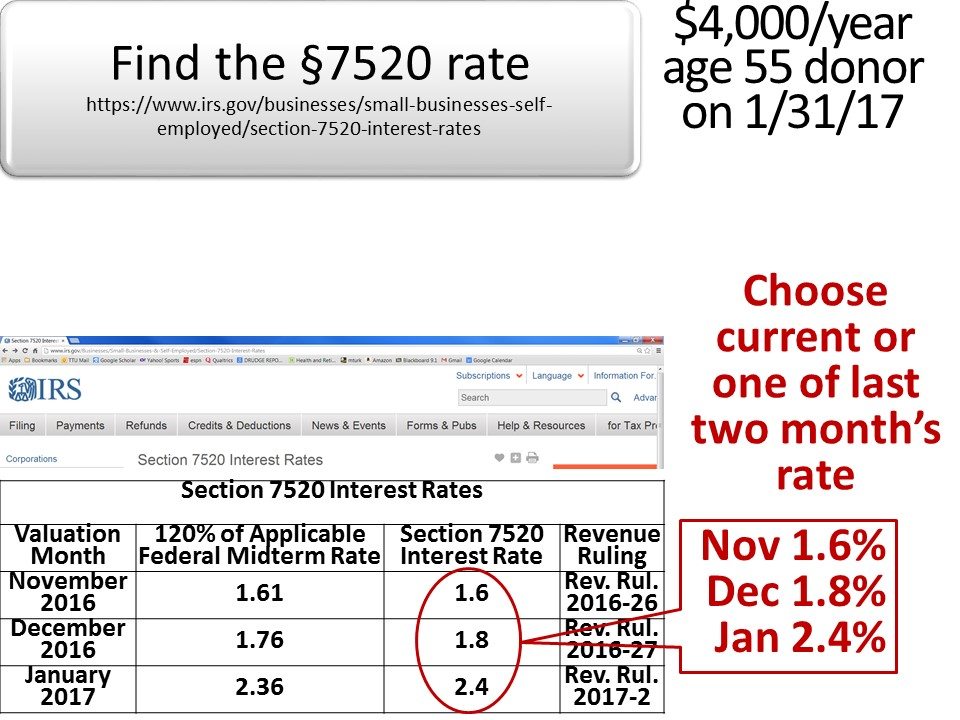
The first step in valuing the annuity is to determine the appropriate interest rate. Because the §7520 interest rates change each month, we will have to set a date for our hypothetical transaction. So, let's assume that our 55 year old donor gave $100,000 in exchange for a $4,000 per year annuity on January 31 of the year 2017. The IRS website for the §7520 interest rates shows that January had a 2.4% rate. However, tax law allows the donor to choose the current or either of the prior two month's §7520 interest rate for his calculation. (In fact the next month's rates are published several days early, so towards the end of the month, the donor also knows the interest rate for the upcoming month and could postpone the transaction in order to take advantage of a favorable rate change.) For a transaction on this date, the donor could choose the 2.4% rate from January or the 1.6% rate from November or the 1.8% rate from December. Which rate should the donor choose?
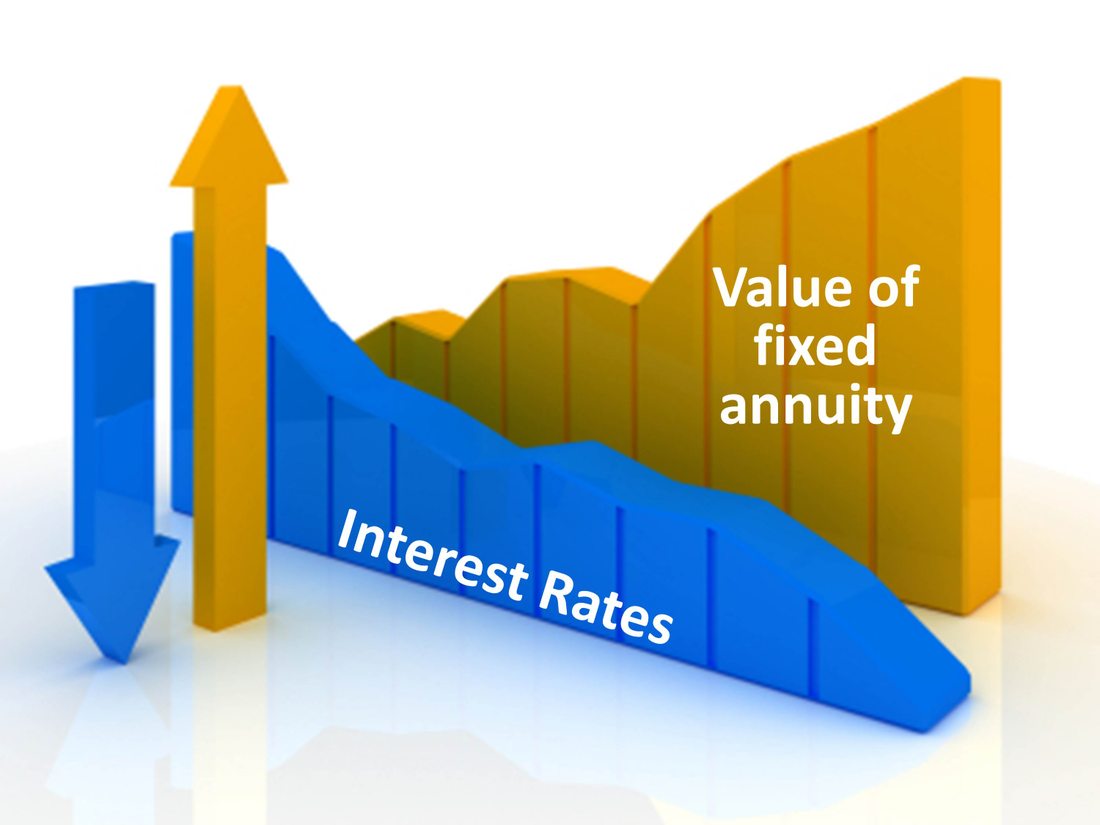
As discussed previously, the value of the annuity depends upon the current interest rates. As interest rates rise, it takes a smaller and smaller investment to generate $4,000 per year. Thus, the value of a $4,000 per year payment falls as interest rates rise. So, if the donor selects the higher interest rate (2.4%), the annuity the donor receives from the charity will be valued at less than if the donor selected the lower interest rate (1.6%). Does the donor want the annuity he receives to be valued higher or lower? In most cases, the donor is interested in having the highest charitable income tax deduction. Here, the donor's deduction will be $100,000 minus the value of the annuity. As the interest rate rises, the value of the annuity falls. As the value of the annuity falls, the value of the donor's deduction rises. Consequently, the donor will choose the higher interest rate (2.4%) in order to generate the highest charitable income tax deduction. (Choosing the higher interest rate is normally the "right" answer for a donor. However, if the donor cannot make use of the income tax deduction, then the lower rate is preferable because, as discussed later, it will increase the amount of each payment considered to be tax-free return of investment.)
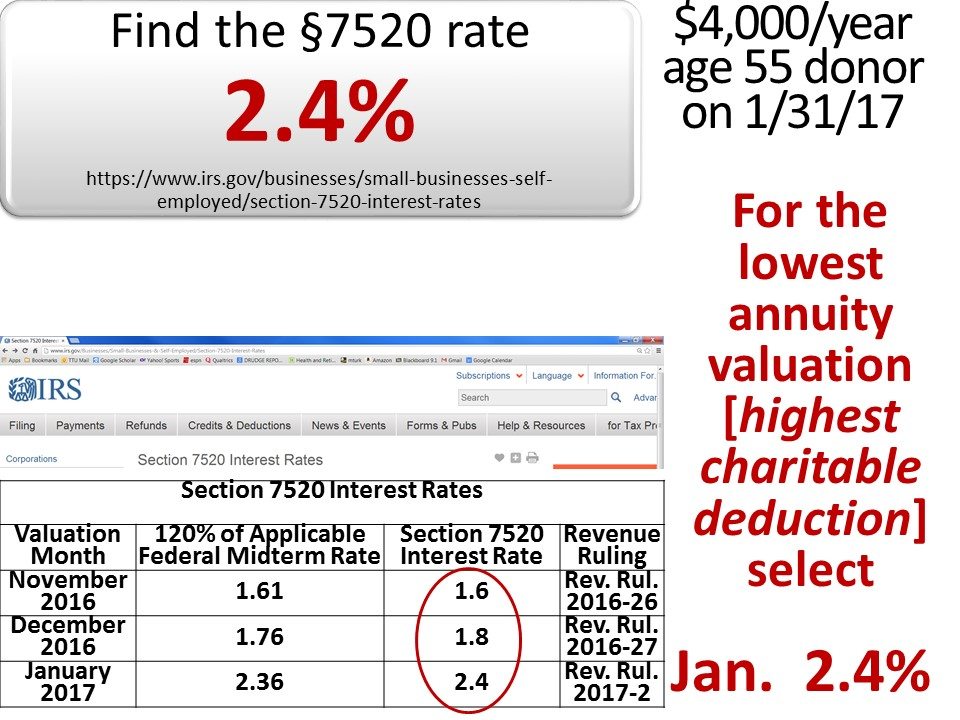
Because our donor wants the highest charitable deduction, he consequently wants the lowest valuation for his annuity. (Remember that the charitable deduction is the value of what the donor gives to the charity less the value of what the donor receives back from the charity. In this case, what the donor receives back is the annuity.) To get the lowest valuation for his annuity, the donor chooses the highest §7520 interest rate, in this case 2.4%.
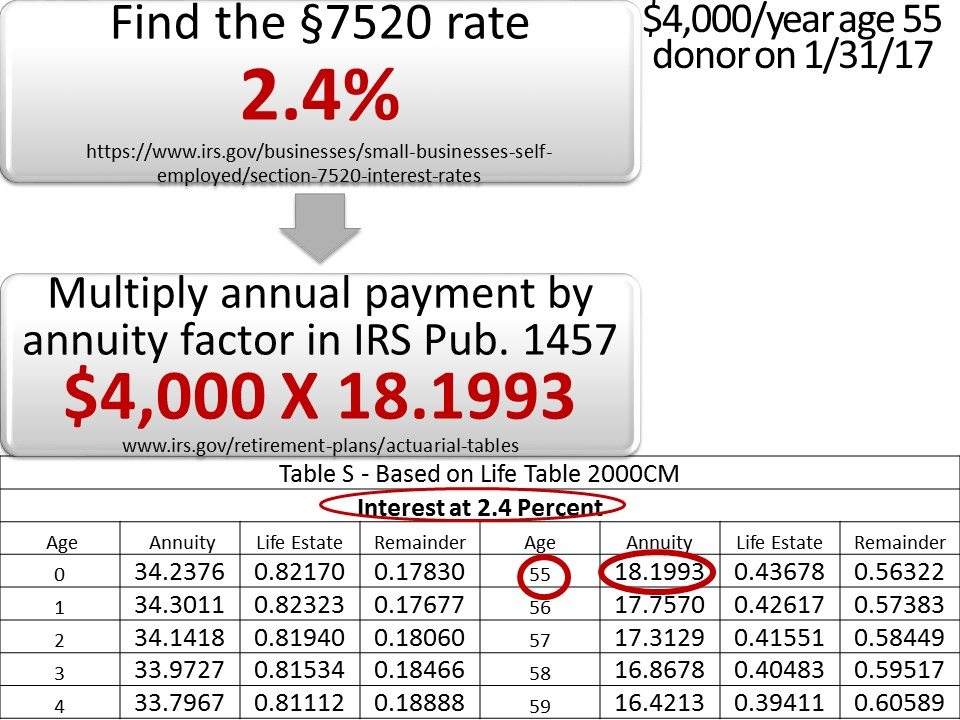
After identifying the appropriate §7520 interest rate (2.4%), we next look at the relevant actuarial tables. Going to the IRS webpage (www.irs.gov/retirement-plans/actuarial-tables) provides links for tables of single life factors and last-to-die factors. In this case, the annuity pays for the life of the donor only and so we will use the table for single life factors (Table S). Scrolling down through this table until we reach the section for a 2.4% interest rate reveals the annuity factor for each age at this interest rate. Because our annuitant is age 55, we use the annuity factor of 18.1993. (Of course, if the annuitant were a different age or if the interest rate were different, then this annuity factor would also be different.) This annuity factor of 18.1993 is multiplied by the annual payment amount of $4,000 to generate the value of the annuity for purposes of calculating the income tax deduction.
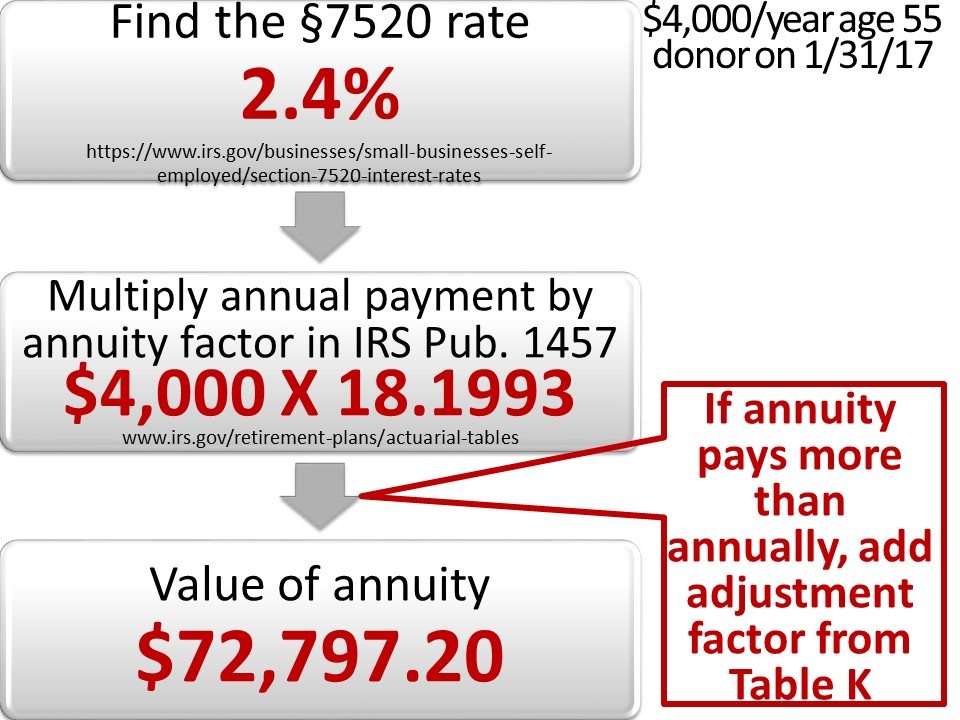
An annuity factor of 18.1993 multiplied by an annual payment of $4,000 generates a value for this annuity of $72,797.20. (As a point of comparison, if the donor had chosen the lower interest rate of 1.6%, then the annuity factor would have been 20.2512 and the annuity would have been valued at $81,004.80. The use of this lower interest rate would have reduced the donor's tax deduction by over $8,200.)
Charities are allowed to make annuity payments more frequently than once per year. This slightly modifies the valuation of the annuity because the donor does not have to wait as long to receive his payment. (For example, if the annuitant is paid annually, he must wait 12 months to receive his first check, but if he is paid weekly he only waits 7 days. In either case, the total payments in each year still sum to $4,000. But, receiving the payments earlier in the year is more valuable than being required to wait until the end of the year.) This increase in value due to more frequent payments is calculated by multiplying the initial value by the frequency factor found in Table K. Table K is found at the same webpage with the other actuarial tables. The frequency factor for annual payments is simply 1.0, meaning that no valuation adjustments are made. The frequency factor for semi-annual, quarterly, monthly, and weekly payments will be greater than one and will depend upon the current §7520 interest rate. (The value of receiving the payment earlier depends upon how much interest that early payment could earn between the time it was received and the time the later payment would have been received.)
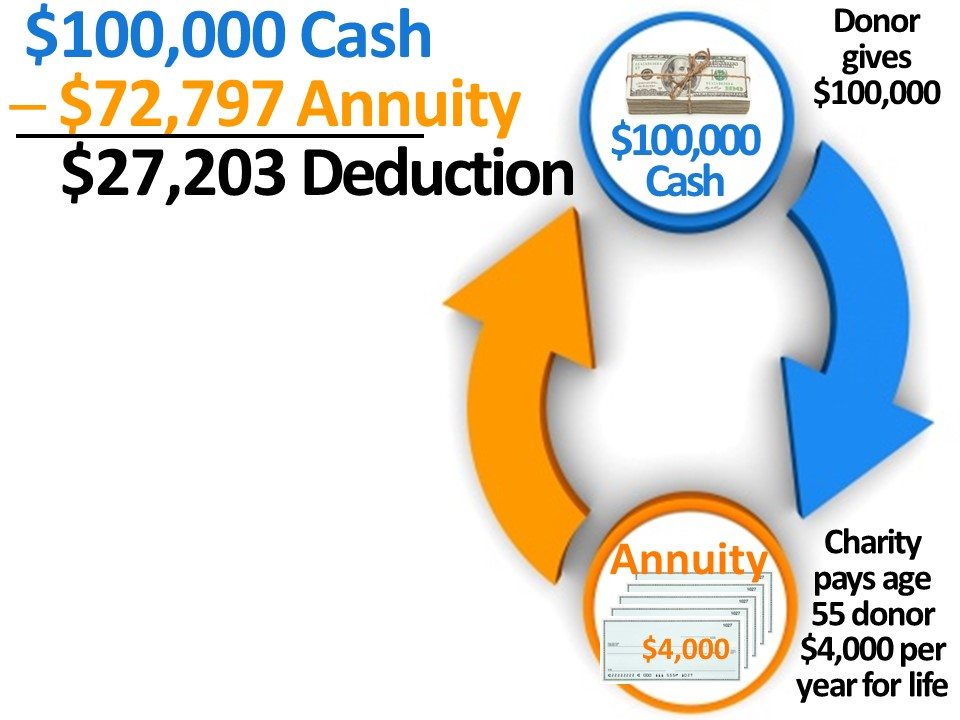
Having determined the value of the $4,000 per year lifetime payments to the donor, i.e., the value of the annuity, it is now easy to calculate the charitable deduction. As with any bargain sale, the charitable deduction is simply the value of what the donor gave to the charity (in this case cash worth $100,000) less the value of what the donor received from the charity (in this case an annuity worth $72,797.20). Thus, this transaction generates a $27,202.80 deduction for the donor.
Note that this calculation is based upon a $4,000 per year payout to a donor age 55 and corresponds with the suggested rates offered at the time of the transaction by the American Council on Gift Annuities. Charities are always open to paying a lower annuity than the suggested rates. It is good practice for charities to present a Charitable Gift Annuity proposal with three different payout rates, high (e.g., $4,000 per year as per the American Council on Gift Annuities suggested rate), medium (e.g., $3,000 per year), and low (e.g., $2,000 per year). Remembering that the goal of the donor is, in part, to benefit the charity, the lower rates may more closely match the donor's preferences and income needs while maximizing the benefit to the charity. If a donor chose one of the lower payout rates, the value of the resulting annuity would be less and, consequently, the charitable income tax deduction would be greater.
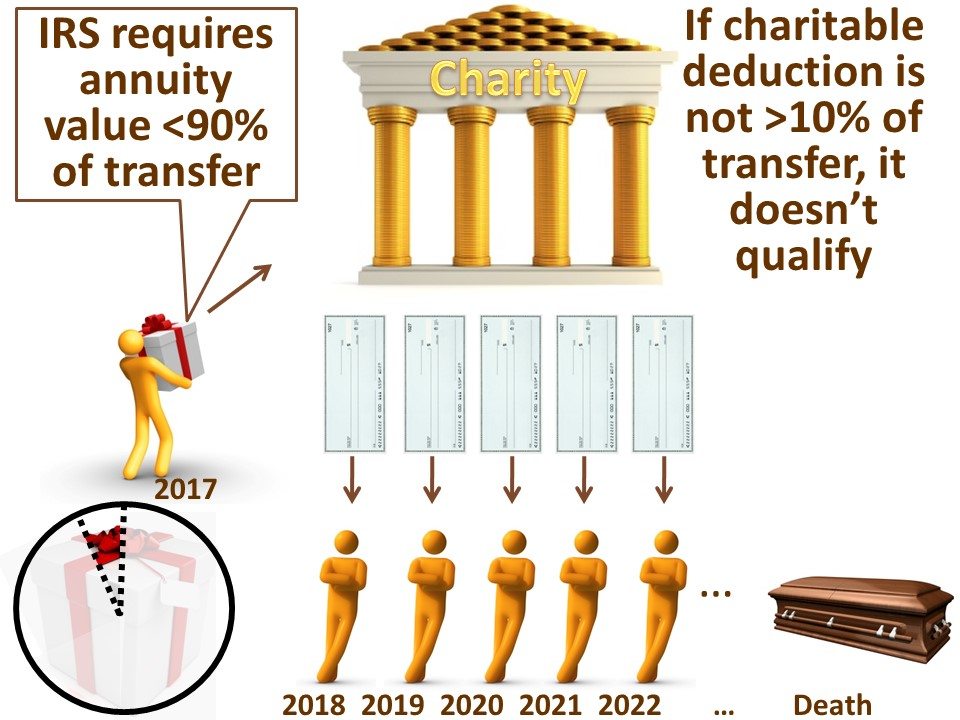
In our example, the charitable deduction was approximately 27.2% of the $100,000 given by the donor. Of course, if the charity had paid the donor more than $4,000 per year for life, then the charitable deduction would have been less. There is, however, a limit on how much the charity can pay to the donor. The IRS requires that the value of the annuity given to the donor must be less than 90% of the value of the gift the donor gives to the charity. A quick way to see that this requirement has been satisfied is to make sure that the charitable deduction is greater than 10% of the amount given to the charity by the donor. If this rule is violated the charity will be treated as if it is engaging in an unrelated (non-charitable) business and will be taxed accordingly. Consequently, charities do not normally offer gift annuities that violate this rule.

Our first example was the simplest Charitable Gift Annuity case where the donor gives cash in exchange for lifetime payments. However, married donors are frequently interested in payments that last for two lives, rather than just one. Two-life annuities are allowed and there is no requirement that the annuitants be related. (However, annuities for more than two lives are not permitted.) The actuarial tables used in the single life example will not work for a two-life annuity. Consequently, we must slightly alter the process for valuing such annuities.
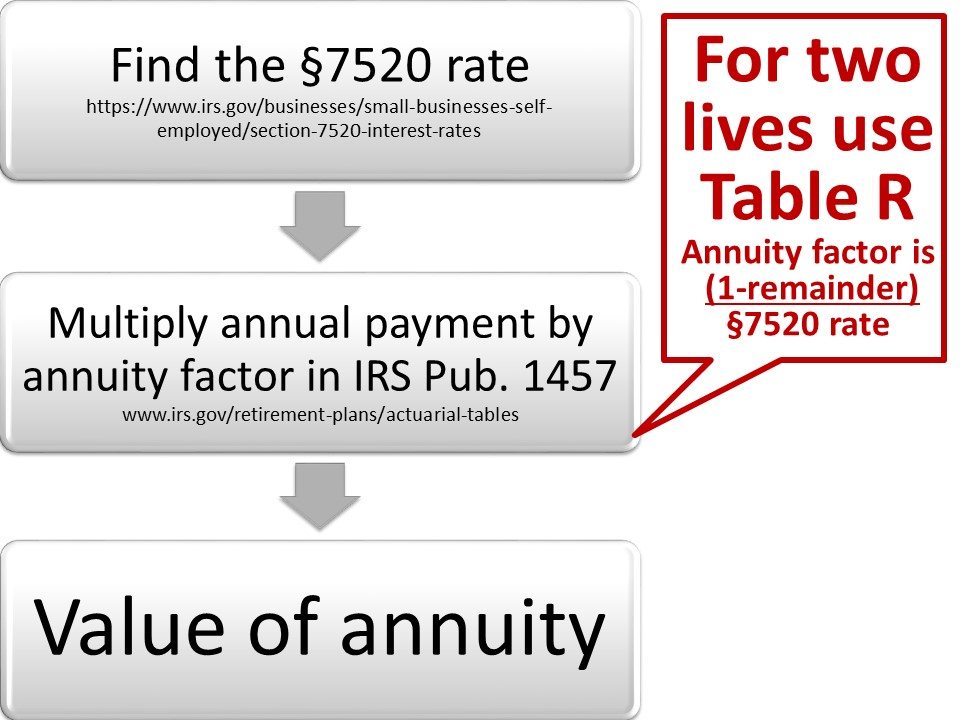
For two-life annuities, calculating the value of the annuity uses Table R, rather than Table S. However, Table R looks different from Table S. Where Table S has three numbers for each age (the annuity factor, the remainder interest, and the life estate), Table R has only one number for each age combination. This one number is the remainder interest factor. But, we don't want the remainder interest factor; instead, we want the annuity factor. Using Table R requires knowing that the annuity factor is calculated by subtracting the remainder interest factor from one and then dividing this amount by the current §7520 rate. Thus, calculating the annuity factor for a two-life annuity will have one extra step.

As in the example for a single life annuity, once we know the value of the annuity given by the charity, we are able to calculate the tax deduction. The deduction is the amount given by the donor to the charity less the value of the annuity given by the charity to the donor.
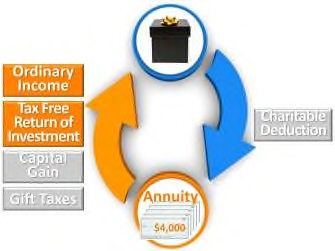
Knowing how to value the annuity allows us to calculate the charitable tax deduction resulting from purchasing the Charitable Gift Annuity. However, the tax implications of a Charitable Gift Annuity do not end there. Unlike other gifts, the Charitable Gift Annuity produces a lifetime income stream. Each year (or quarter, month, or week) the annuitant receives a check from the charity. How should the annuitant report this check to the IRS? Let's begin with the simple transaction where the Charitable Gift Annuity was purchased with cash. In that case, each check will be reported as some combination of ordinary income and tax-free return of investment.
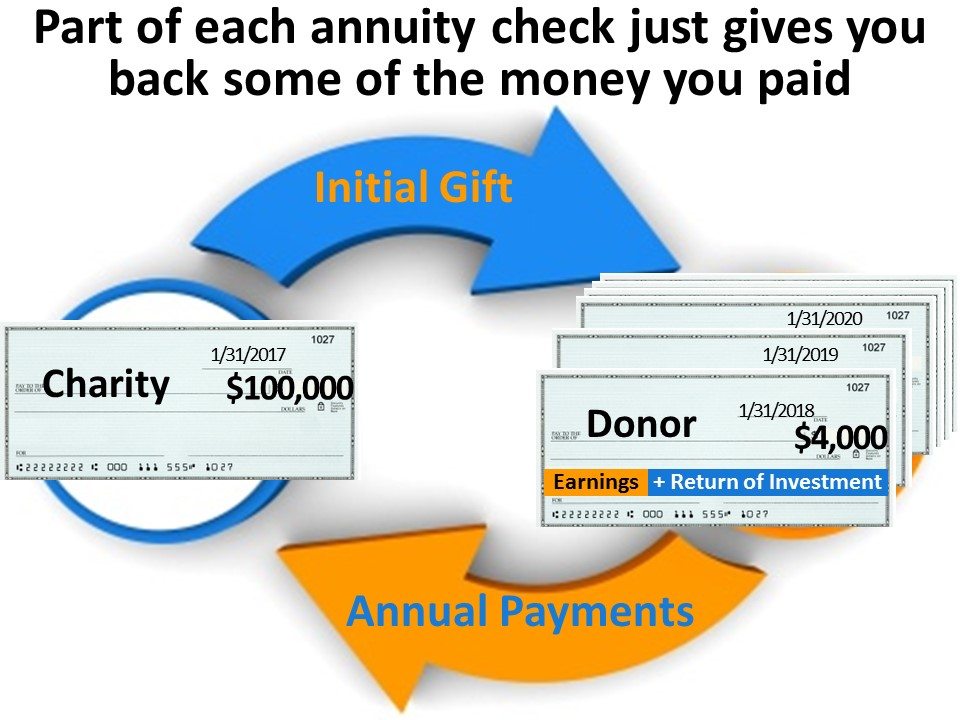
Some part of each annuity check given to a donor simply returns a part of the money paid for the Charitable Gift Annuity. This part is a return of the donor's original investment. There are no income taxes on this portion of the annuity check, because this is not "new" earned money coming to the donor. This is the donor's own money being returned to him. (Or, in the case of a gift annuity paid to someone other than the donor, this is a gift from the donor and is likewise not taxable income.)
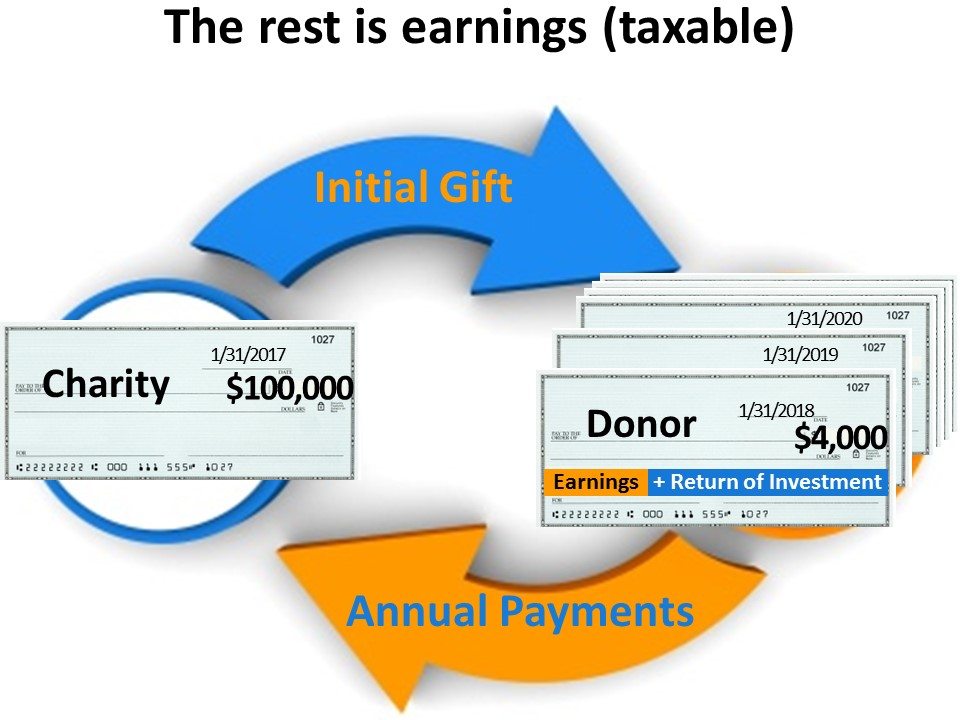
The remaining part of each annuity check is taxable. When the Charitable Gift Annuity is purchased for cash (i.e., not with appreciated property), this remaining part is taxed as ordinary income. In this case, everything that is not tax-free return of investment is taxable as ordinary income.
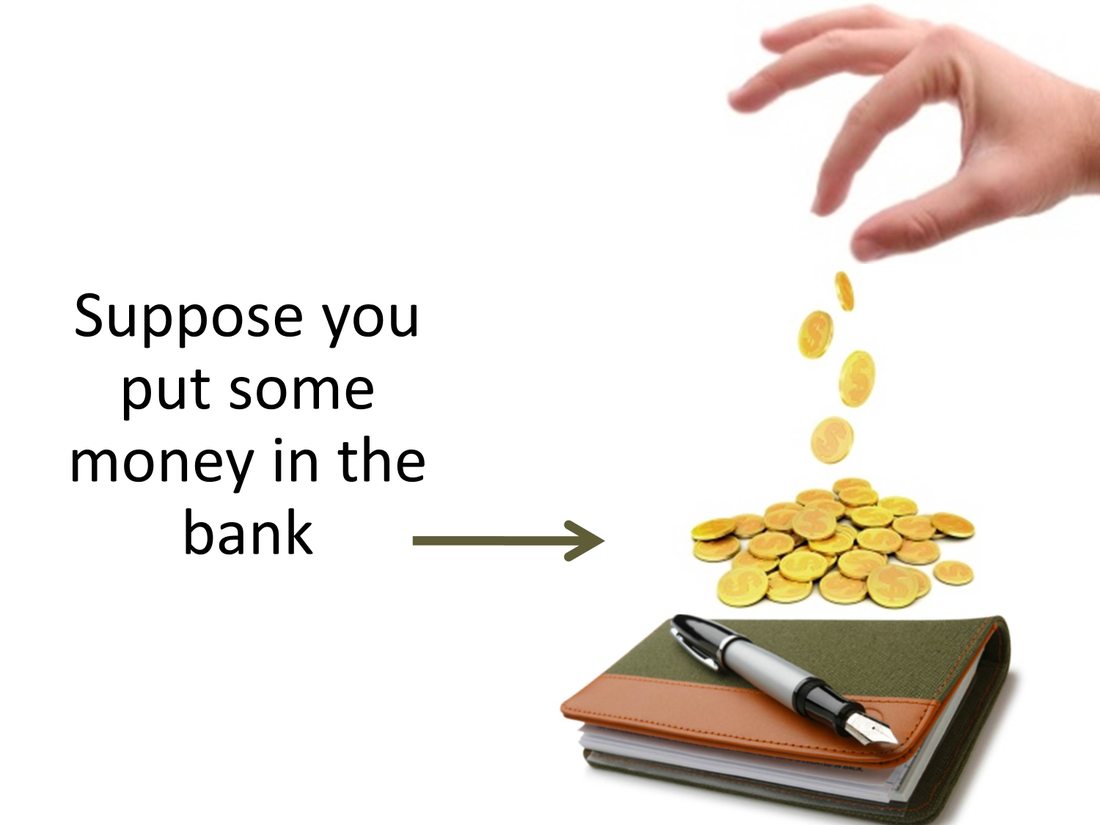
Let's look at an example that may help to explain the difference in tax treatment between earnings and tax-free return of investment. Suppose you open an interest-bearing bank account and put in $1,000.
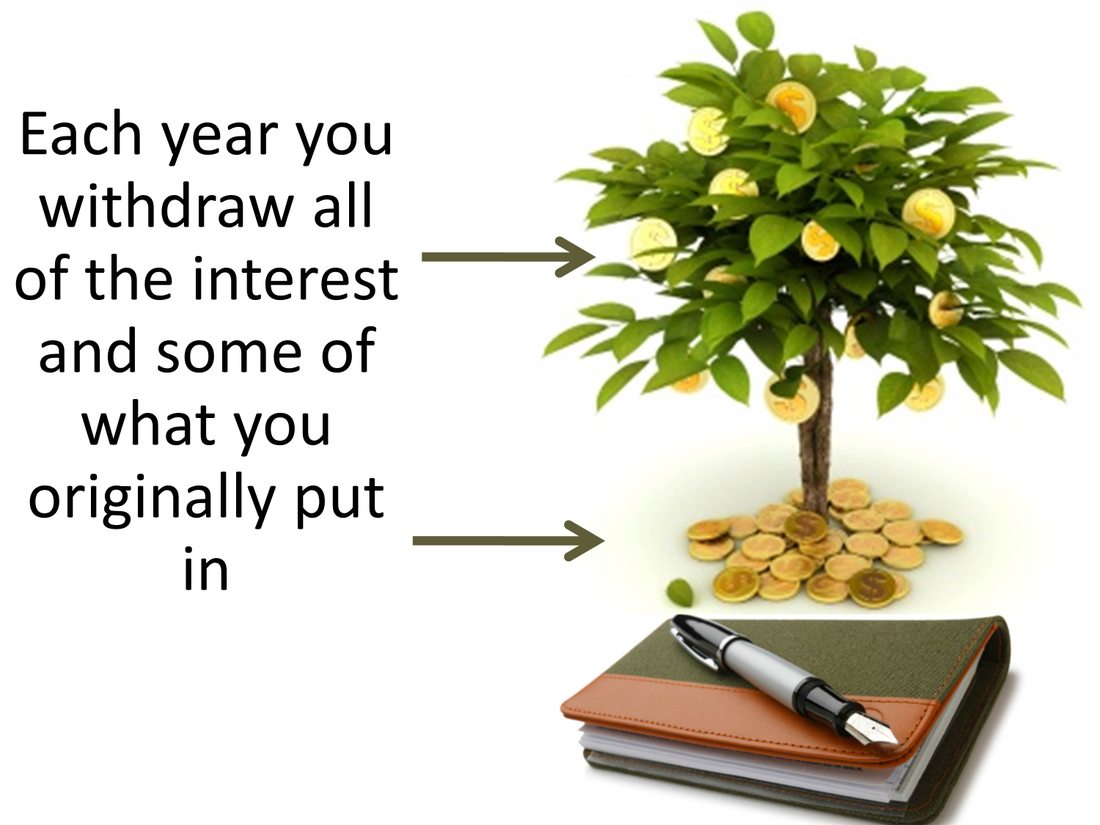
Further, suppose that each year you withdraw all of the interest earned in the account and some of your original $1,000 deposit. For example, suppose that the bank account earns 5% interest per year. At the end of the first year you withdraw the $50 of interest earned on your $1,000 deposit and you withdraw $100 of your original deposit.
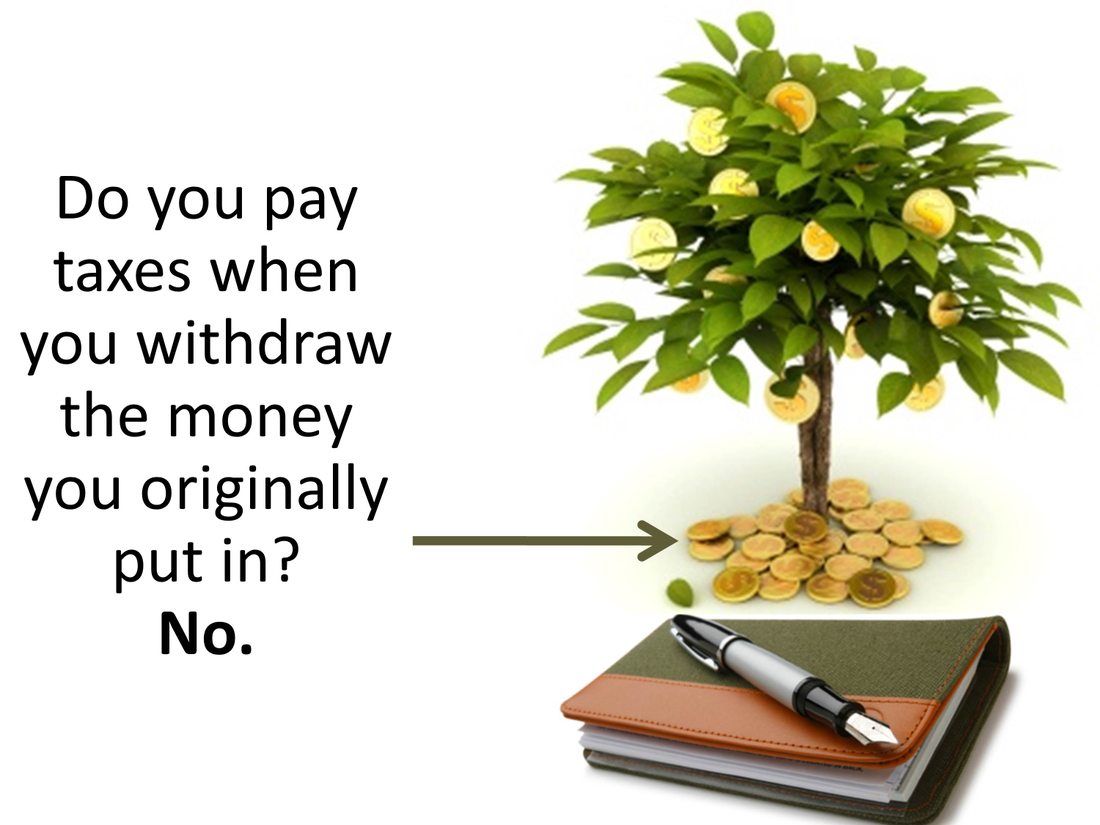
Do you pay more taxes because you withdrew $100 of your original deposit? Does removing $100 of your original deposit mean that you have $100 more of income this year? No. Removing money from an account does not cause you to have more income. It simply shifts the location of your money.

Putting money into an account and then removing the same money from the account is no different than burying money in the ground and then later digging it up and taking it out of the ground. This is tax-free return of investment. The money was yours before you put it in the ground and is still yours after you take it out of the ground. Neither of these actions changes your taxable income, even if they may change the amount of cash in your pocket.

Let's return to the example of the bank account where you earned $50 in interest (on the original $1,000 deposit) and withdrew $150. Do you pay taxes on the $50 of interest earned during the year? Yes. This $50 is not part of the $1,000 original deposit. It is new. This new money earned on the deposit is taxable income. The idea of taking all of the interest and some of the principal each year from a bank account is similar to receiving an annuity. Each annuity check represents all of the earnings during the year, plus some of the original investment. The portion of the annuity check that represents a return of the original investment is not taxed. The rest is treated as earnings and is taxed as ordinary income.
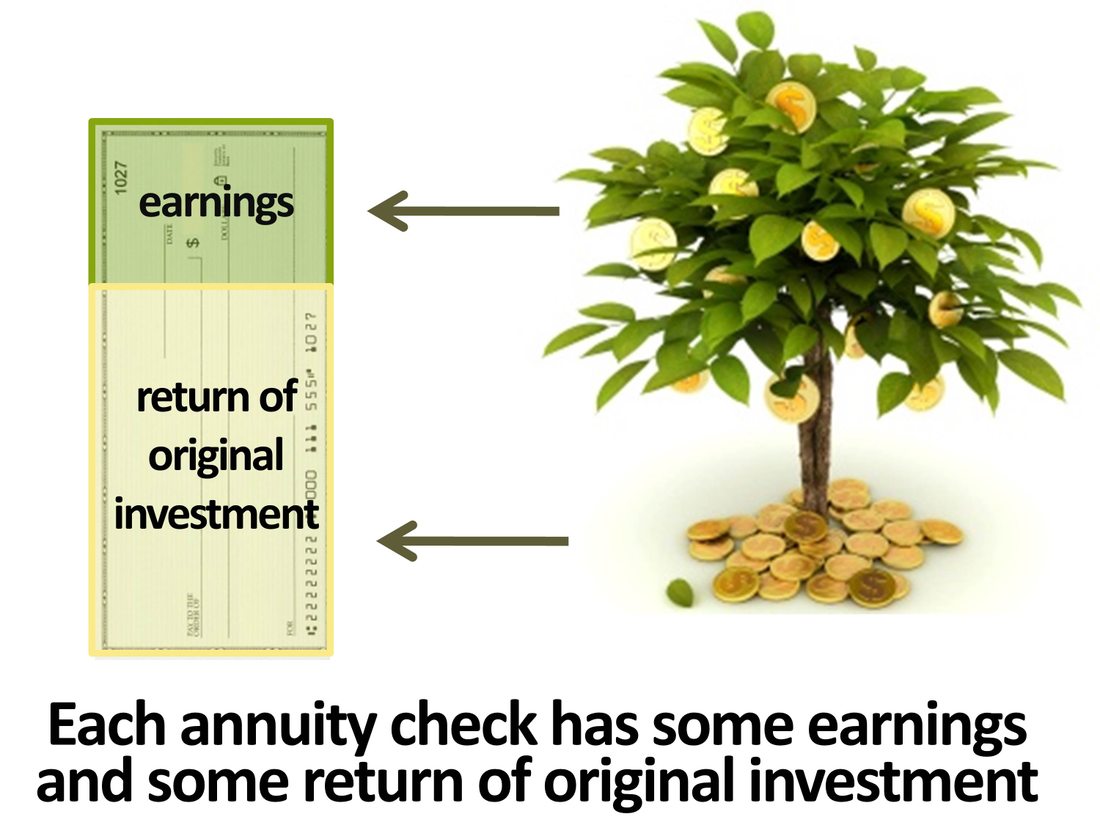
So long as the annuity was not purchased with appreciated property, each annuity check will consist of some combination of taxable earnings and non-taxable return of original investment. Using the bank account analogy, the tax-free return of investment is like removing some of the original principle from a bank account, and the remainder of each annuity payment is like the taxable earnings from a bank account.
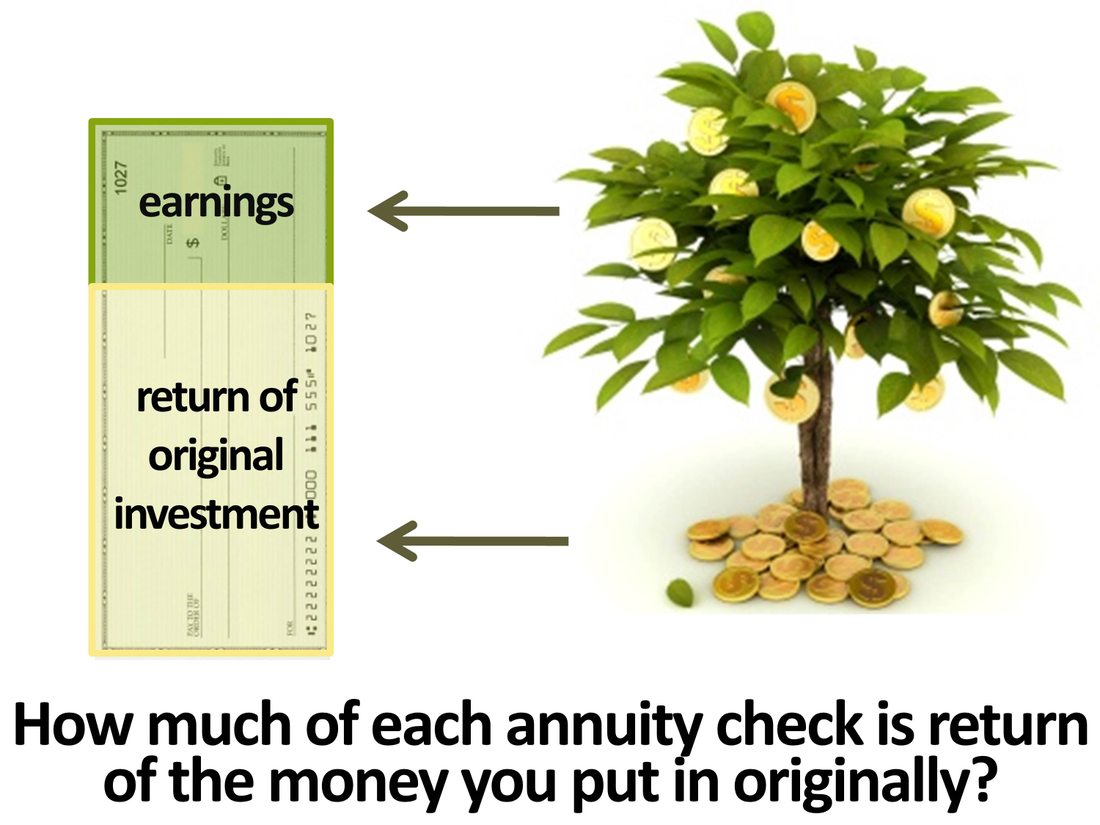
How much of each annuity check is taxable income? We calculate this indirectly by determining how much was simply a return of the money originally invested. The rest is taxable income.
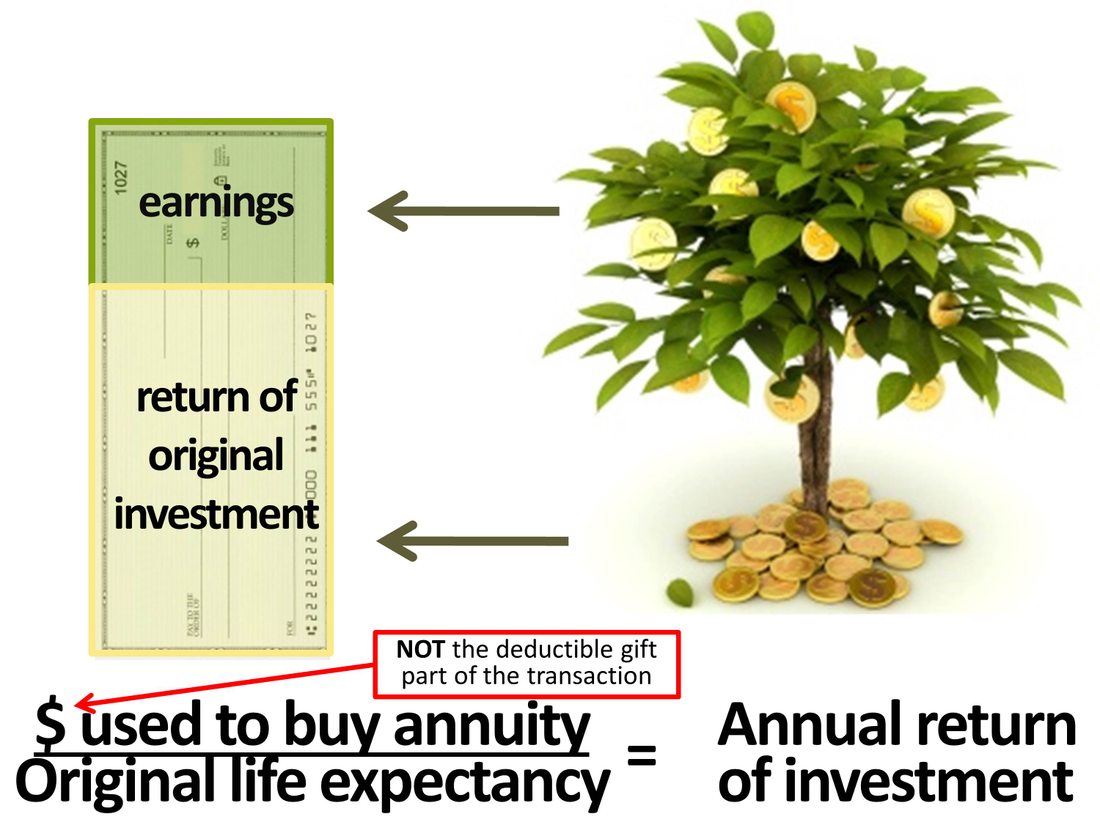
The formula for determining the amount of each annuity check that qualifies as tax-free return of investment divides the part of the transaction used to purchase the annuity by the annuitant's original life expectancy. Note that the part of the transaction used to purchase the annuity is not the entire cost of the Charitable Gift Annuity. Part of the cost of the Charitable Gift Annuity is a charitable gift. That is the part which generates the charitable income tax deduction. The rest of the money used to purchase the Charitable Gift Annuity (i.e., not the deductible gift part of the transaction) is the money used to purchase the annuity part. It is this part of the transaction that is the investment part (i.e., not a gift). Consequently, this is the part of the transaction that can become tax-free return of investment. The gift part of the transaction cannot become tax-free return of investment, because it was given to the charity as a deductible charitable gift.
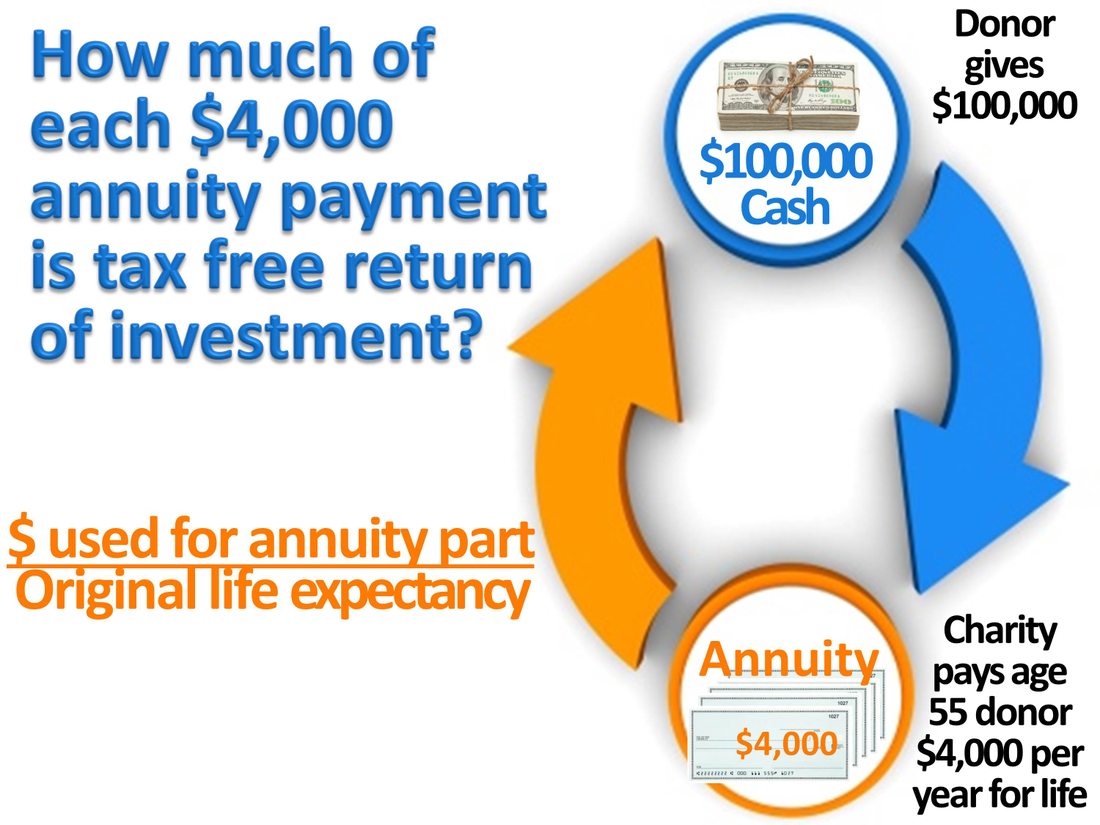
Let's return to our original example where a 55-year old donor gave $100,000 of cash to the charity and the charity, in return, agreed to pay the donor $4,000 per year for life. The amount of each annual $4,000 annuity check that is tax-free return of investment is determined by dividing the dollars used to purchase the annuity part by the annuitant's life expectancy when the Charitable Gift Annuity was purchased.
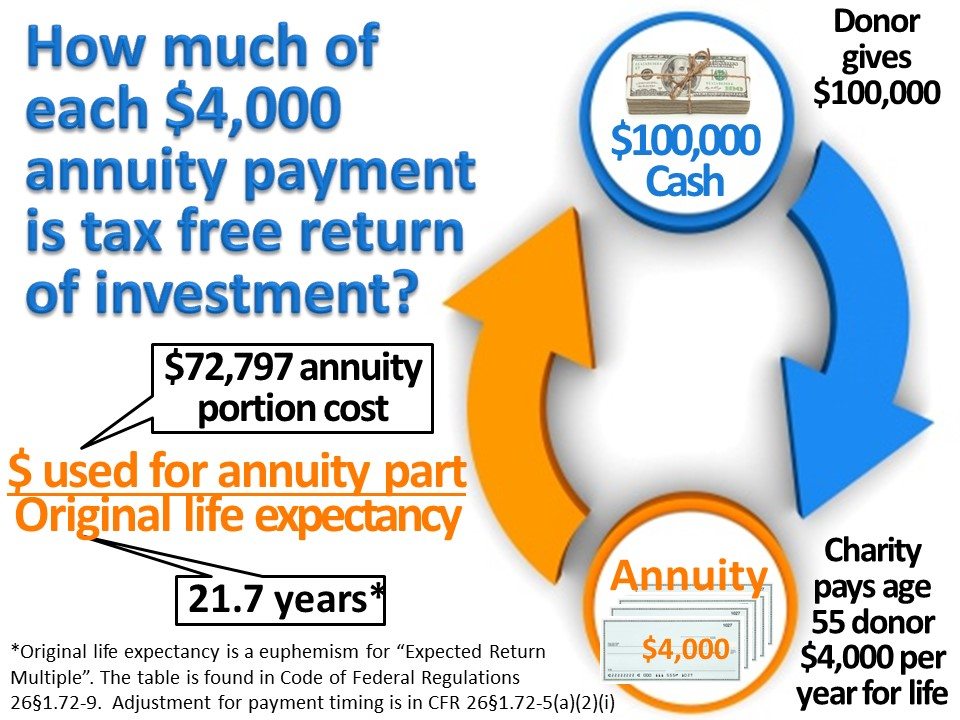
In this case we have previously calculated the value of the annuity as $72,797.20. Thus, this is the portion of the $100,000 transfer that was used to purchase the annuity. The remaining amount from the $100,000 was not used to purchase the annuity. Instead, it was used to make a charitable gift (and was thus deductible as a charitable gift). Dividing this $72,797.20 annuity part by the annuitant's 21.7 year original life expectancy results in $3,354.71. Thus, $3,354.71 of each $4,000 annuity check will be tax-free return of investment until all of the donor's original investment has been returned. How do we find the annuitant's life expectancy? The life expectancy used for this calculation is called an "expected return multiple" and is identified in the table found in the Code of Federal Regulations Title 26 §1.72-9. (Several free websites show the Code of Federal Regulation such as www.law.cornell.edu/cfr/) This factor is called an "expected return multiple" because it is the period that payments are actuarially expected to be received. In this case, the "expected return multiple" for a 55 year old male is 21.7 years.
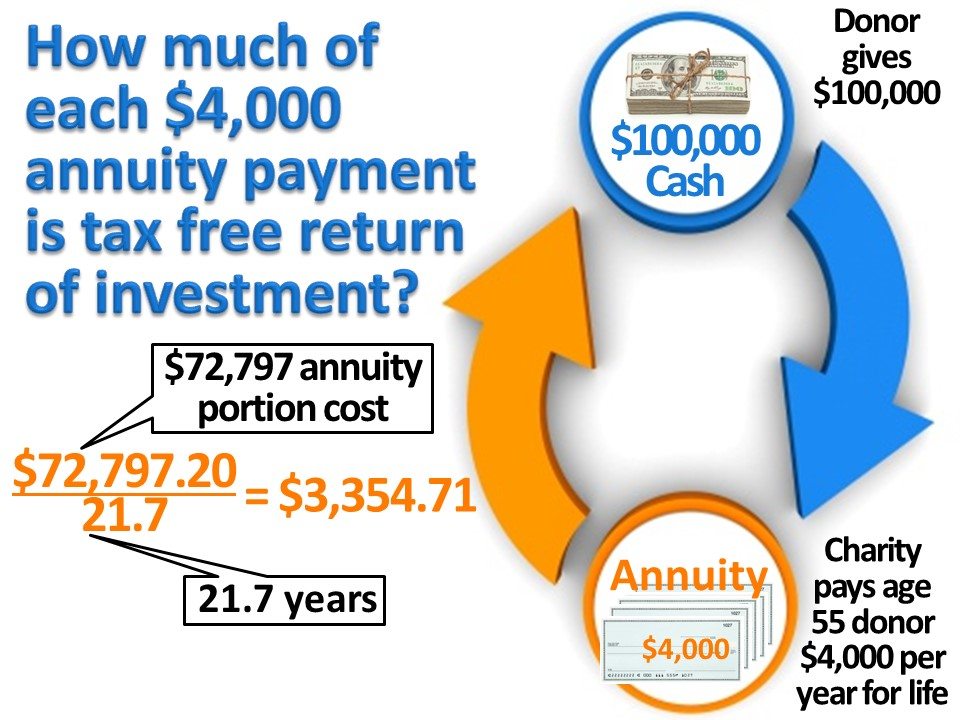
As a result of this calculation, we can now say that out of each $4,000 annuity payment, $3,354.71 will be treated as tax-free return of investment. This is how each annuity check will be treated until the entire $72,797.20 of the investment in the annuity portion has been returned. Note that the charity is required to send each annuitant an IRS Form 1099R which indicates what part of each payment is tax-free return of investment, what part is taxable income, and (if the gift annuity was purchased with appreciated property) what part is capital gain.
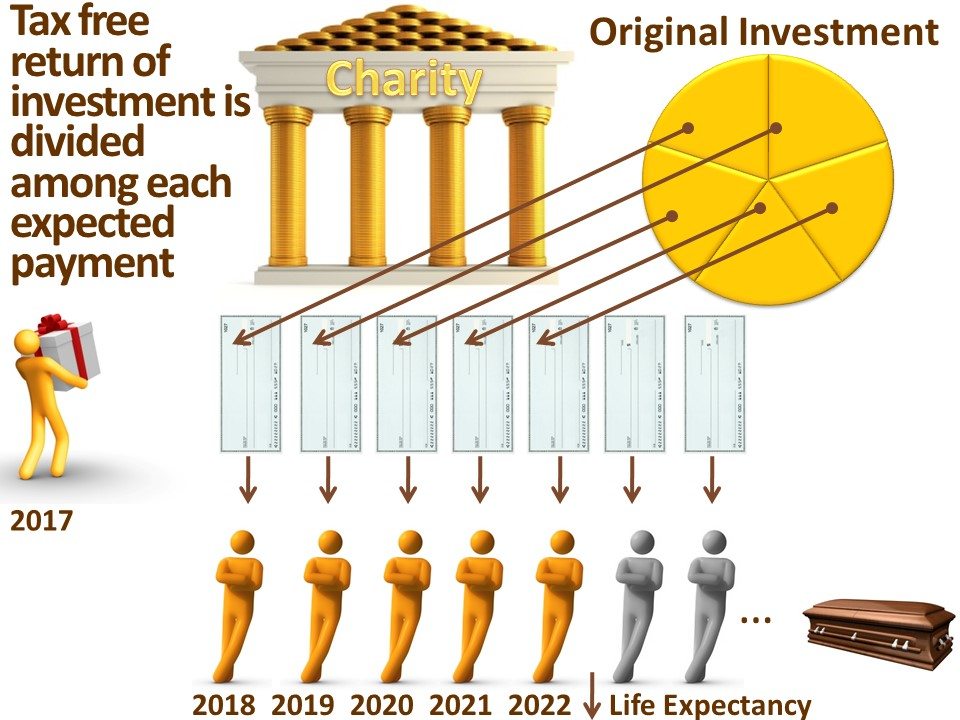
The tax free return of investment is divided among each expected payment. If an older annuitant had a life expectancy ("expected return multiple") of five years at the creation of the charitable gift annuity, then each year for five years 1/5th of the donor's original investment in the annuity portion of the transaction would be returned to the donor. But what happens once the entire original annuity portion cost has been returned? (In other words, what happens if the annuitant outlives his or her "expected return multiple"?)
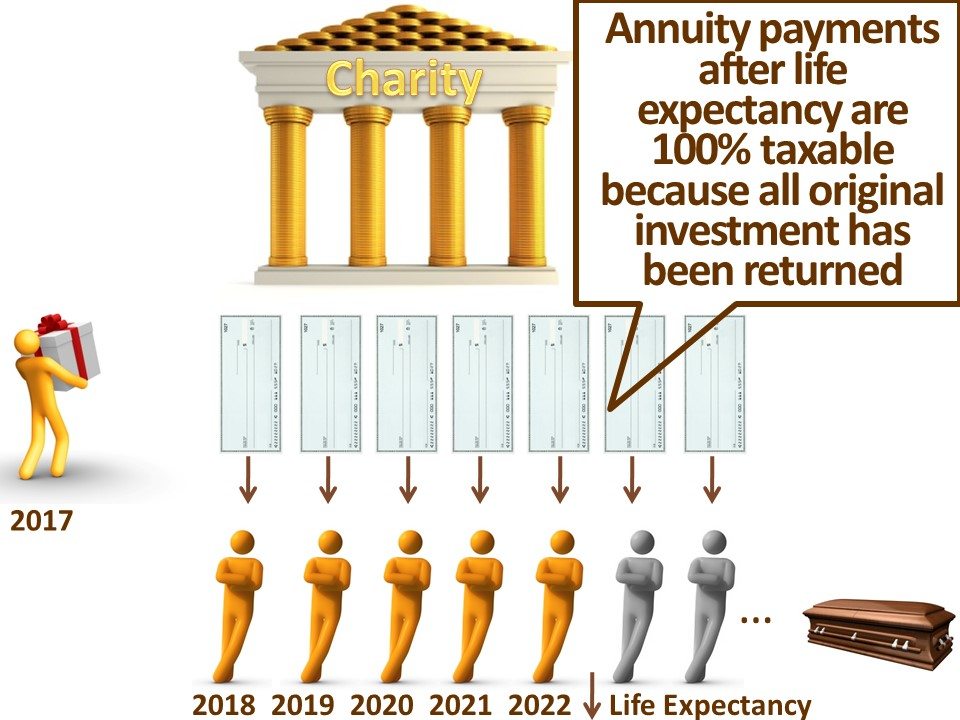
Once the entire original investment (in our example, $72,797.20) has been distributed to the annuitant, there is no part of the original investment left. Consequently, after that point, no part of the subsequent annuity payments will be tax-free return of investment. Thus, once an annuitant has lived past his or her life expectancy ("expected return multiple"), the entire annuity payment will be treated as ordinary income.
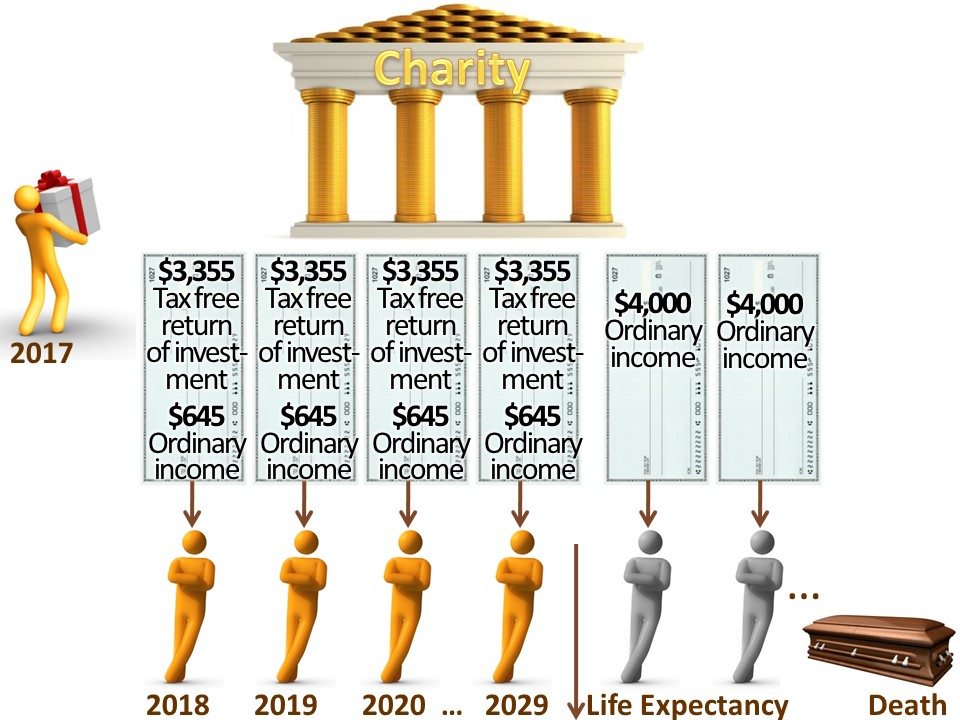
Returning to our example, $3,354.71 of each $4,000 annuity check will be treated as tax-free return of investment for 21.7 years. (For the check in the 22nd year, the tax-free return of investment would be $3,354.71 X .7, or $2,348.30.) After that point, however, every additional $4,000 check will be treated entirely as ordinary income.
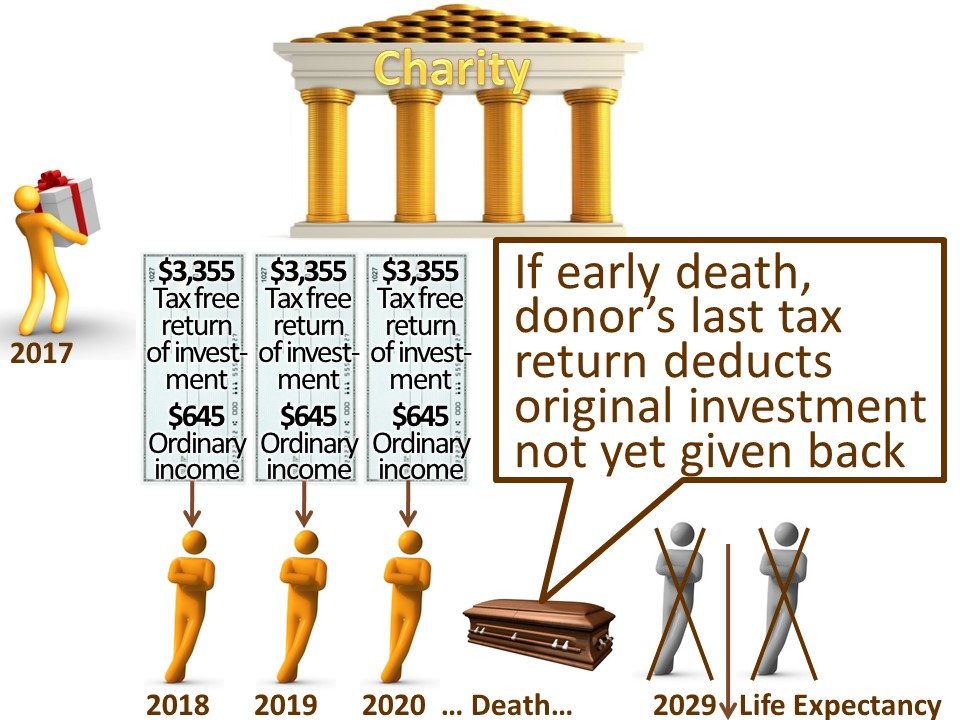
If the donor dies prior to reaching his original life expectancy ("expected return multiple"), then the donor fails to receive his entire original investment in the annuity portion of the transaction. In this case, the donor's last tax return can deduct the portion of the original investment not yet returned to the donor.
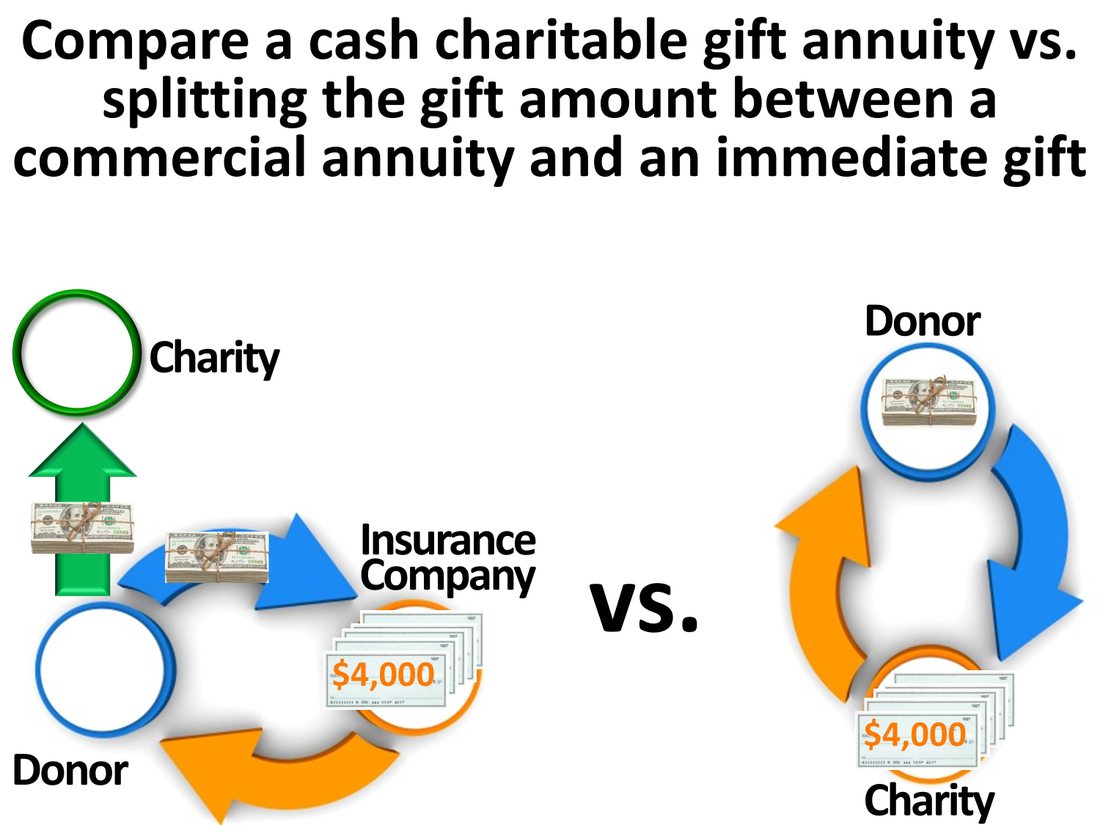
For a donor who wishes to benefit a charity that does not offer a Charitable Gift Annuity, a similar transaction would be to use part of the money to purchase a commercial immediate annuity from an insurance company and then simply donate the remaining amount to the charity. This accomplishes roughly the same goals as a Charitable Gift Annuity. However, there are two tax disadvantages that make this substitute transaction less advantageous.
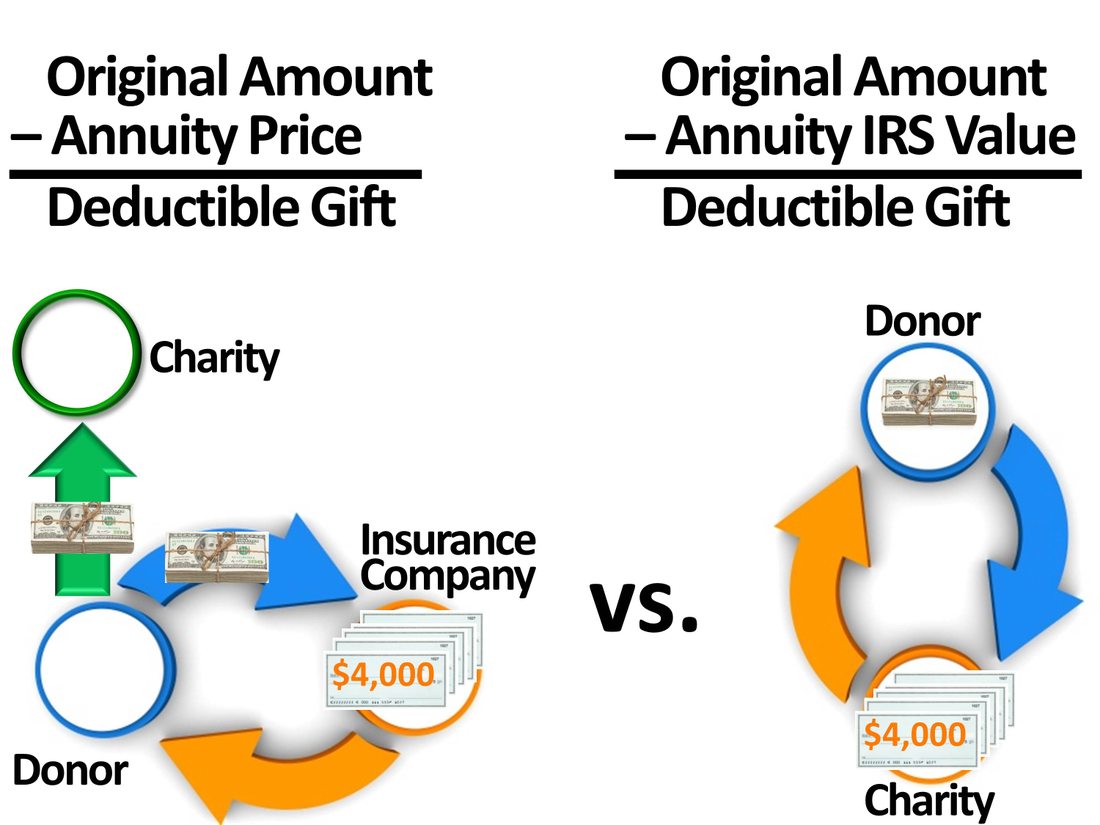
The deduction generated by the substitute transaction (purchasing a commercial annuity from the insurance company and donating the remaining cash to the charity) will be lower than the deduction generated by a comparable Charitable Gift Annuity. With a Charitable Gift Annuity, the charitable deduction is the amount transferred less the value of the annuity as determined by the IRS tables. In the substitute transaction the charitable deduction will be the amount given to charity, in other words, the total original amount less the price of the commercial annuity. However, a commercial annuity will inevitably be more expensive than the IRS valuation of a similar annuity from a charity. This occurs for two reasons. First, the commercial annuity product must incorporate the salaries and profit of the insurance company into its pricing. This margin must be above and beyond the value of the expected payout based upon current interest rates. Additionally, the IRS valuation for an annuity from a charity will be lower because the IRS uses standard life expectancy tables. However, people who buy annuities, on average, live longer than others of the same age. (As discussed in the previous chapter, this is because people who are sick or dying or poor do not purchase annuities. The exclusion of these groups means that those who purchase annuities will, on average, live longer than others of the same age.) Thus, the insurance company must price its annuity based upon the longer life expectancy of annuity purchasers, and not the generic life expectancy used by the IRS. This expectation of a longer life means that the insurance company must charge more for its annuities as compared with the IRS calculation.
The second tax disadvantage of the substitute transaction is that it cannot be used to shelter capital gains taxes when contributing appreciated property. Despite these disadvantages, if a donor wants to purchase a Charitable Gift Annuity with cash to benefit a charity that does not offer Charitable Gift Annuities (or perhaps does not offer them in the donor's state of residence), this substitute transaction might be suggested as a possible alternative. Having just mentioned sheltering of capital gains as a potential advantage of Charitable Gift Annuities, let's now turn to a discussion of capital gains taxes.
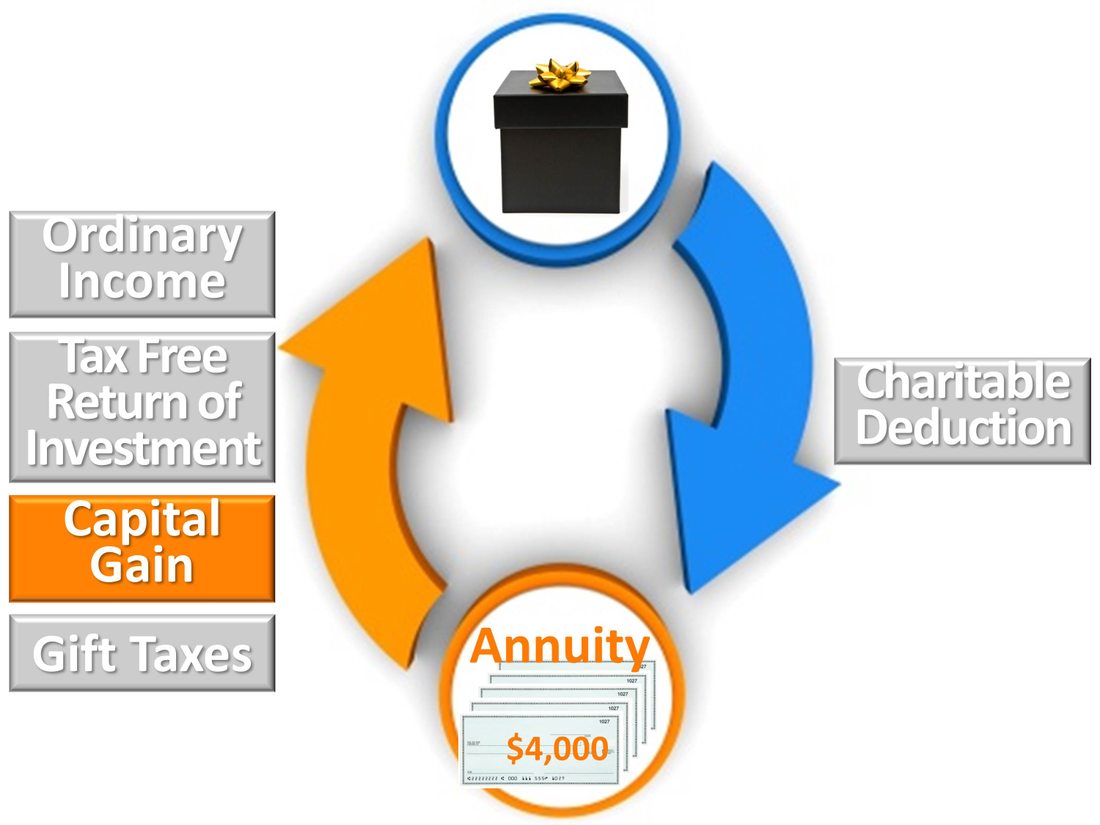
To this point, we have been looking at a Charitable Gift Annuity transaction where the gift annuity is purchased with cash. However, it is also possible to purchase a Charitable Gift Annuity with appreciated property. This complicates our tax scenario because when a gift annuity paying to the donor is purchased with appreciated property, some part of the annuity check given to the annuitant will be treated not as ordinary income, nor as tax-free return of investment, but rather as capital gain.
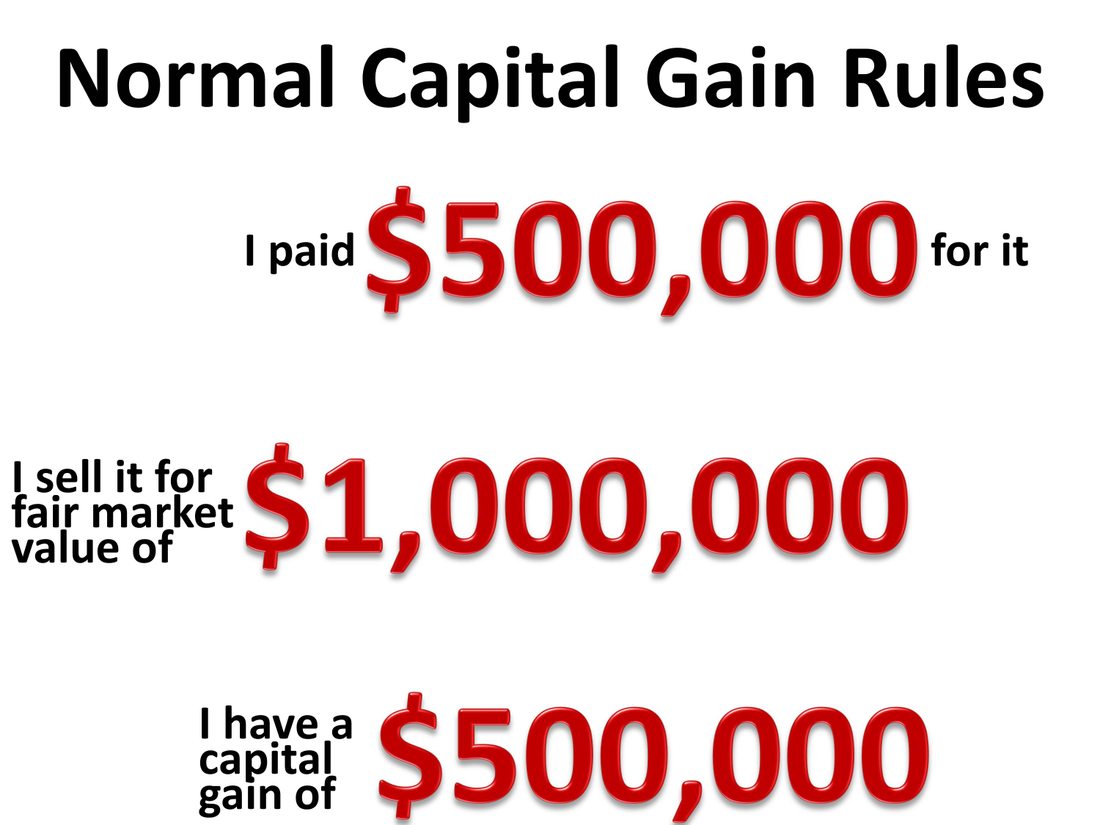
Let's first consider the straightforward rules that normally apply to capital gains. If a taxpayer buys an item (for example, shares of stock), for $500,000 and later sells the item for its fair market value of $1 million, then it is simple to calculate the capital gain. The capital gain is simply what the taxpayer sold the item for ($1,000,000) reduced by what the taxpayer originally paid for the item ($500,000). Thus, the taxpayer would have a capital gain of $500,000 (i.e., the profit from the sale would be $500,000).
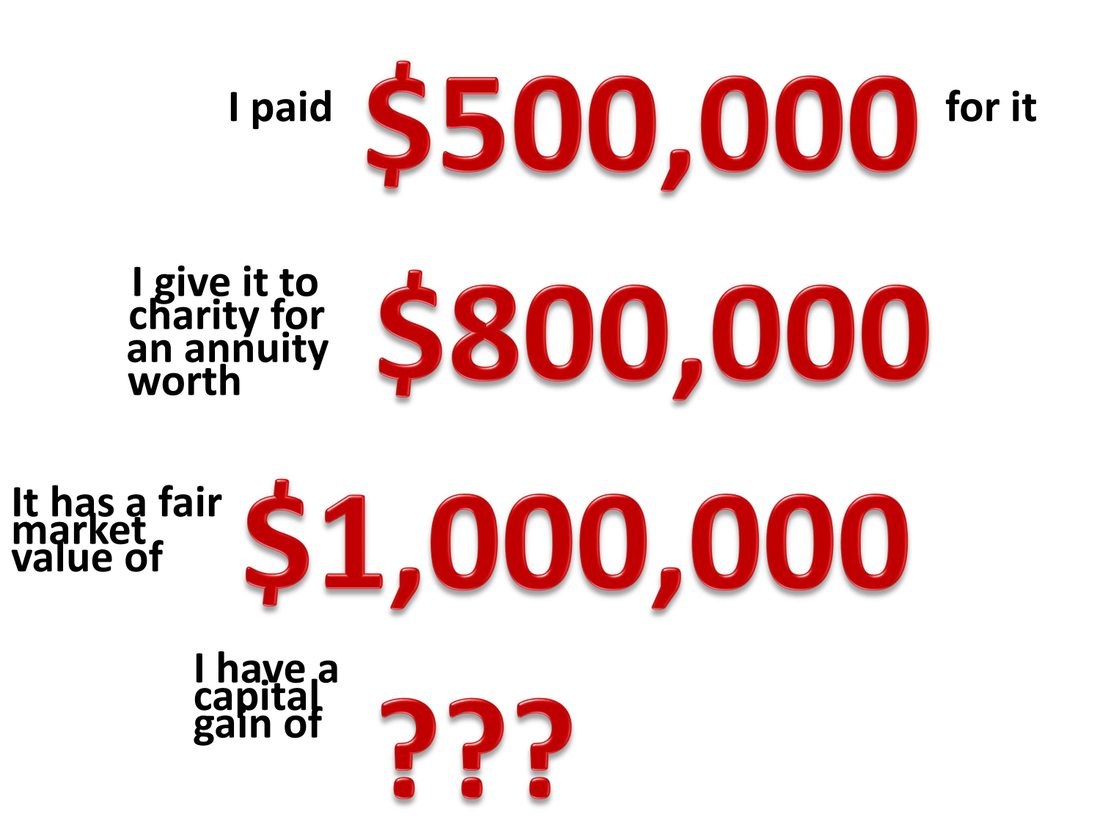
The capital gain calculation becomes more complicated in the context of a bargain sale. Suppose the taxpayer has the same asset which he purchased for $500,000 that now has the same fair market value of $1 million. But instead of selling the asset for $1 million, the taxpayer donates the asset to a charity, and in exchange for the donation receives an annuity worth $800,000. What is the capital gain resulting from that transaction? It is NOT simply the value of the annuity ($800,000) less the price of the property ($500,000). The calculation of capital gain for this transaction uses the same process for calculating capital gain in any type of bargain sale.
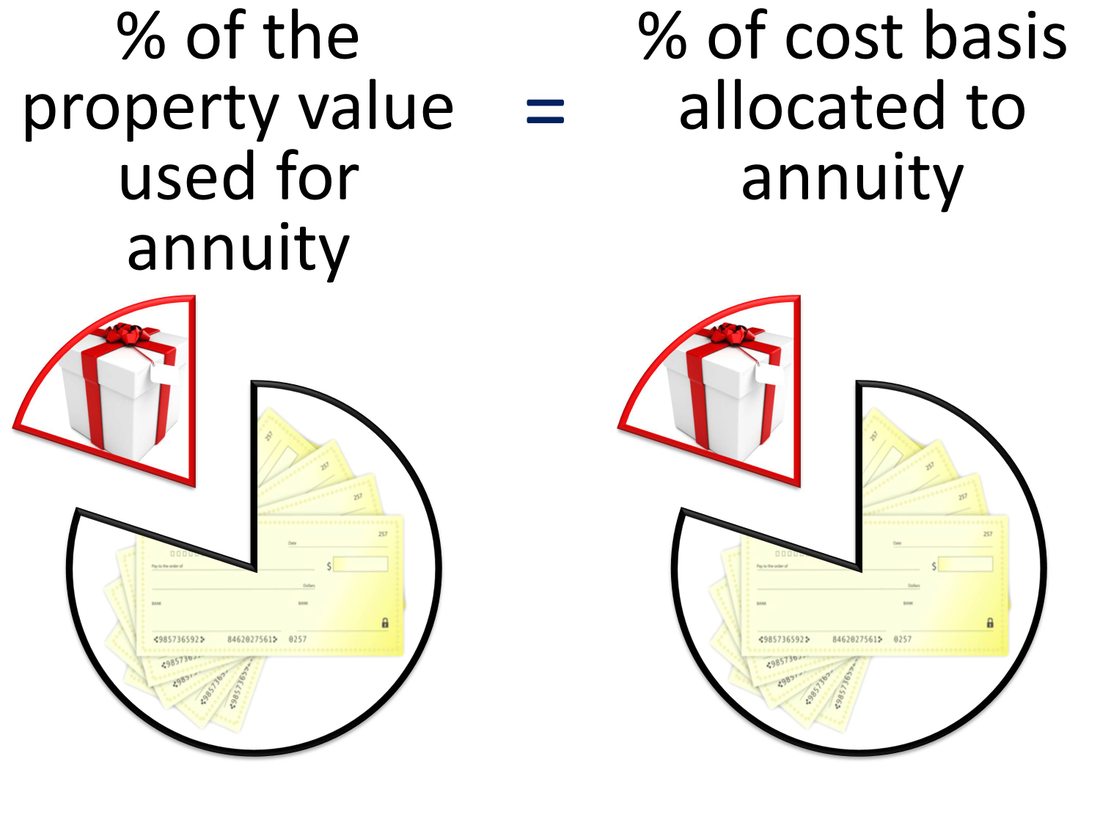
The reason that the capital gain on the previous transaction is not simply $800,000-$500,000 is because the donor may not use the entire $500,000 cost basis in the property for the annuity part of the transaction. Part of the cost basis is allocated to the gift portion and part is allocated to the annuity portion (a.k.a. the "sale" portion).
A simple way to think of a capital gain is "What I got for it" less "What I paid for it." In this case, it is easy to determine "What I got for it." The donor receives an annuity worth $800,000 (and also makes a charitable gift). Determining the "What I paid for it" is more tricky, because the donor paid for both the portion of the property that bought the annuity and the portion of the property that became a charitable gift. Only the basis from the share of the property that was used to purchase the annuity can be included in the capital gain calculation. (In some cases, the basis from the share of the property that became a charitable gift might also be important when, according to the rules on valuing charitable gifts of property, the value of the donation is limited to the basis.)
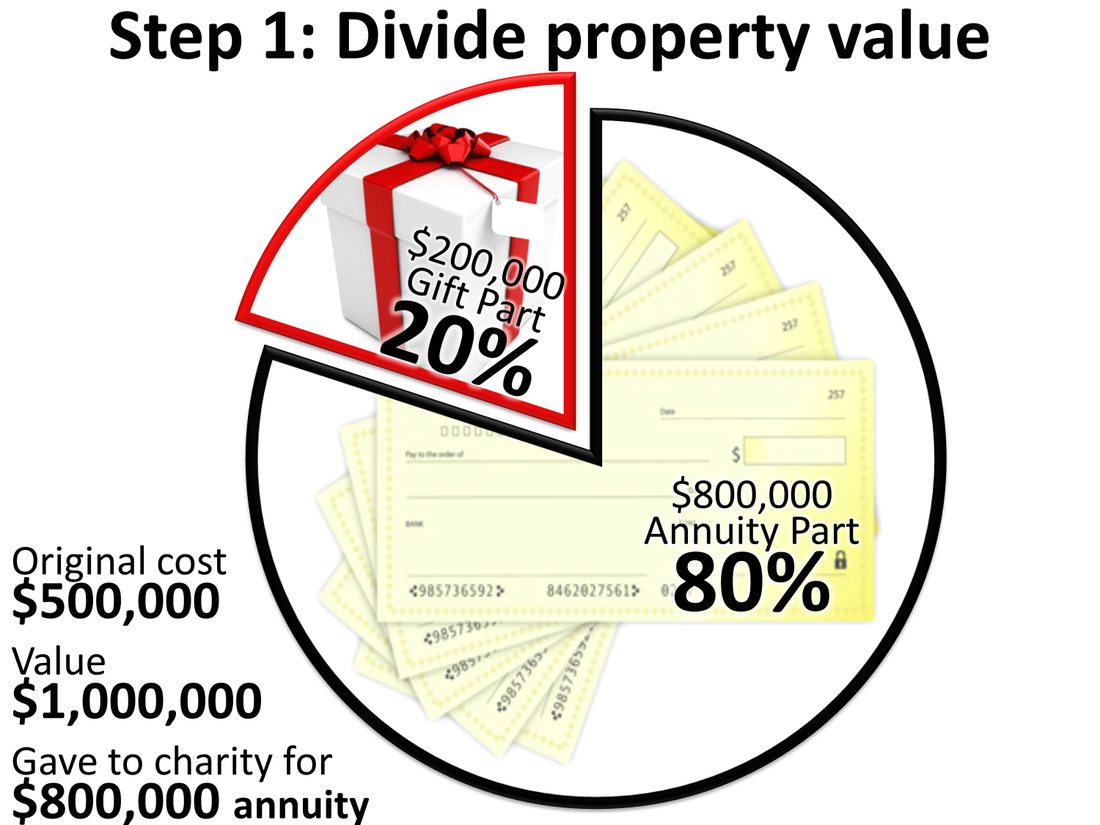
Let's apply this concept to our proposed transaction. The donor purchased property (perhaps intangible personal property like shares of stock) for $500,000 that grew in value to $1,000,000. He then gave that property to charity in exchange for a gift annuity worth $800,000. The first step is to divide the property into the part that was used to purchase the annuity (the "sale" part) and the part that was used to make a charitable gift (the "gift" part). In this case, $800,000 of the $1,000,000 property was used to purchase the $800,000 annuity. In other words, 80% of the property was used for the "sale" part of the bargain sale. The remaining 20% of the property was used to make a charitable gift (i.e., the "gift" part of the bargain sale).
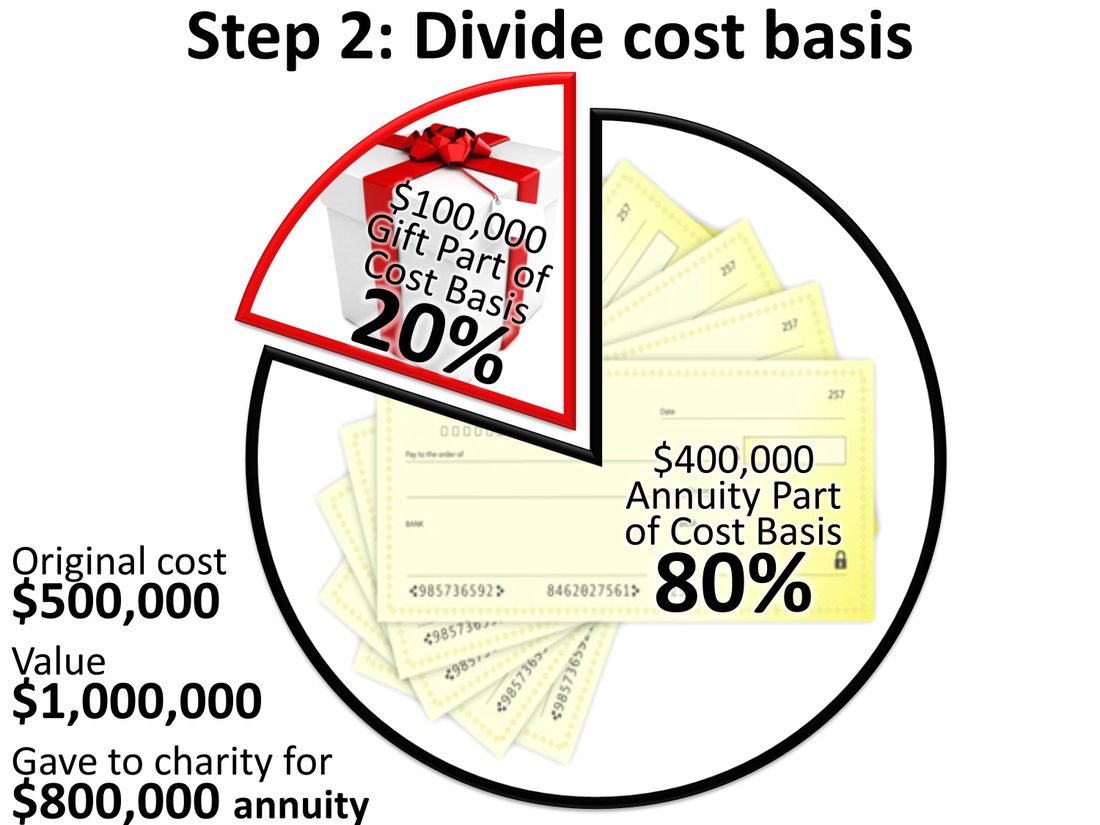
Next, we apply this same percentage division to the cost basis. The total cost basis was $500,000 (i.e., that was the purchase price of the transferred property). 80% of this $500,000 cost basis applies to the annuity purchase (i.e., $400,000 of basis applies to the "sale" part of the transaction). The remaining 20% ($100,000) of basis applies to the charitable gift. (And if the charitable deduction were, for some reason, limited to the basis in the property then the deduction would be for this $100,000 basis applying to the charitable gift, rather than for the full $200,000 difference between the transfer and the value of the annuity.)
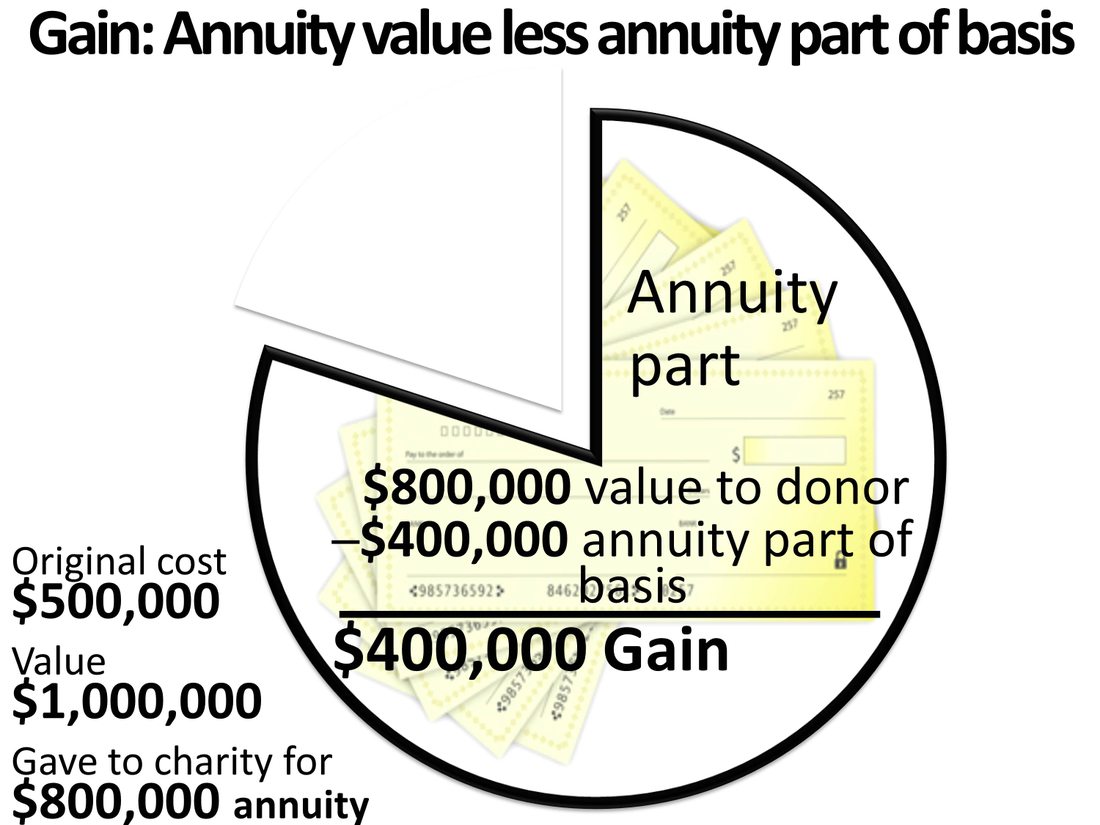
Now that we know both what the donor received for the property transfer (valued at $800,000) and the amount of the basis that applied to this annuity part (a.k.a. "sale part") of the transaction (i.e., $400,000), it is easy to calculate the capital gain. The capital gain is simply the value of the annuity ($800,000) less the amount of basis in the property applied to the annuity part of the transaction ($400,000).
When is the tax on this capital gain paid? The answer to this question depends upon who is receiving the annuity payments. If the donor purchases a gift annuity with appreciated property where the payments are made to another person (not the donor and donor's spouse), then the capital gain must be recognized immediately. This eliminates a substantial part of the tax advantage of purchasing a Charitable Gift Annuity with appreciated property. It also explains why such transactions are relatively rare. Nevertheless, the donor does still retain some advantage by giving appreciated property, rather than cash, to purchase the gift annuity, in that the capital gain attributed to the gift portion is avoided.
The preferable tax result occurs if the donor is receiving (or the donor and the donor's spouse jointly are receiving) the annuity payments. In this case, the capital gain is deferred over the life expectancy of the donor (or joint life expectancy of the donor and donor's spouse). The next best result to complete tax avoidance is tax deferral. In this case, the deferral is for an extraordinarily long period of time, making this a very attractive feature of purchasing gift annuities with appreciated property. In order to receive this treatment, the annuity must specify that it cannot be assigned to anyone (excepting the charity itself, the donor, and the donor's spouse). Even if the donor never uses the right to assign the annuity payments to someone else, simply having this right available will result in immediate recognition of all capital gain.
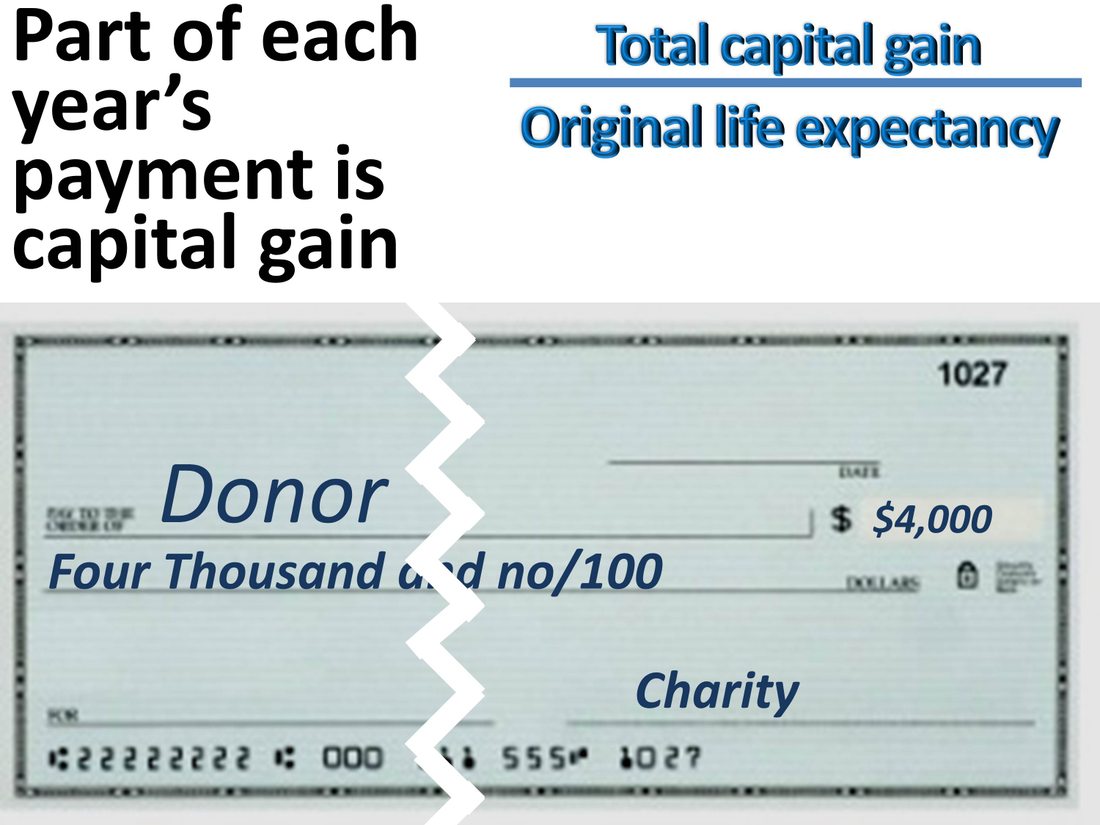
To calculate the share of each year's payment that will count as capital gain, the annuitant donor simply divides the total capital gain by his life expectancy at the time of purchase of the gift annuity (or the donor and donor's spouse's joint life expectancy if paid jointly). As before, this original life expectancy is called the "expected return multiple" and is identified in the table found in the Code of Federal Regulations Title 26 §1.72-9. The process for this calculation is identical to the previously discussed process for identifying how much of each year's payment will be tax-free return of investment.
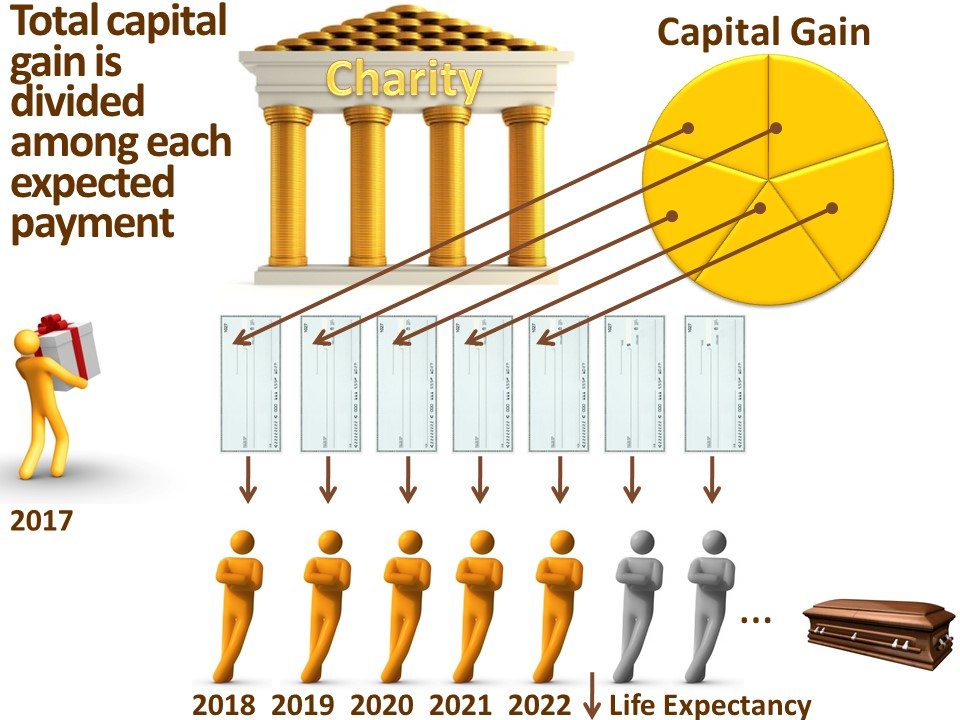
For example, if a donor had a five-year "expected return multiple" (i.e., life expectancy at the time of the purchase of the gift annuity) and a capital gain of $10,000 from the purchase of the gift annuity, then 1/5 of the capital gain would be recognized in each of the first five years. Thus, $2,000 of each annual payment check would count as capital gain for the first five years. After five years, the entire $10,000 in capital gain would have been recognized. Similar to the previous discussion of return of original investment, there is no additional capital gain to recognize if the donor outlives his "expected return multiple" (i.e., original life expectancy). Regardless of the price of the gift annuity or the use of appreciated property, after an annuitant outlives his or her "expected return multiple," all subsequent annuity payments will consist entirely of ordinary income.
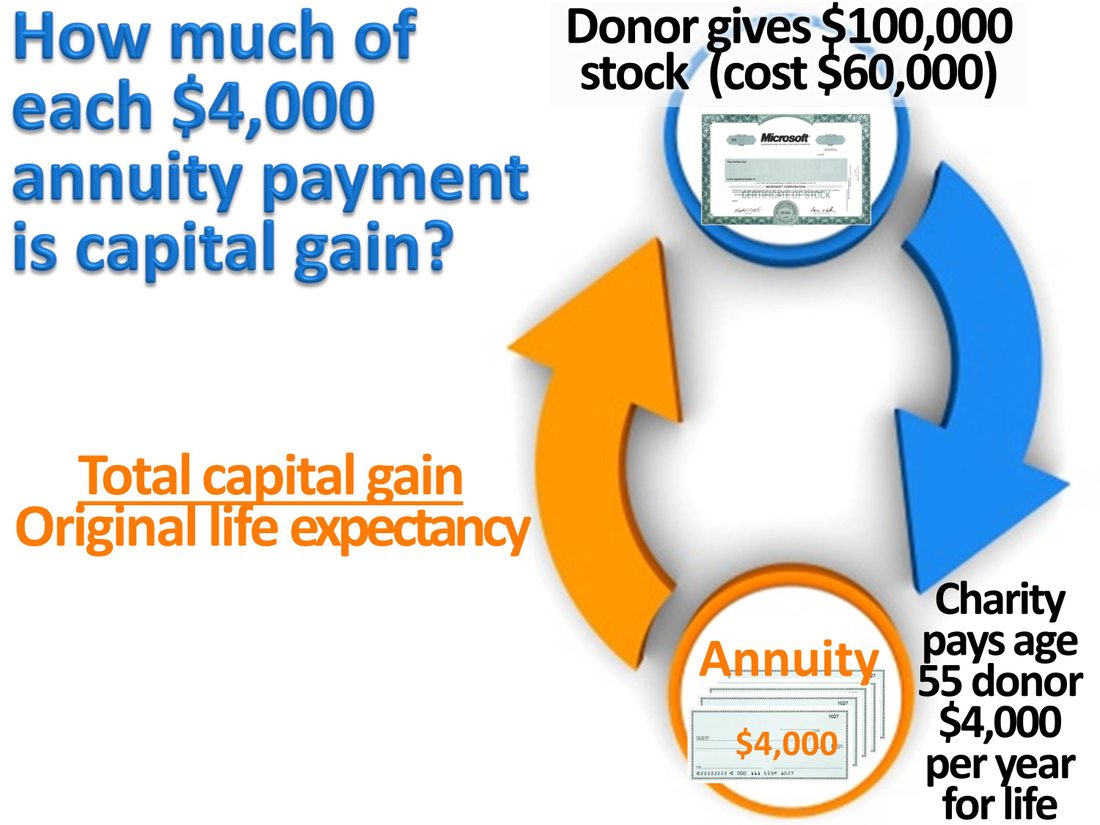
Let's now return to our previous example, with one modification. Rather than giving $100,000 in cash, the donor now gives publicly-traded stock worth $100,000. This is stock that the donor originally purchased for $60,000 (i.e., the basis of the stock is $60,000). In exchange for this stock, the charity agrees to pay the age 55 donor $4,000 per year for life. How much of each $4,000 annuity payment will count as capital gain? To calculate this, we simply divide the total capital gain by the original life expectancy (a.k.a. "expected return multiple").
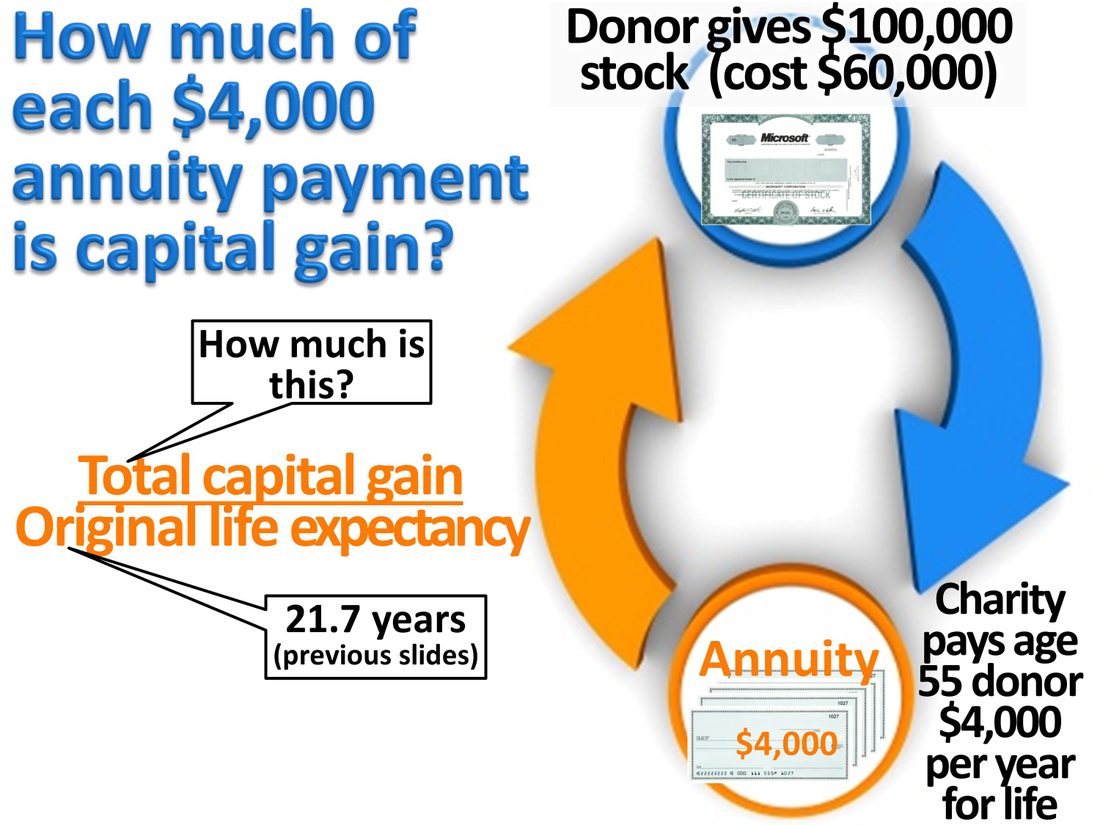
Determining the original life expectancy (a.k.a. "expected return multiple") was already completed in the previous scenario. The table found in the Code of Federal Regulations Title 26 §1.72-9 indicates that for a 55-year-old male, the "expected return multiple" is 21.7 years. However, we have not yet calculated the total capital gain resulting from this transaction.
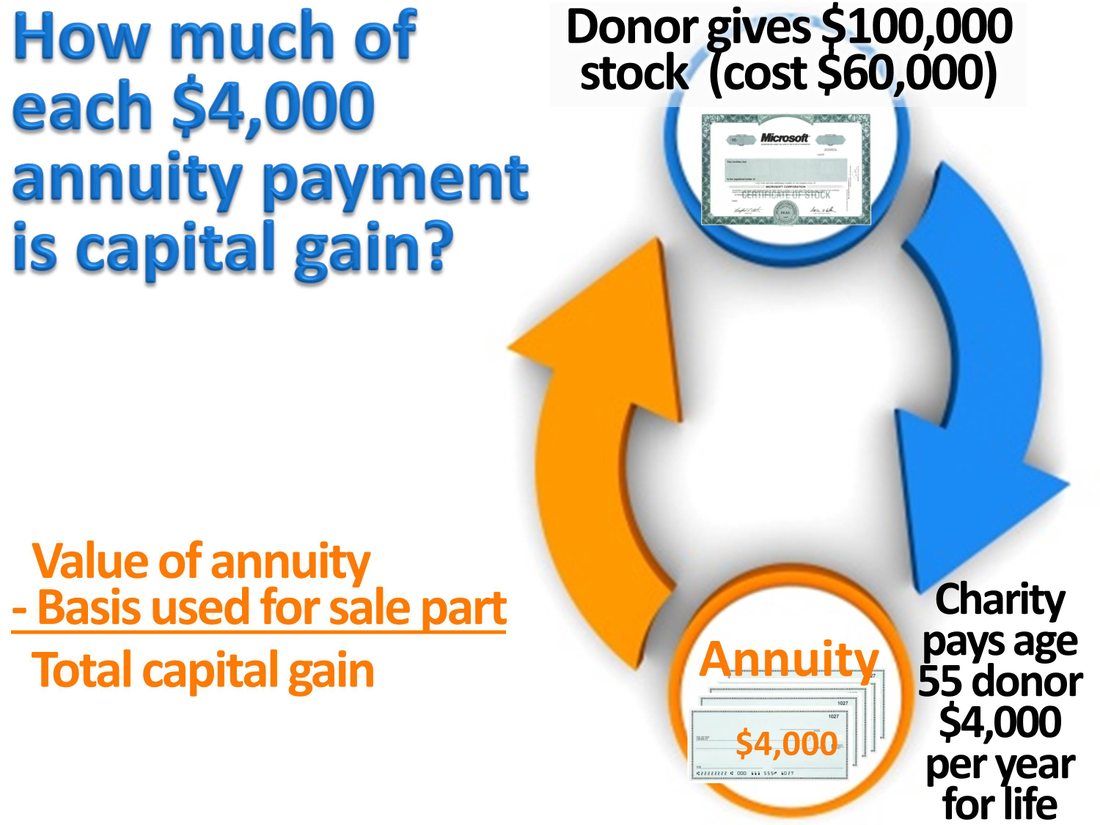
To calculate the total capital gain, we simply subtract the basis attributable to the sale part of the transaction from the value of the annuity. In other words, this is what the donor received (value of the annuity) less the basis in what the donor gave for the annuity portion of the gift annuity (the non-charitable portion of the transaction).
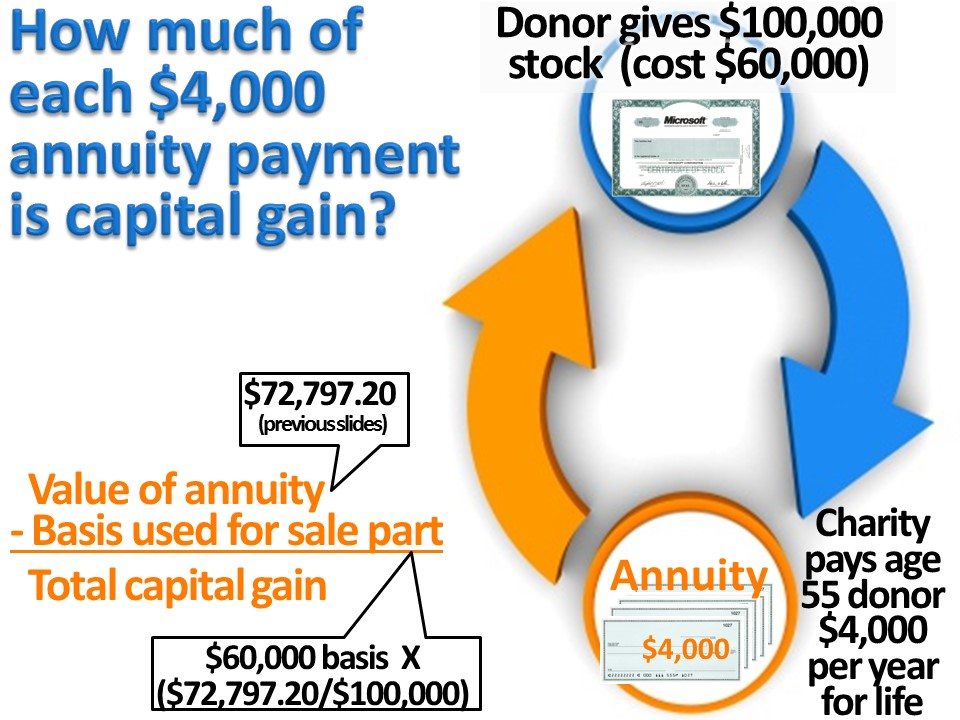
The value of the annuity is $72,797.20 as determined by the calculations from the previous example. (The fact that the annuity was, in this case, purchased with appreciated property has no effect on the value of the annuity being provided to the donor.) We do not simply subtract the entire $60,000 basis from the value of the annuity in order to calculate the capital gain because only part of the property was used to purchase the annuity and the rest was used to make a deductible charitable gift. Thus, we can only use the share of the basis that represents the share of the property used to purchase the annuity (i.e., the "sale" part). In this case, the share of the $100,000 transaction used to purchase the annuity (i.e., the portion that is not a deductible charitable gift) was $72,797.20 Thus, 72.7972% of the property was used to purchase the annuity. Because 72.7972% of the property was used to purchase the annuity, 72.7972% of the basis may be applied to calculate the capital gain resulting from receiving the annuity. Thus, 72.7972% of the $60,000 basis (i.e., $43,678.32) may be used to calculate the capital gain.
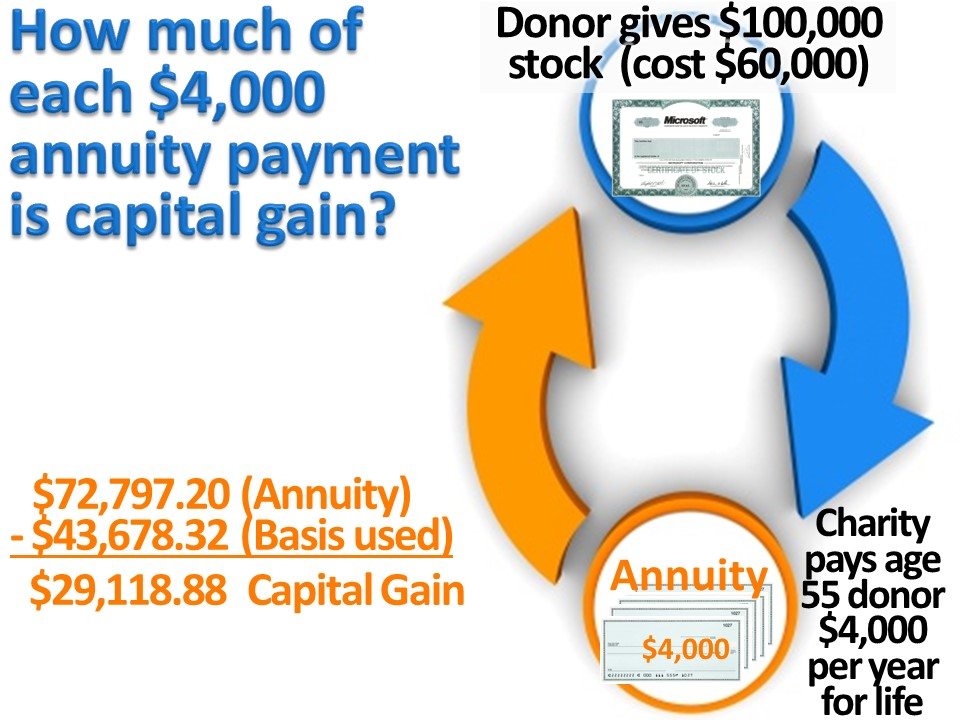
Subtracting this $43,678.32 (i.e., 72.7972% of the $60,000 basis) from the $72,797.20 value of the annuity results in a capital gain of $29,118.88. If this annuity were being paid to someone other than the donor (or donor and donor's spouse), then this capital gain would be recognized immediately. But, in this case, the annuity is being paid to the donor, so this capital gain can be spread out over the life expectancy of the donor as of the date of the initial transaction (a.k.a. "expected return multiple").
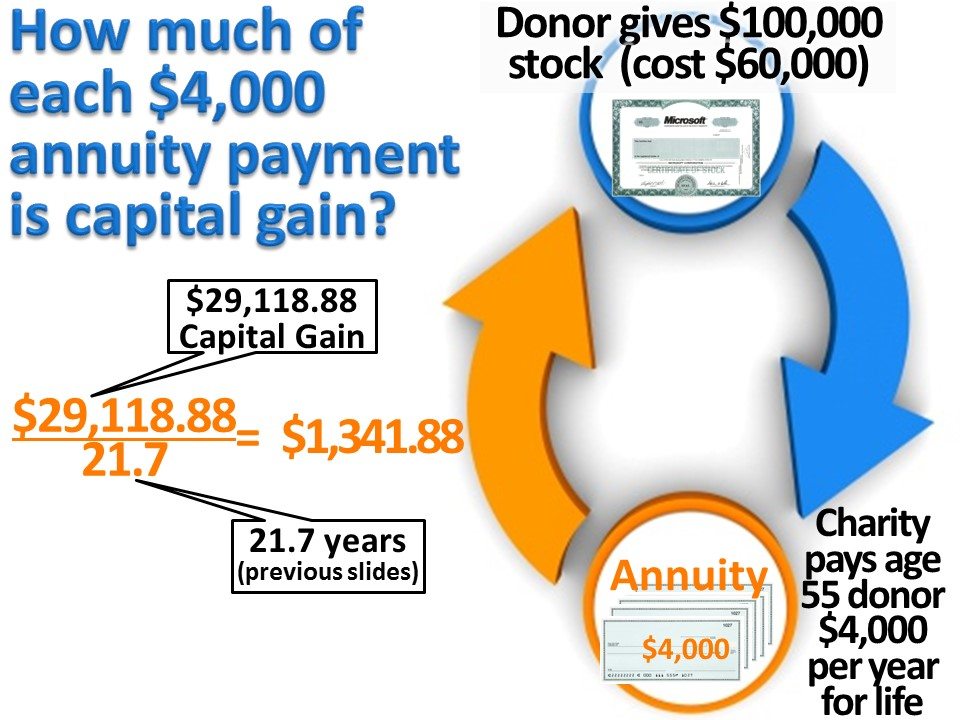
As a result, $1,341.88 of each check ($29,118.88/21.7) will be counted as capital gain until all of the capital gain ($29,118.88) is recognized.
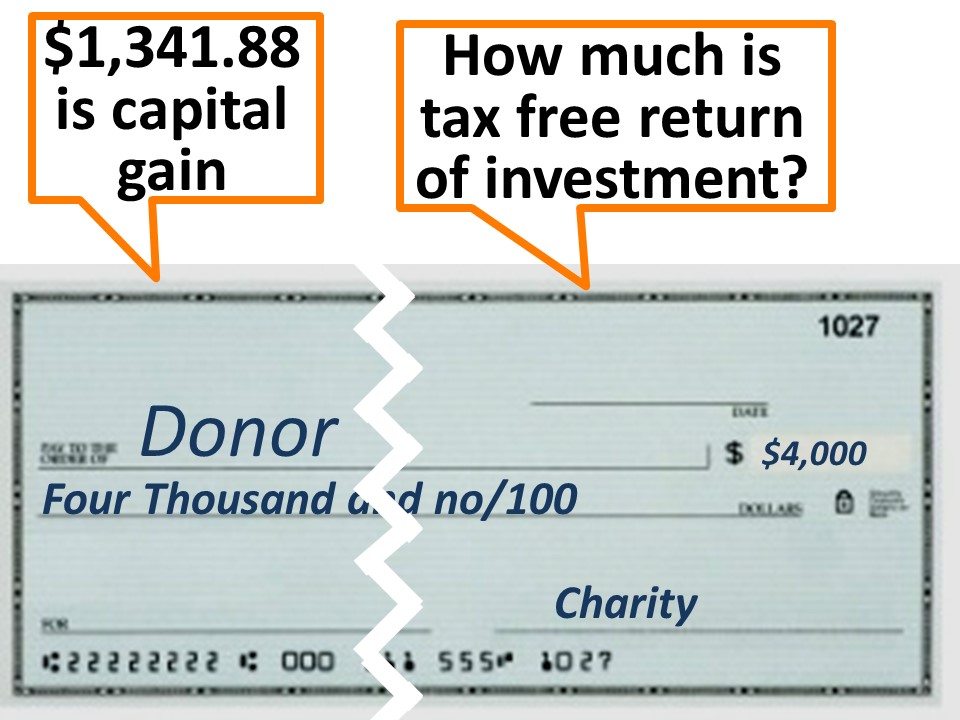
Now that we know that $1,341.88 of each $4,000 check will be counted as capital gain, this leaves open the question of the tax treatment for the remainder of each check. As before, part of each gift annuity check (received prior to the annuitant's outliving his or her "expected return multiple") will be tax-free return of investment.
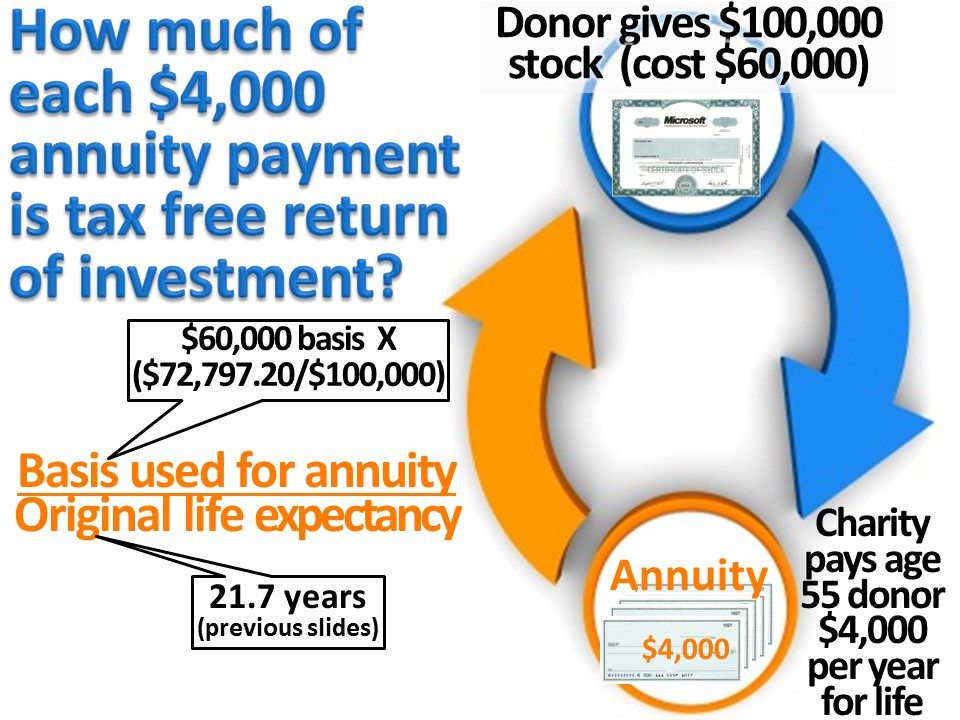
To calculate the amount of each $4,000 annuity payment that will qualify as tax-free return of investment, we divide the part of the basis used to purchase the annuity by the annuitant's "expected return multiple" (i.e., original life expectancy). In this case, 72.7972% of the property was used to purchase the annuity portion (with the remaining part of the property transferred as a deductible charitable gift), meaning that 72.7972% of the $60,000 basis may potentially be returned to the donor as tax-free return of investment.
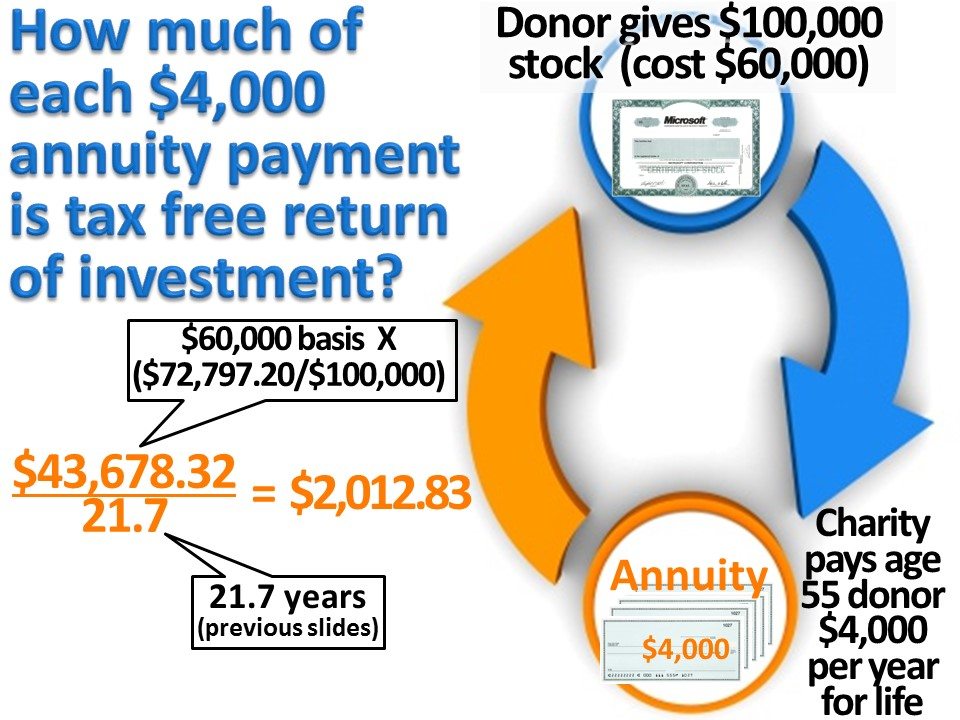
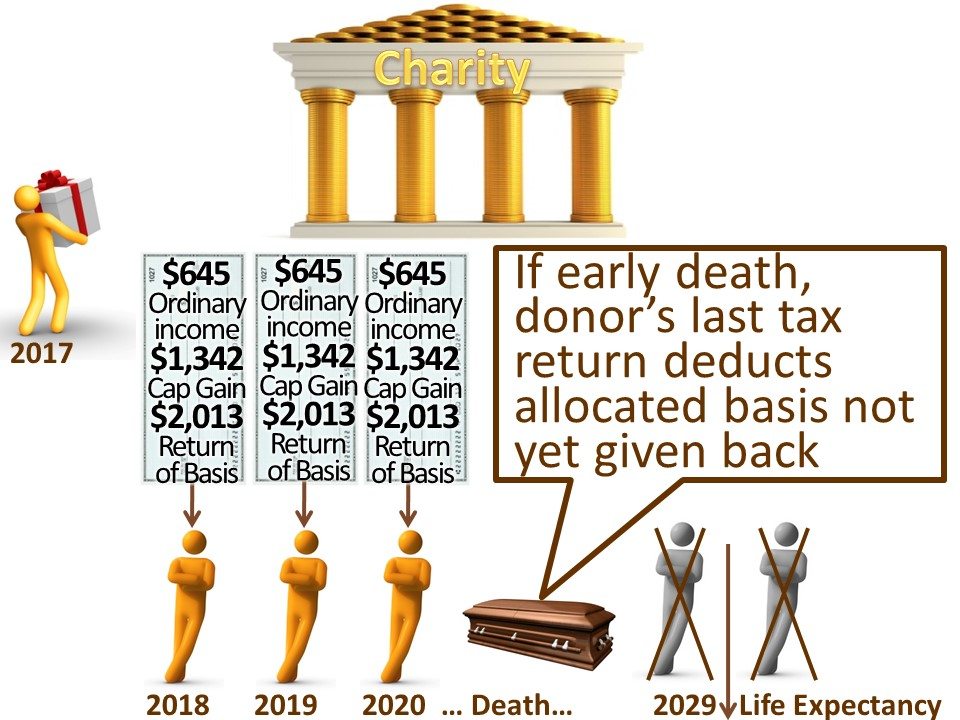
This $43,678.32 (72.7972% of the $60,000) of basis will be returned in equal shares over the first 21.7 years of the annuity payments, meaning that $2,012.83 of each annual $4,000 payment will be tax-free return of investment.
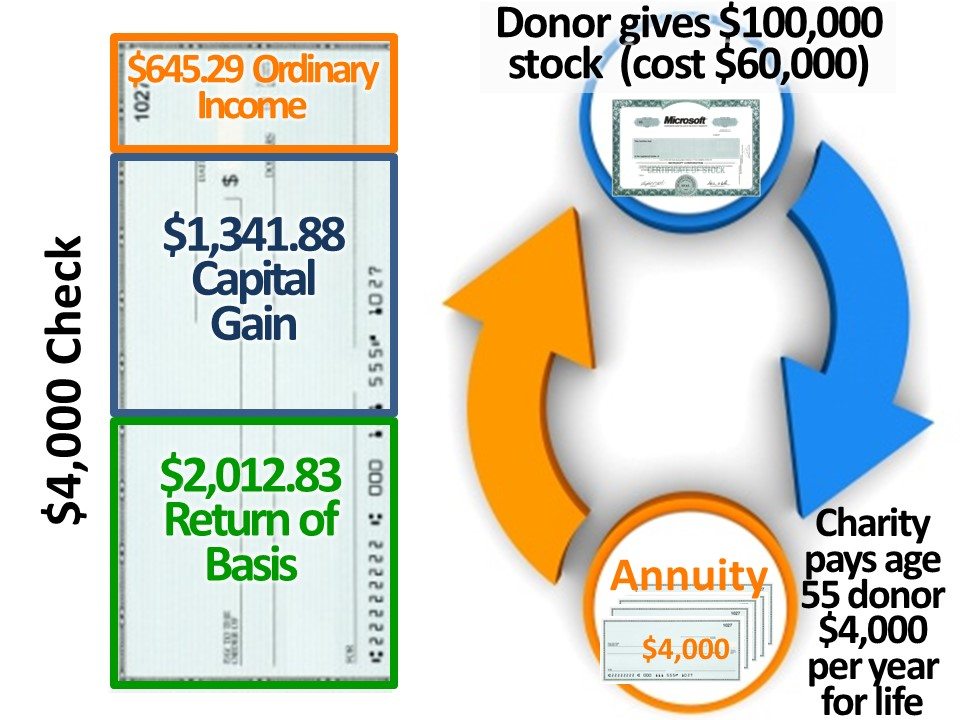
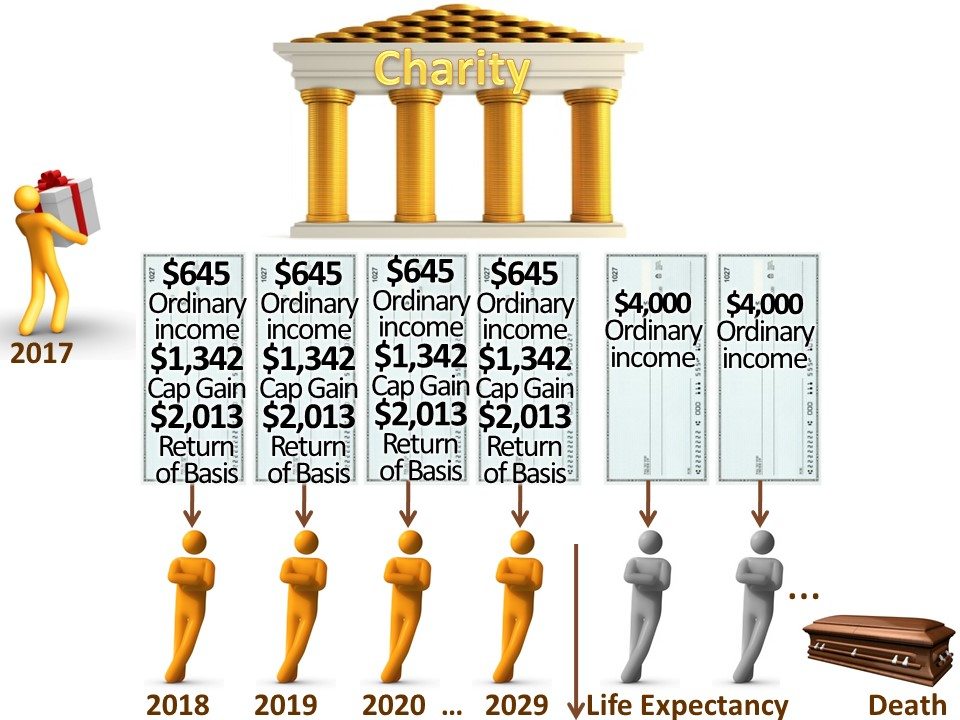
In addition to the $2,012.83 of each annual payment that will count as tax-free return of investment, part of each payment will be capital gain. As previously calculated, the capital gain portion of each check will be $1,341.88. Everything else, by definition, is ordinary income. Thus, in this case the ordinary income portion of each check will be the total check ($4,000) less the portion of each check that is tax-free return of investment ($2,012.83) and the portion of each check that is capital gain ($1,341.88), or $4,000-$2,012.83-$1,341.88 = $645.29.
Until the donor/annuitant lives beyond his "expected return multiple" (i.e., original life expectancy) each $4,000 check will consist of $2,012.83 tax-free return of capital, $1,341.88 capital gain, with everything else ($645.29) treated as ordinary income. After the annuitant lives beyond his "expected return multiple" each $4,000 check will consist entirely of ordinary income.
As a side note, the tax treatment of the check in the 22nd year will be slightly different because of the 21.7 year "expected return multiple." In that year, all of the remaining tax-free return of capital will be returned ($2,012.83 X .7=$1,408.98), and all of the remaining capital gain will be recognized ($1,341.88 X .7 = $939.32), leaving the remaining amount of $1,651.70 ($4,000-$1,408.98-$939.32) as ordinary income.
If the donor dies prior to reaching his original life expectancy ("expected return multiple"), then the donor fails to receive his entire original investment in the annuity portion of the transaction, i.e., the "sale" portion of the basis. In this case, the donor's last tax return can deduct the portion of the basis allocated to the annuity portion of the transaction not yet returned to the donor. No additional recognition of capital gain is made. (This makes sense because the donor, failing to live to his or her life expectancy, did not actually receive any further benefit.)
The final area of potential tax consequences for a Charitable Gift Annuity relates to gift taxation. When discussing gift taxation, we are not referring to any charitable gift or charitable gift portion of the annuity. Instead, we are considering gift transfers to non-charitable recipients. Gift transfers are taxed as part of the estate and gift taxation system. In 2023, the exemption amount for gift and estate taxes was $12.92 million (or $24.84 million for a married couple). Thus, for the vast majority of donors, estate and gift tax considerations will be irrelevant. But, for those where estate tax considerations are important, it is useful to understand the gift tax implications of purchasing a Charitable Gift Annuity that pays to someone other than the donor.
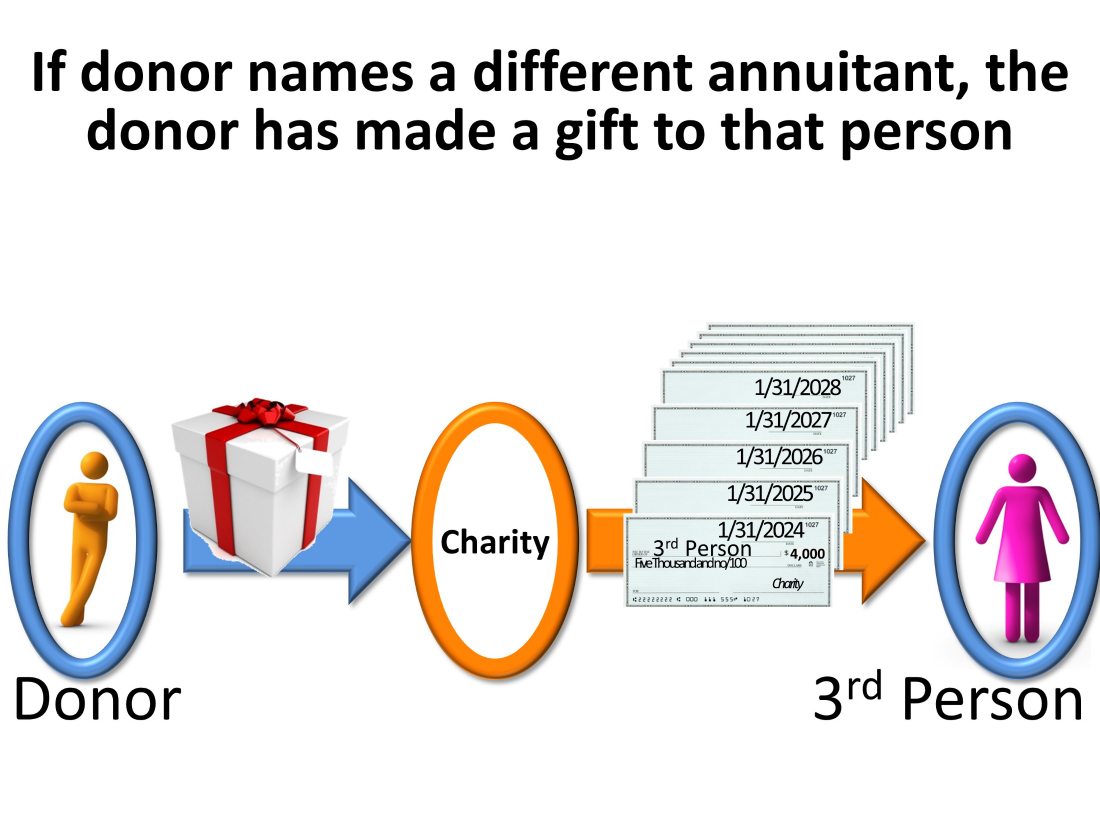
If the donor names an annuitant other than himself, the donor has made a gift to that person. If that person is not the donor's spouse, then this gift is a taxable gift. The value of the gift is simply the value of the annuity as calculated previously.
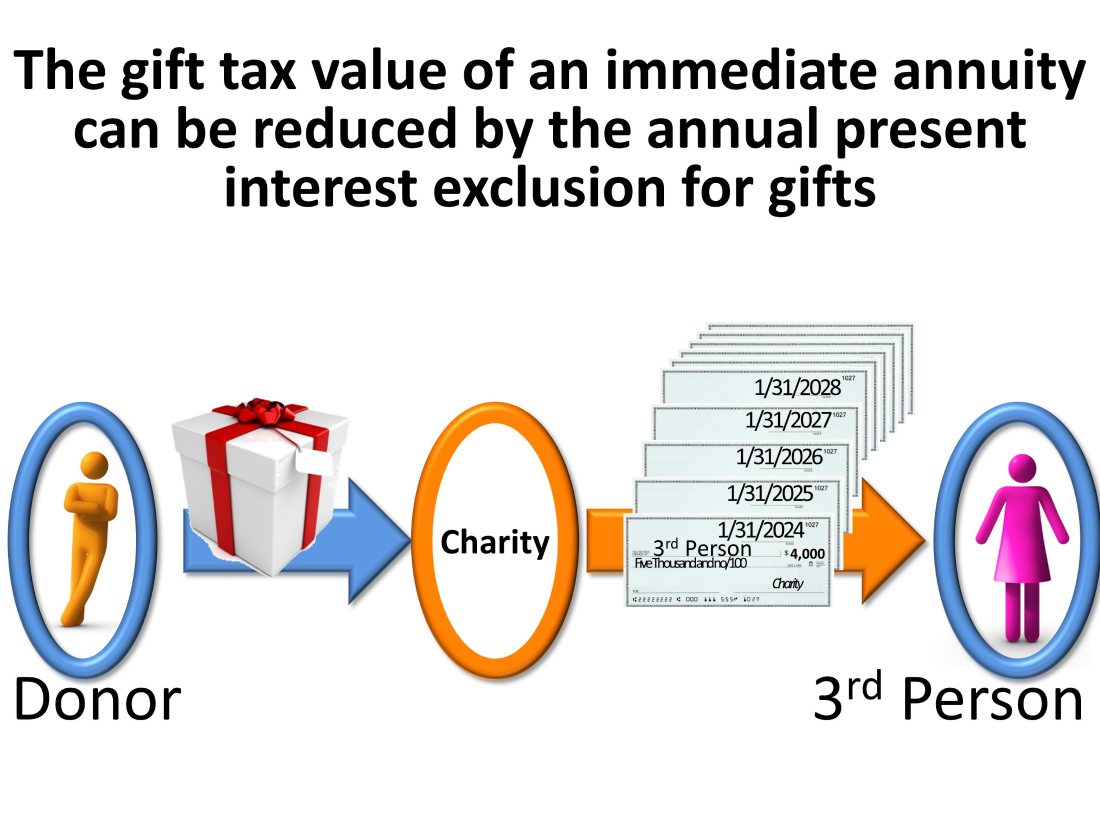
However, the value of the taxable gift made to the annuity recipient will be reduced by the annual present interest exclusion for gifts if the Charitable Gift Annuity is the typical immediate annuity interest. For example, in 2025, the annual present interest exclusion for gifts was $19,000 per donor per donee. Thus, if a donor named another person as the beneficiary of a Charitable Gift Annuity where the annuity portion was valued at $100,000, the amount of the taxable gift would be $100,000-$19,000, or $81,000. This present interest exclusion would not apply if the gift annuity purchased was a deferred gift annuity, because the exclusion only applies for present interests. An immediate annuity is considered to be a present interest, but a deferred annuity is not.
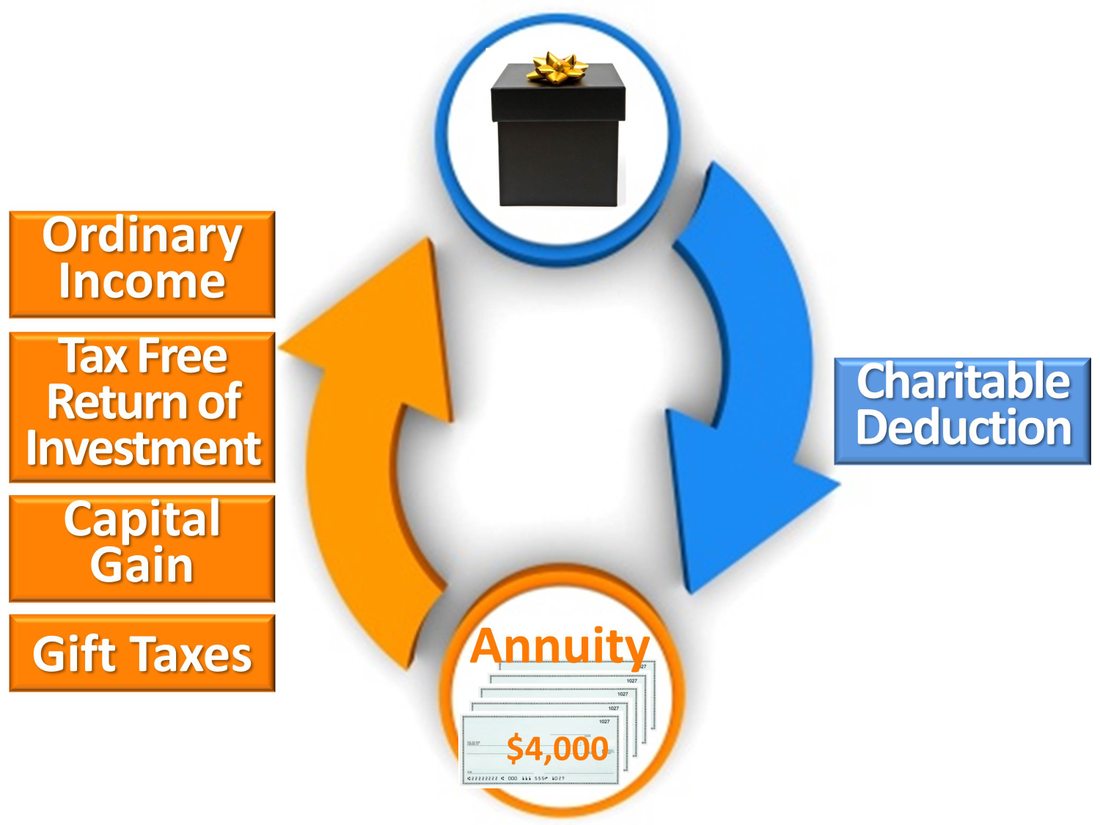
A transaction as straightforward as a Charitable Gift Annuity can result in a wide range of tax consequences, including a charitable income tax deduction, recognition of ordinary income, tax-free return of investment, recognition of capital gain (either immediate or deferred), and gift taxation. This same set of tax consequences also applies to other transactions such as a Charitable Remainder Trust, but in slightly different ways.

We have examined the taxation rules for Charitable Gift Annuities. However, certain scenarios can create unusual cases where the application of these rules may not be immediately obvious. Next, we turn to some of these tricky examples to see how the taxation rules operate in these circumstances.
We have already examined the rules for capital gain resulting from purchasing a Charitable Gift Annuity with appreciated property. However, there is a separate tax rate for long-term capital gain for collectibles. Collectibles are items such as artwork, antiques, stamps, coins, and jewelry. Capital gain on these items is taxed at a maximum rate of 31.8%. What taxation would result if a Charitable Gift Annuity were purchased in exchange for appreciated collectible items?
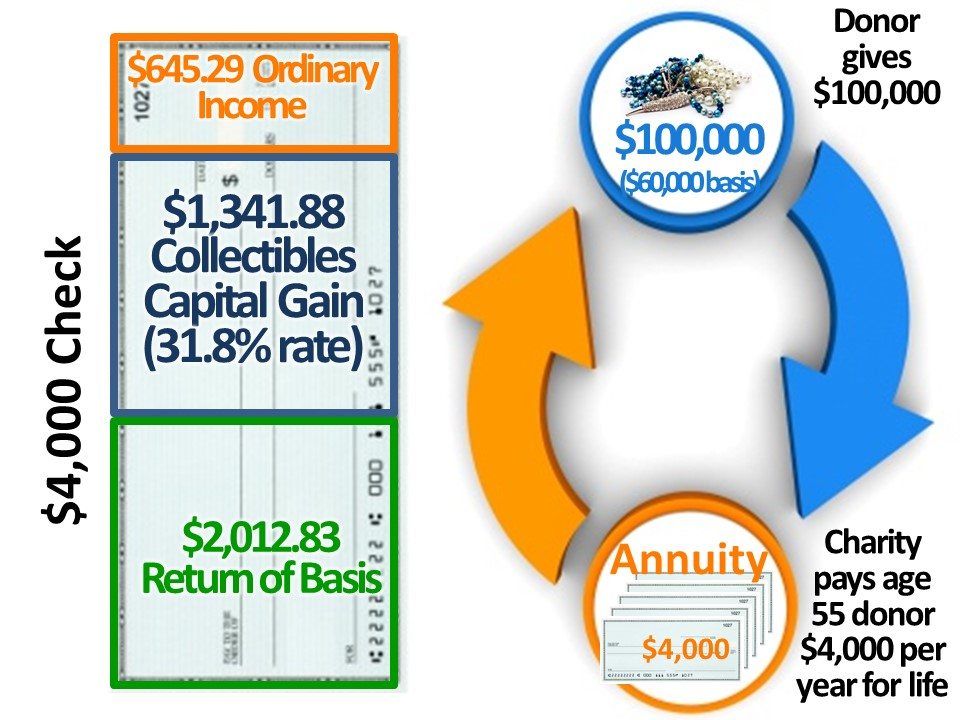
The initial calculations are identical to those used for any other item of capital gain property. Thus, the same amount of capital gain would be recognized from each check as in the previous example where the donor gave appreciated stock rather than appreciated collectibles. The only difference is that when the donor recognizes the capital gain, the donor must recognize the capital gain as capital gain for collectibles.
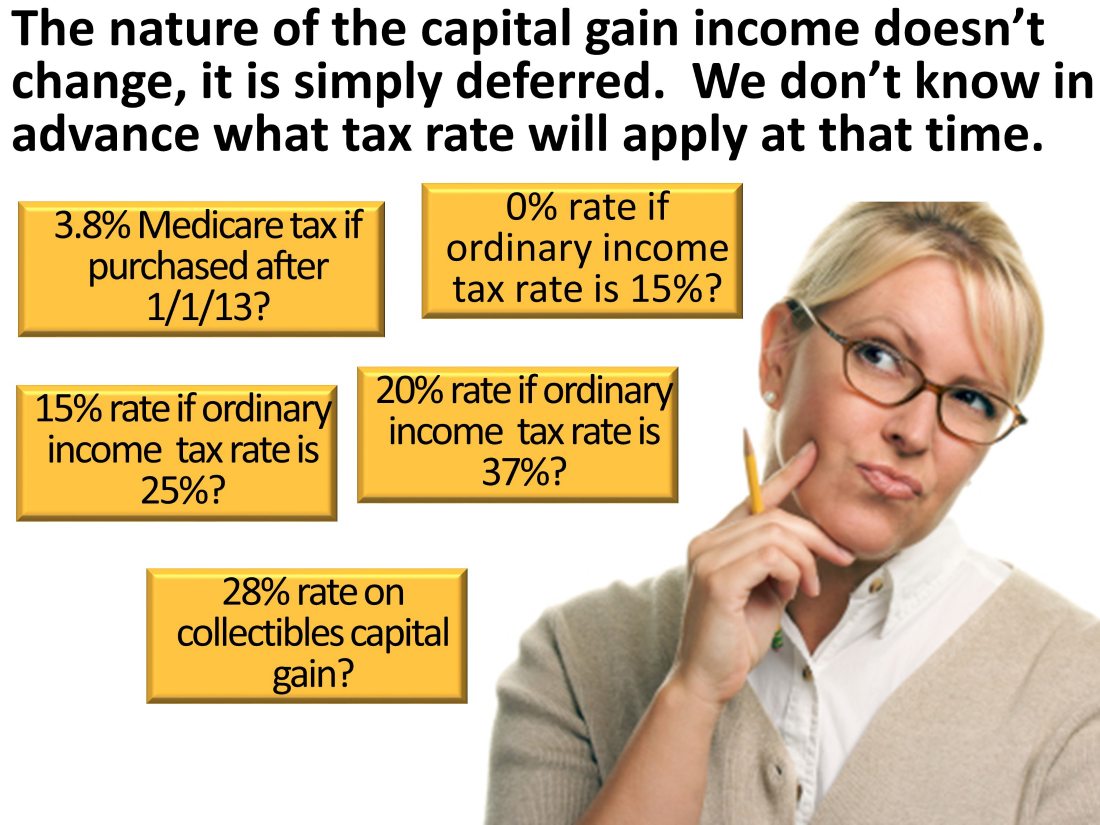
The general principle here applies to all forms of capital gain. The nature of the capital gain income does not change when it is later recognized by the donor. The result of the gift annuity transaction is to simply defer the recognition of the capital gain, but not to change the character of the capital gain. Although we know in advance how much and what type of capital gain will be recognized in future years, we cannot say with certainty what the tax rate will be for that type of capital gain in a future year. Even if current tax rules do not change, the donor's future income levels may change, which will cause the tax rate to change. Purchasing a Charitable Gift Annuity with appreciated property produces the clear advantage of paying capital gains taxes later, rather than today. However, if the donor is in a higher income bracket today, but will be in a lower income bracket in the future (e.g., after retirement), then the gift annuity transaction may result not only in tax deferral, but also in tax reduction (or even complete tax avoidance if the donor's future income is low enough). For the donor who is in a high income tax bracket today, but expects to be in a lower income tax bracket after retirement in the future, the Charitable Gift Annuity purchased with appreciated property generates the "double bonus" of an immediate income tax deduction today (when income and tax rates are high) and deferral of recognizing capital gain until future years (when income and tax rates will be low). The use of a deferred or flexible Charitable Gift Annuity which postpones the initial payments for some years can generate even longer tax deferral.
Given the higher tax rate, the deferment of recognizing capital gains taxes with appreciated collectible items may be even more attractive than with the use of appreciated stocks. A key challenge in such transactions is that the charitable tax deduction may be limited to the share of basis applied to the "gift" portion of the transaction unless the charity plans to make use of the collectibles in its charitable purpose, rather than simply selling them. Let's examine how this might work with a tangible personal property gift.
Suppose that a donor gives a work of art (or any other tangible personal property) to a charity in exchange for a gift annuity. The charity plans to immediately sell the art in order to provide funds for making the annuity payments. As in our previous examples, assume that the donor purchased the art for $60,000 more than one year ago, making this long-term capital gain, with a $60,000 basis. What is the charitable deduction for such a transaction? If the donor were giving $100,000 of cash, the deduction would be the difference between the $100,000 transfer and the $72,797.20 value of the annuity (i.e., $27,202.80). The same deduction would apply if the donor were giving $100,000 of long-term capital gain appreciated securities with the same $60,000 basis. However, in this case, the deduction will be lower. Why? The critical distinction here is that the gift is of "unrelated use" tangible personal property, because the charity intends to sell the artwork, rather than use it in its charitable purposes.
Because this is "unrelated use" tangible personal property, the deduction is limited to the lower of basis or fair market value. Of course, this rule applies to all gifts of "unrelated use" tangible personal property, regardless of whether or not those gifts are given in exchange for an annuity. Can we simply deduct the $60,000 basis as a gift? No. Because part of the basis is used to purchase the annuity (i.e., the "sale" part of this bargain sale), and only part of the basis applies to the charitable gift portion (i.e., the "gift" part of this bargain sale).
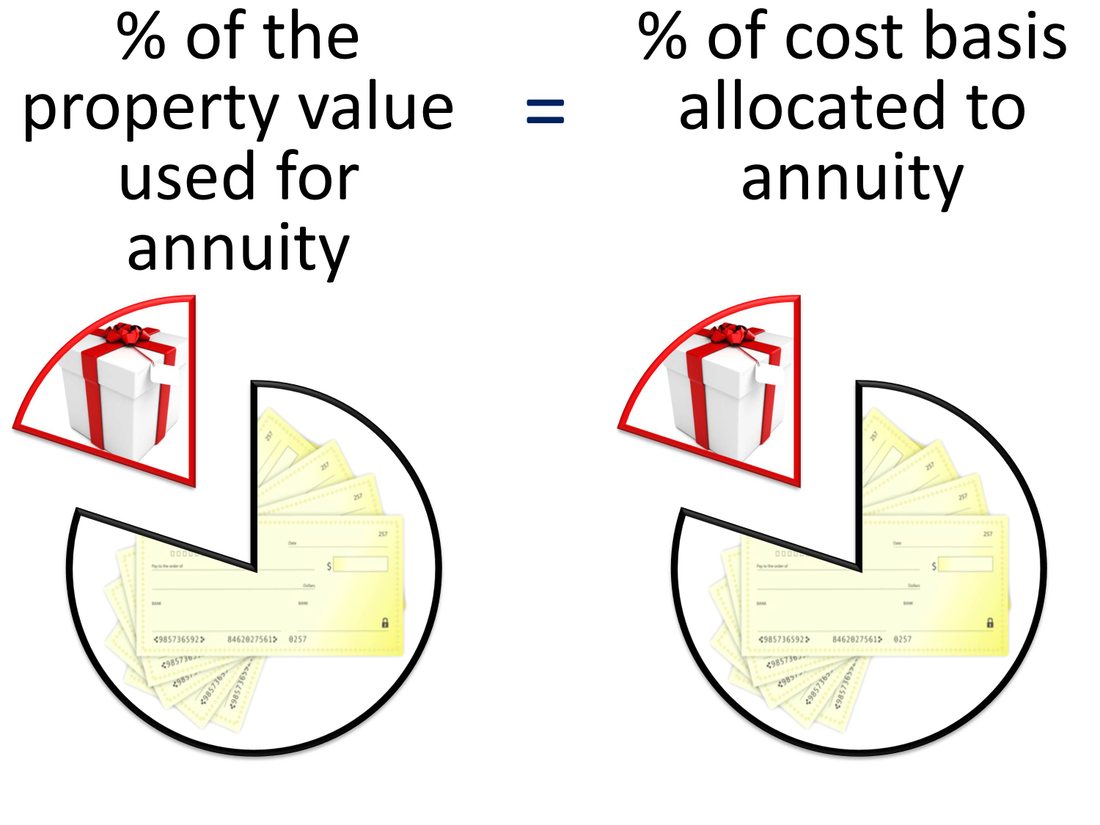
To calculate the share of cost basis used for the gift portion, we follow exactly the same process as before. The only difference here is that this calculation focuses on the gift portion of the basis, rather than the sale/annuity portion of the basis.
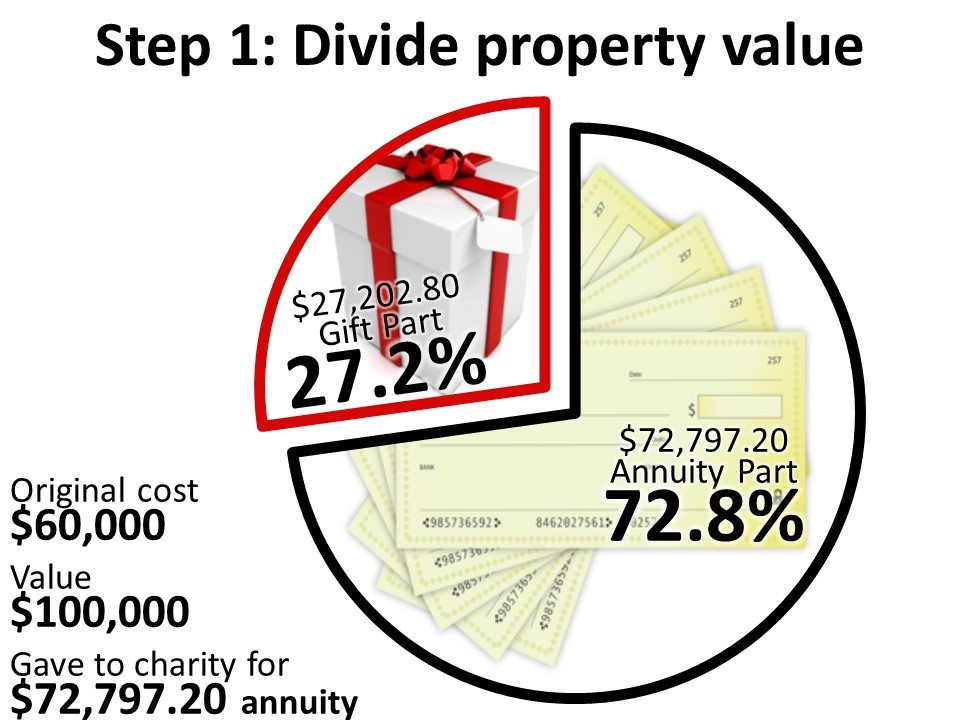
Just as before, the first step is to divide the property value into the gift portion and the annuity/sale portion. The annuity/sale portion is 72.7972%. This is because, as before, the IRS valuation of the annuity is $72,797.20. The remaining amount from the $100,000 transfer is the gift portion. Thus, the gift portion is 27.2028%, representing $27,202.80 of the $100,000 transfer. If the transfer from the donor was cash or appreciated securities held for more than one year, then this $27,202.80 would be the deductible gift. However, we cannot deduct this full amount, because for this type of property gift only the basis can be deducted, not the higher fair market value.
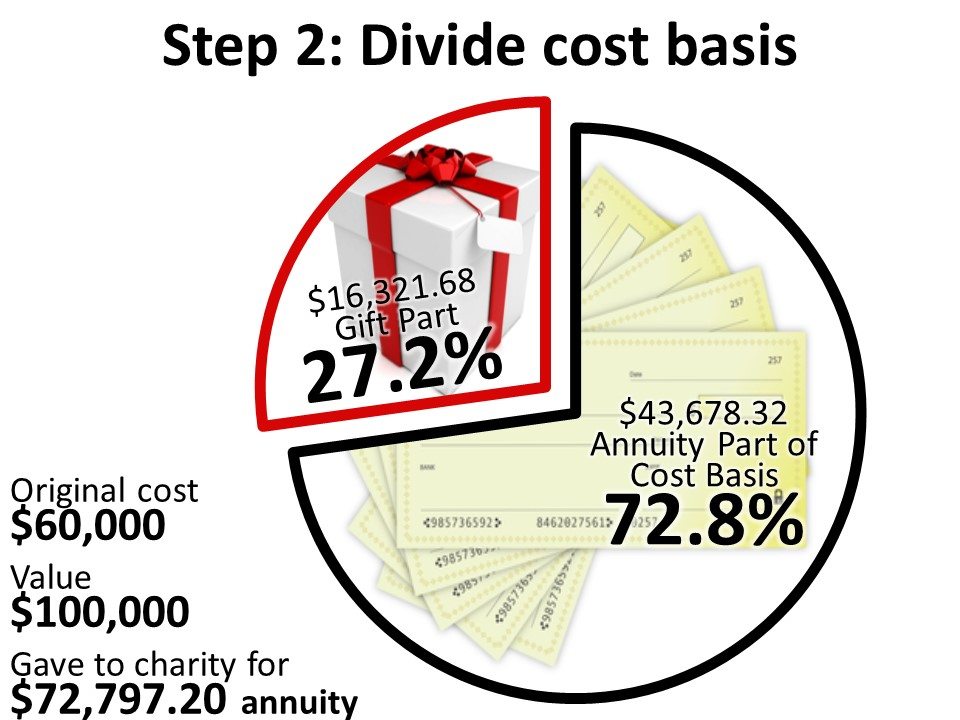
In order to calculate the deduction, we must divide the cost basis between the gift portion and the sale/annuity portion. The cost basis will be divided in exactly the same way that the property value (or total transaction amount) was divided. Thus, 27.2028% of the $60,000 basis (i.e., $16,321.68) will apply to the gift portion of the transaction.
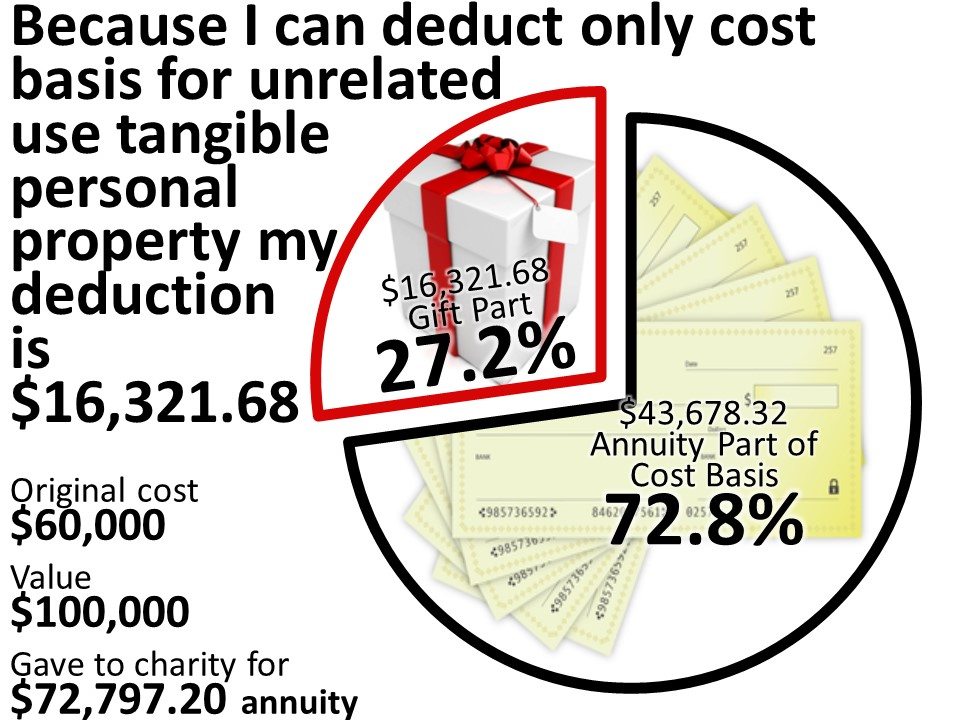
This $16,321.68 of the basis is the deductible charitable gift resulting from the transaction, because only basis may be deducted when giving "unrelated use" tangible personal property (such as artwork that the charity intends to sell).
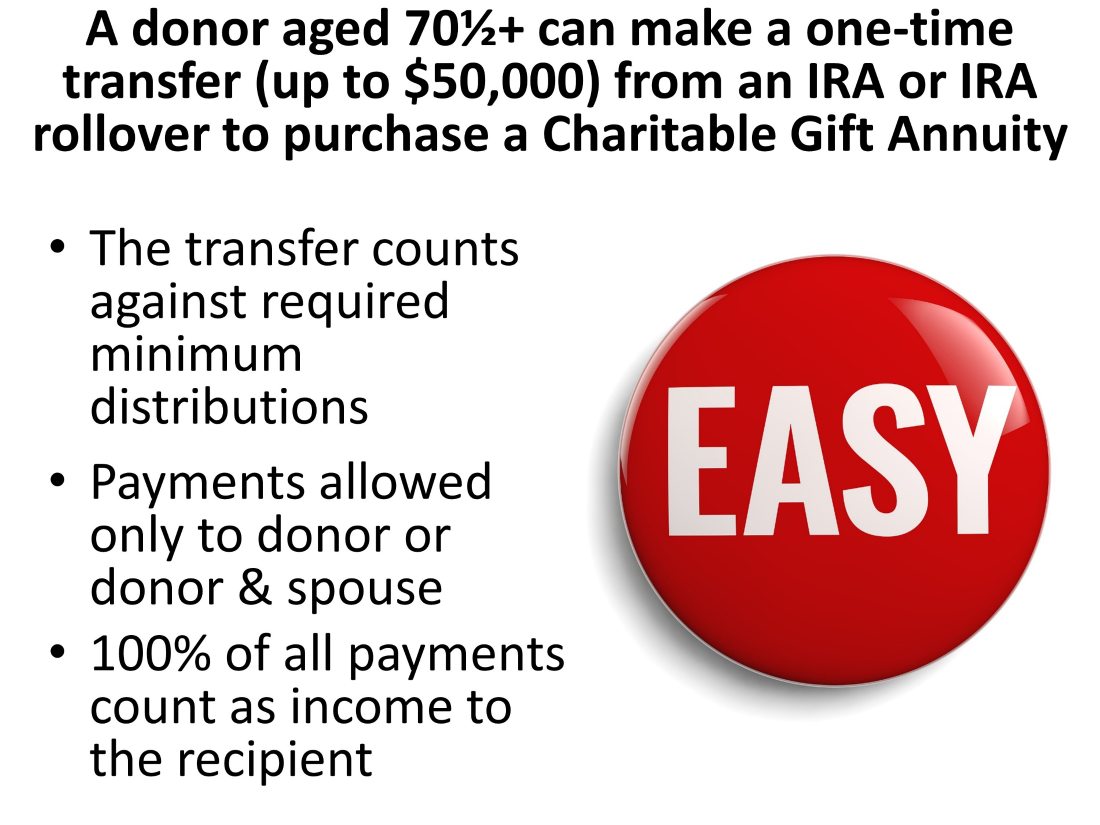
Finally, the simplest taxation result comes from an IRA to Charitable Gift Annuity rollover. All payments received from such an annuity are 100% taxable. That's it. The reason this is so simple is that the annuity is purchased with pre-tax money. So, both the earnings and the return of the original investment are taxable. This is limited to a one-time transfer up to a maximum of $50,000 adjusted for inflation. For example, in 2025 this maximum was $54,000.

Although the Charitable Gift Annuity is a relatively simple transaction (typically documented with a standard one- or two-page agreement used for all gift annuities from a particular charity), the tax results are as complex as those found in more advanced instruments such as the Charitable Remainder Trust. The taxation of Charitable Gift Annuities can become complicated, but it is often important to present them to prospective donors or clients in a simple, intuitive fashion, rather than burying the client with details. As with other forms of charitable planning, successful planning can generate a range of tax benefits, but should be considered only for clients who have a real charitable interest in advancing the work of the charity.